


Samsung Electronics Marks 20 Consecutive Years as the World’s No.1 TV Brand

Key Takeaways
Here are clear takeaways from the Samsung Newsroom Australia notes on Samsung’s 20-year No.1 TV leadership.
Key facts
– Samsung has been the world’s No.1 TV brand for 20 consecutive years (since 2006).
– 2025 global TV market share: 29.1% (per Omdia).
– Premium segments: >$2,500 share 54.3%; >$1,500 share 52.2%.
Leadership implications
– Samsung’s leadership is driven by a consistent emphasis on premium display tech (Neo QLED, OLED, Micro LED) and form-factor innovations (The Serif, The Frame).
– The brand is positioned as a trusted, long-term choice for consumers, not just a one-off purchase.
Innovation milestones (20-year timeline to inform product and marketing planning)
– 2009: LED TVs transition.
– 2011: Smart TVs transform into connected platforms.
– 2015: The Serif design-led TV enters living spaces.
– 2017: The Frame (Art TV) + QLED establish premium picture and design benchmarks.
– 2018: 8K TVs introduced (high pixel density; note: native 8K content is limited; upscaled 8K variance exists).
– 2020: Micro LED pushes self-emissive display quality at ultra-large scales.
Current and near-term product strategy
– Portfolio expansion in premium and next-generation displays:
– Micro RGB models continuing to be developed.
– OLED and Neo QLED lineups strengthened.
– Mini LED expansion across more sizes and price tiers.
– AI-powered TVs to optimize picture, sound, and personalization in real time.
– Market positioning for partners and customers:
– Maintain leadership narrative in premium, ultra-large, and next-gen displays.
– Leverage ongoing innovations to justify premium pricing and larger-screen experiences.
Content and ecosystem note
– 8K content availability remains limited; understand that real 8K resolution is 7,680 x 4,320, with upscaled content varying in quality.
Actionable takeaways and next steps
– Marketing/comms: Highlight 20-year leadership and proven consumer trust; emphasize premium tech milestones (Neo QLED, Micro LED, AI features).
– Product planning: Align roadmap with Micro RGB, Mini LED expansion, and AI features; plan inventory to support continued premium demand and larger screen sizes.
– Partnerships/alliances: Explore content and ecosystem partnerships to bolster 8K and premium content alignment where feasible.
– Sales enablement: Equip sales teams with data on premium shares (54.3% >$2,500; 52.2% >$1,500) to support pricing and SKU strategy.
– Risk management: Monitor availability of native 8K content and adjust marketing claims accordingly; ensure supply chain readiness for Micro LED and Micro RGB/products.
– Internal notes: Consider updating internal briefs and external comms to reflect the 20-year leadership milestone, along with the latest display innovations.
Source: Samsung Newsroom Australia, March 9, 2026 (summary of press release and related assets).
Summary of Samsung Electronics Marks 20 Consecutive Years as the World’s No.1 TV Brand
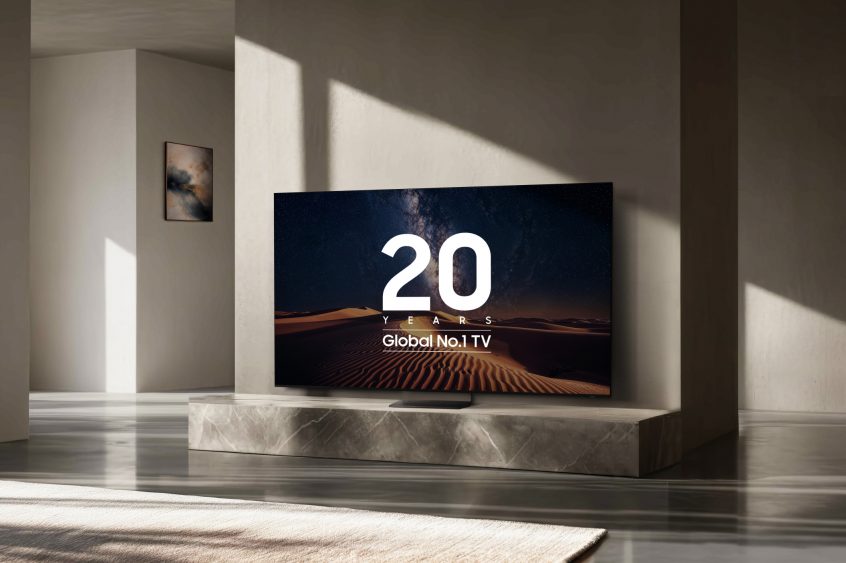
Source – Omdia, Feb 2026. Based on overall TV market share by manufacturer on an annual unit & revenue basis. Image simulated for illustrative purposes. Cables not shown.
Samsung Electronics Co., Ltd. today announced that it ranks as the world’s No.1 TV brand for the 20th consecutive year — marking two decades as the global leader in the television industry.
Samsung had held the top position in the global TV market since 2006, and, according to market research firm Omdia, the company recorded a 29.1% share of the global TV market in 2025. This achievement reinforces Samsung’s leadership across premium, ultra-large and next-generation display technologies.
Samsung led the premium segment priced over $2,500 with a 54.3% market share, driven by Neo QLED, OLED, and lifestyle TVs. It also maintained its lead in the segment over $1,500, holding a 52.2% market share.
“When consumers choose a TV, they’re choosing a brand they can trust for years to come,” said SW Yong, President and Head of the Visual Display (VD) Business at Samsung Electronics. “Our 20-year leadership in the global TV market reflects that trust — built on decades of engineering excellence and premium innovation.”
20 Years of Industry-Defining Innovation
Since first reaching the No.1 position in 2006 with its design-led Bordeaux TV, Samsung has consistently innovated to reshape the television industry:
- 2009: The company accelerated the global transition to LED TVs.
- 2011: The introduction of Smart TVs further transformed televisions into connected entertainment platforms, expanding their role beyond traditional viewing.
- 2015: The Serif reimagined how TVs integrate into living spaces by introducing a design-focused TV that positioned the screen as a statement piece within the home.
- 2017: The company launched The Frame, pioneering the Art TV category by transforming the television into a customisable digital art canvas.
- 2017: In premium picture quality, Samsung continued to set industry benchmarks with the introduction of QLED TVs powered by quantum dot technology.
- 2018: 8K TVs delivered approx r 33 million pixels[1] — four times the resolution of 4K.
- 2020: Samsung introduced MICRO LED technology, advancing self-emissive display innovation and setting new standards for brightness, contrast and colour accuracy in ultra-large screens.
Through continuous advancements in picture quality, smart functionality and display innovation, Samsung has played a defining role in establishing today’s premium TV standards.
Strengthening Leadership in Premium and Next-Generation TVs
Building on its legacy of innovation, Samsung continues to evolve its premium TV portfolio with expanded Micro RGB models, advancing its next-generation display technologies and reinforcing leadership in high-performance screens. The company also continues to enhance its OLED and Neo QLED lineups, delivering premium picture quality, ultra-large screen options and differentiated display performance.
Samsung is expanding its Mini LED offerings as well, bringing enhanced brightness, contrast and precision control to a wider range of screen sizes and price tiers to extend advanced display performance across its lineup. At the same time, continued investment in AI-powered TVs integrates advanced processors and intelligent features that optimise picture, sound and personalisation in real time.
With two decades of proven global leadership, Samsung remains one of the most consistently recognised and trusted TV brands worldwide, offering industry-leading technology across multiple price tiers, screen sizes and display innovations.
[1] Native 8K content availability is very limited. Picture quality of upscaled content will vary. Real 8K Resolution is defined as having 7,680 x 4,320 pixels, 4K Resolution is 3,840 x 2,160
from Samsung Newsroom Australia https://ift.tt/N7J3fos
via IFTTT

