



[World Sleep Day 2026] How Samsung Is Tackling Sleep Apnea to Energise Your Days

Key Takeaways
Here are clear executive takeaways from the Samsung World Sleep Day 2026 notes:
Key findings
– 23% of Samsung Health study participants are at risk of sleep apnea.
– Sleep disruption impacts:
– REM sleep: about 4 minutes less per night for those with signs of sleep apnea.
– Deep sleep: about 8 minutes less per night.
– Nightly awakenings: about 4 minutes longer awake time.
– Total sleep duration: roughly 12 minutes less on average.
– Implications: Small losses in sleep duration and significant drops in sleep quality can compound to affect mood, memory, performance, and daytime fatigue.
Detection and technology
– At-home detection via Sleep Apnea feature on Galaxy Watch (within Samsung Health Monitor app).
– How it works: track sleep for more than 4 hours over two nights within a 10-day period.
– Data used: BioActive Sensor to monitor blood oxygen patterns; provides estimations of Apnea-Hypopnea Index (AHI) to indicate potential severity.
– Intended use: raise awareness and prompt medical consultation; not a diagnostic tool.
– Accessibility and limitations:
– Availability varies by market; the feature is not universally available.
– Requires compatible Galaxy Watch (listed in footnotes), paired smartphone, and appropriate OS/app versions.
– Not a replacement for professional diagnosis or treatment.
Product and user-health ecosystem
– Integration within Samsung Health ecosystem:
– Sleep Coaching: detailed analysis and tips to improve sleep quality.
– Bedtime Guidance: recommended optimal bedtimes to help ensure adequate sleep.
– From awareness to action: data from the watch can start conversations with healthcare professionals and support better holistic sleep health.
Strategic and operational implications
– Market positioning: strengthens Samsung’s health and wearables value proposition by offering at-home sleep screening and actionable sleep-improvement tools.
– User engagement: potential to increase Galaxy Watch and Samsung Health Monitor adoption through a linked health-management workflow.
– Communications and compliance: emphasize that this feature is a screening aid, not a medical diagnosis; include clear medical-advice disclaimers and privacy considerations.
Risks and considerations
– Medical-device classification: not intended for diagnosis or treatment; must avoid overpromising clinical outcomes.
– Data privacy and consent: ensure compliant handling of sleep data and health information across markets.
– Market variability: readiness and coverage depend on region, device availability, and app versions.
Recommended next steps (operational)
– Marketing/comms:
– Update messaging to reflect screening use, limitations, and the importance of medical follow-up.
– Create user education resources about sleep apnea signs and when to consult a clinician.
– Product/engineering:
– Maintain clarity on device compatibility, OS/app requirements, and regional availability.
– Monitor user feedback and performance of Sleep Apnea feature to refine insights and guidance.
– Partnerships and healthcare:
– Explore collaborations with sleep clinics or health networks to streamline patient referrals and guidance.
– Measurement and governance:
– Track adoption metrics (device compatibility rates, app engagement, feature usage).
– Monitor post-launch health outcomes and user satisfaction related to sleep coaching and bedtime guidance.
If you’d like, I can turn these into a one-page briefing for executives or a short slide-ready summary with bullet points and visuals.
Summary of [World Sleep Day 2026] How Samsung Is Tackling Sleep Apnea to Energise Your Days
Millions worldwide suffer from sleep apnea, but 80% of sufferers[1] don’t even know they have it. This serious condition causes people to pause breathing while asleep, potentially disrupting oxygen supply, lowering sleep quality, and leading to health complications including hypertension and stroke. Despite these risks, the disorder largely goes unnoticed because getting a diagnosis usually requires time-consuming and costly in-lab sleep studies.
To mark World Sleep Day 2026, a global study of Samsung Health users[2] is shedding new light on the true extent of the condition and the disruptive impact it has on your sleep. Aligned with this year’s World Sleep Day theme, “Sleep Well, Live Better,” Samsung is turning the invisible signs of sleep apnea into actionable insights through its Galaxy Watch series, helping those affected improve their sleep habits and overall health.
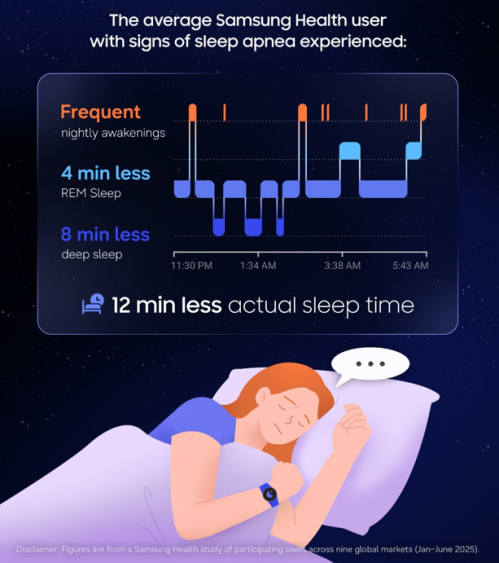
Image: Infographic including all key data on impact of sleep apnea
How Does Sleep Apnea Impact Your Sleep?
The report[2] found that 23% of study participants are at risk of sleep apnea.
“The microarousals and awakenings that follow breathing pauses fragment your sleep,” explains behavioural sleep scientist Dr. Vanessa Hill. “Those occurrences can prevent the brain from staying in the REM and deep sleep stages necessary for cognitive and physical restoration.”
The report[2] shows these constant disruptions take a direct toll on sleep duration and quality, leading to:
- Reduced REM Sleep: Participants with moderate to severe sleep apnea indicators detected by their Galaxy Watch got around four minutes less rapid eye movement (REM) sleep, the phase where our brains process emotions, consolidate memories and cement learning. Without enough of it, people can experience mood instability and memory problems, impacting performance at work and overall well-being.
- Less Deep Sleep: Sleep apnea also robs sufferers of deep sleep, approximately eight minutes less per night, on average. This is the body’s critical physical restoration phase, where growth hormone is released, muscles are repaired, and your immune system is activated. Losing out on deep sleep is why you may feel physically exhausted, have slower recovery times, and get sick more often.
- Frequent Nightly Awakenings: Study participants with signs of sleep apnea also woke up regularly during the night and stayed awake around four minutes longer. These interruptions derail the sleep cycle, locking you into lighter, less restorative stages and making next-day exhaustion inevitable, no matter how long you slept.
- Shorter Sleep Duration: Overall, people with a higher likelihood of sleep apnea averaged around 12 minutes less sleep. While this loss may seem minor, it can have a significant impact on overall sleep quality as your sleep cycle gets fragmented throughout the night.
Why It Matters: “Even a small loss in sleep duration is compounded by a larger loss of sleep quality,” said Dr. Hill. “This can be the difference between simply being ‘in bed’ and getting restorative rest, which could be why people feel so tired the next day.”
Dr. Hill also advocates a multidimensional approach to sleep health. “Sleep apnea affects many dimensions of sleep — duration, quality, sleep efficiency and even daytime fatigue,” she stated. “They together help determine our health and functioning.”
With sleep apnea shown to impact all aspects of sleep and lead to other health complications, detection is an essential first step in the fight against the condition.
How Does Galaxy Watch Help Detect Signs of Moderate to Severe Sleep Apnea?
For years, sleep apnea has been difficult to detect due to the need for inconvenient hospital tests. However, Samsung offers at-home detection with a first-of-its-kind Sleep Apnea[3] feature on your Galaxy Watch.
- How It Works: Users simply track their sleep with a compatible Galaxy Watch[4] for more than four hours over two nights within a ten-day period. Available through the Samsung Health Monitor app, the Sleep Apnea feature may help users to proactively spot signs of the condition.
- The Technology: Leveraging the Galaxy Watch’s BioActive Sensor, the feature provides general insights into blood oxygen patterns during sleep. These insights may help users stay aware of changes in their breathing patterns overtime. Based on this data, the feature can help provide estimations on the user’s Apnea-Hypopnea Index (AHI), which can help indicate the severity of obstructive sleep apnea (OSA).
- From Awareness to Action: By helping to detect signs of sleep apnea early, the feature may provide the data needed for an informed consultation with a medical professional. Your Galaxy Watch can also help you build habits for better holistic sleep health. Features include the Sleep Coaching[5] program for detailed analysis and tips on how to improve sleep quality and Bedtime Guidance,[6] which recommends your optimal bedtime to help you consistently get enough sleep.
“For years, the inconvenience of an in-lab clinical sleep study has been a barrier to diagnosing sleep apnea,” added Dr. Hill. “Wearable technology such as Galaxy Watch is a breakthrough because it democratises that first step. It allows people to gather meaningful data from their own beds, providing a starting point for a conversation with a healthcare professional.”
Take Control of Your Night
A good night’s sleep is the first step toward a healthier, more energised life, and Samsung is here to help guide you. Samsung’s ecosystem offers end-to-end care, from helping to detect signs of sleep apnea on your Galaxy Watch to providing suggestions to receive professional adviceto connecting you with professional advice through our health network.
Looking ahead, Samsung is constantly innovating and improving the Sleep Apnea feature to make it even more powerful with sharper insights. Prioritise your rest today to unlock a healthier tomorrow.
[1]“Obstructive Sleep Apnea National Indicator Report,” American Academy of Sleep Medicine (2023)
[2]Samsung Health users from the U.S., South Korea, Brazil, Canada, Mexico, Russia, Chile, South Africa, and the Philippines participated in the study from January–June 2025.
[3]Sleep Apnea feature requires Galaxy Watch8 to be paired with a compatible Samsung Galaxy smartphone with Android OS 12 or later and latest version of Samsung Health Monitor app. Sleep Apnea feature is currently available in some selected countries only. Sleep Apnea feature requires at least 2 days of sleep data within a span of 10 days (the two days do not necessarily have to be consecutive, but must be recorded within those 10 days). The Sleep Apnea Feature is intended to detect signs of moderate to severe obstructive sleep apnea in the form of significant breathing disruptions in adult users 22 years and older, by tracking sleep twice over a ten-day monitoring period. It is intended for on-demand use. This feature is not intended for users who have previously been diagnosed with sleep apnea. This feature is not intended for use in the screening, diagnosis, treatment or management of sleep apnea and users should not use this feature to replace traditional methods of diagnosis and treatment by a qualified clinician. If a pattern of breathing disturbances is identified by this feature, or you experience any other symptoms of sleep apnea or any other breathing disturbance, consult a doctor. The absence of a notification does not exclude the presence sleep apnea. ALWAYS FOLLOW THE INSTRUCTIONS FOR USE. IF SYMPTOMS PERSIST, WORSEN OR CHANGE UNEXPECTEDLY, TALK TO A HEALTHCARE PROFESSIONAL.
[4]Availability may vary by market, carrier, model, or a paired smartphone. Available on Galaxy Watch4 series and later models. The watch requires the Wear OS 5.0 version or later and must be paired with a Samsung Galaxy smartphone with Android 12.0 or later.
[5]Available on Samsung Health app v.6.24 or above and must be paired with Samsung Galaxy smartphones with Android OS 12 and above. Samsung account login required. Requires sleep data of at least 7 days (including 1 workday and 1 day off). Sleep Coaching feature does not act as a medical/therapeutic device. It is solely intended for fitness and wellness purposes only and is not intended for use in the diagnosis of disease or other conditions; or in the cure, mitigation, treatment or prevention of disease. Samsung recommends that you consult with your doctor or physician before participating in any exercise program,
[6]Bedtime Guidance is available on Android phone (Android 12 and above) and requires Samsung Health app (v6.30.2 or later). Bedtime Guidance based on 3 days of sleep analysis of user’s circadian rhythm and sleep pressure. Bedtime Guidance Feature does not act as a medical/therapeutic device. It is solely intended for fitness and wellness purposes only and is not intended for use in the diagnosis of disease or other conditions; or in the cure, mitigation, treatment or prevention of disease. Samsung recommends that you consult with your doctor or physician before participating in any exercise program.
from Samsung Newsroom Australia https://ift.tt/LD0rdsC
via IFTTT

