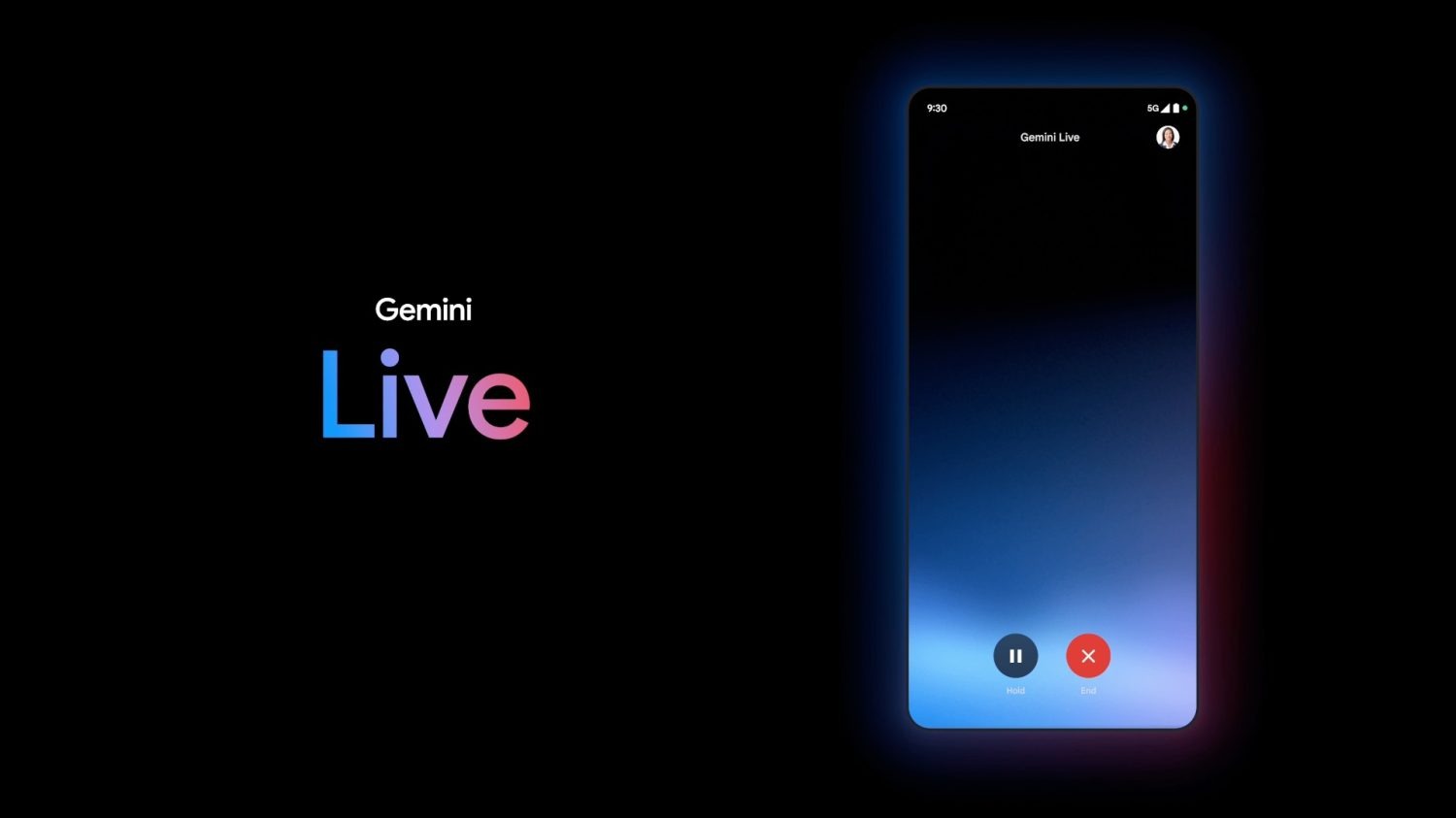
At I/O 2024, Google said Gemini Live would offer ten natural-sounding voices instead of just the one we’re currently limited to, and testing appears to be underway.
Since launch, Gemini has used a male voice to read back responses (2 examples):
Activating Gemini on Android today reveals a female voice (3 examples):
We’re only seeing the new voice in Gemini for Android, with the iOS app and web client unchanged. As of today, there’s no ability to change the voice back in settings. Google could be testing ahead of the broader launch.
Google Assistant today offers 12 voices that use colors for names. Gemini will presumably use the same strategy.
“Live” will let you have a two-way conversation with Gemini when it arrives this summer. Shown as a fullscreen experience at I/O 2024, Gemini Live might also work in the background, including on your lockscreen.
Strings in Google app 15.27 (beta) mention how a “background_mode” will let you “continue [Gemini] Live chats while using other apps or while your screen is locked.”
For the most part, Google Assistant and Gemini will stop after the accompanying UI is off the screen.
Allowing Gemini Live to accept input and reply as you’re doing other stuff on your device could lead to a more immersive and natural experience. In that regard, Gemini Live is basically a phone call. One possible use case is looking through your apps for more information to manually add to a conversation with Gemini.
Once done, you can say “Stop” to Gemini Live or end the chat by looking for a persistent notification.
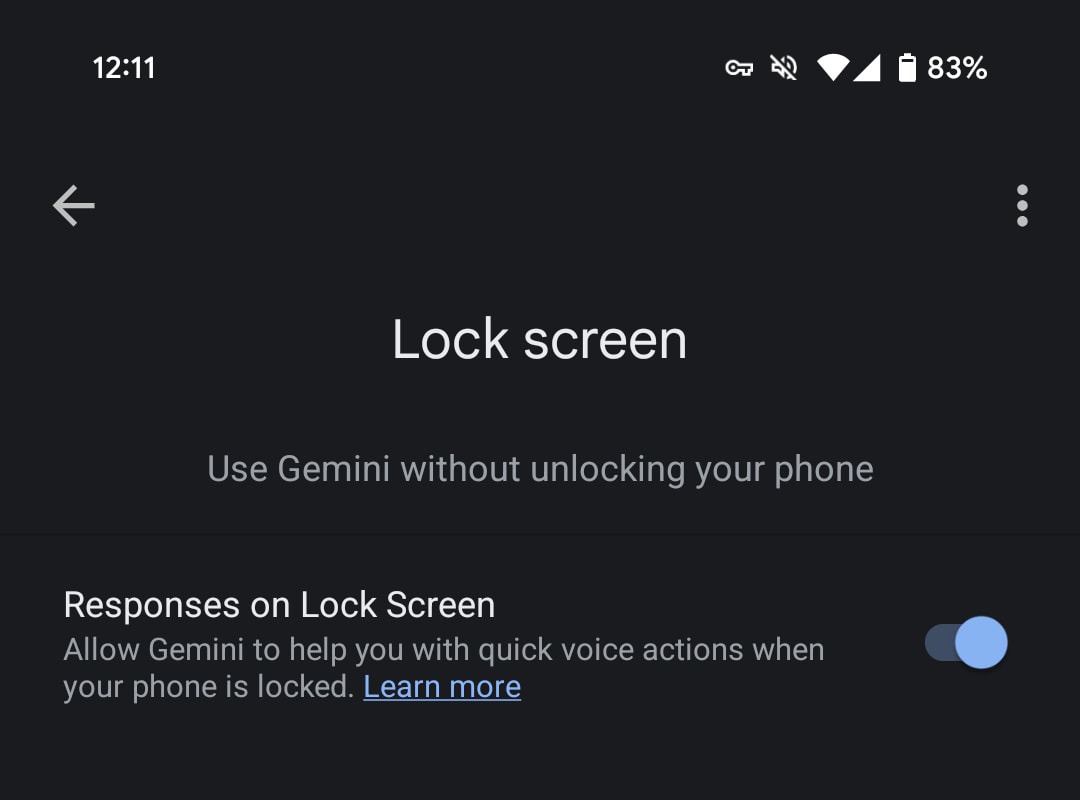
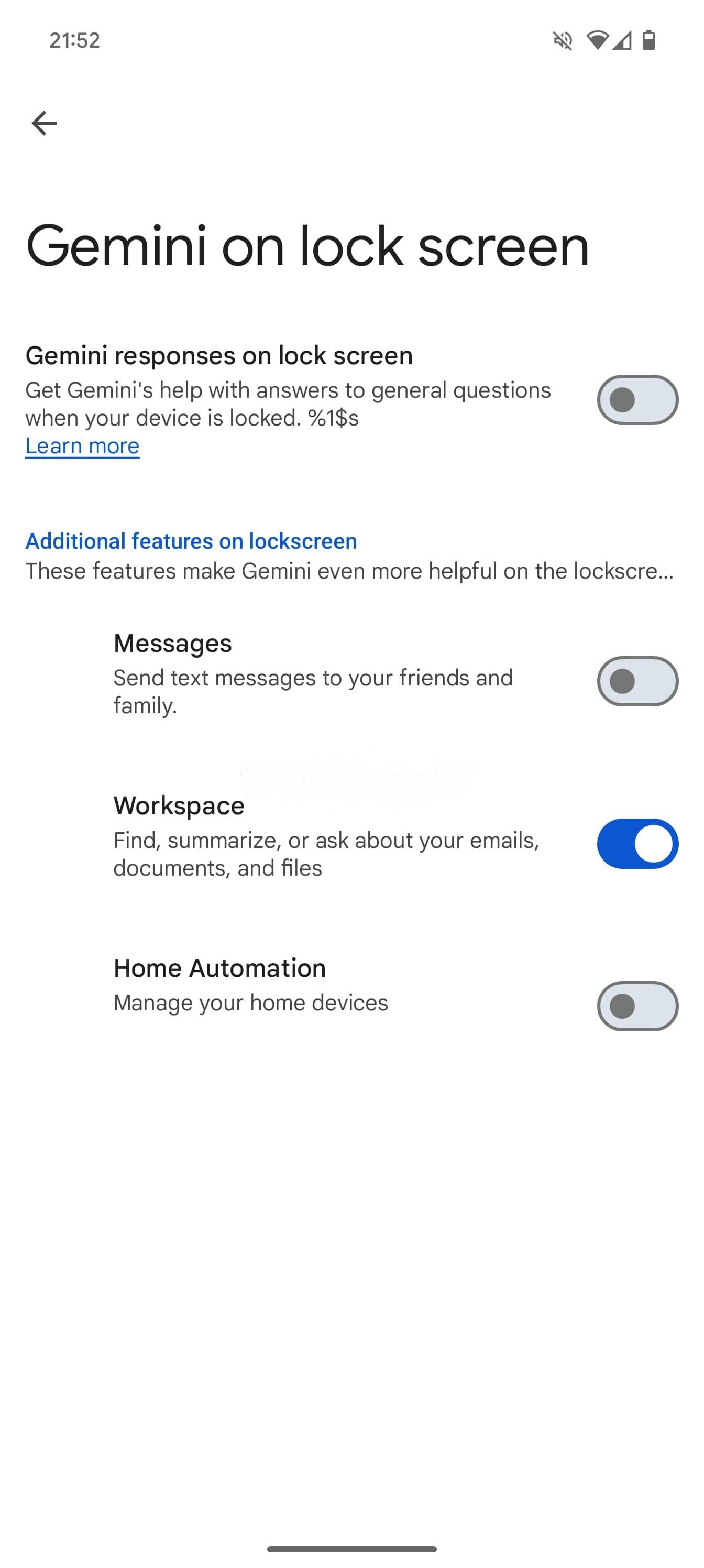
Meanwhile, Google is working to let Gemini do more when your device is locked. Today, enabling that setting allows you to set alarms and timers, with most other commands — including something as basic as asking for the weather — requiring device unlock.
Moving forward, as we enabled below, setting up “Gemini on lock screen” and “extensions on lock screen” will let you get “answers to general questions and more.” Your options are Messages, Workspace, and Home Automation.
Google Maps, YouTube, Google Flights, and Google Hotels extensions are turned on by default on lock screen. Any future extensions that don’t require user credentials or don’t access private data will be on by default. You can turn them off in settings at any time.
Finally, “Gemini will read your messages to you” if you enable “Spoken message notifications.”
Following the announcement at I/O 2024, Gemini in Google Messages has been widely rolling out to stable users over the past few days. It joins recent launches like Gemini 1.5 Pro in Gemini Advanced and the YouTube Music Gemini Extension.
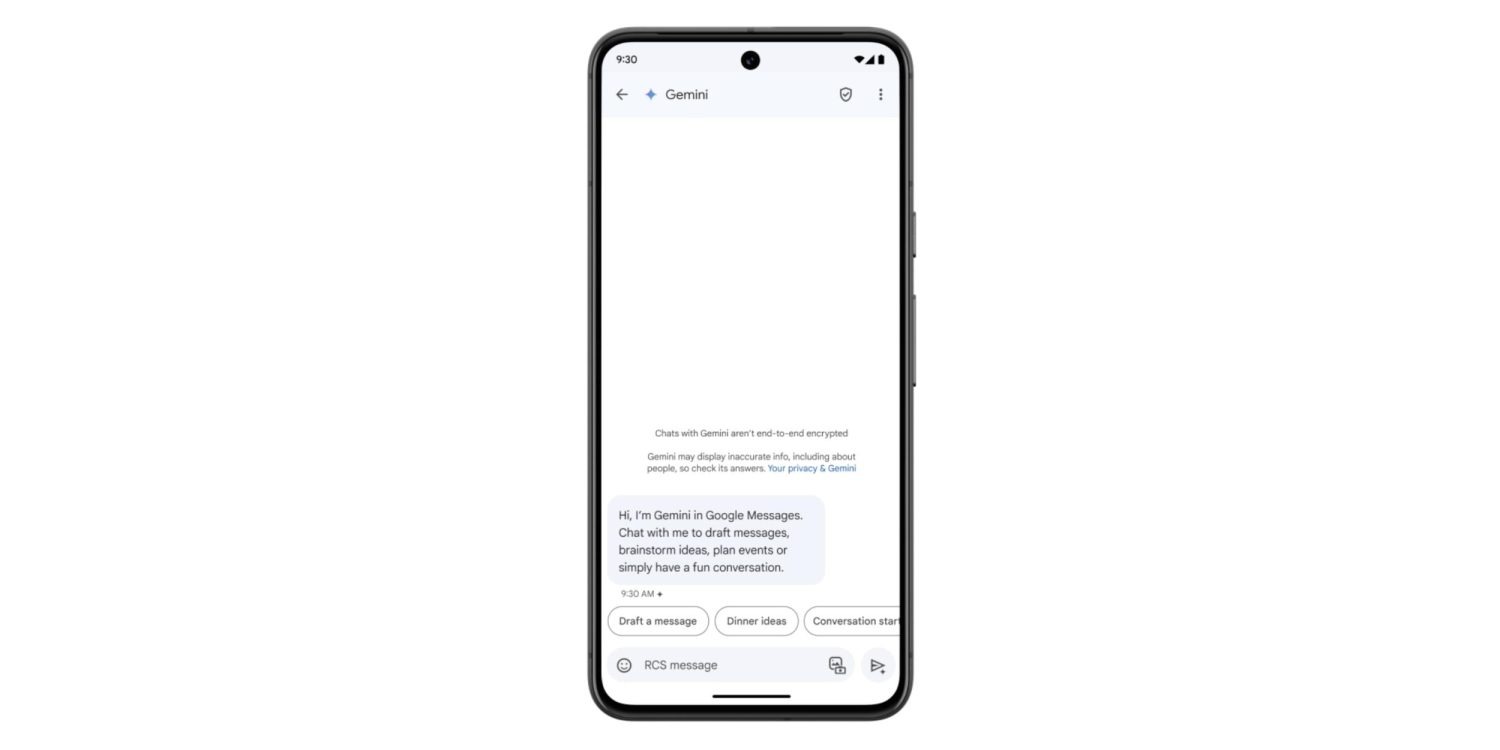
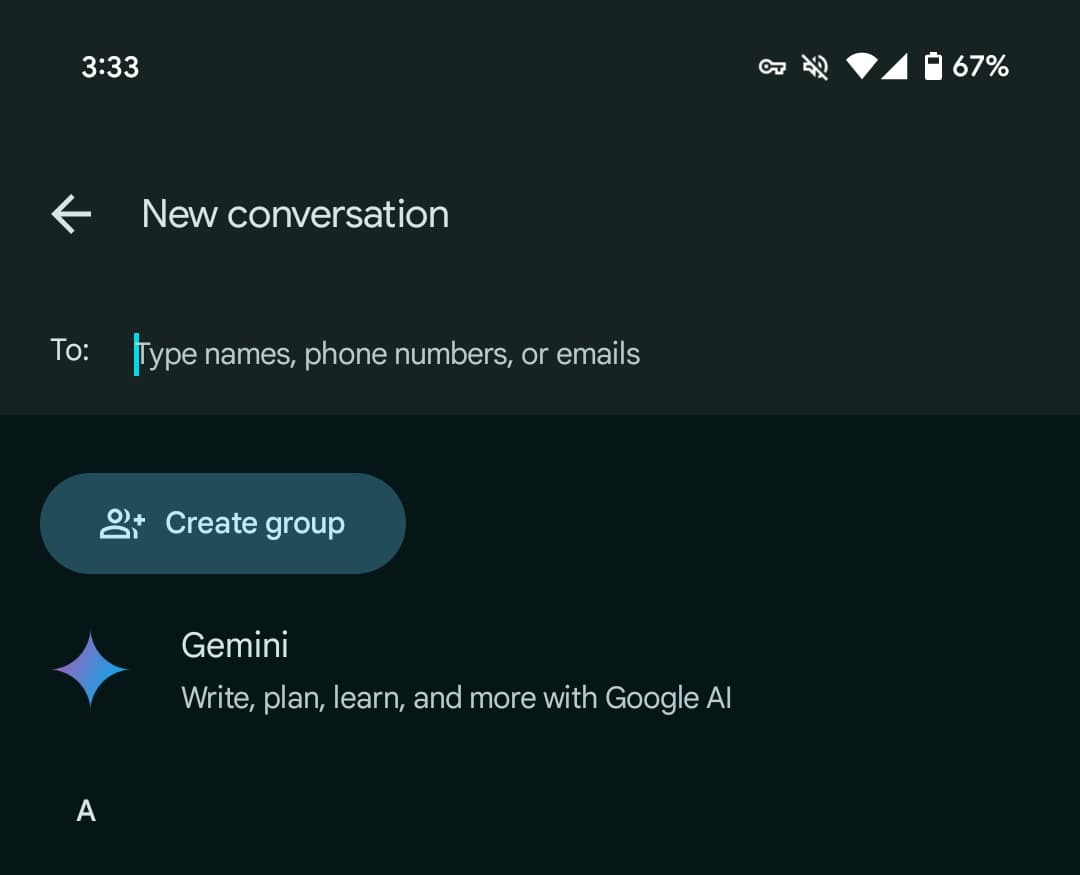
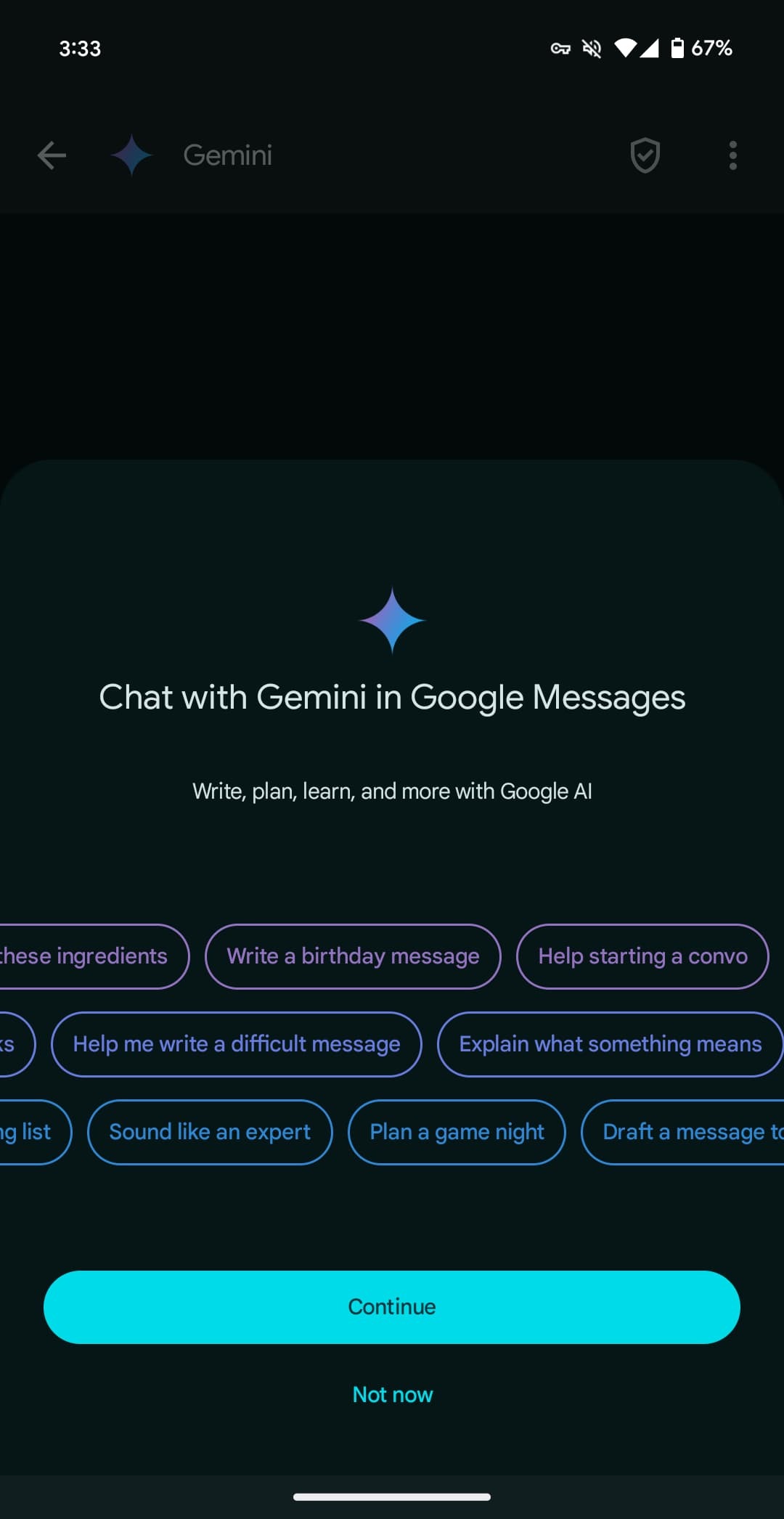
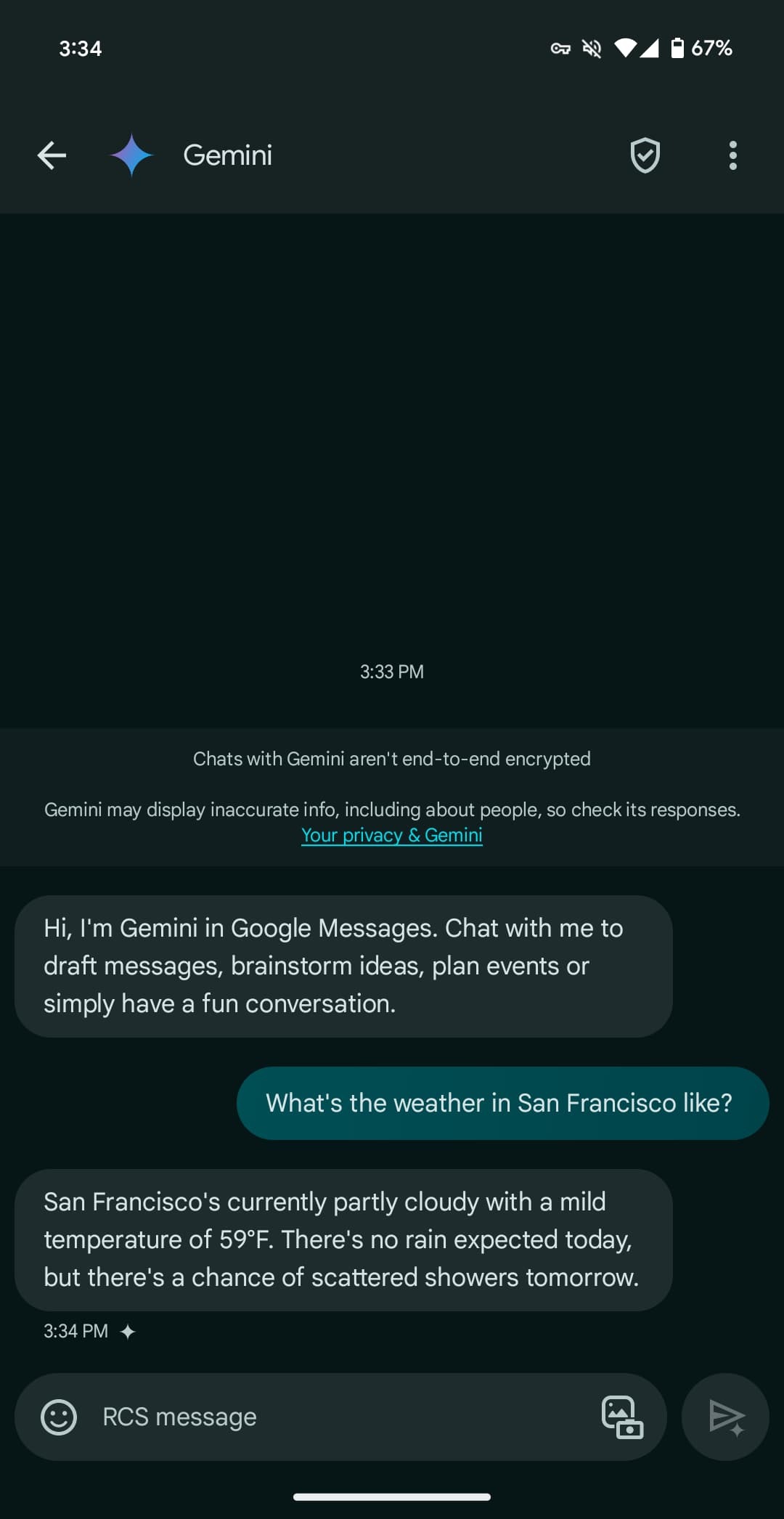
Once available, Gemini will appear as the first contact in the Start chat FAB > New conversation list. After agreeing to some terms, you’re taken to a fairly standard messaging UI. You have emoji and the gallery in the text box, with the ability to upload images for the prompt but not audio memos.
Gemini here can be used to “draft messages, brainstorm ideas, plan events, or simply have a fun conversation.” It has been optimized to deliver more concise responses.
You’re having a direct 1:1 conversation with Gemini, which cannot be pulled into other conversations, like Assistant in Google Allo years ago.
There’s support for Gemini Extensions, like Workspace (@Gmail, etc.), @YouTube, and @GoogleMaps, but the “YouTube Music extension isn’t available in Gemini in Google Messages.”
You can long-press on a response to leave thumbs up/down feedback, with the ability to star and forward also available. Conversations are happening over RCS, which has to be generally enabled, but they are not end-to-end encrypted. Gemini cannot be accessed usingmessages.google.com/web or the Wear OS app (where the chat won’t even appear).
Gemini in Google Messages is rolling out globally — except to the EEA, UK, Switzerland, or India — with support for English and French in Canada. It has been available to betausers since March.
Google has been steadily improving Gemini over the past couple of months, and it seems the Android experience is getting ready for a slew of new upgrades which includes responding in an overlay on top of your current apps.
Gemini on Android replaces Google Assistant when it’s activated, but there are some big downsides to that. Among other things, Gemini opens up all of its responses in a totally new window instead of responding in an overlay like Google Assistant has for years.
It seems that, soon, that may change.
Shared with the folks over at PiunikaWeb, Gemini for Android appears to be working behind the scenes to allow for responses to be available in an overlay. A video demo (see screenshots below, as the video was shared via Google Drive) of the new functionality shows the response appearing on top of the Twitter/X app, never technically causing the user to have to navigate back to the app.
It seems a much more seamless experience overall.
Beyond that, Gemini seems to also be working on some other improvements to its Android app. Shown in another PiunikaWeb post, a “real-time responses” toggle was enabled, enabling Gemini to show data generated as it is available.
Tipster @AssembleDebug also partnered with Android Authority for some other tidbits about what’s going on behind the scenes. This includes the ability for Gemini Advanced subscribers to upload files of any type to Gemini for Android. While the web version supports this already, the Android app is currently limited only to photo files.
The app is also preparing a new “select text” option that would be available alongside the existing “copy text” option.
It’s unclear when any of these new changes will be available, but seeing as they’re already functional, it’s likely they’re not too far away from launch.
In Gmail for web, some users can experience Google’s Workspace Labs integration, which pulls Gemini’s AI functionality into the email site. One of the ways Gemini can operate is with the email summary feature.
In essence, Gemini can create a summary of email threads and content so you don’t have to dig through messages. It can prove to be rather helpful, but it’s still in the early stages of development.
According to PiunikaWeb, the email summary feature may also be coming to Gmail for Android. Hidden in an upcoming version of the app, the email summary tool was discovered. It comes as a button that sits right under the email’s subject, reading “Summarize this email.” Tapping would likely generate a summary at the bottom of the email, much like in the web version.
The tool doesn’t work in this infantile stage, but it showcases Google’s plans to bring Gemini to the mobile Gmail app rather than pioneer it solely on the web, which was unlikely. One could also argue that the feature would be even more useful in a mobile setting rather than on a desktop, where text and formatting are easier to make out.
Since this is a feature that shows signs it’s still being prepared Google hasn’t made any mention of when Android users can expect to see the Gemini-powered email summaries in Gmail. It’s also unknown as to whether the email summary feature from Gemini on mobile will be a limited rollout like the current version on the web.
After “hardware limitations” were cited as the reason that the Pixel 8 isn’t getting Gemini Nano earlier this month, Google announced today that the on-device LLM is coming after all.
The Pixel 8 will get Gemini Nano, in developer preview, to power Summarize in Recorder and Gboard Smart Reply. The latter allows for “higher-quality smart replies” that have “conversational awareness” and should be generated faster. On the Pixel 8 Pro, it works with WhatsApp, Line, and KakaoTalk. Meanwhile, Summarize can take a recording and generate bullet points.
RAM — 8 GB versus 12 GB — is the main hardware difference between the two Tensor G3 phones. Google today says “running large language models on phones with different memory specs can deliver different user experiences, so we have been testing and validating this on Pixel 8.”
It looks like Google found a way to run the LLM on less RAM without impacting the rest of the user experience, with the smaller Galaxy S24 doing the same. As a reminder, Google only ever said Gemini Nano was coming to the Pixel 8 Pro in December. Meanwhile, the comment earlier this month came from an engineer outside the Pixel team.
Gemini Nano is coming to the Pixel 8 with the next Pixel Feature Drop, which should be Android 14 QPR3 in June (if previous timelines remain in place). Besides end users getting those two Google app features, developers with the Pixel 8 will be able to use AICore for their own applications.
Thank you for using
Themify Popup
This is a sample pop up. Themify Builder or Builder Lite (free) plugin is recommended to design the pop up layouts.