Earlier this summer Motorola announced an addition to their G series of devices, the Moto G5S Plus. The new device was described as a “special edition” of the Moto G5 Plus, but in reality is an upgrade to the former device. That should make it a smartphone worthy of consideration by mid-tier buyers as we rated the Moto G5 Plus highly, so the Moto G5S Plus should be a more compelling option.
The biggest upgrade that the Moto G5S Plus gets compared to the original phone is the addition of a dual-camera setup on the rear, the first G series Motorola phone to get a dual-camera. The Moto G5S Plus is also slightly larger with a 5.5-inch screen versus the 5.2-inch screen of the Moto G5 Plus. Some other smaller differences include an upgrade in RAM options to 3GB or 4GB compared with 2GB/4GB and the front-facing camera has been upgraded to 8MP from a 5MP unit. Otherwise, the Moto G5S Plus gets the same Snapdragon 625 processor, metal body, 3,000mAh battery, and choice of 32GB or 64GB of storage.
Pricing for the Moto G5S Plus in the U.S. is $280 for the 3GB/32GB version and $350 for the 4GB/64GB version. However, now through September 28th, Motorola is offering a $50 discount making the prices $230 and $300. The phone will be available on September 29th.
A new Samsung device has just received certification from the National Radio Agency based in Samsung’s hometown of South Korea.
The device has the model number SM-G888N0 and is said to be known as the Galaxy X, which is set to be the company’s first foldable phone that has been heavily rumored Samsung has been working on. Now the device has received formal certification, it would suggest that the Samsung Galaxy X could be launching very soon, albeit in South Korea to begin with.
The Wi-Fi alliance lists the device as Bluetooth 4.2 and running Android 6.0.1 Marshmallow which would be slightly disappointing. I suspect this may be outdated given the profile of the Galaxy X in the lineup for Samsung and would expect similar specs to that of the rest of the Galaxy line.
The foldable smartphone is said to be being developed under codename Project Valley and points to a late 2017 or early 2018 release.
A device that folds up is an interesting concept and one that if executed correctly, would open the door for Samsung to further increase the display size on a smartphone without increasing its physical footprint.
Foldable phones were all the rage pre-smartphone but could Samsung be using the Galaxy X to reignite that trend or has it finally figured out foldable displays?
If the rumors are true we won’t have long to find out as we could see something launched in South Korea at the tail end of the year.
The Huawei Mate 9 was launched in December last year with Android Nougat out-of-the-box.
Huawei is working on the Android Oreo software update for its Mate 9 smartphone, as per reports. Now, a Huawei Mate 9 has been spotted on Geekbench running on Android Oreo 8.0, lending some credibility to those reports.
As spotted by Androidsoul, if the Geekbench listing is to be believed, Huawei might roll out the Android 8.0 Oreo update to its users in the coming months. The Mate 9, as of now, runs Android 7.0 Nougat out-of-the-box wrapped under Emotion UI 5.0. Apart from the Mate 9, the Huawei P10, Honor 8 Pro, Honor 8, Honor 8 Lite and Honor 6X are expected to get Android Oreo update.
With Android Oreo, some of the features the Mate 9 smartphone will get are the Picture-in-Picture mode, Notification Dots, Android Instant Apps, Longer battery life, Notification channel, among others.
One of the talking points of the Mate 9 is its camera. It comes with one 12-megapixel RGB color sensor and a 20-megapixel monochrome sensor. Co-developed by Leica, the camera comes with dual-core ISP, depth measurement ISP and professional DSP for better image focusing speeds and processing. The camera also supports 4K video recording capabilities.
Huawei Mate 9 specifications, features
The Huawei Mate 9 sports a 5.9-inch full HD (1080p) display. At the heart of both smartphones runs Huawei’s homebrewed Kirin 960 octa-core SoC. Built on the 16nm FinFET process, the chipset features four Cortex A73 cores clocked at 2.4GHz and four Cortex A53 cores clocked at 1.8GHz. It is paired with 4GB of RAM and either 64GB or 128GB onboard storage options.
Connectivity options on the smartphone include Wi-Fi 802.11ac, 4G LTE with VoLTE voice calling support, Bluetooth, GPS and USB Type-C port for charging and data transfer. The Mate 9 has a 4,000mAh non-removable battery.
The phone will be called ‘Mate 10’ outside of China.
Huawei has lost no time in releasing its smartphone to catch up with and compete against Vivo’s X20 and X20 Plus launched just a couple of days back.
Huawei’s new phone is named ‘Maimang 6’ (it will be called ‘Mate 10’ outside of China). The phone has a 5.9-inch IPS full HD display, its screen resolution being 2160x1080pixels. It’s a least bezel display with the aspect ratio being 18:9. Under the hood, Huawei has fitted its in-house CPU, the octa-core Kirin 659. The phone comes with 4GB RAM and 64GB internal memory. Further expansion of the storage is feasible through a microSD card.
The optics department is unique on the Huawei Maimang 6 since it has four cameras, a double camera setup in the rear and a double camera setup in the front as well. The rear camera setup has a 16MP plus a 2MP camera. It is capable of capturing images even in blurred backgrounds. On the front, the combination of 13MP plus 2MP sensors with a f/2.0 aperture lens. In addition, the front camera is supported by the spotlight flash and bokeh effect as well.
The operating system is the Android Nougat version 7.0 with Huawei’s UI EMUI 5.1 skin riding over it. The battery fitted on the Huawei Maimang 6 or Mate 10 is 3340mAh.
The phone has all possible connectivity options, including compatibility for 4G LTE networks. A fingerprint sensor is also present on the rear panel of the phone.
Huawei will make the phone available in three colors, black, gold and blue. Priced at CNY 2, 399 (approx. Rs. 24, 000), the phone will start shipping for Chinese customers from September 30 while the rest of the world may see its equivalent launched in October.
Multimedia Excellence, User Personalization and Intuitive Usefulness at the Heart of LG’s New Smartphone UX
SEOUL, Aug. 14, 2017 — The new UX 6.0+ to make its debut in the upcoming V30 from LG Electronics (LG) is an advanced version of LG’s UX that has been optimized to work even better with the immersive 18:9 OLED FullVision display while offering more personalization options for a more intuitive user experience. Featuring the company’s first OLED FullVision display and an advanced dual lens camera, the LG V30 is a powerful multimedia tool and the new UX is designed so that users can leverage its advanced capabilities to the fullest.
Graphy, which can be accessed in the camera’s Manual Mode, gives any shutterbug professional quality photography capabilities. With Graphy, users can choose from among a portfolio of professional shots, each with a different style and mood or they can download photos taken by professionals from the Graphy website or mobile app and apply those metadata presets – such as white balance, shutter speed, aperture and ISO – to photos taken with the V30. Different shooting modes such as auto, grid shot, snap shot and match shot are conveniently grouped under one menu for ease of selection. GIFs can be quickly created in the Gallery menu while the Create Movie option allows for the creation of movie using photos and/or video files which can then be edited in the included Quick Video Editor.
The Second Screen in the LG V20 has evolved to become Floating Bar on the V30. The semi-transparent Floating Bar allows for quick access to frequently used functions and can be dragged completely off the FullVision display when not needed. When powered off, the Always-on Display is even more customizable than before. The AOD now not only shows the clock, it can also be set to display Quick Tools, Music Player or a personal photograph as well.
Security features in the LG V30 are also more advanced than in LG’s previous smartphone UX. Using Face Recognition, the V30 can be unlocked instantaneously using the front facing camera even when the phone’s display is off. And there is no need to press the power button first, unlike on other phones. Voice Recognition uses a combination of the user’s voice and self-generated keywords (ideally three to five syllables combined) to unlock the V30 without the need to press a button or swipe the screen. It is supported by Qualcomm Aqstic voice UI technology for always-on, always-listening capabilities that requires very little battery power.
Even the feel of the UX can be tailored to users’ preference. Haptic feedback on the LG V30 can be customized with various included vibration combinations that can be matched to the phone’s ringtone.
Multimedia Excellence, User Personalization and Intuitive Usefulness at the Heart of LG’s New Smartphone UX
SEOUL, Aug. 14, 2017 — The new UX 6.0+ to make its debut in the upcoming V30 from LG Electronics (LG) is an advanced version of LG’s UX that has been optimized to work even better with the immersive 18:9 OLED FullVision display while offering more personalization options for a more intuitive user experience. Featuring the company’s first OLED FullVision display and an advanced dual lens camera, the LG V30 is a powerful multimedia tool and the new UX is designed so that users can leverage its advanced capabilities to the fullest.
Graphy, which can be accessed in the camera’s Manual Mode, gives any shutterbug professional quality photography capabilities. With Graphy, users can choose from among a portfolio of professional shots, each with a different style and mood or they can download photos taken by professionals from the Graphy website or mobile app and apply those metadata presets – such as white balance, shutter speed, aperture and ISO – to photos taken with the V30. Different shooting modes such as auto, grid shot, snap shot and match shot are conveniently grouped under one menu for ease of selection. GIFs can be quickly created in the Gallery menu while the Create Movie option allows for the creation of movie using photos and/or video files which can then be edited in the included Quick Video Editor.
The Second Screen in the LG V20 has evolved to become Floating Bar on the V30. The semi-transparent Floating Bar allows for quick access to frequently used functions and can be dragged completely off the FullVision display when not needed. When powered off, the Always-on Display is even more customizable than before. The AOD now not only shows the clock, it can also be set to display Quick Tools, Music Player or a personal photograph as well.
Security features in the LG V30 are also more advanced than in LG’s previous smartphone UX. Using Face Recognition, the V30 can be unlocked instantaneously using the front facing camera even when the phone’s display is off. And there is no need to press the power button first, unlike on other phones. Voice Recognition uses a combination of the user’s voice and self-generated keywords (ideally three to five syllables combined) to unlock the V30 without the need to press a button or swipe the screen. It is supported by Qualcomm Aqstic voice UI technology for always-on, always-listening capabilities that requires very little battery power.
Even the feel of the UX can be tailored to users’ preference. Haptic feedback on the LG V30 can be customized with various included vibration combinations that can be matched to the phone’s ringtone.
As yet another evolutionary device rather than the design revolution some cash-strapped iFans may have expected, the iPhone 8 is unsurprisingly overshadowed by the much sleeker X, despite the latter’s delays and availability concerns.
We’re talking of course about media coverage and apparent consumer interest, because in terms of critical reception, the 8 and especially 8 Plus seem to be doing just fine.
While we continue to cook up our exclusive in-depth reviews, it’s definitely worth highlighting how the smaller iPhone 8 handled JerryRigEverything’s obligatory durability inspection.
In a word, pretty great. In more, let’s start off by noticing Apple’s “most durable glass ever” and sapphire camera lens claims don’t exactly hold up in real life. The iPhone 8 screen is about as resistant to scratches as any high-end Android display around, and the rear-facing shooter appears to cut a few build quality corners.
Still, there’s no denying this is a robust slab of (mostly) glass and (very little) metal, largely impervious to razor blades, coins and keys, and impossible to bend with sheer force of will. It even bravely combats flames… if you somehow feel that information is relevant to the way you typically use your mobile device.
Meanwhile, iFixit’s comprehensive teardown examination concluded in a repairability score of 6 out of a possible 10, which is much better than Samsung’s DIY Galaxy S8 nightmare, but actually one point lower than last year’s iPhone 7 and 7 Plus grades.
As always, you’re advised to not try any of the above, including scratch, flame, bend tests and routine disassembly, at home unless you know precisely what you’re doing or just want to watch the world burn.
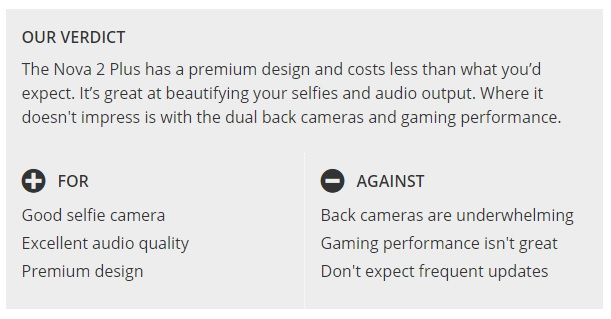
The original Huawei Nova Plus was decent but not necessary a memorable phone. With the follow up, Huawei is focusing on the front camera and audio capabilities.
At AED 1,399 (US$375), the Huawei Nova 2 Plus is cheaper than the likes of Honor 9, but it’s also not at the same performance level as that or the Nokia 8.
Packaged in a white box that looks very much like the one we saw on the Honor 8 last year, the Nova 2 Plus comes with a fast charger, a USB Type C cable and a headset along with the quickstart guide.
Like other Huawei phones we’ve reviewed of late, a translucent case is also bundled to protect the phone. We think it’s great that Huawei is providing basic protection out of the box.
Less is more
The Huawei Nova 2 Plus can be seen as a cheaper version of the Huawei P10 Plus. It has almost identical dimensions and a slightly less premium, yet, a beautiful design.
Instead of the glass strip found on the top of P10 Plus with Leica brand, the Nova 2 plus has a smooth all-metal back.
It’s available in three colors- Graphite Black, Prestige Gold and Aurora Blue. We got that last one for review and it has a nice zen like finish that is achieved by moving the antennae lines on the top and bottom.
HUAWEI NOVA PLUS SPECS
Weight: 169g Dimensions: 153.9 x 74.5 x 6.9mm OS: Android 7.0 Screen size: 5.5-inch Resolution: 1080 x 1920 CPU: HiSilicon Kirin 659 RAM: 4GB Storage: 64GB Battery: 3340mAh Rear camera: Dual 12 + 8 MP Front camera: 20MP
Even though the screen size is 5.5 inches, the Huawei Nova 2 Plus sits comfortably in your hand. And with a weight of 169g, it’s easier to handle than other phones with similar screen sizes.
Huawei has placed the fingerprint sensor on the back of the phone. Although we prefer a fingerprint sensor on the front, the positioning of it on the Nova 2 is well thought out. It sits reasonably below the cameras and in the center making it very easy for your index finger to reach it.
Like the Huawei P10, the fingerprint sensor is extremely quick to recognize and unlock your phone – among the fastest we’ve used. It also allows for gestures such as pulling down the notification shade or browsing your photos. You can even answer calls and take photos by tapping it.
The 5.5-inch screen on the Huawei Nova 2 Plus is FullHD in resolution which is expected from a device at its price point. It’s LED in technology and is bright enough to be used in the outdoor sun, though you will need to crank the brightness levels all the way up when using it outdoors in a place like Dubai. Huawei has also done a good job with colour reproduction, especially when you use one of the bundled theme that brings out the best the screen has to offer.
Design and display
Subtle and elegant design
Display is bright and sharp
While the Huawei Nova 2 Plus has an elegant design, it won’t necessarily turn heads. It’s definitely more premium than what is expected out of a phone in it’s price range, but it’s a phone that will disappear among all other phones that look like it.
At just 6.9mm thickness, the phone sits comfortably in your hands and is easier to use that other phones with a similar screen size. Although there are bezels present on the top and bottom, they don’t feel oversized though most of us will need to use the phone with two hands.
The left side holds the SIM tray which can take one nano SIM and one micro SIM, or a MicroSD card. On the right, you can find a textured power button was well as volume keys that are easy to reach. Moving to the bottom, the Nova 2 Plus features a USB Type-C port along with a 3.5mm jack.
The back holds the dual camera setup along with a flash on the top and the fingerprint sensor below it to the centre. The front of the phone is very generic- a large glass slab with noticeable bezels on the top and the bottom.
The Apple iPhone 8 Plus has a main camera system truly worthy of a flagship phone. Similar to the iPhone 7 Plus, it features two cameras — a wide-angle 12MP main camera, and a 12MP telephoto camera with a slower lens for zooming in on subjects and for special effects such as Portrait mode. Comparing the camera datasheets of the older iPhone 7 Plus and the new iPhone 8 Plus make the two look almost identical; however, under-the-hood upgrades have given the 8 Plus an image quality and camera performance boost in almost every one of our tested categories.
Key camera specifications:
12MP main (wide-angle) camera with BSI sensor, f/1.8 lens
12MP telephoto camera, f/2.8 lens
Optical zoom, with digital zoom up to 10x
Portrait mode
Portrait Lighting (beta)
Optical image stabilization (main camera only)
Quad-LED True Tone flash with Slow sync
Autofocus with focus pixels
Wide-gamut color capture
Body and face detection
AutoHDR
Test summary
The Apple iPhone 8 Plus is the best-performing mobile device camera we have ever tested. Its overall DxOMark Mobile score of 94 sets a new record, beating out the 90 points for both the Google Pixel and the HTC U11, as well as the 92 that its sibling iPhone 8 just scored. Its Photo score of 96 is also a new record, blowing past the Pixel’s 90. For Video, its score of 89 is among our highest, but tied with the HTC U11 and slightly below the Pixel’s 91. Of course, the Pixel is nearly a year old now, so it makes sense that Apple’s new flagship is breaking new ground.
Bright light
Images captured outdoors with the iPhone 8 Plus are generally stunning, with excellent detail preservation, accurate color, and impressive dynamic range. The iPhone 8 Plus builds on the excellent performance of the iPhone 7 family with even better results in bright light. In particular, it has improved exposure calculation, and excellent ability to capture HDR (High Dynamic Range) scenes.
This scene has proved challenging to many of the smartphones we have tested, but the 8 Plus handles it like a champ. If you didn’t know that the image came from a phone, it would it would be very hard to tell.
This scene has proved challenging to many of the smartphones we have tested, but the 8 Plus handles it like a champ. If you didn’t know that the image came from a phone, it would it would be very hard to tell.
iPhone 8 version.
iPhone 8 Plus version.
Google Pixel version.
iPhone 7 Plus version.
Low light and Flash
Low light: Exposures are generally accurate, although there can be some underexposure in very low light. The 8 Plus’s strong performance in low light and with flash, combined with its excellent ability to recognize and properly expose faces, make it a natural for anyone wanting to easily create memories of their indoor events.
Even in tricky mixed-lighting situations, the iPhone 8 Plus does an excellent job of providing an accurate and detailed rendering of indoor scenes.
Flash: Images look good overall, with accurate exposure and white balance; however, there can be a a loss of detail and excessive noise.
Zoom and Bokeh
While the iPhone 8 Plus camera is amazing overall, it is in our new test categories of Zoom and Bokeh where it really stands out. While the technical specifications for the second camera that help make these features possible are very similar to the specs for the second camera on the iPhone 7 Plus on paper, upgrades to the image processing software have raised the 8 Plus’s performance to a new level. Especially important for those looking to capture portraits with their phones, or to create artistic effects in macro and other closeup shots, zoom and bokeh used to require standalone cameras. But phones like the 8 Plus are changing that.
Zoom: The dedicated telephoto camera on the 8 Plus gives it a large advantage over most traditional single-camera designs when it comes to zoom. At 51, it has the highest Zoom sub-score of any mobile device we have measured — a full 5 points better than its predecessor, the iPhone 7 Plus. Here you can see that at 2x (full-frame equivalent of about 56mm), the iPhone 8 Plus does an excellent job of both framing and detail preservation (click on individual images to get a full-size version for easier comparison):
iPhone 8 version
iPhone 8 Plus version.
Google Pixel version of the image.
iPhone 7 Plus version of the image.
Bokeh: Overall, the 8 Plus is the highest-performing phone we’ve tested when it comes to bokeh. Despite the relatively small changes in the actual camera specs, additional development and processing power allow it to beat out the 7 Plus by 5 points, putting it even further ahead of the Google Pixel, with a score of 55 compared to 30.
You can see the improved depth effect on the iPhone 8 Plus compared to the older model, showing that the dual-camera system now does a better job of blurring the foreground like a true optical blur, instead of blurring only the background. The images below also show how the second camera of the 8 Plus provides a much more artistic rendering of the image than the single camera on the iPhone 8 (click on individual images to get a full-size version for easier comparison):
iPhone 8 version.
iPhone 8 Plus version.
Google Pixel version of the image.
iPhone 7 Plus version of the image.
Video
Apple continues to up its game on Video. With a score of 89, the 8 Plus has the best video quality of any Apple device, starting with the best exposure calculation. In particular, exposure is more stable while panning or walking than on previous iPhones. Its HDR capabilities are also very good, but highlights are sometimes blown out. There is still room for improvement, as the iPhone 8 Plus’s Video score of 89 still only ties the HTC U11 and is still behind the Google Pixel’s 91 points. This said, the 8 Plus camera does an excellent job of face tracking when shooting video in bright light.
Photo scores explained
Our Overall Photo Score is a composite of a number of category sub-scores. Here we detail how the 8 Plus performed in each of those categories.
Exposure and Contrast (89)
The 8 Plus does an excellent job of accurately calculating exposure, improving on the performance of the iPhone 7 family. Its ability to represent high-contrast scenes is also improved, probably at least in part due to additional processing power and improved software for combining multiple frames into a single image. Apple’s AutoHDR technology is some of the best on the market for rendering high-dynamic-range scenes. The 8 Plus also does an unusually good job at recognizing and properly exposing faces in an image.
This HDR scene tests the boundaries of what a mobile device camera can capture. The 8 Plus does an excellent job of keeping the highlights visible while still showing detail in the shaded foliage in the foreground.
Color (78)
Color is pleasing both outside and indoors. White balance is also quite good. The 8 Plus improves slightly over the iPhone 8 in its color performance by completely avoiding visible color shading, even in low-light conditions.
The iPhone 8 Plus accurately renders pleasingly colorful outdoor scenes like this one.
Color saturation in iPhone 8 Plus images remains very good, even under low-light conditions. However, in low light and in typical indoor (tungsten) light, 8 Plus images pick up a noticeable color cast that you can see in this chart of test sample patches:
Using the reference patch on the far right, notice that the light gray patch nearly turns peach under very low-light conditions (left-most “H” column, luminosity similar to candlelight).
iPhone 8 Plus version, showing a slight yellow cast
Google Pixel version
Autofocus (74)
Although the 8 Plus doesn’t always focus quickly, once it focuses, it is remarkably accurate. In both our long- and short-delay tests, the 8 Plus was able to repeatably capture an in-focus scene. The sometimes longer delay — which occurred periodically in both bright and low light — can mean that users miss the shot they intended.
Even in bright light, the 8 Plus’s autofocus sometimes hesitated, which can mean missing the shot you want.
Similarly, in our fast trigger tests, the 8 Plus didn’t always refocus right away. However, once the 8 Plus focused, it was on the money. Given a longer interval, the camera focused accurately and quickly every time.
Detail (64)
The 8 Plus does an excellent job of capturing detail under a wide variety of lighting conditions, especially when there is no motion in the scene. That makes it especially good for landscape images. There is a noticeable loss of detail when there is motion, especially in low-light — as you can see in this chart of detail preservation versus light level:
(Our Family score reflects scenes with moving objects, simulating photographing people at events, while the Landscape line is for scenes without subject motion.)
It is easy to forget how far smartphone cameras have come in just a few years. These tight crops of an area in our standard natural test scene demonstrate how much more detail the iPhone 8 Plus captures than previous generations of iPhones:
The images were all taken under very-low light (5 Lux) handheld conditions, showing the improvement in detail preservation and noise suppression in successive iPhone models.
Noise (68)
Similar to its detail score, the 8 Plus features a very low level of noise when capturing static scenes, outperforming every other phone in our database. Even the darkest areas in HDR scenes have very low levels of noise, and blue skies are almost without noise. There is some slight luminance noise indoors and in very low light, but well within acceptable limits. In this indoor test target scene, for example, the 8 Plus is a little further off in exposure than the Google Pixel, but has lower noise:
In very low light, the Pixel does a slightly better job of properly exposing the image (only a small cropped area shown here), but has visible color noise compared to the iPhone 8 Plus (iPhone 8 Plus image crops are on the top row, Google Pixel on the bottom).
This next comparison image is another that shows how quickly smartphone camera technology is advancing. This image was shot with the iPhone 7 Plus and the 8 Plus, both in Portrait mode. The newer model does a much better job of suppressing noise, especially on the model’s face:
iPhone 7 Plus version of the image.
iPhone 8 Plus version, showing better detail and lower noise; note, however, the slight bokeh artifact visible around the hair.
Artifacts (73)
The 8 Plus, like most iPhone models we’ve tested, has very few artifacts in its images, achieving an excellent artifact sub-score as a result. Interestingly, the iPhone 8 outscores the 8 Plus in this area. Slight flare in harsh light and moiré when repeating patterns are present reduced its score somewhat. Some visible ghosting can also occur.
Flash (84)
Flash-only photos with the iPhone 8 Plus feature accurate white balance and good color rendering. With both flash and flash combined with ambient light, there is low noise and good detail preservation. There can be a slight yellow cast when flash is mixed with a low level of ambient light, and exposure and white balance can vary from shot to shot in a sequence.
This portrait, lit with only flash, shows a slight yellow cast.
Zoom (51)
The iPhone 8 Plus sets a new standard for zoom performance in a smartphone, a tribute to its dual camera design, and the image processing improvements Apple has made since the introduction of the 7 Plus. There is still some room for improvement: when shooting several images in a row using zoom, some (but not all) images show artifacts.
Even with the 8 Plus’s stunning Zoom and Portrait mode performance, photographers still need to watch out for possible side effects. For example, these images show that subject motion can detract from an otherwise excellent portrait:
This Portrait mode image is sharp and also blurs the background to help make the subject pop.
However, the same scene with the subject waving his hand shows that the 8 Plus hasn’t addressed the resulting motion blur.
Bokeh (55)
The bokeh effect on the 8 Plus is remarkably reliable, as the 8 Plus is not fooled nearly as often as other smartphone cameras when it makes estimations of depth, even compared to competitors with similar dual-camera systems.
In low light, the iPhone 8 Plus does a much better job of rendering a bokeh effect than the Google Pixel, although at the cost of some noise. Further, the Pixel version of the image has strong artifacts (click on individual images to get a full-size version for easier comparison):
iPhone 8 version.
iPhone 8 Plus version.
Google Pixel version of the image.
iPhone 7 Plus version of the image.
Key to the 8 Plus’s excellent Bokeh score is very good depth estimation and facial recognition. These technologies help ensure that blurs are created naturally and effectively. There is room for improvement, though — in particular, when the subject touches the edges of the frame, the camera can mistake portions of the subject for part of the background, and ends up blurring those portions accordingly.
This type of artifact is visible in the portrait in this review, in which some of the subject’s hair is blurred — an unfortunate and sometimes unpleasant effect on an important part of the portrait.
Video scores explained
The Apple iPhone 8 Plus achieves a total Video score of 89. As with the photo scores, this is calculated from the sub-scores it achieves in a number of categories of tests that help define its overall video capabilities, specifically: Exposure and Contrast (81), Color (87), Autofocus (84), Texture (50), Noise (68), Artifacts (81), and Stabilization (91). Of particular note, stabilization is excellent, color rendering is very accurate, and exposure is greatly improved over previous models. Exceptionally good face tracking also aids in accurate subject exposure. Video suffers from some judder, and a small amount of frame-rate inaccuracy.
One thing the iPhone 8 Plus’s video lacks somewhat is good exposure in low light. As light falls off, the 8 Plus tends to underexpose, as you can see from this chart:
Ideally, the gray patch should expose to about 50. The 8 Plus comes close in bright light, but at low-light levels, it chooses a very dark exposure.
Conclusion: The best smartphone camera we’ve ever tested
Overall, the Apple iPhone 8 Plus is an excellent choice for the needs of nearly every smartphone photographer. It features outstanding image quality, zoom for those needing to get closer to their subjects, and an industry-leading Portrait mode for artistic efforts. It is at the top of our scoring charts in nearly every category — and in particular, its advanced software allows it to do an amazing job of capturing high-dynamic range scenes and images in which it can recognize faces.
We look forward to testing the iPhone X and comparing it against the iPhone 8 Plus, as the X’s wider aperture and its OIS on both cameras should place it on the cutting edge of zoom and portrait performance — enhancing the iPhone shooting experience for memory makers and image lovers even more.
A note about image formats for this review: The iPhone 8 and 8 Plus record photographs in the DCI-P3 colorspace, which their displays also use. DCI-P3 is newer and larger than the sRGB color space that most devices use and most web browsers assume. So to ensure that the images we used in the review display properly on a wide variety of browsers and devices, we converted the originals from DCI-P3 to sRGB using Photoshop (which is why the published test photos show Photoshop as the creator). This can slightly reduce the richness of color in some cases from what you would see when viewing the original images on a DCI-P3-calibrated display with appropriate software. We also captured the original images using the new HEIF (High-Efficiency Image Format), but then converted them to very high-quality JPEGs for viewing in standard browsers and image editing software. (HEIF is very similar to JPEG, but provides better compression for similar image quality, so the conversion makes the sample image file sizes larger than they were when shot.) Please note, however, that unlike our test images, some of the comparison photos used in this review were shot in JPEG and used as-is for illustrative purposes, and were not used to compute scores.
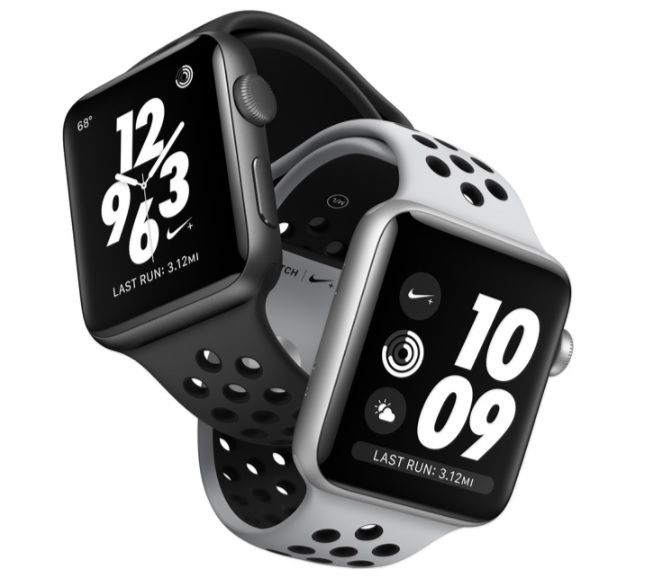
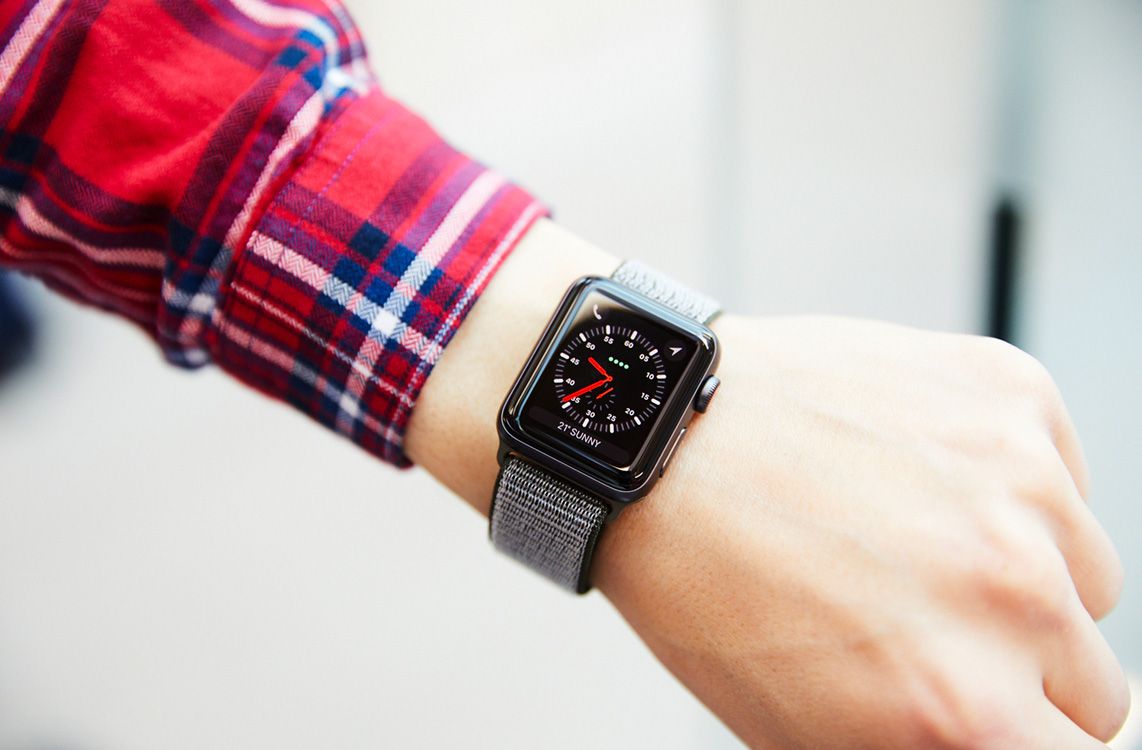
On September 22, Apple Watch Series 3 with built-in cellular and Apple Watch Series 3 with GPS went on sale around the world at 8 a.m. local time. The new Watches add powerful health and fitness enhancements, a faster dual-core processor, a new wireless chip and watchOS 4.
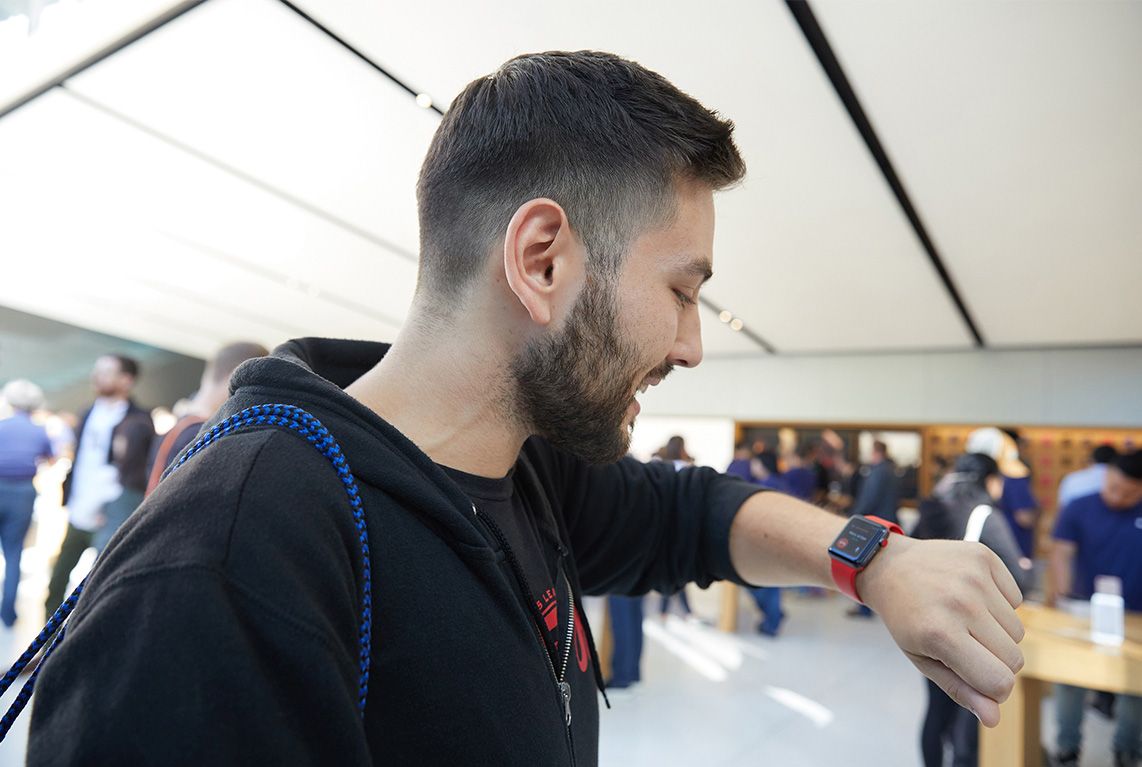
Apple Union Square, San Francisco
A customer uses Apple Watch Series 3 to call his mother from Apple Union Square in San Francisco.