Samsung and Marvel have a history of working together, most recently the two joined forces to create the exclusive Galaxy S6 Iron Man Edition. Such partnerships have also provided Samsung with screen time in Marvel’s big budget superhero movies, clearly it’s an arrangement that works for both companies. According to a new rumor out of China the two might be collaborating once again, this time on an Ant-Man edition of the Galaxy S6 edge+.
There aren’t a lot of details available as yet about the Galaxy S6 edge+ × Ant-Man, but the rumor out of China claims that it’s going to happen, apparently it’s going to have Ant-Man’s helmet on the back of the Galaxy S6 edge+ and a unique color scheme to go along with it. If it does see the light of day it’s most likely going to be a limited run device like the Galaxy S6 Iron Man Edition, expect it to cost a bit more than what you’d normally pay for this handset. There’s no confirmation as yet from either Samsung or Marvel that they’re working on an Ant-Man edition of the Galaxy S6 edge+ so all fans can do at this point is keep their fingers crossed.
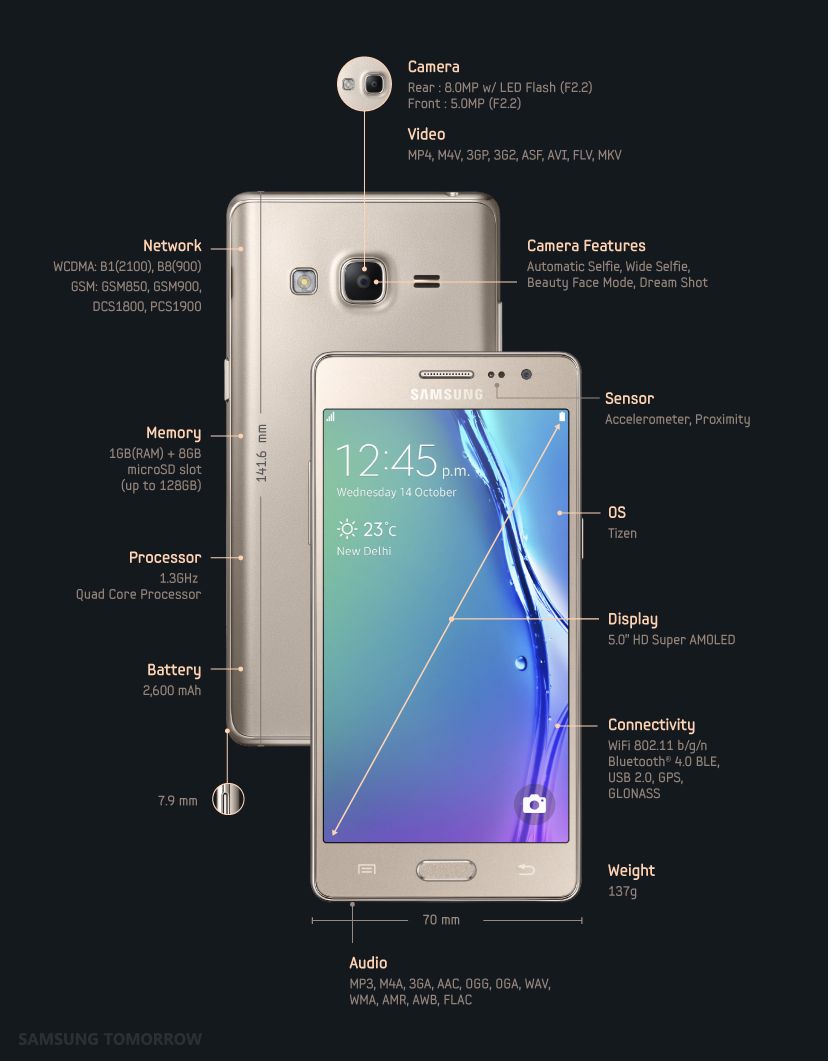
Samsung Electronics announced the Samsung Z3, an advanced Tizen-based smartphone that offers powerful performance and easy customization via exclusive, localized features including “My Galaxy” for easy access to nearby rewards and benefits.
Built with a crisp 5-inch HD resolution display, the Samsung Z3 delivers the ultimate viewing experience with its Super AMOLED technology for clearer and deeper images, along with an advanced 8 megapixel Bright Lens camera to capture more detailed and higher quality images. In addition, the Samsung Z3 features an ‘Ultra Data Saving Mode’ that minimizes mobile data usage as well as ‘Ultra Power Saving Mode’ for continuous performance with low battery life.
“As a pioneer of Tizen platform, we have continuously introduced Tizen-based mobile devices, including Samsung Z1 and Samsung Gear S2, in our commitment to develop the Tizen ecosystem”, said JK Shin, CEO and Head of IT & Mobile Business at Samsung Electronics. “We developed the Samsung Z3 to provide the features that will help consumers capitalize on the growing Tizen ecosystem and make the most out of their personal mobile experience.”
Advanced Viewing and Camera Capabilities
The Samsung Z3 features a superior 5-inch HD screen, made with Samsung’s advanced Super AMOLED technology that delivers clear images and excellent contrast ratio for true-to-life colors. The device is also equipped with an 8 megapixel Bright Lens F2.2 rear-facing camera that captures more light for visibly clearer and more detailed images, as well as a 5 megapixel front-facing camera for advanced selfie capabilities. The Samsung Z3 camera offers ‘Automatic Selfie’ for seamless selfies with facial recognition, ‘Beauty Face Mode’ that automatically retouches images for flawless skin and ‘Wide Selfie’ to capture up to 120 degrees of the users’ surroundings for the perfect group selfie shot.
Long Battery Life and Optimized Data Usage for Indian Consumers
The Samsung Z3 supports a long-lasting 2,600mAh battery complemented by ‘Ultra Power Saving Mode,’ which allows users to operate on standby for up to 33 hours with less than 10 percent of battery life. The device also features ‘Ultra Data Saving Mode,’ providing data compression and management capabilities for up to 40 percent less mobile data usage.
Designed specifically for the Indian market, Samsung Z3 comes preloaded with ‘My Galaxy’ app that offer consumers various exclusive services, local deals, entertainment content, continuous value on extensively used categories like recharge, travel, movies, fashion etc and post purchase assistance. The Samsung Z3 additionally features the ‘Mix Radio’ app, available exclusively for Samsung consumers. Mix Radio is the world’s most personalized free music streaming service with over 35 million songs to choose from, including extensive local catalogue of over 10 genres of Indian music.
The Samsung Z3 is priced at INR 8490 and will be available in India from October in Gold, Black and Silver.
WiFi 802.11 b/g/n, Bluetooth® 4.0 BLE, USB 2.0, GPS, GLONASS
Sensor
Accelerometer, Proximity Sensor
Memory
1GB(RAM) + 8GB
microSD slot (up to 128GB)
Dimension
70 x 141.6 x 7.9mm, 137g
Battery
2,600 mAh
*All functionality, features, specifications and other product information provided in this document including, but not limited to, the benefits, design, pricing, components, performance, availability, and capabilities of the product are subject to change without notice or obligation..
Improved battery life is the most notable part of the changelog – the Note 5 already has respectable battery life despite the not-so-large battery inside, and this update should make things better. It’s currently rolling out in Singapore with build number N920IDVU2AOJ4, and it shouldn’t be long before we see it making its way to the device in other markets (which is a short list since the phone hasn’t been launched in quite a few major markets around the world.) This doesn’t seem to be the major update that our insiders said the Note 5 and other recent Samsung devices will be getting, but it’s still an important one nonetheless.
If you own a Galaxy Note 5, watch out for the notification that signals the update’s arrival. We have the entire firmware available in our firmware database for a manual upgrade, and you can mash the Update now button in the Settings » About device » Software updatemenu if you don’t wish to take the manual route.
How many credit cards do you carry in your wallet? How often do you use each of them? Commerce has come a long way and the forms of “money” have evolved. The credit card has played an important role for people to shop more convenience and safer over recent years, however, it can be replaced to new payment service in the near future. Mobile payment is a burgeoning phenomenon in the world of retail and commerce.
At the moment, mobile payment systems fall into two categories. One method is based on near field communication (NFC) technology. The other relies on magnetic secure transmission (MST) technology, which sends the payment card information to a magnetic card reader wirelessly, using magnetic signals.
NFC is the most widely used payment system, however, it has a critical shortcoming—fewer than 3 percent of retail shops in the world have the NFC readers needed to support it. Despite the technology applying NFC for payment systems being a decade old, retailers have been slow to purchase and install NFC readers, even in Europe, where NFC cards and IC cards are more widely available. Without a doubt, its acceptance will spread, but the pace appears to be somewhat slow.
On the other hand, most retail shops already have magnetic card readers, which are compatible with MST technology. So a mobile payment system that supports both NFC and MST would have the widest level of acceptance—and the only such service is Samsung Pay.
Technology always takes time to be accepted. For example, HD TVs have been around for more than a decade, but there are still a lot of people who watch in standard resolution. As an engineer, I believe we need to follow the lead of our customers. We cannot force people to accept new technologies before they’re ready. Instead, we need to help ease that change naturally.
The Key Is Convenience
Nowadays, we can find WiFi everywhere. But how many people understand how Wi-Fi works, or know the various standards? Most do not. What people care about is being able to access their email easily and safely. The important thing for consumers is convenience.
Recently, one company released an application that shows users where they can use mobile payment services. In my opinion, that gets things totally backward it is a complete flop. People use mobile payment services where they shop; they do not go shopping to where they can use mobile payment services. Convenience drives consumer acceptance, not the technology.
With this philosophy in mind from the beginning, Samsung Electronics applied MST technology to mobile payments together with NFC. I think debating which technology is better, NFC or MST, is pointless. What is essential is making mobile payment convenient for consumers, so they can pay for things without thinking about the technology. If consumers cannot use a mobile payment service in most shops, they will not use it nor accept it. Embracing a technology means being able to use it easily, anytime, anywhere.
I have not used a plastic credit card in over a month. It’s so easy to pay for anything wherever I go, I don’t even worry about my credit cards anymore. I know I do not need them. Even if something did go wrong, finding a solution would just lead to better service, which is essential for mobile payments being accepted.
Comparing MST and NFC Today
The global average NFC penetration rate stands at 15 percent. Here is Korea, it is less than 2 percent. But because MST has a success rate of more than 80 percent, it is essential for today’s consumers.
In the years to come, the number of transactions using NFC will grow steadily, but MST is going to continue to be significant in retail. Even after the percentage of shops using only MST drops to a small number, we cannot just ignore them. The right approach is to support both systems.
Having conducted thousands of tests around the world, I am sure that Samsung Pay will be a success. It is a product that can change the market and provides real benefits to users. No, it isn’t perfect, but it works so often that I haven’t been tempted to return to my credit cards. Most people have the same thinking—they are not going to use mobile payments just for the novelty, but only if they are convenient.
Information Safe and Secure Through Tokenization
To ensure people’s security and privacy, mobile payments on Samsung Pay do not pass along actual credit card information. Instead, they use something called “tokenization.” Using a token means people’s information is encrypted using our propriety technology and kept secure. Even if a transaction was intercepted, all the personal information would be protected.
Another benefit of using tokens is that it allows us to use the existing payment infrastructure that was developed for plastic credit cards. A token service provider (TSP) server performs the exchange between a token and the actual credit card number, so credit card issuers and merchants can just use their existing systems.
Samsung Pay Will Transform the Future of Mobile Payments
Mobile payments can handle the functions of physical credit cards, but as they grow and develop, many predict they will bring deeper changes to banking, money and society. Mobile payments are more flexible than cards and can do more. In Korea, Samsung Pay enables you to withdraw cash from ATMs, allowing the service to also replace debit cards. They are always “on” and can also interact with the phone, offering credit card issuers new opportunities to connect with users and create additional services.
This is the start of a real paradigm shift—but it all depends on people embracing mobile payment services. That is why I want to emphasize that convenience and ubiquity are at the core of technological acceptance. The arrival of new payment services is not far off and I believe that Samsung Pay will play a leading role in these exciting changes. And the root of all this is Samsung’s dedication to placing the needs of consumers first, so change can come naturally and conveniently.