In a move that went a bit under the radar, Fitbit under Google has stopped selling its products in nearly 30 countries around the globe.
Over the past couple of months, Fitbit has ended sales of its fitness trackers, smartwatches, and other products in portions of Asia and Europe, and most recently South Africa. On a support page highlighted by Android Authority, Google lists out the affected regions.
In Europe, those include:
Croatia
Czech Republic
Estonia
Hungary
Latvia
Lithuania
Luxembourg
Poland
Portugal
Romania
Slovakia
Google shut down the renewal of Fitbit Premium in these countries on October 24, 2023 though, as a 9to5Google reader has pointed out, the Fitbit Charge 6 is currently being sold in Portugal via the Google Store.
Prior to that, in August, Google had pulled Fitbit Premium and products from a few regions in Asia including:
Hong Kong
Korea
Malaysia
Thailand
Philippines
Further noticed that Google has also removed Fitbit products from Mexico and all Latin American countries as mentioned on another support page. There’s no date attached to these removals, though. Fitbit products were previously sold in the following Latin American countries:
Argentina
Chile
Colombia
Costa Rica
Ecuador
Guatemala
Mexico
Panama
Paraguay
Peru
Puerto Rico
Venezuela
This all adds up to 29 countries that Fitbit has halted sales in, and leaves only 23 countries that Fitbit is selling products in.
Well, I guess someone internally needed data to prove that Pixel Watch is the best selling product of the Google wearable portfolio.
How to better achieve that than reducing availability of all other wearables?
This really gives vibes of “Google is killing the Fitbit brand” in 2-3 years.
Yes, despite their current “Health by Fitbit” marketing campaign for it.
Why the removal? Speaking to South African publication Tech Central, Google confirmed that the change was made to better “align our hardware portfolio to map closer to Pixel’s regional availability.” The change also applies to Nest products in South Africa.
Update: Google expanded on this in a statement to Android Authority.
We communicated that we will stop selling Fitbit products in select countries in order to align our hardware portfolio to map closer to Pixel’s regional availability. We remain committed to our customers and have not made any changes that impact the existing Fitbit devices they already own. Existing Fitbit customers will continue to have access to the same customer support, warranties will still be honored, and products will continue to receive software and security updates.
Google has long been criticized for the limited availability of its Pixel lineup on the global market, as Pixel phones, watches, and many other Google products are generally only sold in a limited number of countries. With Fitbit cutting its active markets by more than half, it seems like a drastic move.
Google notes that, while products are no longer for sale in these regions, Fitbit customers will still receive support and updates, and extended a free month of Fitbit Premium to any subscribers set to lose their plans.
We are no longer selling Fitbit products in select countries—but don’t worry! We will continue to support you and the devices you currently own with software releases, security updates, warranty fulfillment, and access to customer service.
Redesigned Fitbit app brings back battery percentage
Last month, Fitbit detailed a handful of upcoming changes for its redesigned app in response to user feedback, including the return of battery percentage for trackers and smartwatches.
With Fitbit 4.04, which is currently live on the iOS App Store, there’s a new device pill that includes the battery. When the battery is low, it will turn red as a prominent reminder for you to recharge.
Previously, with the redesign, you had to open the Devices page, which only provided an approximation — like “Battery Full” — of the remaining charge rather than an exact percentage.
On the old app, you could quickly check the battery level by swiping down in the Today tab to initiate a sync. It was somewhat more hidden, but a clever way to declutter the UI until you needed that information.
Something amusing that we’ve noticed today is how battery life for the Pixel Watch 2 appears in the iOS app. On Android, there is no such reading or even the approximation on Fitbit 4.03, and we’ll soon see whether that’s intentional.
Version 4.04 for Android is not yet live on the Google Play Store but will presumably start rolling out in the coming days.
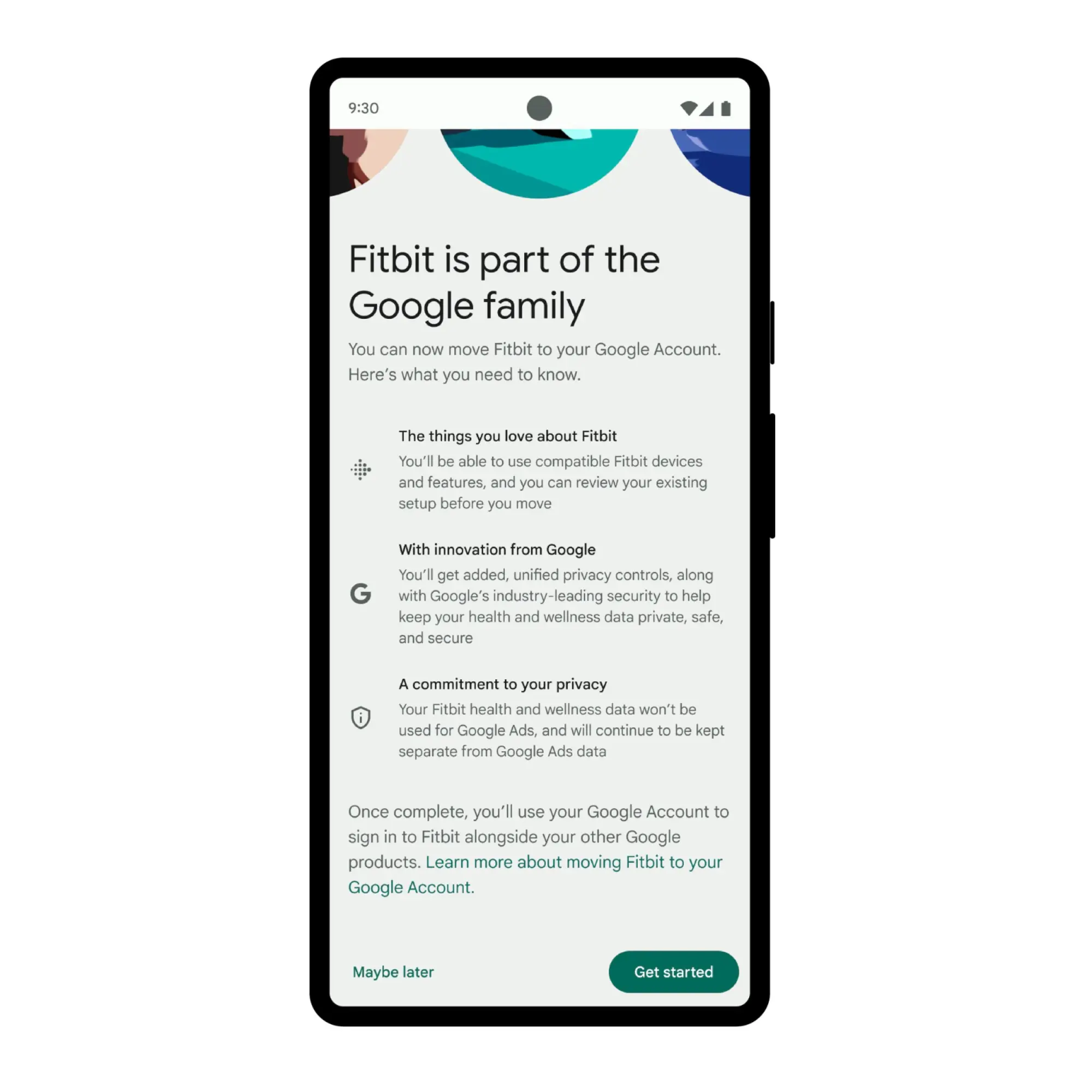
Fitbit shared that its transition to using Google Accounts for logging in and new device registration will start this summer.
Fitbit is moving away from its own login system to just use Google Accounts. Google touts benefits like having one username/password for Gmail/YouTube/Photos/etc., and Fitbit, as well as “industry-leading privacy and security.”
Users will have added, unified privacy controls – including the ability to manage all Fitbit data in the Google Privacy Center – to keep their health and wellness data safe and secure. They will also be able to see and manage where they are logged in across their Google Account.
For example, Fitbit two-factor authentication (2FA) only takes place over SMS today.
Google reiterates that “Fitbit health and wellness data won’t be used for Google Ads, and it will continue to be kept separate from Google Ads data.”
Besides the login experience, Fitbit says users should not expect any changes to accessing historical health and wellness stats. This upcoming move is being positioned as laying the groundwork for future Fitbit capabilities, with similar phrasing used to describe the recent removal of Challenges and open groups.
This will start rolling in a few months, and users will see a prompt in the Fitbit app (or an option in app settings) to migrate to logging in with a Google Account. You will have the ability to “review your existing setup before you move.”
Existing users will not have to switch until 2025, but new Fitbit users will need to go the Google Account route to set up devices when this rolls out.
Fitbit removing Google sign-in support ahead of account transition
As of 2023, Fitbit will require a Google Account to use new devices and features. As part of transitioning to a single account system, Fitbit.com is losing support for Google sign-in.
At the moment, Fitbit.com lets you sign in with a username and password (aka Fitbit account) or by using “Continue with Google” (Google Account). In 2021, the website also supported signing in with Facebook, but that was eventually and unsurprisingly deprecated.
The Fitbit website’s sign-in page has been updated with the following message: “We are removing the option to log in to your account on fitbit.com with your Google credentials to support an improved experience coming soon.” No hard date for when this will occur is provided.
To prepare for this removal, be sure you know the email address and password you use for Fitbit. If you don’t know your password, click Forgot Password
For more information about your Fitbit account, including how to find and change your email address, see our help article.
Fitbit wants all users to be aware of their email addresses and password, which is already required by the Android and iOS apps. You’re advised to reset your password and enter a new one if not.
This change is in service of Fitbit accounts being replaced by standard Google Accounts, so there will no longer be two different systems. A Google Account will be needed to access new features and set up devices, though users will be able to stick with existing Fitbit accounts until 2025.
Besides access to new features, Google touts feature like “industry-leading account security, centralized privacy controls for Fitbit user data, and more features from Google on Fitbit.”
When this consolidation launches, you will have to “consent to transfer your Fitbit user data from Fitbit to Google.” This is no timeline yet for when this will occur.
Fitbit Challenges and open groups are no longer available as Google pulls the plug
Following an announcement earlier this year, Fitbit has today pulled the plug on challenges and open groups, two longtime features of its app.
As of today, March 27, Fitbit has discontinued support for four different “legacy” features within its app. Available since 2017, those most notably include “Challenges & Adventures,” which were social activities that allowed Fitbit owners to compete with one another with real-life movement and activity goals. The challenges included:
Challenges: Find the extra encouragement to move more by competing with friends and family.
Virtual Premium Challenges: It’s even easier to play! For a limited time, earn bonus active minutes and Active Zone Minutes during challenges.
Adventure Races: Virtually race against your friends along real-life locations.
Solo Adventures: Virtually explore real-life locations.
Further, Fitbit has also today removed open groups from its app, now limiting the feature to only private groups with friends. Open groups allowed Fitbit owners to share progress and discuss topics on a public forum accessible through the Fitbit app.
Google and Fitbit said that the reason for removing Challenges and open groups was in an effort to “streamline areas” of the Fitbit app as the two companies move toward further Google integration.
We’re working hard behind the scenes to enhance the Fitbit app with Google technology this year. As a result, we’re streamlining areas of the Fitbit app and will remove all challenges, including adventures, and trophies on March 27, 2023.
However, both of these removals have not been well-received by the community. Longtime Fitbit owners have expressed their outrage at the decision and called on Google repeatedly to reverse the decision. At this point, though, the features have already shut down, and it seems they’re unlikely to make a return unless Google opts to reinvent them in the future.
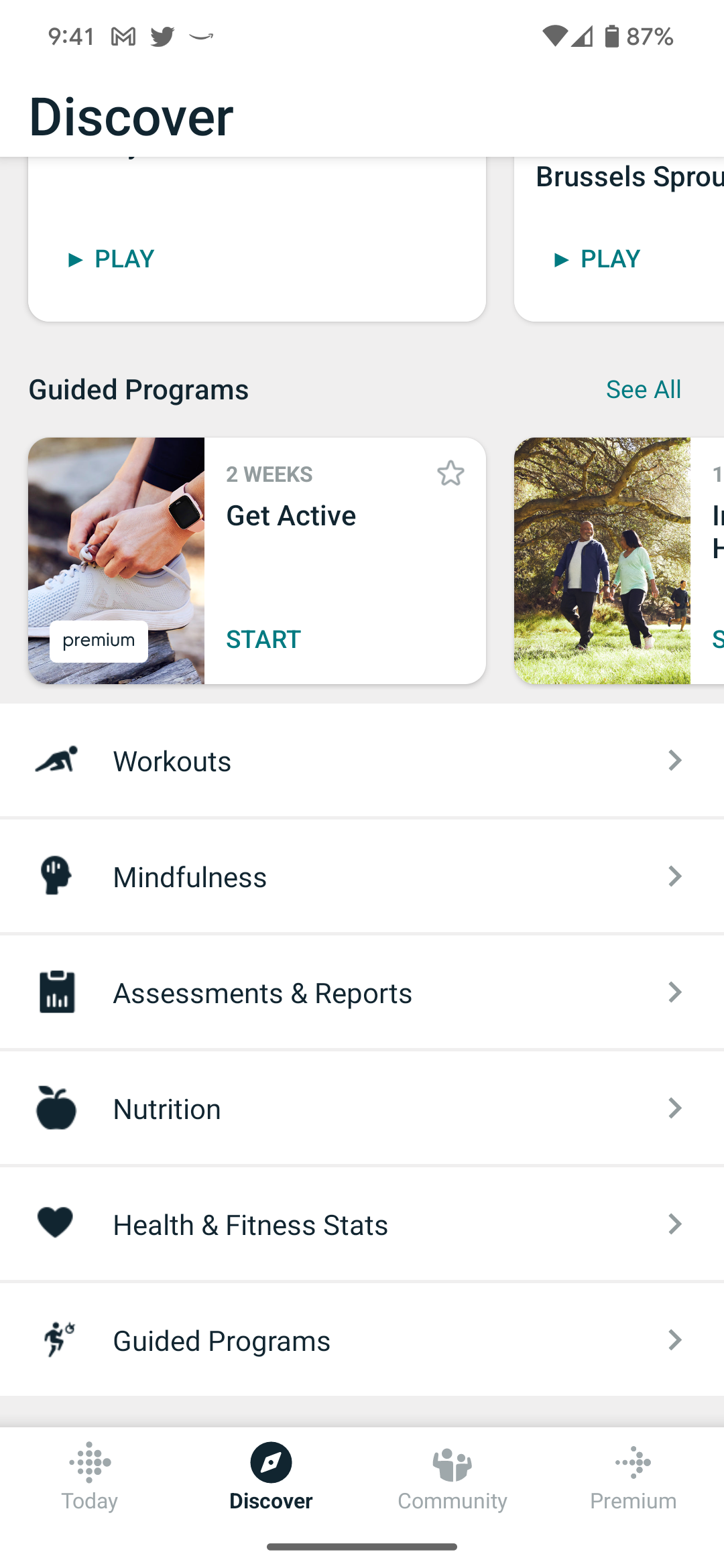
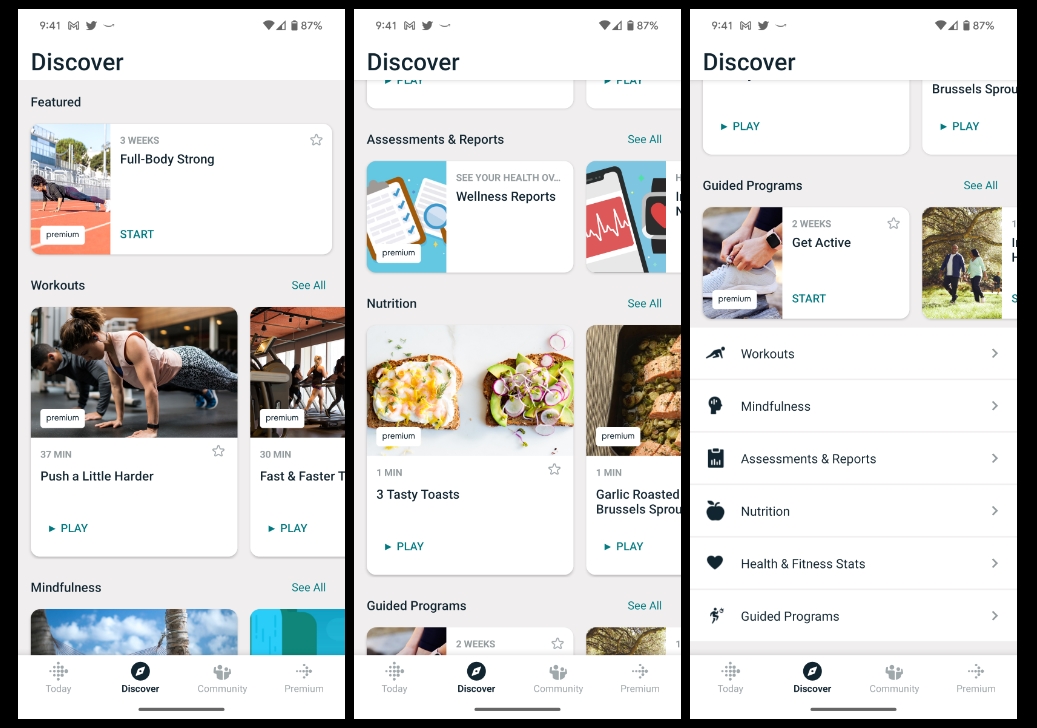
The “Discover” tab in the Fitbit app is now lacking these longtime features, instead only showing workout guides, mindfulness and nutrition content, and similar programs and content.
What separates a smartwatch from a fitness tracker? To me, it’s the ability to see notifications from your phone, replying to messages, taking calls, music controls or even on-wrist playback, and third-party apps.
For the longest time, Fitbit smartwatches in the Versa and Sense lines easily met that criteria. With the Sense 2 and Versa 4 introduced in October of 2022, that began to change. The ability to take calls came after launch, while there are no media controls and certainly no offline storage of songs or podcasts.
Lastly, there’s no support for third-party applications, just watch faces. On Friday, Fitbit reiterated that as it streamlined its developer tools. The web-based Fitbit Studio will be deprecated in April for just a command-line SDK. The company is committed to supporting and allowing third-party watch face development, but was very explicit about how it does “not have plans to offer third party apps on these health and wellness focused devices.”
That’s our clearest view yet into how Fitbit perceives the Sense 2, Versa 4, and any future devices in those lines. Looking at past Fitbit statements, iPhone support is the other reason for the Sense 2 and Versa 4 existing, while multi-day battery life with an always-on display remains appealing.
Where Fitbit is taking these devices makes sense in the context of focusing on the Pixel Watch. However, it might be time to stop considering them to be smartwatches.
Rather, Fitbit should draw inspiration from its line of fitness trackers. Personally, I’ve always been more of a fan of Fitbit’s trackers. (The actual cardinal sin of Fitbit smartwatches is that they never adopted an E-Ink screen post-Pebble acquisition. I kid, but not by much.)
Anyways, trackers are meaningfully smaller with great battery life and simple AODs for just the time. Not having a larger square or rectangular display on your wrist is appreciably different. The Fitbit Luxe from 2021 is a gorgeous device that succeeds at being jewelry-like in nature.
With that in mind, what does a premium fitness tracker look like? Is there room for a tier above the popular Charge series? Such a device would have to appeal to people that want a smartwatch, while decidedly lacking the full feature set given Fitbit’s modern priorities/limitations.
the word “smartband” comes to mind with:
A big enough portrait screen to comfortably show notifications
Rich messaging experience with smart and voice replies
Basic apps: Weather, Agenda, Google Home smart controls
Music playback controls, at the very least, which would require Fitbit to backtrack
Fitbit Challenges and open groups are no longer available as Google pulls the plug
Following an announcement earlier this year, Fitbit has today pulled the plug on challenges and open groups, two longtime features of its app.
As of today, March 27, Fitbit has discontinued support for four different “legacy” features within its app. Available since 2017, those most notably include “Challenges & Adventures,” which were social activities that allowed Fitbit owners to compete with one another with real-life movement and activity goals. The challenges included:
Challenges: Find the extra encouragement to move more by competing with friends and family.
Virtual Premium Challenges: It’s even easier to play! For a limited time, earn bonus active minutes and Active Zone Minutes during challenges.
Adventure Races: Virtually race against your friends along real-life locations.
Solo Adventures: Virtually explore real-life locations.
Further, Fitbit has also today removed open groups from its app, now limiting the feature to only private groups with friends. Open groups allowed Fitbit owners to share progress and discuss topics on a public forum accessible through the Fitbit app.
Google and Fitbit said that the reason for removing Challenges and open groups was in an effort to “streamline areas” of the Fitbit app as the two companies move toward further Google integration.
We’re working hard behind the scenes to enhance the Fitbit app with Google technology this year. As a result, we’re streamlining areas of the Fitbit app and will remove all challenges, including adventures, and trophies on March 27, 2023.
However, both of these removals have not been well-received by the community. Longtime Fitbit owners have expressed their outrage at the decision, and called on Google repeatedly to reverse the decision. At this point, though, the features have already shut down, and it seems they’re unlikely to make a return unless Google opts to reinvent them in the future.
The “Discover” tab in the Fitbit app is now lacking these longtime features, instead only showing workout guides, mindfulness and nutrition content, and similar programs and content.
Thank you for using
Themify Popup
This is a sample pop up. Themify Builder or Builder Lite (free) plugin is recommended to design the pop up layouts.










Yes, despite their current “Health by Fitbit” marketing campaign for it.
Why the removal? Speaking to South African publication Tech Central, Google confirmed that the change was made to better “align our hardware portfolio to map closer to Pixel’s regional availability.” The change also applies to Nest products in South Africa.
Update: Google expanded on this in a statement to Android Authority.
Google has long been criticized for the limited availability of its Pixel lineup on the global market, as Pixel phones, watches, and many other Google products are generally only sold in a limited number of countries. With Fitbit cutting its active markets by more than half, it seems like a drastic move.
Google notes that, while products are no longer for sale in these regions, Fitbit customers will still receive support and updates, and extended a free month of Fitbit Premium to any subscribers set to lose their plans.
Redesigned Fitbit app brings back battery percentage