A new Samsung device has just received certification from the National Radio Agency based in Samsung’s hometown of South Korea.
The device has the model number SM-G888N0 and is said to be known as the Galaxy X, which is set to be the company’s first foldable phone that has been heavily rumored Samsung has been working on. Now the device has received formal certification, it would suggest that the Samsung Galaxy X could be launching very soon, albeit in South Korea to begin with.
The Wi-Fi alliance lists the device as Bluetooth 4.2 and running Android 6.0.1 Marshmallow which would be slightly disappointing. I suspect this may be outdated given the profile of the Galaxy X in the lineup for Samsung and would expect similar specs to that of the rest of the Galaxy line.
The foldable smartphone is said to be being developed under codename Project Valley and points to a late 2017 or early 2018 release.
A device that folds up is an interesting concept and one that if executed correctly, would open the door for Samsung to further increase the display size on a smartphone without increasing its physical footprint.
Foldable phones were all the rage pre-smartphone but could Samsung be using the Galaxy X to reignite that trend or has it finally figured out foldable displays?
If the rumors are true we won’t have long to find out as we could see something launched in South Korea at the tail end of the year.
If you’re considering making the switch from an iPhone to the upcoming Samsung Galaxy Note 8, you should know that Samsung makes this process as painless as possible with their Smart Switch app. Even if you’re not switching away from iPhone, Samsung has you covered. They’ve also highlighted some interesting things you can do with your new Galaxy Note 8 including making GIFs, multi-tasking, using the low light cameras and more. Check it out.
How to transfer everything from an Android phone
Connect your phones with the cable included with your Galaxy Note 8.
Select Smart Switch in the menu that pops up.
Select which phone sends and receives the data.
Press Allow on your old device.
Choose what files you are keeping and then press Transfer.
How to transfer everything from an iPhone
Use the iPhone cable and the adapter included with the Galaxy Note 8 to connect your phones.
Select Smart Switch in the menu that pops up.
Tap Trust on your old phone.
Pick the files you want to keep and press Transfer.
How to make GIFs on your Galaxy Note 8
Tap the floating Air Command symbol on your chosen video.
Press Smart Select.
Press Animation.
Adjust where you want to capture with the S-Pen.
Hit Record then Stop when the time is right.
Then hit share.
How to use Live Focus on the Galaxy Note 8 camera
Quick launch the rear camera by double tapping the power button.
Select Live Focus.
Frame your subject and adjust your focus level.
Take the picture and then tap on it in the bottom right.
You can adjust the focus level in the background and even add stickers.
Save and share.
How to use the S-Pen with the Galaxy Note 8
Curious about the S-Pen that’s included with the new Galaxy Note 8? This video is a short primer on all the things you can do with your S-Pen through the help of Air Command, which is the interface that launches automatically when you remove the S-Pen from the phone. Tired of having Air Command pop up automatically? There’s a setting that allows you to change that, too.
How to multi-task with the Galaxy Note 8
The 2:1 screen ratio of the Galaxy Note 8 makes it perfect for multi-tasking. Here’s how.
Tap the Recents button.
Press and hold the app you want.
Drag it to the top of your screen.
Then open the other app you want.
You can even preset two apps to launch together using your Edge panel. Here’s how.
Swipe left on the Apps Edge tab.
Tap the + button to create a new Apps Pair.
Select two apps you use together and press Done.
How to take good low light pictures with the Galaxy Note 8
Quick launch your rear camera by double tapping power button.
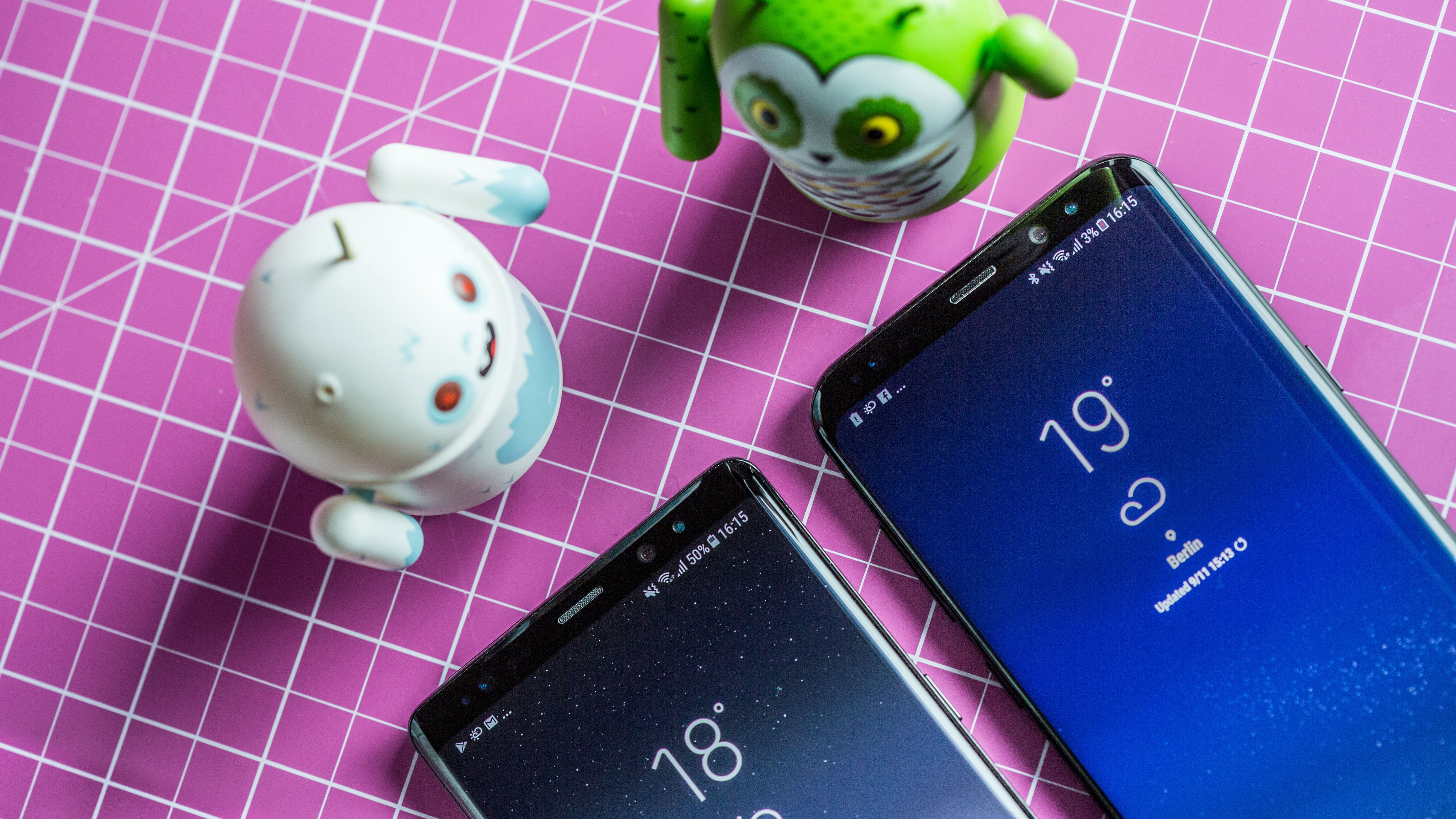
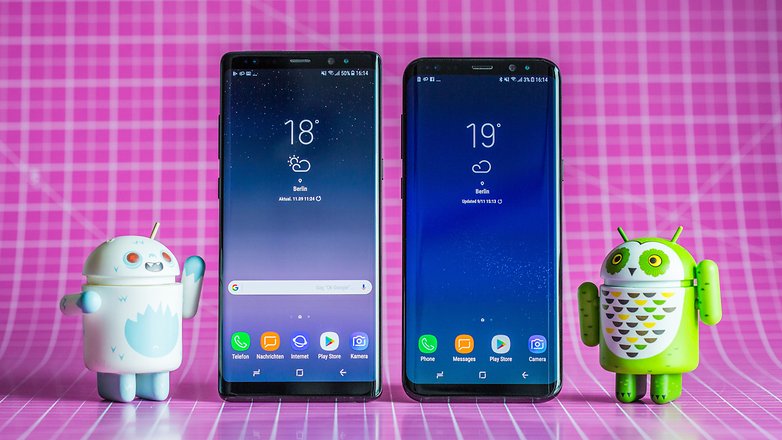
At first glance, the Samsung Galaxy Note 8 and Galaxy S8+ look like twins. But there are many differences between the smartphones which aren’t just limited to looks. The differences are also under the hood, which is where both the Note 8 and the S8+ are ahead of the pack.
Anyone who does a side-by-side comparison of Samsung’s largest smartphones of the moment doesn’t need a magnifying glass to find the design differences; just having a second glance is enough. The Galaxy Note 8 is a little bit thicker than the Galaxy S8+. It’s also a bit more angular at the corners, but the build quality of both devices is flawless.
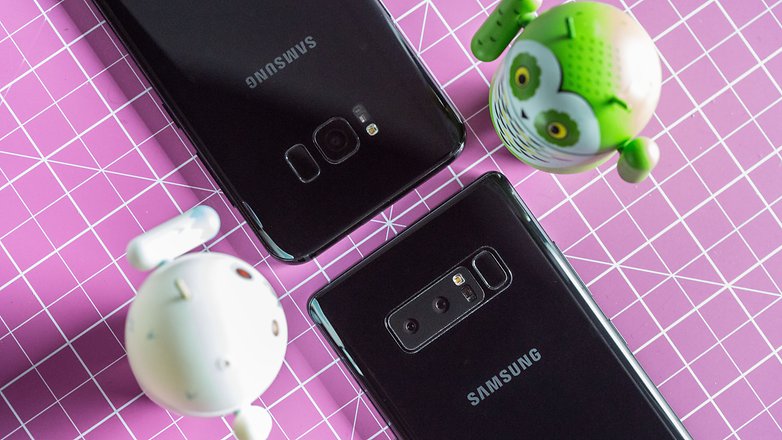
Compared to the S8+ (right), the Note 8 is hardly bigger but distinctively edgier.
The Note 8’s display is merely 0.1 inches bigger, and we estimate that the bezels are just as slim. Despite the curved glass surfaces, the Galaxy Note 8 is more massive and also heavier than the S8+. The controls, including the standalone Bixby button, are located in the same places.
The button arrangement is identical.
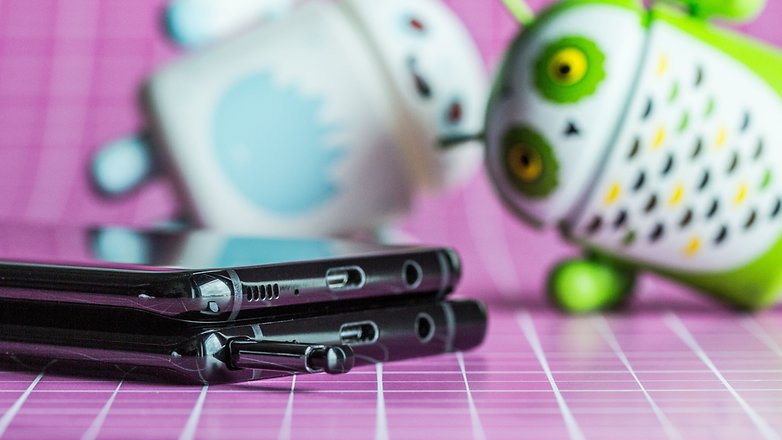
The Galaxy Note 8’s most important differentiating factor is the S-Pen. This digital input stylus, which can be pulled from below the housing as usual, divides Samsung fans. For Note aficionados, the S-Pen is what makes this device truly interesting and thus, without equal. But, the pen critics do not see the need for the S-Pen and emphasize other things instead.
Only the Note 8 (bottom) sports the S-Pen.
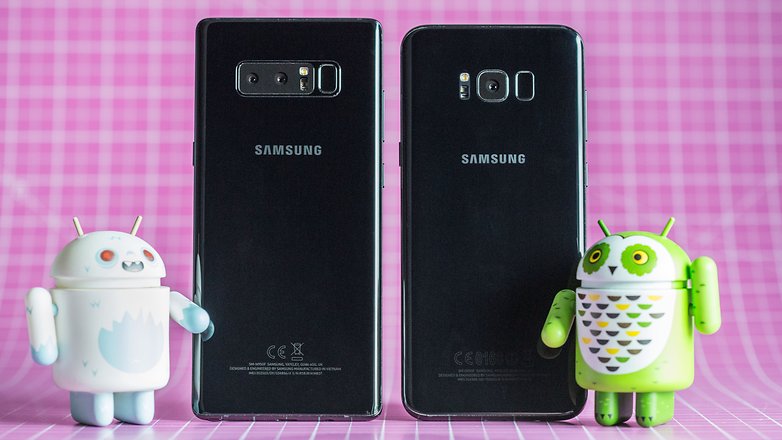
There are large differences between the cameras. The Galaxy Note 8 is the Korean manufacturer’s first smartphone that is equipped with a dual camera, while the Galaxy S8+ takes the conservative route and has a single 12 MP lens on the back. Although the camera still has to prove its worth in our review, it already offers more opportunities for creativity. Both are evenly matched when it comes to the front camera.
Galaxy S8+ has better battery life than the Note 8
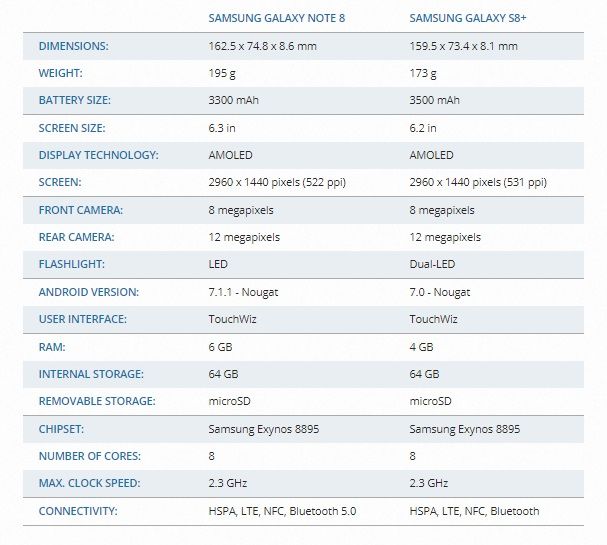
A look at the technical specs sheet reveals the following: The Galaxy S8+ has the larger battery of the two Samsung smartphones, and that’s in spite of the smaller size and thinner body. To make up for it, the Note 8 offers the S-Pen, which takes up space inside the body as well. Furthermore, the Galaxy Note 7 battery incidents caused Samsung to stay on the safe side and, for better or worse, not go for maximum capacity. As a result, the Galaxy S8+ lasts a bit longer on one charge, even if the differences are minor in practice. Both Galaxy smartphones support quick charging and wireless charging.
Samsung Galaxy Note 8 vs. Samsung Galaxy S8+ technical specifications
Performance wise, both smartphones are very close, which is no wonder since they are equipped with the same processor. RAM is the only thing where the Note 8 has a bit more to offer, which is hardly noticeable in practice. The Snapdragon 835 (or the Samsung Exynos 8895 outside of the US), powers both XXL smartphones and you won’t have to wait long for apps to load or deal with a laggy browser with either phone.
The Note 8 is the first Samsung with a dual camera.
Note 8 buyers pay $270 more for an $-Pen
There is quite a price difference between both smartphones, with the Galaxy Note 8 starting at a full $929, which is $80 more than what the Galaxy S8+ cost when it was released on the market ($850). Now the price for the latter has dropped further, and you can currently get it for as little as $659, which is an enormous $270 difference that will make some Note fans think twice.
Samsung took a huge gamble on the Galaxy S8 when it went all in on its virtual assistant and included a dedicated button to launch Bixby.
Unfortunately for consumers, Bixby wasn’t ready. That, unfortunately, left the Bixby button as merely a quick launch for Bixby Home, which housed some basic information from your calendar and news feed. There were some workarounds but Samsung kept responding to break the method used to remap the button.
It seems that Samsung may now finally be listening as a new update finally allows the Bixby button to be officially disabled. Unfortunately, it doesn’t go any further than that so you’re left with an even more useless button. Hopefully, Samsung takes this one step further and allow the button to be completely remapped to launch an app of the users choice like Google Assistant.
SamMobile reports the update isn’t appearing for everyone just yet so keep checking in Settings to see when it finally trickles down to your device.
The dedicated Bixby button on the Galaxy S8 and Galaxy S8+ didn’t really serve any meaningful purpose until last month when Bixby Voice was rolled out globally. Before the global release of Bixby Voice, the dedicated button could only be used for Bixby Home.
Most users didn’t feel the need for Bixby Home to have a dedicated key. Third-party apps were developed that allowed them to remap the button to launch any app of their choice. Samsung was quick to clamp down on those apps for reasons that our editor in chief explained in great detail.
I bemoaned recently that the Bixby button was driving me nuts and many of our readers agreed with me. I don’t like how it gets in the way and that you can’t avoid accidental presses of the button. However, it’s time for us to rejoice.
Samsung is finally allowing us to disable the Bixby button, to an extent. The latest Bixby updates add a new toggle which lets you decide whether or not Bixby Home should be launched when the dedicated button is pressed. This can also be configured from the Bixby settings menu.
You’ll see this toggle at the very top of Bixby Home once you install the update. You can tap on the gear icon to hide the toggle should you so desire. It’s just a matter of tapping on a toggle now and that makes me happy.
To be clear, Bixby Home isn’t going anywhere. You can still access it by swiping left from the home screen. The Bixby button will also work for summoning Bixby Voice. Just press and hold like you already do.
Are you happy that Samsung is finally giving us this option? Share your thoughts with us in the comments below.
Update: The implementation appears to be random right now. Some of our devices have got this toggle after the update. Some haven’t. Perhaps it will take more time for this to be available on all Galaxy S8 and Galaxy Note 8 units.
This shouldn’t be too much of a surprise, but Samsung is working on an Android Oreo build for the Galaxy S8. Common sense, right? Manufacturers are pretty much always working on newer software for their flagship devices.
The big story here is that a Galaxy S8 running Android 8.0 has popped up on Geekbench, which means there’s definitely at least one, if not a few, of these devices at Samsung HQ stable enough to run benchmarks with new software. That’s good news for all of us waiting for an update.
Yep, definitely a Galaxy S8, definitely running Android 8.0. Performance doesn’t really seem drastically improved, but then again, it’s rare to see a massive difference just because of a newer version of software anymore.
While this doesn’t mean Samsung is pushing out an Oreo update right away, it does mean we can expect an update for their current round of flagship devices very soon. Fingers crossed the Galaxy S7 sees some love, too.
With the Galaxy S8 pushing the boundaries of the display by extending the bezels on the device it set the way for other manufactures to follow suit. Samsung followed with the Note 8 and even Apple got into the game with the iPhone X.
The subtle differences between the Samsung and Apple implementation of a bezel-less display saw Apple opt for a top notch to house the front facing camera and various sensors, while Samsung extended the top bezel the entire way across the device.
One concept that has surfaced suggests the Samsung may take a design cue from Apple when it comes to the Galaxy S9 and reduce the bezels of the device even further with the top cutout.
We’ve seen this design on the Essential Phone as well where the camera is cut out from an otherwise edge-to-edge display.
The latest Samsung Galaxy S9 concept comes from the YouTube channel DBS Designing that sees the top and bottom bezel almost completely eliminated.
At the top of the Galaxy S9 there’s a small cutout to house the camera, speaker, iris scanner, and other sensors. The iPhone X cutout is more pronounced than that of the Galaxy S9 concept but arguably the cutout on the iPhone is that size for a reason given the available technology it has to pack in that small space.
Other key points of the Galaxy S9 concept are the inclusion of the 3.5mm jack that the designer believes Samsung will retain. The concept also has dual front-facing cameras with a 18:9 aspect ratio Quad HD+ Infinity OLED display. The device is said to have 6GB of RAM, 128GB of internal storage and will be the first device to run the upcoming Snapdragon 845 SoC.
We’ve heard previously that Samsung may expedite the arrival of the Galaxy S9 to combat sales of the iPhone X that may see a January or February arrival, a few months before when it is actually expected.
While there’s no doubt Samsung will continue to push the boundaries of what is possible with display technology, it could be very possible Samsung reduce the bezels even further to mimic the design of the iPhone X. However, I think reducing the bezels to the amount shown in the concept simply isn’t possible with the available technology and the size of the components needed in that notch.
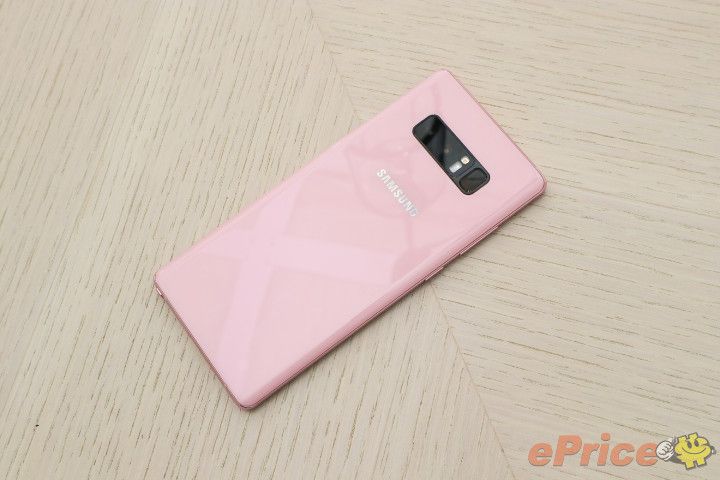
Samsung has a habit of offering exclusive color options for its flagship smartphones in select markets across the globe. Taiwan happens to be one of those markets. After launching the Pink Galaxy S8+ there earlier this year, Samsung has now launched a Star Pink color option for the Galaxy Note 8 in Taiwan.
The Galaxy Note 8 will be widely available in four color options – Midnight Black, Maple Gold, Orchid Gray and Deep Sea Blue. Star Pink appears to be exclusive to Taiwan. Samsung has a good reason for offering the handset in this color.
This is a particularly popular color with customers in Taiwan. According to a report, 30 percent of all smartphones sold in the country are touting some shade of pink. This is why it makes sense for Samsung to offer this color option in Taiwan.
The pink color isn’t just limited to the back panel. The metal frame is pink and so are all of the buttons. The same color has also been applied to the handset’s S Pen.
Everything else remains the same. It’s the same Galaxy Note 8 handset with its Exynos 8895 processor and exceptional 6.3-inch Super AMOLED Infinity Display.
The price remains the same as well. Customers in Taiwan can purchase the handset for TWD 34,200 or $1,075.
The Galaxy S9 should sport the same shape screen as the Galaxy S8, according to The Bell,which also claims that the firm has already placed an order for the 5.8-inch and 6.2-inch Infinity Display panels for the Galaxy S9 and Galaxy S9+, respectively.
Looking to the future, Samsung is also believed to have commissioned its screen-making division, Samsung Display, to start manufacturing the 6.3-inch Infinity Display that’s set to be on board the upcoming Galaxy Note 8 for the Galaxy Note 9.
In addition, the report notes that Samsung is working tirelessly to find a way to feature the on-screen fingerprint recognition technology that was scrapped from the Galaxy S8 at the last minute on the Galaxy S9 and Galaxy Note 9.
If a recent hands-on image is anything to go by, the company should have the optical scanner ready in time as the only technical hurdle it needs to overcome is matching the brightness of the area containing the sensor to the rest of the screen.
It’s a little too early to speculate about both the Galaxy S9 and Galaxy Note 9, though we expect them to feature a Snapdragon 845 processor, at least 6GB of RAM and a dual-camera. They should also ship running Android O.
[THE IVESTOR]Samsung Electronics‘ upcoming flagship smartphone Galaxy S9 is expected to use the same size and shape of the display screen as S8, The Bell reported on July 18.
Citing unnamed industry sources, the report said Samsung has recently informed Samsung Display, its display-making unit, of the S9’s display specifications.
The S9 will have a 5.77-inch display screen, while the bigger S9 Plus will come with a 6.22-inch screen. The same size as the S8 lineup launched in April.
The so-called “infinite” shape is also expected to curb the right and left sides with no home button.
The report said Samsung is likely to attempt again to feature on-screen fingerprint scanning that is missing from the S8 due to technical immaturity.
In the meantime, Samsung has also tentatively decided to use the same 6.32-inch display screen for the Galaxy Note 9 as the upcoming Note 8 that is expected to be unveiled on Aug. 23 in New York.
The report said Samsung is playing it safe with its flagship phones next year rather than taking too many risks.
Samsung had unveiled the Galaxy A5 (2017) earlier this year running Android 6.0.1 (Marshmallow), but it looks like the phone will soon get the Android 7.0 update. The company received Wi-Fi certification for the Galaxy A5 (2017) running Android 7.0 earlier today, which means that the South Korean smartphone giant is close to releasing the Android 7.0 (Nougat) update to the smartphone.
The Galaxy A5 (2017) features a 5.2-inch 1080p Super AMOLED display with support for Always On Display. It comes with a 16-megapixel primary camera and a 16-megapixel secondary camera, both with f/1.9 aperture and 1080p video recording. The phone comes equipped with an octa-core Exynos 7880 processor, 3GB RAM, 32GB internal storage, a microSD card slot, and a 3,000mAh battery.
Samsung has already released the Android 7.0 update for various Galaxy S and Galaxy Note series of smartphones, and now it’s time for the Galaxy A series smartphones to get the Nougat update.
Both the Galaxy A5 (2017) and here available A7 (2017) are almost ready to update to Android 7.0.This is evident from the newly Vernieuwe certification of the devices in the Wi-Fi Alliance.
That we know of course exactly when Samsung will launch the update for the device. In the past, followed updates sometimes quite rapidly after certification, but it could also take weeks. However, we assume that the Android 7.0 update for the Galaxy A5 (2017) will first launch overseas. Appliances in the Netherlands then follow at a later time.
The Galaxy A5 (2017) came as any A-Phone so far, the market with a just-not-quite-new version of the Android operating system. So it was clear from day one that the device will be updated to Android Nougat. Last year, the Galaxy A5 (2016) the update to Android Marshmallow from late July . For the A5 (2017) is such a planning forecast , but it’s always wait and see how it goes in practice.
Yet in any case clear that the Nougat update for the Galaxy A5 (2017) is coming. Now we just have to wait – hopefully within the next several weeks – extent. Once the deployment begins, we will of course already a preview of the new software on the device.
SanDisk has a new record-breaking microSD coming to market, which will deliver so much storage you might be at a loss as to what to do with it all. The new 400GB SanDisk Ultra microSDXC UHS-I card is the world’s highest capacity card of its type, and is ideally suited for use in Android smartphones that feature an expansion slot.
Android’s most recent versions allow you to adopt microSD-based storage as “native internal” storage, which allows you to use it to install apps, store photos and more as if you were using a built-in flash memory drive. Most recent Android devices that offer a microSD slot will support the new 400GB chip out of the box, meaning you can get your phone up to almost double what the top-end iPhone currently offers in onboard storage.
The SanDisk 400gb microSD card can hold up to 40 hours of 1080p HD video, Western Digital notes, and offers transfer speeds of up to 100mb/s. It’s also designed to comply with the A1 App Performance Class specification for flash memory, which means it can load and run apps faster when operating as adopted internal storage.
Even though it offers so much added storage, the price won’t break the bank – at $250, it’s actually very reasonable for in terms of price to storage ratio. It also comes with a 10-year limited manufacturer’s warranty, and should be available soon via SanDisk directly and all the usual retail suspects. Could be a perfect partner for the new Galaxy Note 8, if you happen to be picking one of those up.