Here are clear takeaways from the Odyssey Cup Counter-Strike 2 Championship notes.
Executive summary
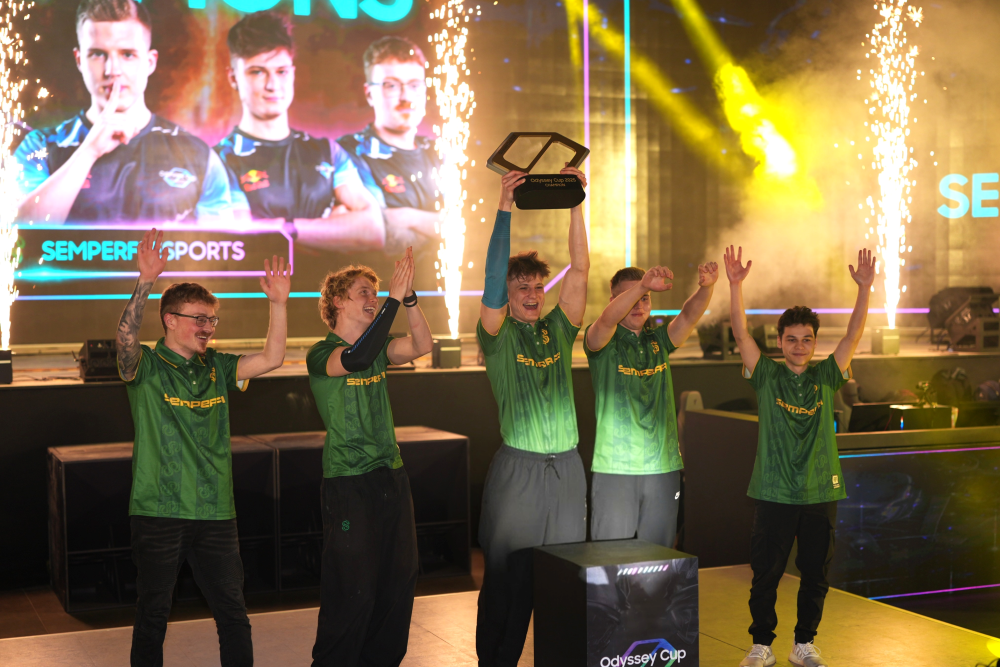
– Samsung Odyssey Cup CS2 2025 concluded with SemperFi Esports (Australia) winning the grand prize of US$20,000, against Deep Cross Gaming (Indonesia) in the finals. MVP: Kristers Darznieks (SemperFi Esports) earning US$2,000.
– Event date and location: December 12–14, 2025, at EBN Esports City, Quill City Mall, Kuala Lumpur, Malaysia. Prize pool: US$50,000. Eight finalist teams competed in person.
– Event reach: Live-streamed on Samsung’s official channels; strong in-person attendance with media, influencers, and fans.
Detailed takeaways
1) Winners and prize distribution
– Champion: SemperFi Esports (Australia) – US$20,000 prize
– Runner-up: Deep Cross Gaming (Indonesia)
– Third place: Beyman Esports (Malaysia)
– Fourth place: Ground Zero Gaming (Australia)
– MVP: Kristers Darznieks (SemperFi Esports) – US$2,000
2) Event scope and engagement
– Eight finalist teams from Southeast Asia and Oceania competed for US$50,000 total.
– Grand Finals drew a vibrant live audience; event also streamed online, increasing regional reach and engagement.
3) Technology and equipment
– Tournament powered by Samsung Odyssey G5 G50F QHD 180Hz monitors.
– Monitors highlighted for high refresh (180Hz), fast response (1ms), and strong visuals/contrast to support high-level CS2 play.
– Note on specs: 1ms is measured as average response time; performance varies by input source and content; “Extreme mode” may be required for some metrics.
4) Quotes and branding implications
– James Savage (SemperFi Esports captain) emphasized the importance of high-refresh, low-latency monitors (180Hz, 1ms, strong dynamic contrast) for competitive play.
– Leslie Goh (Samsung Southeast Asia and Oceania) highlighted record sign-ups this year and the positive impact of the gaming-monitor ecosystem on regional esports communities.
– Overall branding: The Odyssey monitor line is positioned as a core enabler of competitive performance and immersive viewing experiences.
5) Marketing and community impact
– Positive optics for Samsung monitors in esports contexts; opportunities to leverage for future events and product storytelling.
– High fan engagement and media attention suggest strong ROI potential for continued Odyssey Cup sponsorships and regional activations.
6) Opportunities and next steps
– Internal PR/marketing: Create post-event recap including highlights, MVP interview, and player testimonials; feature the Odyssey G5/G50F in event case studies.
– Sponsorship planning: Explore extending partnerships with SemperFi Esports or other top teams for ongoing branding and co-branded content.
– Future events: Plan for the next Odyssey Cup cycle with enhanced sign-up campaigns, regional qualifiers, and more livestream promotions.
– Product communication: Develop marketing collateral around the 180Hz+1ms performance for CS2 and other fast-paced titles; consider limited-time promotions tied to the event.
– Data collection: Compile viewership metrics, in-event engagement data, and post-event sentiment to quantify impact for executive briefings.
If you’d like, I can turn these takeaways into a one-page executive brief or a slide-ready summary for distribution to stakeholders.
Summary of Samsung Concludes Odyssey Cup Counter-Strike 2 Championship
SemperFi Esports from Australia took home the Grand Prize
Samsung Electronics is proud to announce the successful wrap-up of the 2025 Odyssey Cup Counter-Strike 2 Championship; a premier esports tournament consisting of some of the finest gaming talent from across Southeast Asia and Oceania.
The Grand Finals for this year’s Odyssey Cup took place at the EBN Esports City, Quill City Mall in Kuala Lumpur, Malaysia, from 12-14 December, which saw eight finalist teams from across the region compete in person for a total prize pool of US$50,000.
SemperFi Esports from Australia secured the championship title, defeating Deep Cross Gaming from Indonesia in a hard-fought battle to clinch the grand prize of US$20,000. Star player Kristers Darznieks of SemperFi Esports took home the MVP award and won US$2,000 for his performance during the tournament.
Beyman Esports of Malaysia and Ground Zero Gaming from Australia won third and fourth place respectively.
The Grand Finals in Kuala Lumpur was attended by a vibrant crowd, including media representatives, influencers and passionate fans. It was also streamed live online across Samsung’s official channels for fans across the region to engage in the thrilling action.
Competitors battled it out during the Grand Finals
“My passion for gaming began when I was 9 years old, and watching the pro scene made me realise what I wanted to do for the next 10 years – play on stage and achieve the highest prestige in competitive esports. As a competitive gamer, there are a few features that holds crucial to me in a gaming monitor,” said James Savage, team captain of winning team SemperFi Esports. “A 180Hz refresh rate, 1ms response time and great dynamic panels with good visual contrast.”
Samsung’s Odyssey G5 G50F QHD 180Hz gaming monitor, which powered the tournament, features stunning QHD resolution, a lightning-fast 180Hz refresh rate, and an ultra-responsive 1ms response time[1]. These advanced monitors are engineered for sharp visuals and heightened immersion, delivering the precision and performance essential for high-level Counter-Strike 2 battles.
“It was wonderful to see the region’s gaming community come together for such an exciting showcase of talent. The atmosphere throughout the tournament was electric, with players bringing incredible energy to every match. We are delighted that our gaming monitors helped equip players to perform at their best,” said Leslie Goh, Head of Regional Display Solutions, Samsung Southeast Asia and Oceania. “It is also worthwhile to note that this year’s Odyssey Cup saw a record number of sign-ups, and we hope that we will continue to see growing enthusiasm and participation for these events.”
Odyssey G5 G50F QHD 180Hz Gaming Monitor
Looking forward, Samsung is dedicated to the continued cultivation of a vibrant gaming community, through innovations and crafting experiences that resonate with both competitive gamers and casual fans.
[1] Refresh rate and response time may vary based on the performance of the input source. ‘1ms’ means one millisecond, which is the average response time range between 1.00ms and 1.99ms, truncated to a whole number. Based on GtG measured under internal test conditions. Results may vary by content and monitor settings (Requires ‘Extreme mode’ setting). GtG (Gray to Gray) measures the time taken for a monitor pixel to change from one gray value to another.
Here are concise takeaways from the Samsung privacy-layer notes:
Executive summary
– Samsung will unveil a new layer of privacy designed to shield Galaxy phones from shoulder surfing in public and other public-facing contexts. It adds a customizable, pixel-level privacy layer built on Samsung Knox security foundations. Availability is expected “very soon.”
Key takeaways
– Privacy goal: Reduce visibility of sensitive content when in public (e.g., on transit, in lines).
– Customizable: Users can tailor privacy in a granular way—per-app, per-context, and for specific on-screen elements (e.g., notification pop-ups). It’s not a blanket on/off solution.
– Security foundation: Builds on Samsung Knox (hardware protections like Knox Vault and ecosystem protections like Knox Matrix). Privacy at a pixel level complements existing security.
– User experience: Emphasizes visibility controls and configurability to balance privacy with usability; users can fine-tune or switch off privacy settings as needed.
– Timeline and scope: Described as “coming very soon” with rollout across Galaxy devices. Availability varies by model and region.
– Compatibility notes: Knox Matrix requires One UI 6.0 or above; availability may differ by country/region; models mentioned include Galaxy S Series, Galaxy A Series, Galaxy Tab S Series, and more.
– Brand/message: Declared as “privacy you can see and security you can feel”; expands the privacy-security narrative within the Galaxy ecosystem.
Implications for customers and UX
– Expect a new privacy toggle/controls within Settings, with guidance on how to customize per-app/privacy contexts.
– Possible changes to notification presentation and input screens in public spaces.
– Education and onboarding will be important to help users understand how to configure protections effectively.
Technical and rollout considerations
– Requires integration across hardware (Knox Vault) and software (One UI 6.0+ with Knox Matrix).
– Rollout specifics (which devices, regions, and exact release timeline) are not defined beyond “very soon.”
– Some features may be model/region dependent.
Risks and questions to resolve
– Will there be any impact on app compatibility or performance?
– How will user data be handled within these new privacy controls?
– What marketing/education materials will accompany the launch?
– What metrics will be used to measure effectiveness (adoption, user satisfaction, observed reduction in shoulder-surfing incidents)?
Action items / follow-ups
– Confirm exact device eligibility, regions, and a concrete launch timeline.
– Coordinate with Knox product team for technical specifics (Knox Vault/Knox Matrix integration, pixel-level privacy details).
– Develop user education content (how-to guides, FAQs, in-app tutorials).
– Prepare rollout plan and KPIs to track adoption and impact.
Footnotes from the notes
– [1] Knox Vault availability may vary by model (e.g., Galaxy S Series, Galaxy A Series, Galaxy Tab S Series, and more).
– [2] Knox Matrix requires One UI 6.0+; availability varies by country/region.
If you’d like, I can tailor these takeaways for a specific audience (executive briefing, product team, or PR), or expand into a one-page summary with suggested talking points.
Summary of Coming Soon: A New Layer of Privacy
Our phones are our most personal space, but we use them in the least private places. On the bus, in the elevator, and wherever we’re waiting in line, our digital laundry gets aired in plain view. As phones become more tailored to our routines and preferences, concerns about privacy are only growing.
That’s why Samsung will soon unveil a new layer of privacy to shield your phone from shoulder surfing wherever you go. You’ll have a more secure way to check your messages or enter a password when commuting or on public transit.
Flexible Protection Built Over Years
Not everyone needs the same level of privacy. This new layer gives you the choice to decide what works best for you. You can customise the security with specific apps, or when entering access details for more private areas of your phone. With multiple settings for adjusting visibility, you can limit what others can see based on the level of privacy protection you need.
You can also choose to protect specific parts of your experience, such as notification pop-ups. It’s a tailored approach that you can fine-tune or switch off entirely, rather than a blanket one.
It took over five years of engineering, testing and refining to get here. We studied how people use their phones, what they consider private, and how security should feel in everyday life. The result is a fusion of hardware and software expertly calibrated to enhance mobile security.
A New Standard for Mobile Privacy
This is the latest in a series of Galaxy innovations designed to keep you safe. There is no privacy without strong security. For more than a decade, Samsung Knox has established layers of protection for Galaxy devices, from dedicated security hardware like Knox Vault[1] to ecosystem defenses such as Knox Matrix[2]. This latest safeguard builds on that commitment to security, introducing privacy at a pixel level.
This is privacy you can see and security you can feel – and it’s coming to Galaxy very soon.
[1] Samsung Knox Vault availability may vary by model including but not limited to Galaxy S Series, Galaxy A Series, Galaxy Tab S Series and more.
[2] Knox Matrix is supported on Galaxy smartphones and tablets One UI 6.0 or above. Availability may vary by country or region.
Executive takeaways from the meeting notes on Samsung’s Zero Trust strategy for enterprise mobility
Executive summary
– Samsung is positioning Zero Trust as a core, endpoint-centric security framework for enterprise mobility, addressing the growing risk surface of mobile devices and BYOD in modern work environments.
– The approach emphasizes hardware-backed trust, continuous risk assessment, and real-time access control, integrated across devices, OS, and security interfaces.
– Strategic collaborations with Cisco and Microsoft enhance end-to-end protection and visibility across enterprise fleets.
Key takeaways
– Endpoint risk is the primary attack surface: IDC data cited (70% of breaches originate from endpoints), and mobile devices have limited visibility, necessitating a shift from network-centric to endpoint-centric protection.
– Zero Trust principles for endpoints:
– Never trust, always verify: devices must be verified before access.
– Continuous risk assessment and enforcement: context (location, time, device security) drives dynamic policy decisions.
– Restricted privileges and narrowly scoped access: real-time, context-based access control with minimal privilege.
– Integration of user identity, device security, and behavioral signals for granular trust decisions.
– Holistic, platform-wide security: Zero Trust is embedded from hardware to OS to security interface in Samsung Galaxy devices, enabling threat detection and rapid response within existing security ecosystems.
– Partnerships and integrations driving practical value:
– Cisco Secure Access integration (2024): secure, flexible employee access with user identity, device security, and context verification.
– Microsoft collaboration (2023): Knox integrated with Microsoft Intune (on-device, hardware-backed solution; default in Android App Protection Policies); Knox Asset Intelligence integrated with Microsoft Sentinel for centralized visibility and SIEM capabilities.
– Return on security and operations:
– Enhanced protection for mobile endpoints and more reliable responses to threats.
– Improved visibility into mobile threats via central monitoring and SOC integration.
– Support for remote work and BYOD, with solutions designed to fit existing enterprise infrastructures.
– Product and licensing nuances:
– Knox Vault availability may vary by model.
– Knox Asset Intelligence is a paid offering through Knox Suite plans.
– Call to action and next steps:
– Learn more at samsungknox.com.
– Continue and deepen partnerships with Cisco and Microsoft to extend Zero Trust across the fleet.
– Consider pilot programs to validate hardware-backed attestations, Intune/Sentinel integration, and SOC visibility in your environment.
Strategic implications
– This approach elevates mobile endpoints as a first-class element of enterprise security, reducing reliance on network perimeters alone.
– The emphasis on hardware-backed attestation and real-time context-based decisions aims to reduce breach surface area and improve incident response speed.
– The combination of Knox, Cisco, and Microsoft solutions aims to deliver centralized control and telemetry across diverse device fleets, including BYOD.
Operational takeaways
– For security teams: assess alignment with existing Zero Trust initiatives, plan for endpoint-centric policies, and leverage integrated telemetry via Knox Asset Intelligence and Sentinel.
– For IT and procurement: evaluate model compatibility with Knox Vault availability; assess licensing needs for Asset Intelligence and corresponding ROI.
– For program management: design a phased rollout starting with devices and policies supported by Knox, Intune, and Cisco Secure Access; define success metrics (e.g., time-to-detection, access denials based on risk, policy enforcement coverage).
Questions to consider (stakeholders)
– Which device models in our fleet offer Knox Vault features, and how does availability impact rollout plans?
– What is the proposed sequence for integrating Knox with Intune and Sentinel in our environment, and what dependencies exist?
– How will we measure impact (security metrics, user experience, administrative overhead) during a pilot?
– What are the licensing costs for Knox Asset Intelligence within our current security budget?
Recommended actions (short term)
– Initiate a pilot to evaluate Knox with Intune and Sentinel in a controlled subset of devices, focusing on hardware-backed attestation and context-based access decisions.
– Map current BYOD and corporate-owned device policies to the Zero Trust principles outlined, identifying gaps in visibility and enforcement.
– Engage with Samsung for a detailed roadmap on Vault availability for targeted device models in your fleet and discuss licensing for Asset Intelligence.
Sources referenced in the notes
– Zero Trust endpoint principles and Samsung’s implementation approach (Editorial content).
– Partnerships: Knox with Cisco Secure Access; Knox with Microsoft Intune; Knox Asset Intelligence and Microsoft Sentinel integration.
– Additional notes on Knox Vault availability and licensing considerations.
– For more information: samsungknox.com.
Summary of [Editorial] Leading the Way in Enterprise Mobile Security: Samsung’s Zero Trust Strategy
Today’s world is full of unprecedented innovations and rapidly evolving technologies. It’s an era of endless possibilities, coupled with a new set of risks for security and privacy. At Samsung Electronics, we recognise that as we enter these uncharted territories, we must be prepared for the ever-changing security landscape and champion a dynamic approach to enterprise security.
The cybersecurity threats of today affect everyone, from consumers to businesses. Enterprise device fleets must be resilient— from suspicious URLs, insider employee threats and malware, to emerging risks associated with AI usage in the workplace, including sensitive data leaks. As a growing number of employees across industries — from corporate offices to the frontlines — use devices to access enterprise networks and resources, there are increased security risks that may also lead to a substantial financial toll on businesses.
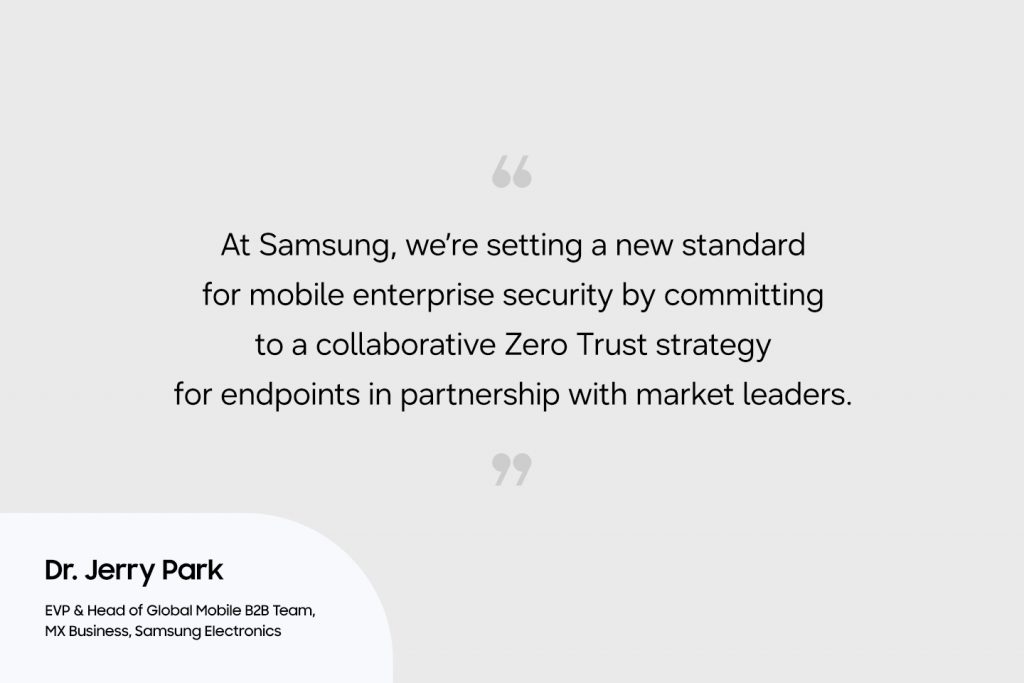
Enterprise security incidents can arise across operations. However, the International Data Corporation (IDC)[1] found that an overwhelming 70 percent of successful breaches originate from endpoints — the devices that connect to networks like phones, laptops and tablets. Unfortunately, in today’s security operations landscape, IT administrators have much less visibility into mobile devices compared to PCs and servers. With mobile devices now being the most common method of employee network access, this has to change. A systematic, comprehensive approach is critical to ensuring seamless mobile capabilities and a enhanced way of protection. At Samsung, we’re setting a new standard for mobile enterprise security by committing to a collaborative Zero Trust strategy for endpoints in partnership with market leaders.
Core Principles for Endpoint Security
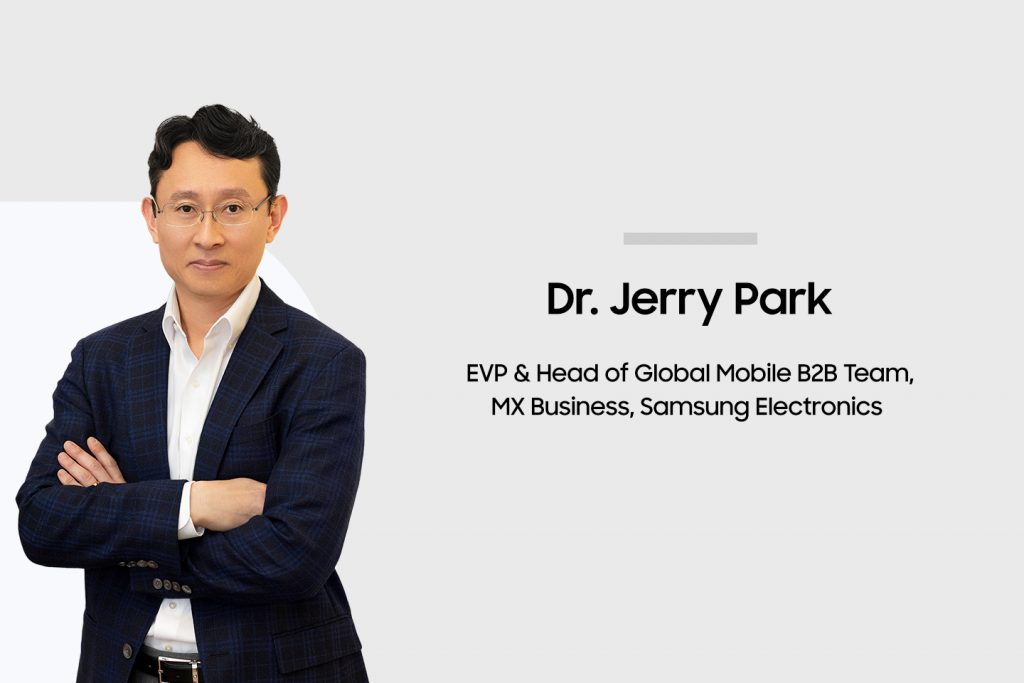
Samsung’s legacy of innovation is built upon our deep understanding of users. We’re constantly listening to feedback from consumers and businesses, anticipating the evolution of mobile technology. This is what enables us to develop industry-first solutions for consumers and businesses alike. As the Head of the Global Mobile B2B Team, I’m especially proud of how we’ve led the way in critical areas that deliver value to enterprises across the board. From advancing hardware-backed device attestation and threat detection to fully embracing the security principles, we are constantly striving to provide our customers with mobile devices and solutions that exceed their security requirements.
Zero Trust is a security framework that continuously assesses security, risk and trust levels based on context. The current security solutions market is dominated by network-centric Zero Trust solutions that focus on securing access at the network edge. Unfortunately, this approach by itself neglects a critical blind spot: the endpoint. Endpoints have the largest attack surface and are the most challenging IT assets to protect against cyberattacks. In most cases, they are the most vulnerable points in an organization’s IT ecosystem.
Zero Trust principles for endpoints, when realised correctly, ensure that access requests from endpoints are handled based on context that correlates with the device’s security and the user’s needs, and are continuously verified in real time. Although there is no definitive list of core principles behind Zero Trust endpoint protection, the following principles are the most commonly adopted:
“Never trust, always verify” approach for devices: Devices should no longer be implicitly trusted just because they are within the network boundary. Instead, each device needs to be verified prior to being granted access.
Continuous risk assessment and enforcement: Endpoint protection must be agile and ready to adapt to constantly changing risk conditions. This means continuously evaluating context — such as location, time of access and the device’s security— and adjusting security policies accordingly. Suspicious activity needs to be addressed through enforcement actions such as access restrictions or complete isolation.
Restricted privileges and narrowly scoped access: Endpoints must enforce access control in real time based on context while ensuring privileges are granted dynamically with a narrow scope.
Incorporation of user identity, device security and behavioral signals: A Zero Trust-compliant solution needs to make granular and informed trust decisions to enforce tight access controls. To enable such decisions, Zero Trust’s continuous evaluation of context integrates user identity, device security and behavioral signals.
While the Zero Trust security strategy is growing in adoption, Samsung is fully embracing it. By doing so, we are helping to protect the most vulnerable points in an organisation’s IT landscape. Risks related to endpoint security are constantly increasing as cloud-based applications, Bring Your Own Device (BYOD) programs and remote work prevail in the modern workplace environment. Samsung recognises the critical nature of this problem and is proactively addressing it in collaboration with partners.
Innovation and Collaboration for Security at Every Level
How does this work in practice? From the hardware level and all the way to the operating system and security interface, Zero Trust security principles are built into the architecture of Samsung Galaxy devices, enhancing protection at every layer while intuitively integrating with a business’s existing security infrastructure. Together, these practices empower enterprises to administer security threat detection and provide more reliable responses.
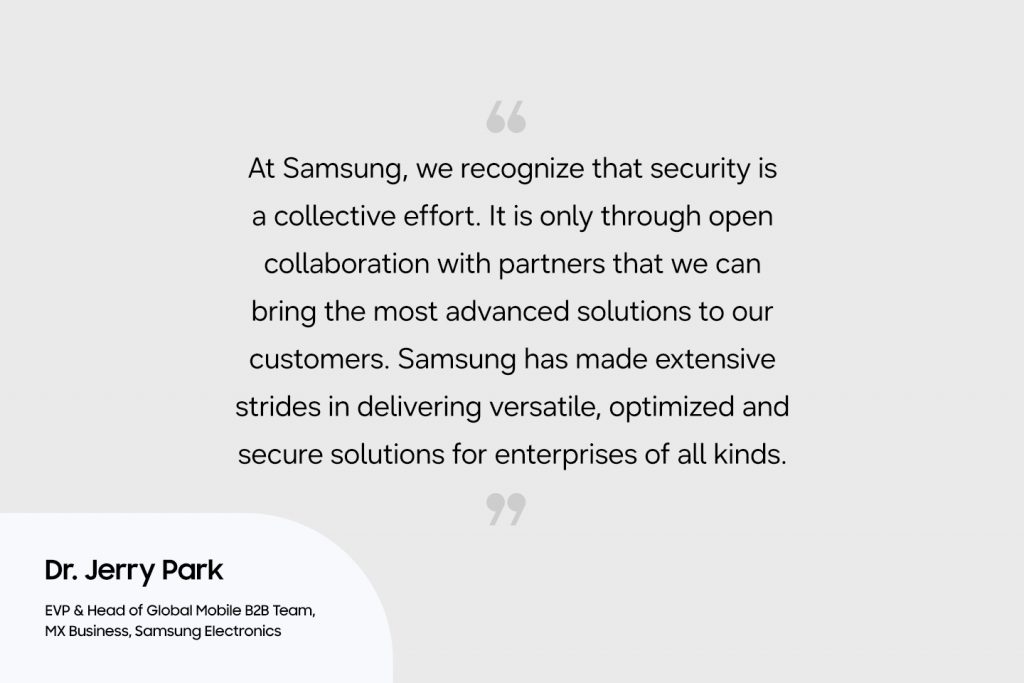
At Samsung, we recognise that security is a collective effort. It is only through open collaboration with partners that we can bring the most advanced solutions to our customers. In my time at Samsung, we’ve made extensive strides in bringing forth versatile, optimised and secure solutions[2] for enterprises of all kinds.
In 2024, we integrated Samsung Knox[3] — our multilayer security management platform — with Cisco Secure Access, an innovative Security Service Edge solution. This collaboration delivers a secure and flexible employee access experience, enabling organisations to verify user identity, device security and context before granting access.
We also have a strong partnership with Microsoft, defined by a shared vision of reimagining mobile device security for business customers. The first step of this strategic plan began in 2023, when we integrated Samsung Knox with Microsoft Intune, creating an on-device mobile hardware-backed device = solution that works equally well on both company and personal devices. This solution is now enabled by default in all new Android App Protection Policies, empowering organisations to bolster the security of all Samsung devices in their fleet. In yet another step forward in our partnership with Microsoft, Samsung offers a direct-to-security operations center (SOC) connector. This was achieved through the integration of Knox Asset Intelligence[4] and Microsoft Sentinel, a scalable, cloud-native security information and event management (SIEM) solution. This integration delivers unprecedented visibility into mobile security threats, providing centralised monitoring and protection across enterprise device fleets.
Working together with partners, Samsung is addressing key challenges in multiple areas — securing mobile devices, minimising damage from potential cyber threats and empowering employees to work efficiently and effectively, reducing concerns for security.
Holistic Security for Enhanced Privacy
We’re constantly innovating, refining and developing Samsung Knox solutions in order to bring our customers enhanced control, greater transparency and better protection against cyber threats.
As threats become increasingly complex with AI and hyperconnectivity taking center stage, security and privacy are more important now than ever before. Today’s business landscape is constantly being threatened by an increasing volume of cyberattacks that aim to exploit IT vulnerabilities, with mobile devices and other endpoints quickly becoming prime targets.
That’s why Samsung is working with market-leading companies to provide security solutions that work seamlessly with existing infrastructure, offering increased end-to-end protection. These collaborative solutions are a testament to our commitment to not only adhere to industry standards but to also drive their continued development when it comes to Zero Trust endpoint security. This is just the beginning.
To learn more about Samsung Knox’s approach to mobile security, visit samsungknox.com.
### Meeting Takeaways: Samsung FAST Forward Panel at CES 2026
**Date:** January 7, 2026
**Location:** The Wynn, Las Vegas, Nevada
**Moderated by:** Natalie Jarvey, The Ankler
**Panelists:**
– Salek Brodsky, SVP & Global Head of Samsung TV Plus
– Alessandra Catanese, CEO of Smosh
– Bruce Casino, EVP, Sales & Distribution, U.S., NBCUniversal Global TV Distribution
**Key Topics Discussed:**
1. **Emergence of FAST (Free Ad-Supported Television):**
– FAST models are gaining traction as audiences face subscription fatigue in a complex streaming environment.
– Samsung TV Plus aims to simplify the TV experience by offering a variety of live and on-demand channels for free, thereby enhancing viewer accessibility and experience.
2. **Hybrid Streaming Ecosystems:**
– The panel discussed the integration of FAST with traditional and subscription models, emphasizing that FAST can complement existing distribution channels rather than replace them.
– Bruce Casino highlighted the benefits of reaching diverse audiences and maximizing content value without cannibalizing existing channels.
3. **Role of Creators as Studios:**
– The changing media landscape allows creators to operate independently from legacy studios, enabling them to reach broader audiences.
– Platforms like Samsung TV Plus are facilitating this transition, empowering creators to enhance their production quality and broaden their market reach.
– Smosh’s partnership with Samsung TV Plus is cited as a successful example of a digital brand evolving into a legitimate television studio.
4. **Engagement Through Live and Interactive Experiences:**
– There is a growing trend towards live programming and interactive content, which fosters viewer engagement and participation.
– Features that encourage real-time participation, such as synchronized premieres, are transforming TV from a passive to an interactive medium.
– Emphasis on creating authentic content that connects culturally and builds community among viewers.
5. **Samsung’s Strategic Focus:**
– Samsung is committed to shaping a TV ecosystem that offers substantial value to viewers, profitable opportunities for creators, and scalable solutions for advertisers to redefine the television landscape in 2026 and beyond.
**Next Steps:**
– Regular updates on Samsung’s 2026 product line-up will be available through registration on their official website: [Samsung Australia’s CES registration](https://ift.tt/devTZUr).
This panel provides insight into how Samsung is positioning itself at the forefront of the evolving television industry, focusing on innovation and engagement strategies to meet changing consumer demands.
Summary of Samsung Outlines the Impact FAST, Creators and Live Experiences Are Having on the Future of Television at CES 2026
Samsung Electronics Co., Ltd. yesterday held “FAST Forward: How New Streaming Models Are Shaping the Next Generation of TV” as part of its Tech Forum panel series at CES 2026. Taking place at The Wynn in Las Vegas, Nevada, the panel brought together leaders from entertainment and media to explore the evolution of streaming and the rapid rise of free-ad-supported television (FAST).
The session highlighted the interconnected relationship between today’s rapidly evolving consumer behaviours and preferences, the transformation of content by technology and monetisation models, the expanding role of creators as studios and the ways in which interactive and live experiences are catalysing a shift from passive viewing into active engagement.
Moderated by Natalie Jarvey of The Ankler, the panel featured Salek Brodsky, SVP and Global Head of Samsung TV Plus; Alessandra Catanese, CEO of Smosh; and Bruce Casino, EVP, Sales & Distribution, U.S., NBCUniversal Global TV Distribution.
FAST Gains Momentum as Audiences Recalibrate Value
As audiences grapple with subscription fatigue and a fragmented streaming landscape, the panel focused on how FAST is restoring simplicity and value to television. Samsung TV Plus anchored the conversation as a platform designed to reduce friction, offering hundreds of live and on-demand channels in one free, easily accessible experience across compatible Samsung TVs and devices across the world.
“The TV experience today can often feel like too much work for the viewer,” said SVP Brodsky. “Our goal with Samsung TV Plus is to simplify television again and combine the power of linear discovery with a modern, connected experience that feels effortless, curated and truly valuable.”
The panelists emphasised that FAST has evolved into a core part of the streaming ecosystem, complementing subscription and traditional models while delivering premium, proven programming at scale. For Samsung TV Plus, that evolution is rooted in shared experiences that elevate viewing and meet users not just where they already are, but where they want to be.
Hybrid Models Redefine the Streaming Ecosystem
Panelists emphasised that the evolution of streaming is less about replacing traditional models and more about expanding how audiences engage with content. FAST, subscription and linear distribution models are increasingly working in tandem, allowing studios to extend the life of proven franchises, reach new viewers, and unlock additional value without sacrificing performance elsewhere. By leveraging data, audience behaviour and decades of content insight, media companies are deploying FAST to complement existing channels and create more resilient and diversified ecosystems.
EVP Bruce Casino highlighted how this approach has enabled NBCUniversal to bring both classic and contemporary content to FAST audiences while continuing to see strong performance across platforms. “FAST doesn’t replace traditional distribution, it extends it,” said Casino. “What we’re seeing is that when great content shows up in multiple places, it creates incremental value rather than cannibalisation – allowing franchises to thrive across FAST, streaming and linear channels.”
Creators Emerge as the New Studios
The panel also examined how the changing nature of consumer habits and television platforms means content creators do not have to work exclusively with legacy studios to reach a broad audience. As this medium expands from social platforms to the living room, FAST is helping bridge digital culture and traditional TV, while also serving to elevate its production quality.
Samsung TV Plus was highlighted as a platform that helps creators evolve from digital-first brands into full-fledged television studios, helping expand reach, unlock new monetisation opportunities, and introduce content to broader, global audiences.
One of the clearest examples of a brand that has taken the step from digital-first brand to legitimate TV studio is sketch comedy-improv collective Smosh. By launching a FAST channel with Samsung TV Plus, Smosh has been able to strengthen its connection with its already-dedicated fans while gaining access to a much larger viewer base. Due to this evolution, Smosh has enhanced long-term growth.
“Partnering with Samsung TV Plus allowed us to elevate our production quality and invest in the future of the Smosh brand,” said CEO Alessandra Catanese. “It was the right platform to help us reach a broader audience while positioning our content in a premium environment that supports where we’re headed as a company.”
Live and Interactive Experiences Drive Engagement
Looking beyond on-demand viewing, panelists discussed how live programming like concerts and interactivity are reshaping the television experience by creating shared moments that audiences actively participate in.
With features such as synchronised premieres and real-time participation, technology is transforming television from a passive activity into an interactive experience – fostering connection, excitement and a sense of belonging that brings viewers together organically. Together, the panelists agreed that the future of television will be defined by flexibility, cultural connection and experiences that invite participation, not just consumption.
“Authentic content that creates cultural connection and brings people together is what matters most,” said SVP Brodsky. “That’s why we’re investing in live events, creator programming and interactive formats that remind people why TV has always been the center of the home.”
As streaming continues to evolve, Samsung is focused on helping shape a TV ecosystem that delivers value for viewers, opportunity for creators and scale for advertisers, redefining what television can be in 2026 and beyond.
To stay up to date with the latest product news and special offers on Samsung’s 2026 product line-up, Australians can register their interest via https://www.samsung.com/au/handraiserces/
**Meeting Takeaways: Samsung and Fender Partnership Announcement**
1. **Partnership Overview**:
– Samsung Electronics has formed an exclusive global partnership with Fender to integrate Fender Play on Samsung TVs starting in 2026.
2. **Service Details**:
– Fender Play will offer video-based lessons for four instruments: electric guitar, acoustic guitar, bass, and ukulele.
– Users can access courses tailored to their skill level, featuring step-by-step lessons focused on familiar songs.
– A ‘Jam Mode’ allows players to perform alongside curated tracks, enhancing the interactive experience.
3. **Launch Timeline**:
– A live preview of the Fender Play experience will be showcased at CES 2026.
– The app is expected to be available in the first half of 2026.
4. **Target Audience**:
– Available to Samsung TV users in 49 countries, including the Americas, Europe, Australia, New Zealand, and South Korea.
5. **Requirements**:
– Users must provide their own instruments. Additional service subscriptions and app downloads may be required.
– An internet connection and a Samsung account are necessary to utilize the service.
6. **Quotes from Executives**:
– Hun Lee from Samsung emphasized the integration of learning into daily life through video lessons on Samsung TVs.
– Cliff Kim from Fender expressed excitement about aiding guitar enthusiasts in enhancing their skills with interactive lessons.
7. **Registration for Updates**:
– Interested customers in Australia can register for updates on Samsung’s 2026 product offerings via the Samsung website.
**Action Items**:
– Monitor the development of the app and upcoming announcements from Samsung and Fender.
– Prepare promotional materials and strategies for the launch of Fender Play on Samsung TVs.
Summary of Samsung Brings Fender Play to Samsung TV Home Screen
Samsung Electronics Co., Ltd. today announced an exclusive global partnership with the leading guitar brand, Fender, to the TV edition of Fender Play to Samsung TVs in 2026.[1]
“With video-based lessons on Samsung TVs, learning an instrument fits into daily life and helps players reach goals faster,” said Hun Lee, Executive Vice President of the Visual Display (VD) Business at Samsung Electronics. “By bringing Fender Play to TVs, Samsung is turning screens at home into a place to learn and play together.”
Players can choose an education path for four different instruments[2]: electric guitar, acoustic guitar, bass or ukulele. Musicians can also access on‑demand courses by skill level, each with a wide range of step‑by‑step lessons built around familiar songs. Through Jam Mode, players can pick a fun background and play along with curated tracks from a variety of genres, turning their screen into a stage.
Samsung will debut a live preview of the experience at CES 2026, with on-screen demos that will showcase the immersive learning experience. With 20 consecutive years of leading the global TV market, Samsung delivers the picture, sound and reliability that keep new players engaged as they build skills.
“We are thrilled to bring Fender Play’s immersive learning experience to Samsung TV users, helping guitar enthusiasts take their skills to the next level,” said Cliff Kim, VP of Growth Strategy, Digital Products at Fender and President of the Fender Play Foundation. “Our mission has always been to educate and inspire players globally and this partnership gives music lovers the opportunity to learn, practice, and play with Fender Play’s high-quality, interactive lessons directly on their Samsung TV.”
The app will be released in the first half of 2026. To stay up to date with the latest product news and special offers on Samsung’s 2026 product line-up, Australians can register their interest via https://www.samsung.com/au/handraiserces/
[1] Beginning in 2026, Fender Play will be available on 2025 and later Samsung TVs in 49 countries across the Americas, Europe, Australia, New Zealand and South Korea.
[2] Users will be required to provide their own instrument. This service may be subject to additional service subscriptions and app download. Content services are subject to change without notice. Internet connection and Samsung account required.
**Meeting Takeaways: Samsung’s CES 2026 Tech Forum**
**Event:** CES 2026 Tech Forum
**Date:** January 9, 2026
**Location:** The First Look space at The Wynn Las Vegas
**Moderator:** Debbie Millman, host of “Design Matters”
**Panelists:** Mauro Porcini (Samsung Chief Design Officer), Karim Rashid, Fabio Novembre
### Key Themes and Insights:
1. **Future of Design:**
– The panel emphasized the need to evolve beyond minimalism in tech design, encouraging a shift towards warmer and more expressive technologies.
– Designers discussed the importance of creating emotionally resonant experiences in the current AI landscape.
2. **People-First Design:**
– Design should prioritize human needs and experiences over purely functional specifications, addressing the uniformity seen in current tech design.
– Samsung aims to integrate technology into daily life thoughtfully, enhancing user experiences.
3. **Humanity in Technology:**
– Technology should visibly reflect intention, care, and humanity, encouraging users to see the thoughtfulness in products.
– Porcini articulated Samsung’s mission to enhance lives through meaningful technology that supports wellbeing and creativity.
4. **AI and Human Values:**
– AI should be guided by Emotional Intelligence (EI) and Human Imagination (HI) to unlock its full potential.
– Porcini proposed the formula “AI × (EI + HI)” to represent this balance in design and innovation.
5. **Expressive Design:**
– There is a growing need for expressive design that incorporates emotion, self-expression, and connection, transitioning from designing mere objects to crafting meaningful experiences.
– Fabio Novembre highlighted that the ultimate goal of design is to bring happiness and that design must regain its central importance.
### Conclusion:
The discussion reinforced the idea that technology should actively enhance and shape human experiences, leading to more meaningful designs that reflect individual identities and emotions. The panelists collectively advocated for a future where design is central to human connection and wellbeing, pushing the boundaries of traditional tech design.
Summary of Samsung Reimagines the Future of Design at CES 2026, Guiding Technology for Humanity
Samsung Electronics, Co., Ltd. today held the final session in its CES 2026 Tech Forum series, “The Human Side of Tech: Designing a Future Worth Living,” at Samsung’s The First Look space at The Wynn Las Vegas. The panel, moderated by Debbie Millman, host of “Design Matters,” featured Samsung Chief Design Officer Mauro Porcini and industry-leading designers Karim Rashid and Fabio Novembre.
With minimalism having defined the visual language of the tech industry for the past two decades, this panel of designers convened by Samsung asked: What comes next? Together, the panelists explored how warmer, more expressive and emotionally resonant technology can shape meaningful experiences in today’s AI era, while also charting a path forward for the industry.
Design as an Act of Love
The session covered a shared view on the purpose of design as fundamentally people-first. “In recent years, design in tech has been somewhat uniform,” said moderator Debbie Millman. “Compared to other industries, the uniformity in the world of tech is an anomaly. So what if we were to extend technology beyond specifications and functionality?”
Samsung is currently addressing this question by focusing on how technology fits into people’s lives, experiences and needs. The panelists discussed the growing importance of this mindset in the current landscape in which traditional barriers to entry such as access to tools, scale and technical capability continue to diminish.
The Human Side of Tech
The discussion highlighted technology’s role in making intention, care and humanity visible in everyday life. Panelists noted that technology should help people recognise the thoughtfulness embedded in the products they invite into their homes and routines.
In this context, Samsung Chief Design Officer Mauro Porcini shared Samsung’s design purpose: to enhance everyday lives through meaningful technology. He outlined the company’s commitment to help people through advanced technologies that support wellbeing, creativity and self-expression.
Panelist Karim Rashid added to this sentiment, saying, “When we think about physical things in our world, we think not only about diversity of choice but also the fact that we can develop strong connections to objects,” he said. “Through design, you can end up with a very powerful, emotional connection with inanimate objects, or even products.”
Designing for Human Values
The panel went on to explore how AI can unlock new possibilities for expression when shaped by human values. Panelists discussed a shared view that AI reaches its true potential when guided by Emotional Intelligence and Human Imagination, not as a replacement for human creativity but as a force that expands it.
CDO Porcini articulated this with “AI × (EI + HI),” his approach to balancing Emotional Intelligence and Human Imagination to bring meaning to innovation. While describing this philosophy, CDO Porcini said, “When we design and develop, AI is amplified by Emotional Intelligence and Human Imagination. “Then, when people use products, AI amplifies Emotional Intelligence and Human Imagination.”
Through these insights, the session reinforced the belief that technology is shaping people’s lives in increasingly new and meaningful ways.
Expressive Design Drives More Meaningful Experiences
The discussion reinforced the importance of expressive design in bringing human-centered purpose to life, creating experiences that reflect emotion, support self-expression, invite connection and stimulate imagination.
“Happiness is the aim of design,” said Fabio Novembre. “Our pursuit of happiness is through design. I strongly believe in design, and that it must move back to the centre of the stage.”
Panelists noted that this reflects a shift from merely designing objects to designing experiences where emotion, meaning and identity are increasingly integral to how people relate to technology. This approach inspires a new kind of expression, resulting in designs that range from subtle and minimal to bold and imaginative — all meant to shape a better future.
### Meeting Takeaways: Samsung VD Deep Dive Session at CES 2026
**Date:** January 9, 2026
**Location:** The Wynn, Las Vegas
**Led by:** SW Yong, President of VD Business
1. **Market Leadership and Vision:**
– Samsung aims to redefine the role of televisions in connected homes, building on two decades of leadership.
– The global TV market is evolving toward premium demand, larger screens, and intelligent user experiences.
2. **Focus Areas for 2026:**
– Introduction of **Micro RGB** and **OLED** technologies as leaders in the premium TV segment.
– Enhanced accessibility to premium technology through **mini LED** displays.
– Development of **ultra-large displays** for immersive entertainment.
3. **Vision AI Companion (VAC):**
– Introduction of the Vision AI Companion (VAC), designed to offer intuitive television experiences.
– Integration of AI will support smart home connectivity, enhancing user engagement while prioritizing picture quality.
4. **Innovations in Scale and Design:**
– Launch of **Micro RGB 130-inch TV**, marking a significant technical achievement for Samsung.
– Emphasis on lifestyle innovation and creating immersive viewing experiences rather than focusing solely on technical specifications.
5. **Commitment to Continuous Innovation:**
– Samsung reinforces its leadership in the TV industry through ongoing innovation, combining hardware excellence with smart, connected experiences.
– Acknowledgment of the evolving viewer experience from mere viewing to interactive engagement.
**Conclusion:**
Samsung’s 2026 strategy outlines a commitment to transform user experiences with TVs by leveraging advanced technologies and intelligent integrations, ultimately enriching the lifestyle of consumers worldwide.
Summary of Samsung Unveils Vision for the Next Era of Television at CES 2026 VD Deep Dive Session
Samsung Electronics Co., Ltd. today hosted a Visual Display (VD) Deep Dive session at CES 2026. Led by SW Yong, President of VD Business at Samsung Electronics, the session was held at The Wynn Las Vegas and highlighted how Samsung is building on two decades of market leadership to redefine the role of the TV in the connected home. As the global TV market enters a new phase defined by premium demand, larger screens and intelligent experiences, Samsung outlined its strategy for the future of television.
During the session, Samsung emphasised its focus on expanding the TV’s capabilities through next-generation AI while delivering exceptional picture quality. 2026 will be a pivotal year for the VD business, with Micro RGB and OLED leading the premium TV segment, mini LED increasing accessibility to premium TV technology, and ultra-large displays further enhancing the immersive entertainment experience at home and beyond. As a result, the full lineup will bring Samsung’s state-of-the-art screen experience to a wider range of consumers, while reinforcing the company’s leadership in performance and innovation.
“We are currently experiencing a transformation in the way viewers enjoy the television experience, shifting from one centred on viewing to one based on direct interaction with users,” said President Yong. “As television evolves, Samsung is continuing to earn its leadership role year after year by building on its legacy of hardware excellence.”
Elevating the TV Experience With Vision AI
At the heart of Samsung’s 2026 strategy is Vision AI Companion (VAC)[1], a new intelligent platform designed to make television more intuitive.
By embedding AI across its ecosystem, Samsung is expanding the TV’s role beyond entertainment, enabling refined smart home integration and more meaningful engagement. This approach reflects Samsung’s commitment to building connected experiences that adapt to users, while maintaining the picture quality consumers continue to prioritise.
Redefining Scale, Design and Lifestyle Innovation
During the session, Hun Lee, Executive Vice President (EVP) of VD Business, provided additional detail surrounding Samsung’s new Micro RGB 130-inch TV, a Samsung first technical achievement, as well as the company’s commitment to lifestyle TV innovation.
“As the quality of content improves, it’s natural for users to want a higher degree of immersion,” said EVP Lee. “As we develop our products, Samsung is focusing on the tangible experiences brought by technologies like VAC, rather than just their technical specifications.”
As Samsung celebrates twenty consecutive years as a top TV brand, the VD Deep Dive underscored a clear message: leadership is earned through continuous innovation. By combining hardware excellence with intelligent, connected experiences, Samsung is shaping a future in which TVs deliver not only superior picture quality, but smarter, more personal and more meaningful experiences in homes around the world.
[1] Feature available in certain regions and models. Availability and supported features may vary by region and watching conditions. Voice commands recognise English, French, Spanish, Portuguese, German, Italian, and Korean, but not all accents, dialects, and expressions are recognised. Requires a specific Bluetooth remote (TM2660H/TM2661H) (sold separately on some models). In-box remote for some models (M70H/U800H) does not support voice recognition. Requires either a Mobile Quick Remote or separately purchased Bluetooth remote. Feature accessible with the AI button or the Home button (via long press) on remote controls without an AI button.
### Meeting Takeaways: Samsung Bespoke AI 2026 Vision at CES
1. **Event Overview**:
– Samsung showcased its vision for the Digital Appliances (DA) Business at CES 2026, emphasizing the integration of AI into home appliances to create “Home Companions.”
2. **Key Presenters**:
– Cheolgi Kim (Head of DA Business): Outlined the vision and relevance of Bespoke AI appliances.
– JS Moon (Head of R&D, DA Business): Discussed regional strategies and product adaptations.
3. **Bespoke AI Appliances**:
– Devices integrate with SmartThings and are powered by Bixby technology, enabling them to see, hear, and understand user needs.
– Aim to intelligently adapt to users’ daily activities and build a comprehensive AI ecosystem, including integration with TVs and mobile devices.
4. **Samsung’s Vision**:
– Cheolgi Kim stated the goal is to enhance living standards through the Bespoke AI ecosystem, providing differentiated consumer experiences.
5. **Regional Strategies**:
– Tailoring product portfolios to suit specific market needs:
– **North America**: Focus on innovative products like the Bespoke AI Laundry Combo and unified kitchen designs.
– **Latin America**: Growth driven by laundry and air conditioning products.
– **Asia**: Rising interest in smart home ecosystems and localized AI features such as language support and AI Energy Mode.
6. **Commitment to Regional Customization**:
– Samsung strives to align AI experiences with local lifestyles and plans to extend AI features across various price points beyond premium offerings.
7. **Future Directions**:
– Exploring new applications for AI beyond traditional appliances, including HVAC systems and modular homes.
– Focus on open collaboration, regional customization, and sustained software support to enhance practical AI experiences in daily life.
### Conclusion:
Samsung’s presentation at CES 2026 highlights their strategic focus on integrating AI into everyday life through tailored appliance solutions that meet regional needs, aiming to create valuable, interconnected experiences for users.
Summary of Home Companion: Comprehension of Samsung Bespoke AI 2026
Samsung Electronics Co., Ltd. today outlined its vision for its Digital Appliances (DA) Business during a Deep Dive session at CES 2026 in Las Vegas, Nevada. The outline for the company’s vision comes at a time in which the global home appliance market navigates the growing importance of AI in connected living.
Led by Cheolgi Kim, Head of the DA Business, the session laid out how Samsung’s Bespoke AI appliances are seamlessly connected through SmartThings to become “Home Companions.”
These devices are equipped with Bixby voice recognition technology, screens, and cameras that allow them to see, hear and understand to proactively respond to users. This makes them capable of intelligently adapting to users’ daily lives. At the same time, intelligent adaptation extends beyond home appliances to TVs and mobile devices to build a broader AI ecosystem in which devices can fulfil the role of a true Home Companion.
“Samsung’s ultimate goal is to enable better living through Bespoke AI,” said Cheolgi Kim. “Through our extensive ecosystem that connects devices across DX products – including mobile phones and TV – and our appliances’ unique form factors, we are providing differentiated experiences to our consumers and creating more value through those experiences.”
Regional Strategies Powering Global Growth
Also during the session, JS Moon, Head of R&D at the DA Business, highlighted how Samsung is tailoring its 2026 appliance portfolio to meet regional market needs. In North America, innovative form factors like the Bespoke AI Laundry Combo continued to drive strong growth. In addition to the AI lineup, new kitchen packages featuring unified stainless-steel designs are expected to satisfy local preferences in 2026.
Latin America continues to see strong momentum led by laundry and air conditioning solutions, while rising interest in smart home ecosystems and localised AI features like regional language support and expanded AI Energy Mode represent a major growth opportunity in Asia.
“At Samsung, we aim to deliver meaningful AI experiences that are deeply aligned with local lifestyles and needs,” said EVP Moon. “As such, we will keep enhancing these regional features and expand core AI features such as AI Energy Mode to a wider range of price points and product types beyond premium lineups.”
Expanding the Role of AI in Everyday Life
Looking ahead, Samsung reaffirmed its commitment to expanding beyond traditional appliances into areas such as HVAC, modular homes, and connectivity in new aspects of daily life. By combining open collaboration, regional customisation and long-term software support, Samsung aims to deliver AI experiences that feel practical, trusted and deeply aligned with everyday lives.
**Meeting Takeaways: Samsung Tech Forum at CES 2026**
**1. Importance of Open Ecosystems**
– The panel emphasized that the future of home AI relies on open collaboration rather than closed ecosystems.
– Such openness enables interoperability among devices and services from various brands, enhancing user experiences.
**2. Trust and Interoperability**
– Yoonho Choi from Samsung highlighted the need for AI in homes to earn user trust through respected and valuable interactions.
– Interoperability is essential for unifying devices, ensuring they function as a cohesive system rather than isolated features.
**3. Samsung’s Connected Ecosystem**
– Samsung showcased its extensive SmartThings community, emphasizing its leadership and insights in connected living over the past decade.
– The goal is to create AI experiences that seamlessly coordinate across various appliances, enhancing user convenience.
**4. Measurable Consumer Benefits**
– Panelists discussed how open ecosystems can lead to tangible benefits, using Samsung’s partnership with Hartford Steam Boiler (HSB) as an example.
– This collaboration demonstrates how smart home data can translate into savings and value for consumers.
**5. Human-Centric AI Design**
– Successful home AI must blend into daily routines like cooking and family care, requiring thoughtful design and understanding of user behavior.
– The discussion stressed that future AI should feel like a reliable companion rather than just a tool.
**Conclusion**
– The consensus among panelists was that interoperability, responsible data use, and cross-industry collaboration are critical for the advancement of home AI that genuinely improves everyday life.
– Samsung is committed to developing open ecosystems for a more meaningful connected living experience.
**Next Steps**
– For updates on Samsung’s product line in 2026, Australians can register their interest on the Samsung website.
Summary of Samsung Highlights How Open Ecosystems Unlock the Real Promise of Home AI at CES 2026
Samsung Electronics Co., Ltd. today convened leaders across industries in to discuss the importance of smart home interoperability in the first of its Tech Forum panels at CES 2026 at The Wynn in Las Vegas, Nevada. In the session, titled “When Everything Clicks: How Open Ecosystems Deliver Impactful AI,” experts discussed how cross-industry partnerships are transforming connected homes into intelligent environments that feel seamless.
Openness as the Foundation of Home AI
The panelists agreed that the next era of home intelligence must be built on open collaboration, not closed ecosystems. As homes increasingly rely on devices and services from many brands and industries, openness enables AI systems to work together in ways that create real-world impact. Samsung shared its belief that open connectivity allows appliances to deliver experiences that would be impossible in siloed environments.
“Home is the most personal place in our lives, so home AI must earn trust — quietly, respectfully, and with value users can feel,” said Yoonho Choi, President & Chair of the Board of the Home Connectivity Alliance and Head of Strategic Alliances at Samsung Electronics. “That requires interoperability across brands, so the home works as one system instead of disconnected features. Through cooperation with HCA and across industries, we’re turning openness into outcomes: safer homes, simpler routines and measurable savings — built on consent and transparency.”
Powering A Connected Home Ecosystem
Samsung highlighted the scale and depth of its connected ecosystem, noting that millions of users are already part of the SmartThings community. With over a decade of leadership in connected living, Samsung brings deep insight into how AI companionship in the home is evolving, from today’s smart devices to tomorrow’s system-wide intelligence.
This foundation allows Samsung to design AI experiences that coordinate across appliances and services, delivering value that feels seamless.
“It’s crucial to deliver tangible user benefits that make people’s lives better,” said Michael Wolf, founder and editor-in-chief of The Spoon. “Along these lines, there’s no area that will bring more benefit than a broadly connected kitchen — one that allows users to understand what’s in their refrigerator, allowing for a more holistic understanding of everyday life.”
Turning Collaboration Into Measurable Consumer Benefits
The panel also examined how open ecosystems enable measurable benefits for consumers through cross-industry partnerships. Samsung highlighted its collaboration with Hartford Steam Boiler (HSB) as a first-of-its-kind example of how smart home data — used responsibly and transparently — can deliver meaningful outcomes.
“We’re at a point where the connected home can bring seamless integration into user lifestyles, which begins to develop trust in smart home equipment that results in direct benefits to consumers,” said Jed Usich, Senior Vice President of Strategic Growth Solutions at HSB. “Through our partnership with Samsung, we’ve created a bridge to the insurance industry that takes simple datapoints and turns them into tangible savings for consumers.”
Designing AI That Feels Human
Throughout the discussion, the panelists emphasised that for home AI to succeed, it must fit naturally into routines including cooking, relaxing, entertaining and caring for families. Design, storytelling and behavioral understanding all play a role in making connected devices feel like calm, reliable companions.
Together, the panelists agreed that the future of home AI depends on interoperability, responsible data use and collaboration across industries, ensuring intelligent homes deliver real value.
Samsung remains focused on building open ecosystems that make connected living simpler and more meaningful, proving that when everything clicks, home AI can help improve everyday life.
To stay up to date with the latest product news and special offers on Samsung’s 2026 product line-up, Australians can register their interest via https://www.samsung.com/au/handraiserces/
### Meeting Takeaways: Looking Forward to Another Year of Purpose and Partnership (January 2026)
**Overview:**
– The transition from 2025 to 2026 is marked by pride in the achievements of the SEAO teams at Samsung.
– The SEAO region is recognized as a strategic hub for innovation, cultural diversity, and digital adoption.
**Strategic Pillars for 2026:**
1. **Delivering Breakthrough Innovations:**
– Emphasis on becoming an AI-driven company by integrating AI into operations and product innovations.
– Key announcements from CES 2026 include:
– Enhanced AI capabilities in home appliances and displays.
– Partnerships with leading AI firms to advance AI capabilities.
– A unified AI experience across Samsung’s devices and services.
2. **Empowering the Next Generation:**
– Initiatives aimed at fostering youth as creators and innovators:
– Significant growth in the “Solve for Tomorrow” program (40% increase in participation).
– Samsung Innovation Campus (SIC) focuses on bridging the skills gap with ICT and AI education.
– The strategic objective is to cultivate talent for the AI-driven digital economy through CSR efforts.
3. **Driving Ecosystem Transformation:**
– Commitment to security and privacy as foundational elements in AI development.
– Launch of Samsung Business Experience Studios across SEAO, aimed at helping organizations leverage innovative solutions.
**Call to Action:**
– Continued collaboration with partners, consumers, and regional leaders to build on achievements and pursue Samsung’s ambition as a leader in AI.
– Emphasis on using technology to connect people, communities, and opportunities throughout SEAO.
**Conclusion:**
– The focus for 2026 is on innovation, youth empowerment, and ecosystem transformation, with ongoing efforts to ensure AI serves a broad, inclusive audience.
—
This summary highlights the key strategic directions and initiatives discussed in the meeting, positioning Samsung for future growth in the SEAO region.
Summary of Looking Forward to Another Year of Purpose and Partnership
We have said farewell to 2025 and as we look ahead and welcome a new year, I am immensely proud of what our teams across Southeast Asia and Oceania (SEAO) have achieved together so far. To Samsung, the SEAO region is more than a collection of markets; it is a strategic hub of innovation, defined by dynamic growth, cultural diversity, and rapid digital adoption. While commercial targets continued to be important last year, we were also focused on anchoring Samsung as a genuine, long-term partner in SEAO’s development.
To strengthen the fundamentals that we established in 2025, I would like to share three core strategic pillars that will continue to anchor our growth path in 2026: delivering breakthrough innovations, empowering the next generation, and driving transformation for our customers; all underpinned by our commitment to become a truly AI-driven company.
Delivering Breakthrough Innovation Through an AI-Driven Future
At Samsung, we believe AI has fundamentally changed how we operate, innovate, and serve our customers. We have embraced a bold vision to be an AI-driven company and are already weaving AI meaningfully into our operations and innovations.
We first introduced Galaxy AI[1] to the world back in 2024 and we reinforced our AI leadership in 2025 as we delivered an even broader vision of living with AI. In addition to democratisation, we are driving a new era of multi-modal intelligence. This means ensuring that our hardware and software evolve together, creating devices that do not just process commands, but function as intuitive companions.
At CES 2026, we announced our efforts to unify intelligence across devices to deliver meaningful experiences as your trusted companion to AI living, creating a positive impact on how you work, live and play. I am excited for you to see how our commitment to AI innovations will shape our devices, solutions and services in 2026.
Some of our key announcements at CES 2026 include:
A more intuitive and personal AI integrated into our home appliances and displays that adapts to your routines, and helps support your daily life
Partnerships with leading AI players and industry partners to introduce next level AI capabilities
A more refined AI experience featuring a single design language and intuitive layer of contextual intelligence whether on One UI, Bixby or other services.
Empowering the Next Generation
What also continues to excite me is that the next generation in SEAO will not just be users of technology; they will be creators, innovators, and entrepreneurs who shape how these applications of AI serve their communities.
I believe that technology should serve as a bridge that enables everyone, regardless of background, to connect, create, and thrive. To fully unlock this potential, we have directed our corporate social responsibility (CSR) efforts towards cultivating and investing in our youth, nurturing the next generation of talent.
Our flagship Solve for Tomorrow (SFT) program empowers young people to drive meaningful change through technology and innovation. In 2025, participation grew by 40% from 2024, with a total of more than 16,900 youth across the region developing solutions to address challenges in their communities. This growth highlights young people’s readiness to apply technology in practical and meaningful ways when given the tools and opportunities.
Last year, the Samsung Innovation Campus (SIC) actively bridged the regional skills gap by providing advanced information and communications technology (ICT), coding, and AI education across multiple SEAO markets. This approach mirrors our internal capability-building methodology: just as we train our employees through a structured GenAI curriculum, SIC provides youth with a similar roadmap for progression, enabling them to build foundational AI capabilities and progress to working with more complex applications.
These initiatives are more than CSR programs, but strategic investments we are making to contribute and build up the talent pipeline for our region’s AI-driven digital economy.
2026 is set to be a year where we build on this strong momentum with our CSR programs, as we aim to do even more with governments, corporations, schools, NGOs and community partners.
Driving Ecosystem Transformation
Finally, the foundation of a hyper-connected world fueled by AI agents must be trust. At Samsung, security and privacy are at the heart of our strategy. This principle is increasingly critical as we enter an era of Agentic AI, where intelligent systems do not just respond to commands but anticipate needs on users’ behalf. The power of our “One Samsung” ecosystem ensures that intelligence extends seamlessly from mobile to the entire connected home via SmartThings[2], protected by Samsung Knox.
We also uphold this standard of trust at the enterprise level. Last year, Samsung Business Experience Studios (BES) were launched in markets including Indonesia, Thailand, and Singapore. These spaces are designed to help organisations envision how they can adopt innovative Samsung solutions to meet their specific industry challenges. With additional studios set to roll out across Southeast Asia and Oceania, we look forward to more opportunities for collaboration as we partner with enterprises to implement smart and secure solutions for their businesses.
Shaping Our Future Together
My first year leading SEAO has been characterised by our efforts to innovate, empower youth, and transform ecosystems across industries, all anchored in our evolution as an AI leader.
While we are encouraged by what we have achieved so far, our work here is far from over. I invite all our partners, consumers, and regional leaders to continue this journey with us in 2026 and beyond. As we pursue our ambition to establish Samsung as the undisputed leader in AI, we will strive to ensure that AI serves everyone throughout everyday life.
Together, let us shape a future where technology does not just connect devices, but connects people, communities, and possibilities across our vibrant region.
[1] Galaxy AI features are currently free of charge, with any specific plans for premium AI services to be decided in close coordination with our partners. There are currently no plans to charge for Galaxy AI features, however different terms may apply to other AI features provided by third parties.
[2] Requires Samsung Account, internet connection and SmartThings enabled devices. Please visit https://ift.tt/irYKw9B for a list of current compatible devices.