One of the more interesting features recently added to iPhone is something called Clean Energy Charging. Apple says that this feature aims to “reduce your carbon footprint” by charging when lower carbon-emission electricity is available. In a support document, Apple has more details on how this feature works.
Apple says:
When Clean Energy Charging is enabled and you connect your iPhone to a charger, your iPhone gets a forecast of the carbon emissions in your local energy grid and uses it to charge your iPhone during times of cleaner energy production.
Clean Energy Charging is available only in the United States and is on by default when you set up your iPhone or after you update to iOS 16.1.
Clean Energy Charging is enabled by default, but you can manage the setting by going into the Settings app, choosing Battery, then Battery Health & Charging. Here, you’ll see a new toggle dedicated to the Clean Energy Charging feature.
Clean Energy Charging works together with Optimized Battery Charging to learn your charging habits. Clean Energy Charging engages only where you spend the most time and regularly charge your iPhone for long periods of time, such as your home and place of work. The feature doesn’t engage if your charging habits are variable or you’re in a new location, such as when you travel.
For Clean Energy Charging to work, Apple says the following settings must be configured:
Go to Settings > Battery > Battery Health & Charging and make sure that Clean Energy Charging is on.
Go to Settings > Privacy & Security > Location Services and make sure that Location Services is on.
Go to Settings > Privacy & Security > Location Services > System Services and make sure that System Customization is on.
Go to Settings > Privacy & Security > Location Services > System Services > Significant Locations and make sure that Significant Locations is on.
Finally, if you enable Clean Energy Charging but want to override it, you can do so directly from your iPhone’s lock screen. When Clean Energy Charging suspends charging, you’ll see a notification on your lock screen. Long press on this notification then choose the “Charge Now” option to override.
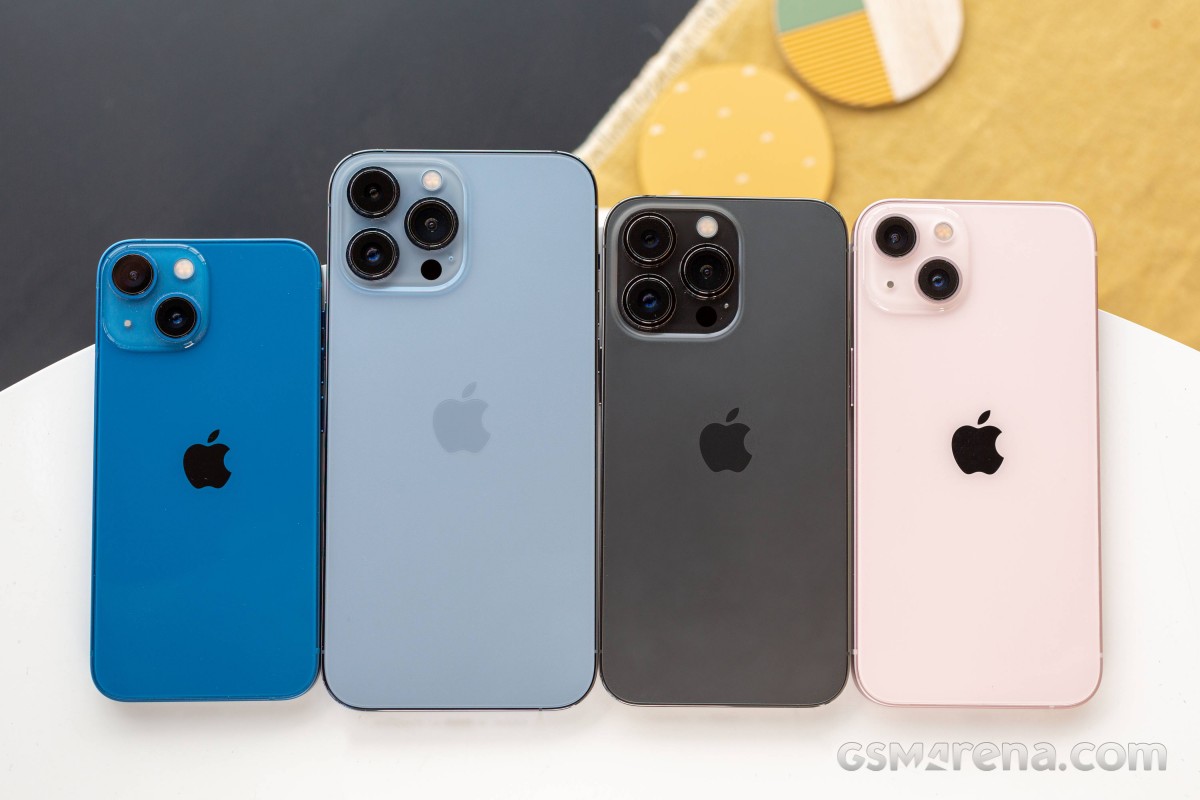
The Apple iPhone 13 mini is the most compact flagship smartphone money can buy. It’s also easy enough to outright recommend to anyone looking for this particular type of device. It is astonishingly rare to find such a pocket-friendly smartphone, let alone one of flagship caliber.
Apple launched the first iPhone mini a year ago, and while it did not turn out to be the massive success some hoped for it to be, it was still a popular purchase among the fans of compact phones, Android and iOS alike. But because of the lackluster sales, the rumor has it the iPhone 13 mini will be the last of its kind before it is merged with the iPhone SE in a year or two.
The iPhone 13 mini brings few updates over the iPhone 12 mini – an improved chipset, a better main camera with new sensor and stabilization, about 10% battery capacity increase, and a couple of software features. And a smaller screen notch, of course! But we imagine few if any iPhone 12 mini users will be upgrading to the iPhone 13 mini.
But as a standalone smartphone, the iPhone 13 mini seems like a great offer for a number of reasons – it is the cheapest current flagship iPhone with unmatched compact and lightweight design. It employs the most durable design on the market so far, runs on the most powerful Apple A15 chip with 5G, has excellent cameras, there are loud stereo speakers and a great 5.4″ OLED screen with Dolby Vision support.
Disclaimer. We can not guarantee that the information on this page is 100% correct.
For a device of this size, the Apple iPhone 13 mini is jam-packed with features. We can’t but appreciate that how Apple made the mini possible without cutting any corners – it is basically a shrunk version of the regular iPhone 13. It even offers Face ID and MagSafe wireless charging. And despite the new improvements, Apple managed to increase the battery capacity, too.
The iPhone 13 mini, just like the iPhone 13, has a regular 60Hz OLED, though that’s hardly surprising. The ProMotion screen is reserved for the iPhone ProModels. And that’s probably the only missing feature worth a mention before we get this review started.
Unboxing the Apple iPhone 13 mini
The iPhone 13 mini may be jam-packed with features, but its retail bundle is the opposite. Inside the thin paper box, you will find the iPhone 13 mini and a USB cable.
If you dig a little deeper, you’ll also discover the SIM ejection pin and one Apple sticker. This year Apple’s removed all plastic wrapping of its boxes and became even greener, so we guess the iconic sticker will be a goner soon enough.
The competition
The Apple iPhone 13 mini is a rare occurrence – it’s not only one of the most compact phones on the market, but it’s also a flagship one. And while people are still hoping for Sony to make a new Xperia mini, Apple is making compact iPhones by the dozen. Not only that, but it also offers budget phones as part of the iPhone SE lineup.
Apple iPhone 13 series
The new iPhone 13 mini is a minor upgrade over the 12 mini model with a smaller screen notch and a brighter panel, a bit faster chipset, doubled base storage, a slightly larger battery, and an improved primary camera. We’d say the battery bump is what got us excited the most about this mini, and it indeed offers improved battery autonomy over the previous model.
The compact class is ruled by Apple, so you can imagine our first alternative recommendations come from Apple’s camp. The iPhone 12 mini is still available, if the new upgrades don’t excite you, you can just as well go for the older model and save yourself €120 and maybe spend them on a pair of AirPods instead.
There is also iPhone SE (2020), which is €320 cheaper than the €799 iPhone 13 mini, but it still offers a great iOS experience, excellent performance, good photo quality, and excellent videos. The bezels and the lack of Night Mode are potential deal-breakers, though.
If the mini is too small for you, then you can consider the iPhone 13 (€100 over the 13 mini) – it’s the same phone but with a larger 6.1″ display. The regular model is still considered compact, and many users may find it striking the best balance between pocketability and multimedia-friendly.
Apple iPhone 12 mini • Apple iPhone SE (2020) • Apple iPhone 13
Outside Apple, we want to mention the Asus Zenfone 8 and the Samsung Galaxy S21 5G for being one of the most compact Android flagships with outstanding screens, performance, hardware, battery life. The Zenfone is a bit cheaper than the mini, while the S21 5G costs about the same.
Asus Zenfone 8 • Samsung Galaxy S21 5G
Verdict
The Apple iPhone 13 mini is the most compact smartphone on the market right now, with a flagship feature set and surprisingly good battery life for its small size. It has a lively Dolby Vision OLED screen, one of the most powerful chipsets to date, superb stereo speakers, and it offers a proficient trio of cameras that delivers great photo and video quality.
The iPhone 13 mini is also one of the most durable phones – it has a scratch-resistant screen and is IP68-rated for dust and water endurance in up to 6m deep water. Oh, and it’s incredibly thin and lightweight.
The iPhone 13 mini is not perfect, of course, but it’s close. It doesn’t offer a 120Hz refresh rate, it ships without a charger, and iOS is not for everyone. Plus, it’s a minor upgrade over the iPhone 12 mini, and the notch reduction is far from what many were hoping for.
We don’t know if the iPhone 13 mini is the last of its kind, for a while at least, but if it goes extinct, we know many people will miss it dearly. Because it is the phone you get if you want a small yet powerful flagship – it’s that simple. Even with its imperfections, it is the perfect smartphone for fans of compact phones.
It was confirmed back in September that Apple will need to comply with antitrust requirements relating to app sales, and it seems most likely this will require the company to allow third-party app stores on iPhones. Microsoft has now indicated its intention to run one of these.
One key driver for the plan is likely Microsoft’s $69 billion acquisition of mobile gaming giant Activision Blizzard …
The App Store is officially a monopoly
Currently, the only place you can buy and download iOS apps is from the App Store. Apple had argued that consumers and developers were free to buy and sell Android versions of apps, therefore it didn’t have a monopoly on mobile apps as a whole – but the European Union rejected this as irrelevant, as Apple has an undeniable monopoly on the sale of iPhone and iPad apps.
Apple eventually conceded the point, and the matter was finally settled in September. The EU named the companies which will be subject to the Digital Markets Act (DMA) antitrust law, with the iPhone maker on the list.
Apple will likely have to allow third-party app stores
We still don’t know for certain what action Apple will have to take to comply with the DMA.
As a minimum, Apple must allow developers to use third-party payment platforms for European app sales, and in-app purchases. However, it seems more likely that it will need to permit third-party app stores to fully comply.
All indications are that Apple has reluctantly accepted this. The company has for some time had a senior team working on permitting third-party app stores.
This work is being spearheaded by Andreas Wendker, a software engineering vice president within Apple. Wendker reports directly to Craig Federighi. In addition to the engineering teams, Apple’s services team is also involved. Jeff Robbin, Apple’s “top engineering manager for its services,” is leading the effort on that side. Robbin reports to Eddy Cue.
Apple has until March 6 2024 to comply.
It’s not known whether the company will limit the changes to EU countries, or make the change globally. Apple faces similar antitrust pressures in the US and elsewhere, so may decide it’s best to bite the bullet and make one change worldwide.
Microsoft plans to offer an app store for games
Bloomberg reports that Microsoft has confirmed reports that it plans to offer an iOS app store for games.
Microsoft Corp. is talking to partners to help launch a mobile gaming store that will take on Apple Inc. and Google’s dominant position in the business, according to Phil Spencer, who leads the company’s Xbox video-game division.
“It’s an important part of our strategy and something we are actively working on today not only alone, but talking to other partners who’d also like to see more choice for how they can monetize on the phone,’’ Spencer said in an interview in Sao Paulo during the CCXP comics and entertainment convention.
Earlier reports said that it plans to launch the store next year, and the company more-or-less confirmed this.
The executive declined to give a specific date for a launch of the online store, which earlier reports suggested could be next year. “I don’t think this is multiple years away, I think this is sooner than that,’’ he said.
What does this mean for iPhone users?
What will likely happen is that you’ll be able to go to Apple’s App Store, and download apps for third-party app stores, like the planned Microsoft one.
If you do, you’ll then be able to choose where to buy your apps – either from the official App Store, or from any of the third-party ones.
You may pay the same price or different ones; that will be up to developers. However, the most likely outcome is that third-party stores will offer lower commissions to developers, and they will pass on at least some of the savings or offer other incentives to encourage you to use the stores which charge them the lowest commissions.
But most iPhone owners likely to stick to Apple
However, while the law will give you the option of buying apps from other stores, the choice will be yours. We’d expect most iPhone owners to stick to Apple’s own store, for three reasons.
First, interia. The average iPhone user probably won’t even know that third-party app stores exist, and even those who do will likely continue to use the App Store out of habit.
Second, comfort with Apple. If you need a refund, or want to cancel a subscription, you know that Apple will take care of that for you. If you buy elsewhere, you’d be dependent on the third-party store to handle those issues.
Third, security. Apple has long argued that it does more than other app stores to exclude scam apps. Even if that might be a somewhat questionable claim, people may be less inclined to trust Microsoft.
Apple loves a good “buzzword” as much as the next company, probably even more. The trendy “r words” arguably get the most love and attention. Words like Reduce, Reuse, Repair, Recycle. But arguably, one of Apple’s greenest practices to date is the repackaging and reselling older designs as new products after a refresh. It’s been done time and time again, be it with iPhone SE models or Macbooks.
The new iPhone 14 sort of fits into this category of product. Just sort of, though, since Apple has redesigned the internals quite a bit to facilitate easier repairability, among other things. Plus, you do get new cameras and a few other new features. Externally, though, the iPhone 14 is essentially the same as the iPhone 13, and so is the core experience these devices offer. If Apple still did “s” models in their naming scheme, the iPhone 14 would probably be the iPhone 13s.
Disclaimer. We can not guarantee that the information on this page is 100% correct.
The vanilla iPhone 14 even starts at $799 in the US, just like its predecessor, so it occupies the same segment and fills the same shoes if it were. That said, most markets outside the US have a price hike on the iPhone 14, and the iPhone 13 has come down in price since its launch. Even in the US, it is now $100 or so cheaper.
So, we have our work cut out for us, and the real question here is clear as day – is the iPhone 14 better than the iPhone 13 and is it worth shelling out a bit more for it instead?
Unboxing
Before we really dig into the iPhone 14 to see just how much different and potentially better it is, let’s start simple with its retail package. Apple basically created the new standard for the “bare minimum” accessory package and is not about to suddenly become more generous in that department.
We have the typical Apple affair – minimal in and out. The two-piece white cardboard box is very small in every dimension.
Inside the box, you’ll find a relatively short 1-meter long USB Type-C to Lightning cable, a SIM ejector tool (outside the US, where the iPhone 14 is e-SIM only and lacks a physical SIM tray) and some leaflets. That’s it. Nothing more, nothing less.
Alternatives
The iPhone 14 starts at $800 in the US, but if you are outside of the US, there is a price hike compared to the MSRP of the iPhone 13. One in Europe will set you back at least EUR 1,000, barring any carrier or similar deals. That’s a pretty penny to pay for the vanilla iPhone. Apple has decided to still offer the iPhone 13 and 13 mini. If you’ve already gone through the review, then you have probably made up your mind on whether the new iPhone 14 offers enough of an upgrade for you to shell out the extra money. A vanilla iPhone 13 starts at $699, which is a decent bit of savings.
Part of the charm of the iPhone 14 is definitely its size. Now that there is no current “mini,” it is the smallest iPhone in this generation. And indeed, even its size is hard to come by in the Android realm, where display diagonals have only been growing steadily. Still, there are some viable options to consider. If the camera is your first priority or you are into a clean as possible OS experience, then the Google Pixel 6a might be just up your alley. Assuming, of course, that this alley is in a market where Google officially sells its phones.
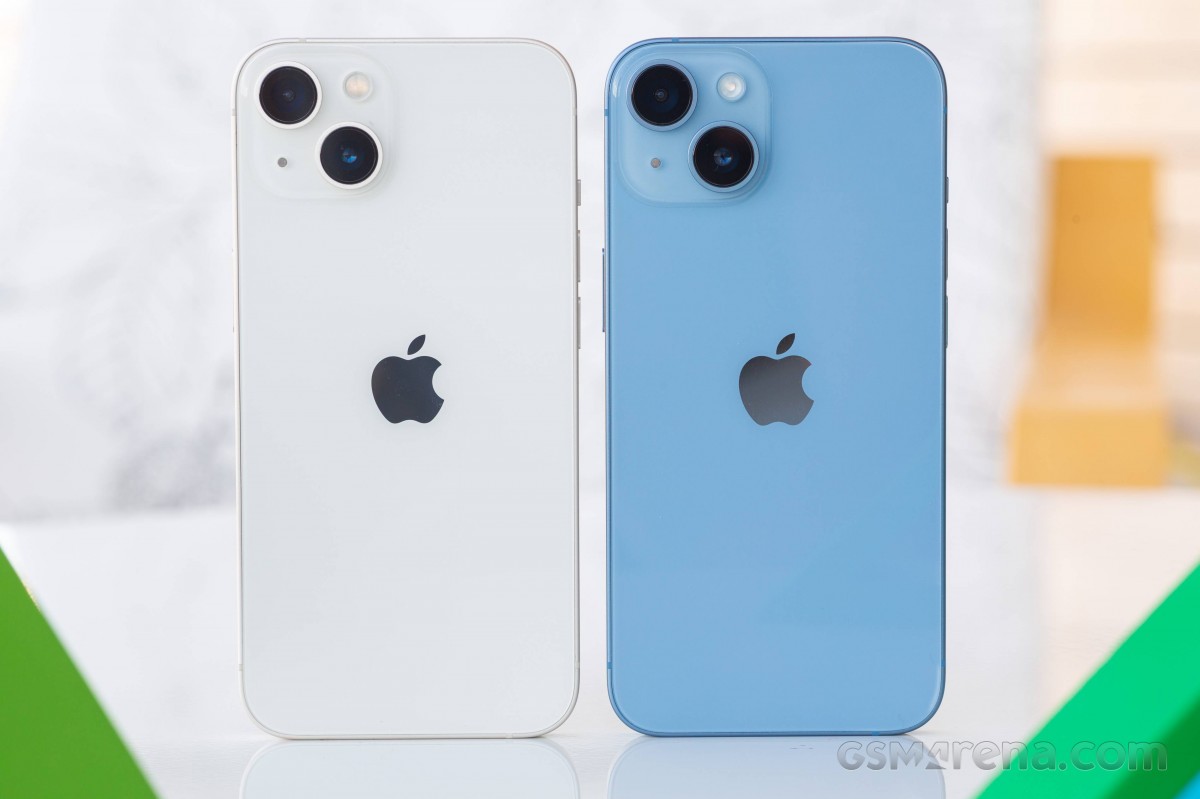
Left: iPhone 13 • Right: iPhone 14
The same is mostly true of the Asus Zenfone 9. It is compact and still packs a full set of flagship features and hardware, including Qualcomm’s latest and greatest Snapdragon 8+ Gen 1 chipset and a decently large 4,300 mAh battery. Among other things.
Left: iPhone 13 • Right: iPhone 14
Sort of on the other end of the spectrum, we find the Samsung Galaxy S22 5G. It runs the company’s highly-regarded One UI UX with all of the added high-level features it includes. Plus, you still get the latest generation of Samsung hardware, including excellent cameras.
Our verdict
The iPhone 14 is very much a familiar affair. It is an incremental upgrade over last year’s model. If you didn’t have time to go through the entire review, allow us to list all of the upgrades really quicky.
The iPhone 14 has a major internal redesign that makes it more easily repairable, particularly a back panel or a display swap is now much less of a pain. The iPhone 14 has only a slightly larger battery pack but notably better battery life and even faster charging. The chipset is last year’s A15 Bionic, but with five GPU cores, 6GB of RAM (50% more), Bluetooth 5.3, a more energy-efficient Qualcomm 5G modem, new satellite connectivity for SOS messages and new Crash Detection. The camera department has a new larger 12MP main camera with a 1/1.65″ sensor, 1.9-micron pixels, a new 12MP ultrawide and a new 12MP, f/1.9 selfie camera now with autofocus onboard. There is also the new Action Mode video stabilization, 4K Cinematic mode at 30 fps and a new Photonic Engine for better low-light photos.
It’s not an insignificant list of changes once you really dig in. Some are obviously more impactful than others, and it will be up to the individual user to judge what constitutes enough reason for an upgrade. The way we see it, anybody on an iPhone 13 has little to no incentive to jump ship. Unless you really need autofocus on your selfie cam, all of those other camera improvements only realistically result in shorter capture times in low light. We would even go as far as to say that iPhone 12 users shouldn’t feel too tempted by the 14 and can hold off upgrading for at least another year.
If you are running any iPhone older than that and you are looking to upgrade, then the iPhone 14 is nothing short of a solid and dependable way to go. Sure, it is a bit on the boring side in more ways than one, but you definitely know what you are getting into. For the more adventurous or frugal, there is also the option of picking up an iPhone 13 and potentially banking on some extended software support now that the A15 Bionic has gotten a new lease on life in the iPhone 14. Either way, you will be getting a great phone for the years to come.
Pros
Major internal redesign for easier repairability.
Bright OLED screen, HDR10, Dolby Vision and excellent color accuracy.
Solid battery life.
Loud stereo speakers, excellent output.
Great all-around performance from the older but still solid chipset.
Great photo and video quality across all three cameras.
Autofocus on the selfies camera and Action Mode are great camera additions.
Every iPhone comes with at least five years of iOS updates.
Cons
Minor upgrade over iPhone 13.
Wider feature gap with the 14 Pro: no 120Hz refresh rate, A16 Bionic, zoom camera or AF on the ultrawide.
The notch is still a polarizing design element.
The fast charging isn’t particularly fast, and the charger is not bundled.
Apple’s iOS restrictions can be off-putting to newcomers to the ecosystem.
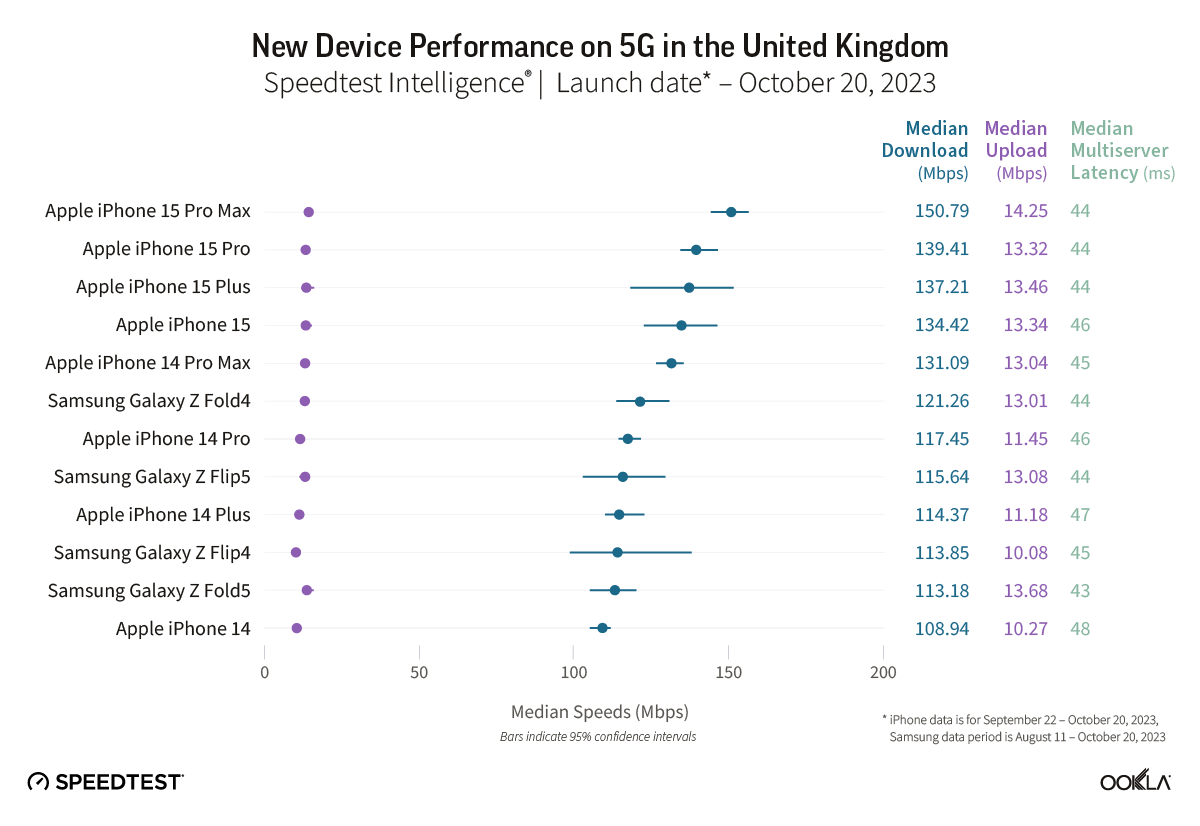
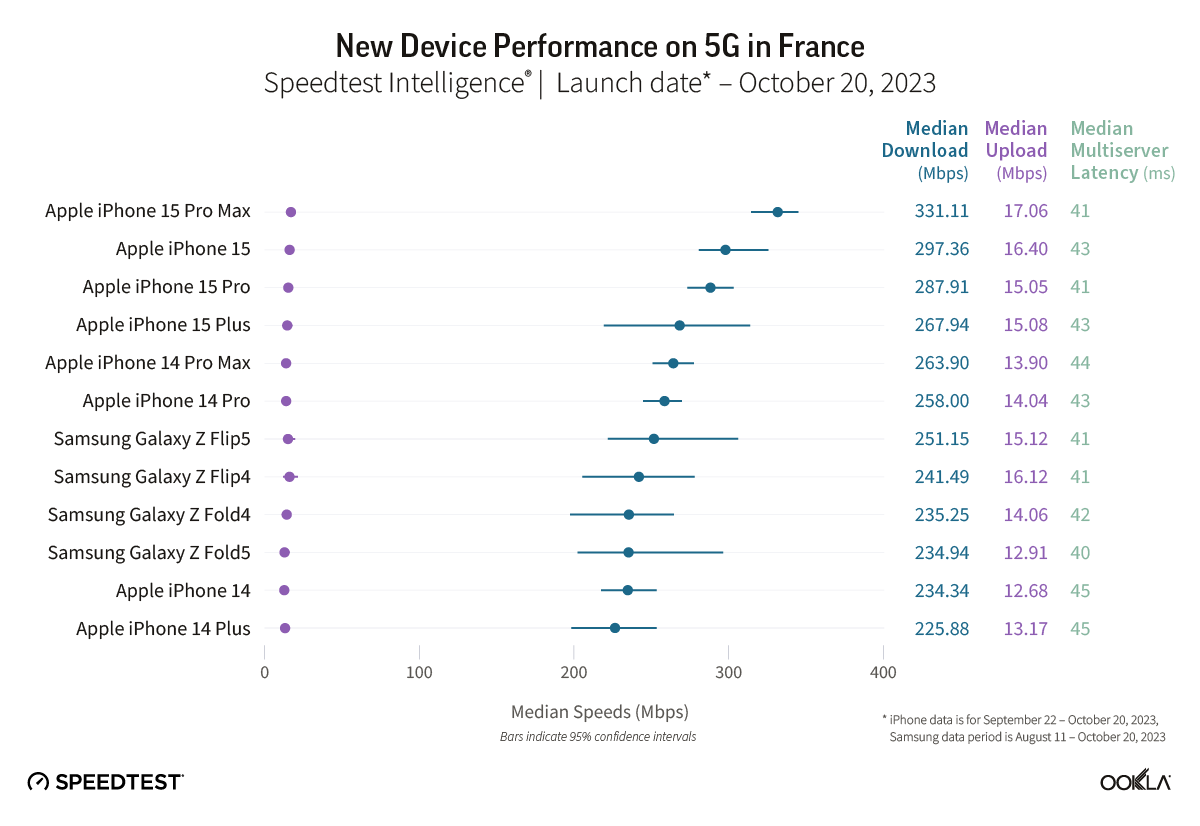
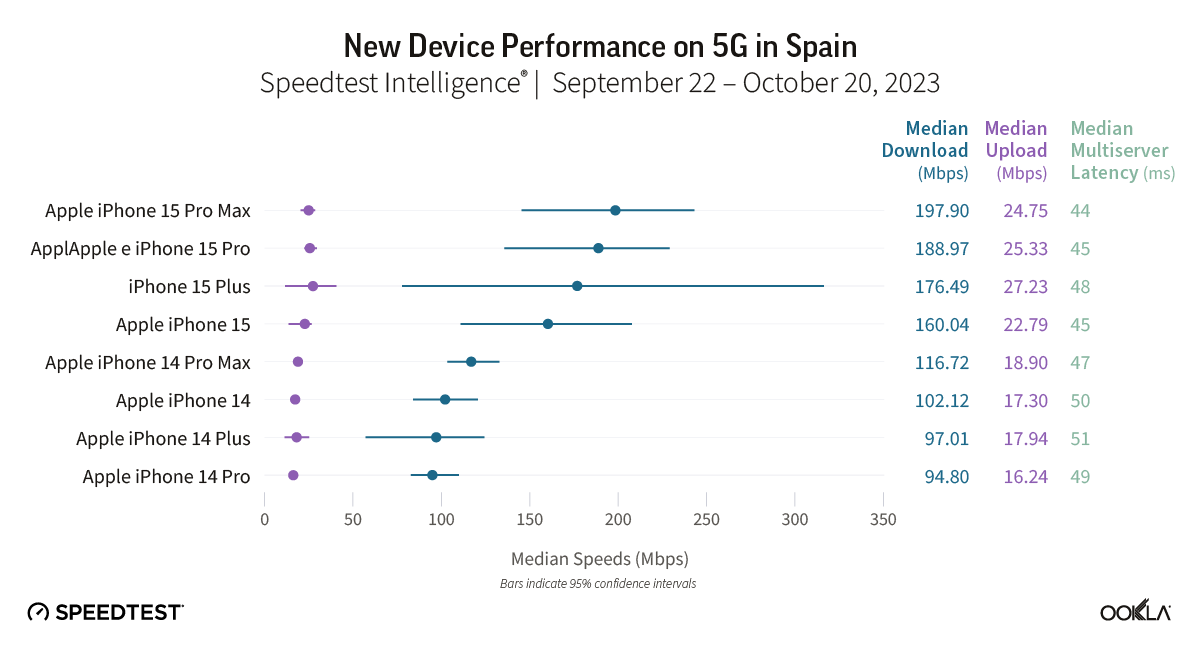
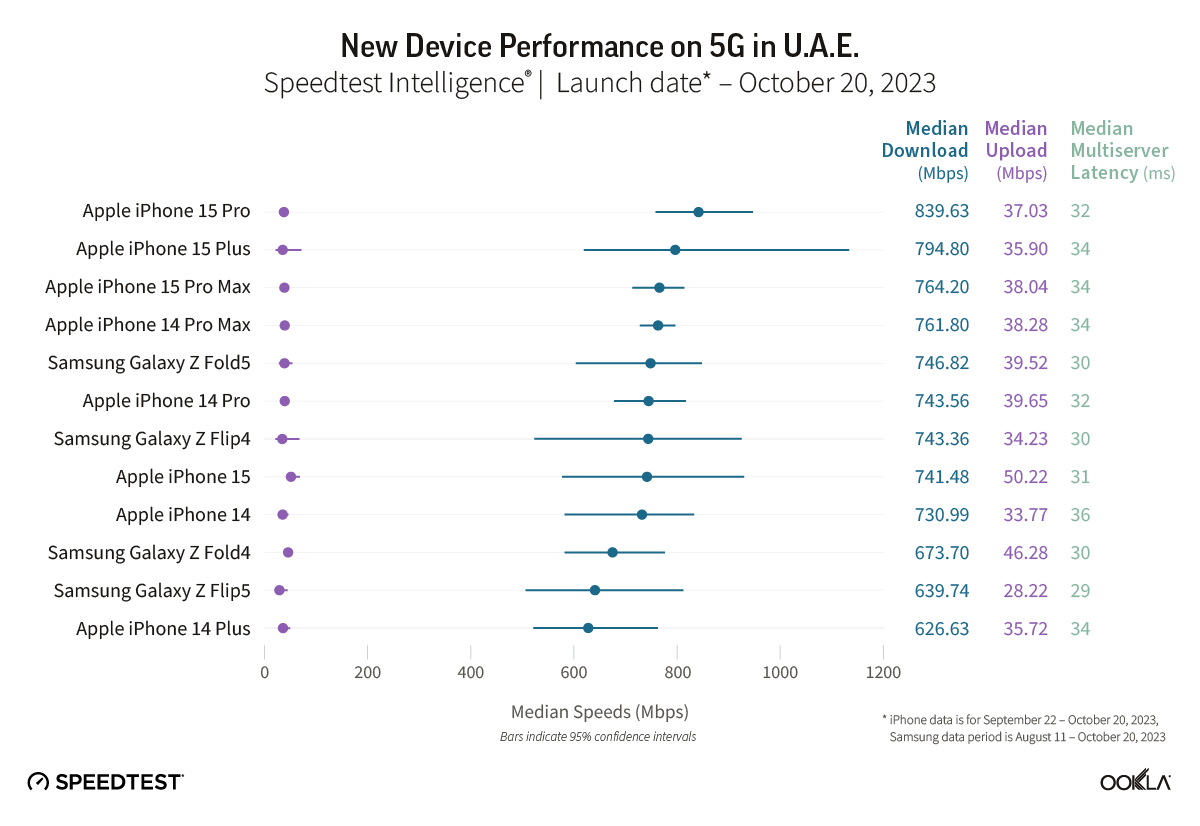
We got an early look at the iPhone 15 Pro Max cellular performance from Ookla in October with its Q3 report showing almost 100% faster 4G/5G speeds compared to iPhone 14 Pro Max. Now Ookla has shared a new 5G performance study and iPhone 15 lineup has dominated as the fastest 5G devices around the world.
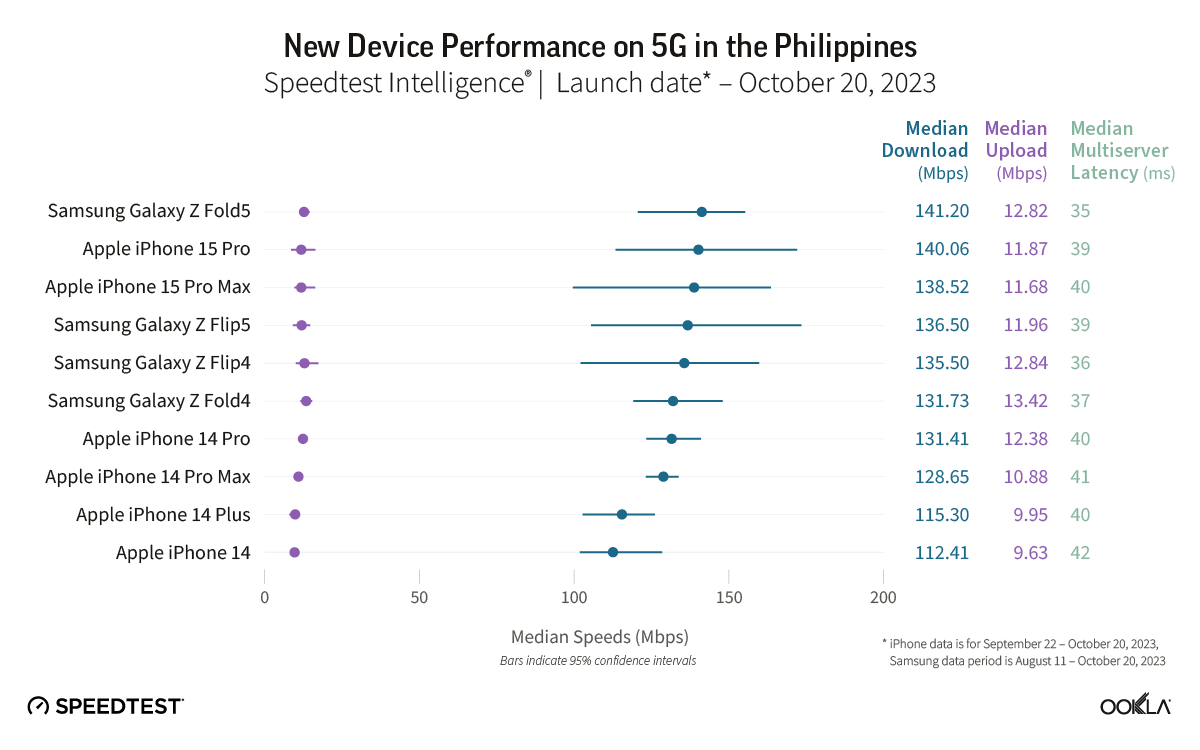
Ookla shared the new report on its blog. Collecting data from 13 countries between September and October for iPhone (August to October for Samsung devices), the results show the iPhone 15 Pro Max or in some cases the iPhone 15 or 15 Plus are the fastest 5G smartphones by a good margin. And an iPhone was the fastest 5G device in all but just one of the 13 countries.
Ookla notes that there are a number of variables when it comes to 5G performance like “5G investments by governments and mobile operators, different 5G spectrum allocations, and mobile 5G plans.”
In the US, the iPhone 15 Pro Max was on top with 285.02 Mbps as the median 5G download speed. The rest of the iPhone 15 family took 2nd, 3rd, and 4th place, with the next closest device being the Samsung Galaxy Z Fold5 with 231.56 Mbps.
5G performance in Canada was lower overall with the iPhone 15 Pro Max at 217.35 Mbps. The 15 Plus and 15 Pro took 2nd and 3rd and the Galaxy Z Fold5 snuck into 4th place with 175.63 Mbps.
In the UK, the new iPhones dominated with the Galaxy Z Fold4 coming in 6th place roughly 20-30 Mbps slower than the modern iPhones’ median 5G download speed.
One interesting result was in Brazil – the iPhone 15 took the top spot over the 15 Pro and Pro Max with 533.32 Mbps. However, the 15 Pro and Pro Max were close being with 523 Mbps.
The only country on the list where an iPhone didn’t have the fastest 5G median download speed was the Philippines. The Galaxy Z Fold5 beat out the iPhone 15 Pro by just 1 Mbps.
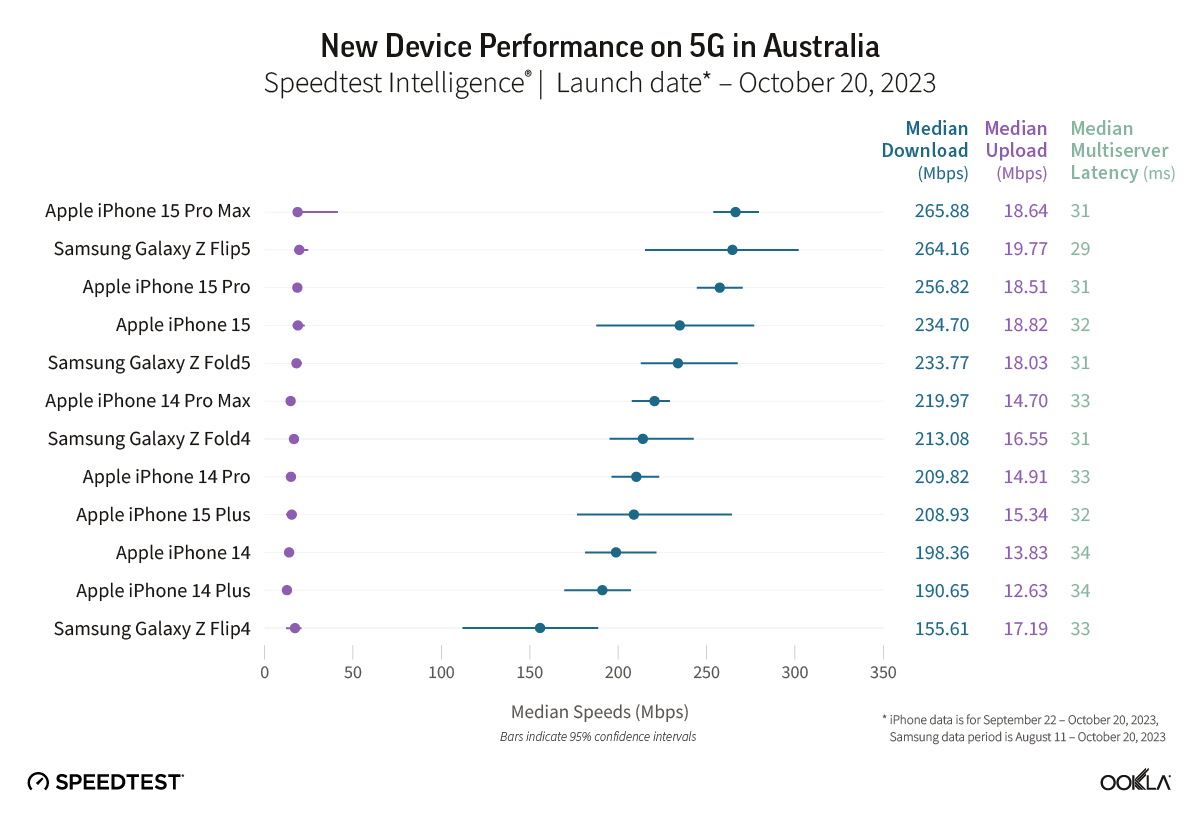
In Australia, two out of four iPhone 15 models showed median 5G download speeds that were significantly faster than their iPhone 14 equivalents during the September 22-October 20, 2023 period. Speedtest Intelligence reveals the iPhone 15 Pro and the iPhone 15 Pro Max both had a 14% better download speed than their prior year counterparts. There was no statistical winner for the iPhone standard model or the iPhone Plus in Australia during this period.
The Galaxy Z Flip5 had a 30% better download speed than the Galaxy Z Flip4 during the August 11-October 20, 2023 period in Australia, while there was no statistical winner for the Galaxy Z Fold.
Recommendation: Depending on your model of choice, only half the devices surveyed merit an upgrade based on performance alone in Australia.
Other Countries are:
Check out the full Ookla report on iPhone 15 5G performance against other devices for more details.
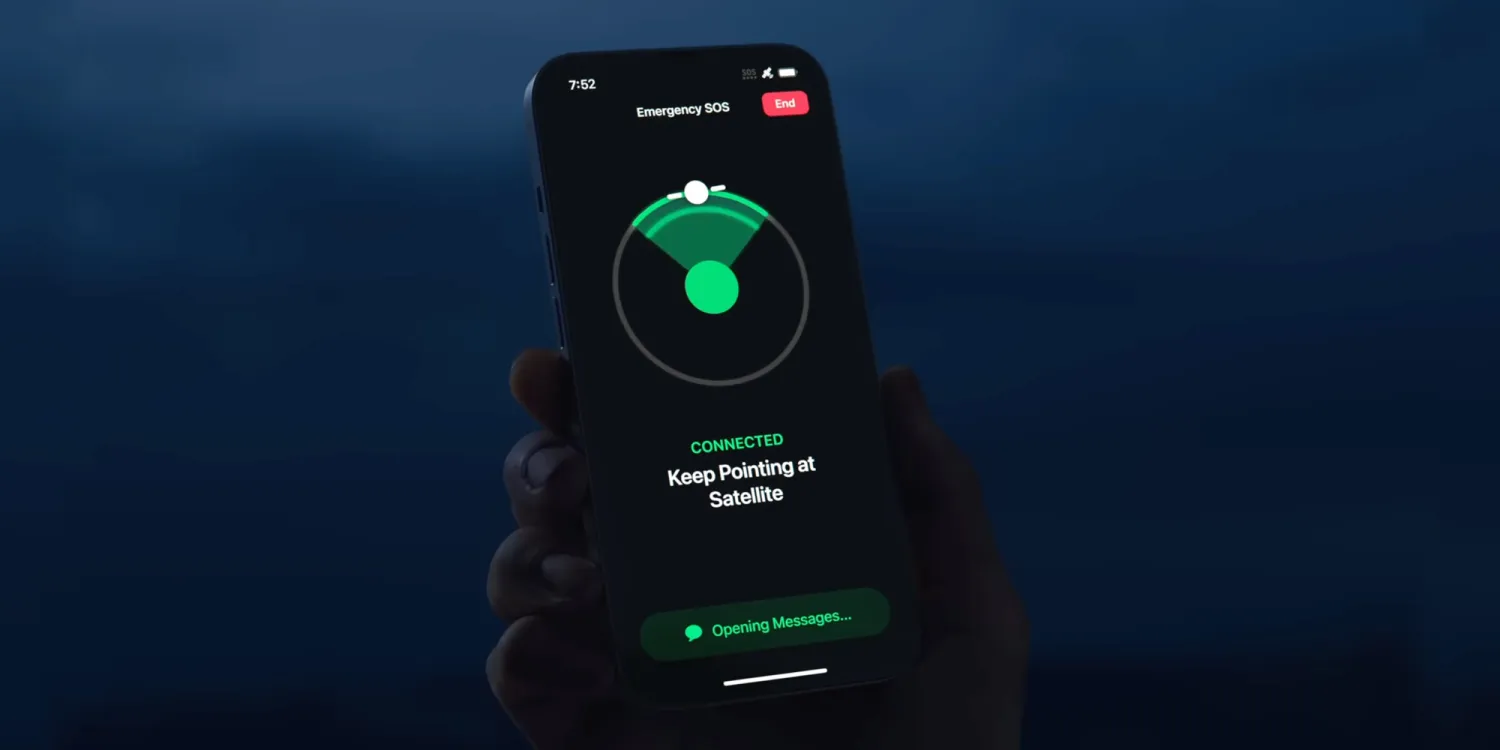
Apple today announced it is extending the free usage period for Emergency SOS satellite features for iPhone 14 users. Previously, Apple gave iPhone 14 customers two free years after device activation, which would have began expiring this time next year.
But now, all current iPhone 14 users will be able to use the service for free for another two years. Apple has not revealed how much it will charge for Emergency SOS via satellite when the free period is up, and today’s announcement means the company can defer any decision making on that further into the future.
The free period for iPhone 15 customers has not been extended. That means iPhone 15 users still currently are working on a two free years model, which will begin to elapse in September 2024.
This means iPhone 14 and iPhone 15 customers will see their free periods expire at roughly the same time, beginning September 2025. It gives Apple more time to decide on pricing plans for these features.
Emergency SOS via satellite allows compatible iPhone users to send short text messages to nearby emergency services even when outside of Wi-Fi or cellular signal range. It allows people to get help if they get into trouble in places where usually they would have no way to contact anyone else.
Users can also update their location in the Find My app using the satellite signal. With iPhone 15, Apple also extended the Emergency SOS feature to include contacting roadside assistance when your car breaks down.
Apple’s proud boast that the entire Scary Fast event was shot on the iPhone 15 Pro Max has lead to a lot of discussion and debate about what that really means, and whether or not it’s a big deal.
There are those suggesting it really does mean the camera is something special, while other are suggesting that it’s at best meaningless, and at worst a cheat …
The Verge’s Jess Weatherbed was one of the naysayers.
Still images and a video reveal that (unsurprisingly) a great deal of fancy equipment — from drones, gimbals, dollies, industrial set lighting, and other recording accessories — is still required to make iPhone footage look this good […]
It’s a neat way to promote the recording quality of iPhone cameras, but it’s not like everyday folks can recreate these kinds of results at home unless they happen to own a shedload of ludicrously expensive equipment. The gear shown in the “Scary Fast” behind-the-scenes footage is fairly standard for big studio productions, but Apple’s implication with these so-called “shot on iPhone” promotions is that anyone can do it if only they buy the newest iPhone.
I saw a few folks mocking Apple for this on Mastodon and Threads, too. This is ridiculous. Do these people think that previous Apple keynote films were shot with just a single camera person wielding something like a $40K RED cinema camera and no crew, no lighting, no cranes? That the iPhone “needs help” that traditional cinema cameras do not? I mean, guess what, they used professional microphones too.
The whole point is that an iPhone 15 Pro camera is so good that it can fit right in on a high-budget commercial film shoot, and produce world-class results. There’s no implication that a casual user can get results like this by just hitting the shutter button in the iPhone Camera app.
Personally, I fall somewhere between the two views.
There’s one cheat Apple didn’t use
First, there is one cheat that is often used on ‘Shot on iPhone’ video footage, and that’s the use of high-end lenses.
You can buy adapters that allow you to use either DSLR or even full-on cinema lenses with iPhones. While those still have to go through the built-in lenses, of course, they do allow you to achieve things that simply cannot be achieved with the built-in lenses, like anamorphic perspectives and really shallow depth of field (DoF).
Since Apple showed us behind-the-scenes footage, and we saw no sign of external lenses, we can be reasonably confident that the company didn’t use that particular cheat.
But set control is a very good workaround
Very often, you want shallow DoF because there are distractions in the background. When you or I are filming on the street, or in a public area, there are other people around, trash cans, litter, all kinds of distracting elements.
A big-budget production, in contrast, has complete control of the set. You can either build the background you need, or simply take complete control of it.
Clear out all the people, ensure there’s nothing untidy to clutter up the scene, add a bit of dry ice, and voila: a setting in which everything being in focus is just fine.
Lighting is everything
When I introduced a friend to studio photography, he was amazed that camera settings were set-and-forget. Manual mode, ISO 100, f/11, 1/125th, done.
All the control is achieved with the lights. High-key, low-key, upbeat, moody, colorful, monochromatic, background visible, background invisible – lighting is the route to achieving the exact look you want.
The same is true with video. But more than this, studio or cinema lighting enables you to overcome weaknesses in a sensor. Almost any modern camera phone does just fine in bright light; it’s in low-light conditions that we see the difference between a high-end sensor and a mediocre one. Throw in the kind of lighting rigs we see in the BTS video and it’s no surprise that the iPhone sensor can cope.
Now, you might argue that this was a Halloween theme, and a lot of it was pretty dimly lit – and that’s true. But the presenters are very well-lit indeed, and it’s them we’re looking at. If we turn our attention to the low-lit background, that has nothing like the same clarity or sharpness. Those areas are as muddy and noisy as we’d expect from low-light filmed with a smartphone sensor (and bear in mind this is the result after professional editors have done their very best to clean it up):
Camera angles, movement, and transitions do a lot
The other factor to bear in mind is that a lot of heavy lifting was done by all the rest of the kit we got to see in the BTS videos. Dollies, jibs, gimbals, drones, you name it.
Plus some absolutely superb editing, with Apple’s trademark transitions.
The result was a lot of camera movement, a lot of angles, a lot of fast-paced transitions to capture our attention. So we don’t have much time to take in the wider framing and notice the noise and muddiness in the background areas.
Is Apple pulling a fast one?
The debate essentially comes down to whether Apple is trying to give the impression that the iPhone 15 Pro Max camera is so good that anyone can get these types of results.
There are those who say: No, of course not. The very fact that Apple chose to share the BTS video acknowledges that you need all the extra kit to get these results. You’d use exactly the same additional kit if you were shooting with Arri movie cameras.
That much is true. But … you could take your Alexa Mini into an ordinary room, partly lit by window light alone, without all those fancy lighting rigs, and still get very good results. The results from the iPhone wouldn’t even come close. And it’s that latter situation where most of us would find ourselves shooting.
So while Apple does acknowledge that it used movie-grade kit, at the same time the implied message is ‘See? The iPhone can get similar results to movie cameras’ – when that is, in most circumstances, very much not the case.
You decide
Ultimately, this comes down to opinion. What Apple did was real, and used exactly the same kit it has used with cinema cameras in the past. At the the same time, those are the least-challenging conditions for any camera – and there are a lot of weaknesses in the images that simply flashed past unnoticed.
Exit iPhone mini, enter iPhone Plus! Indeed, the rumors came true, and this year Apple launched a bigger non-Pro model instead of a mini one. We can only guess what Apple‘s plans are about the mini model, but today’s review is about Apple’s newest addition to the iPhone series – the iPhone 14 Plus.
We thought the iPhone 13 would go down in history as the most insignificant iPhone update ever, but the iPhone 14 snatched that title. See, the iPhone 14 and iPhone 14 Plus are based on the same Apple A15 Bionic chipset as the iPhone 13 models, and even the screen specs have stayed the same – OLEDs with about 460ppi, 800nits brightness and 60Hz refresh.
In fact, there are only four notable upgrades on the iPhone 14 when compared to the iPhone 13 – the new primary rear camera (lifted from iPhone 13 Pro), the updated selfie camera with the new lens and AF, 2GB more RAM, and the Emergency SOS via satellite feature.
The new iPhone 14 Plus adds a couple of extra ones – the larger screen and the larger battery. The Plus model brings a Max-sized screen to the regular series – even if it’s only 60Hz.
The selfie camera, while retaining its 12MP sensor, has a new brighter aperture lens with optical stabilization, and autofocus. We always wondered why Apple didn’t introduce AF capabilities sooner, as the Face ID tech is there to provide a massive assist to that, but alas, it is finally here.
The iPhone 14 Plus is as waterproofed as the rest of the recent iPhones – it can last for 30minbs in up to 6m deep clean water. And it should be a desirable smartphone for its large screen and yet thin and lightweight design. It is also touted as the iPhone with the best battery life, and we will surely test this out.
Disclaimer. We can not guarantee that the information on this page is 100% correct.
Just like the iPhone 13 and iPhone 14, the iPhone 14 Plus has one glaring omission – high refresh rate support. And the size of the notch is an eyesore you need to put up for a few more years, apparently. At least, it looks subjectively smaller on this large screen.
We are glad the non-Pro iPhones are getting the new software features like Action Mode for the video camera, the improved Cinematic Mode, and the satellite connection, too.
Unboxing the iPhone 14 Plus
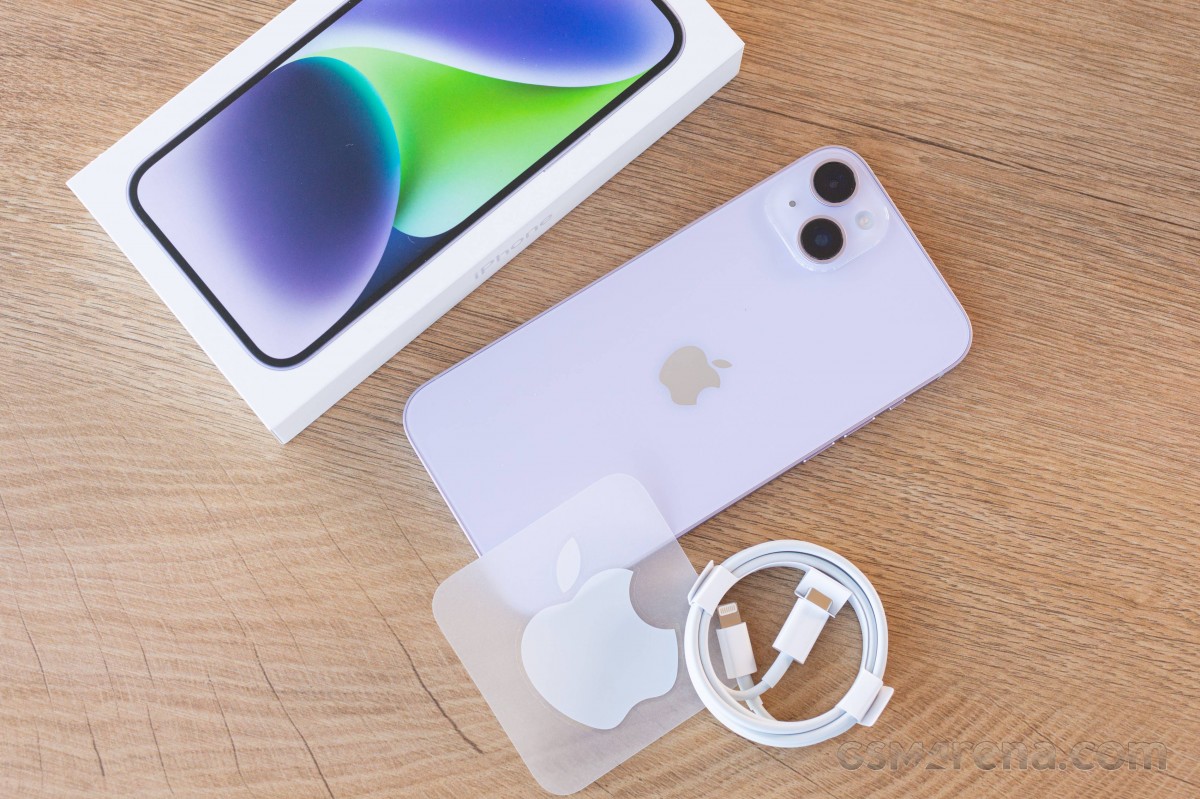
The eco-friendly iPhone box contains a USB-C-to-Lightning cable and the iPhone 14 Plus. There is also a SIM ejection pin, some paperwork, and an Apple sticker.
Apple was among the first manufacturers to ditch the headphones and the charger from its boxes.
If you have a 20W+ USB-PD power adapter with a USB-C port, you should be good.
Alternatives
The iPhone 14 Plus makes total sense in the grand Apple design – the maker has turned the SE model into a special mini edition iPhone, and that’s why the mini had to go from the flagship series. In fact, the vanilla iPhone 14 is so compact and lightweight that we can argue it has been the mini one all along.
Meanwhile, the absence of a larger iPhone for the masses has been quite obvious for the last couple of years, and it was only time for Apple to answer that call. And it did, in its own way.
The iPhone 14 Plus is essentially a supersized iPhone 14 and not much else. What you get is a Max-size display of non-Pro quality and better battery life thanks to the larger battery.
Now, all those Apple users who wanted a large iPhone that’s not overweight and ‘oh so premium’ can have the iPhone 14 Plus.
But, if you are still on the fence about this new Plus model, probably because of its €1,150 price tag, we can understand why you would want to explore more options.
For example, you can get the iPhone 13 Pro Max, which is pretty much the same phone but with an additional zoom camera, a better ultrawide shooter with AF, and a 120Hz ProMotion display. It can be purchased for €1,200 – which is quite an offer to consider. Yes, it is heavy because of the stainless-steel frame and the extra parts like LiDAR and the telephoto, but it’s a tradeoff many would take.
The iPhone 14, as we established, is the most compact current iPhone in circulation, and it’s quite the treat despite the 60Hz screen. It has the same specs as the Plus; it’s just smaller in size and incredibly pocketable. Oh, and it’s €150 cheaper.
Finally, Apple is also selling the older iPhone 12, which is basically an iPhone 13, and so on, starting at €800 for the 64GB model at Apple Store, or about €650 from third-party retailers. So, if you want the cheapest premium iPhone officially available, that’s the one.
Apple iPhone 13 Pro Max • Apple iPhone 14 • Apple iPhone 12
Of course, there are plenty of cheaper offers you can consider for their large screens outside Apple’s lineup. The €780 Xiaomi 12T Pro impressed us with its screen, charging speed, all-around performance and camera quality. The same goes for the Motorola Edge 30 Ultra – a phone with a 144Hz OLED screen, one of the first 200MP imagers, a 60MP selfie camera, and 125W fast charging. Finally, the Samsung Galaxy S22+ 5G has a large 120Hz OLED, one of the fastest Android chips, and an excellent trio of cameras on the back, including a zoom one.
The iPhone 14 Plus is one of the best iPhones Apple has ever made, as usual. It does exactly what it is supposed to do – offering the non-Pro experience on a larger display. A big bonus from the new size is the larger battery capacity and hence – the better battery life.
The iPhone 14 Plus is one of the lightest 6.7-inch smartphones around with a flagship-grade design, screen, speakers, battery life, performance and video quality. Meanwhile, its new cameras, including the AF-capable selfie one, are as controversial as usual – it’s like their quality hasn’t changed for generations because of the heavy processing and over-sharpening.
Still, this iPhone 14 Plus finds its way to the hearts and pockets of people despite the lack of a high refresh rate screen or zoom camera. A lot of users won’t mind this.
Its price tag may be too close to the 13 Pro Max for its own good, but last year’s flagship model has been officially discontinued, so you’d have to source it from an independent retailer but it’s definitely the better one between the two.
That doesn’t make the iPhone 14 Plus a bad smartphone and it’s well worth considering if you don’t need the extra features that the Pro models bring.
Pros
Sturdy design and sleek looks.
Excellent OLED, Dolby Vision, HDR10, high brightness.
Very good battery life.
Top-notch stereo speakers.
Flagship-grade performance even if not the latest chipset.c
Dependable photo quality from the main and selfie cameras.
Outstanding video quality and stabilization across the board, great action clips.
Every iPhone gets at least five years of iOS updates.
Cons
Wide feature gap with the 14 Pro family: no 120Hz refresh rate, A16 Bionic, zoom camera or AF on the ultrawide.
Priced too close to last year’s iPhone 13 Pro Max, which has most of the above.
No charger in the box, somewhat slow charging.
Apple’s iOS restrictions can be off-putting to newcomers to the ecosystem.
iPhone 15 and 15 Plus are Apple’s latest non-pro smartphones that come with a number of new features. But are they worth the upgrade if you have an iPhone 13? Follow along for an in-depth look at the iPhone 13 vs 15 for everything that’s changed.
Screen sizes and design
The screen sizes between the iPhone 13 and iPhone 15 remain the same at 6.1 inches. However, the 15 Plus offers a 6.7-inch option that wasn’t available with the iPhone 13 lineup without stepping up to the 13 Pro Max.
New with the iPhone 15 displays is the Dynamic Island and an outdoor brightness of up to 2000 nits.
Here’s the full look at the display specs for iPhone 13 vs iPhone 15:
The bezels on the iPhone 15 are also slimmer than the 13, which is what allows the very slight increase in pixels.
Size, weight, design
Overall, the physical design of the iPhone 15 remains very similar to the 13, but Apple has given the 15 more rounded edges for a more comfortable feel.
And as mentioned above, you’ve now got the larger iPhone 15 Plus option.
For size, weight, and materials, here’s iPhone 13 vs 15:
Of course, the new iPhones also come in new colors.
Performance – A16 vs A15 Bionic
Here’s a breakdown of the iPhone 13 vs iPhone 15 chip specs:
Both the A15 and A16 Bionic are powerful enough for almost everyone. But GeekBench offers a look at the performance difference between the A15 and A16 Bionic.
16% faster single-core score
21% faster multi-core score
29% faster GPU
Battery life
When it comes to battery life, the iPhone 15 has one hour longer battery for video playback than the 13 and 5 hours longer for audio playback.
The iPhone 15 Plus offers 7 hours longer video use and 25 hours more audio than iPhone 13.
iPhone 13 vs 15 cameras
Rear cameras
iPhone 15 and 15 Plus come with a 48MP main rear camera, next-gen portrait with Focus and Depth Control, Smart HDR 5, and more.
The iPhone 15/Plus main camera also has more powerful sensors and supports shooting both 24 and 48MP “super-high-resolution photos.”
Video recording
The main new feature for video recording with the iPhone 15/Plus compared to iPhone 13 is Action mode.
The other new video features this year are reserved for the iPhone 15 Pro and Pro Max.
Selfie camera
Apple’s TrueDepth front camera on the iPhone 15 gets a mix of upgrades found on the main rear camera.
iPhone 13 vs 15 I/O
The major change for iPhone 15 I/O is the switch from Lightning to USB-C.
Unfortunately, it’s only the 15 Pro and Pro Max that offer much faster transfer speeds with USB 3 support at up to 10Gbps. The 15 and 15 Plus have USB 2 speeds up to 480Mbps.
Two more differences between the iPhone 15 vs 13 include Bluetooth and UWB upgrades.
Whether the new iPhone 15 devices will support Qi2, Apple is saying yes but it’s a bit confusing.
So it’s also unclear if iPhone 13 will support Qi2.
Safety
iPhone 15 has two more advanced safety features than iPhone 13 Pro:
iPhone 15 colors
iPhone 15 and 15 Plus come in these five colors:
Black
Blue
Green
Yellow
Pink
Storage and pricing
iPhone 15/Plus comes in these storage options:
128GB – $799 / $899
256GB – $899 / $999
512GB – $1,099 / $1,199
What’s in the box?
iPhone 15/Plus comes with the iPhone and a USB-C cable in the box.
If you need a power adapter, go with at least a 20W so you get fast charging for your iPhone.
iPhone 13 vs 15: Is it worth upgrading?
The iPhone 15 and 15 Plus are fantastic smartphones, but whether upgrading from the 13 is worth it for you will depend on how you want to use your iPhone and what features you find important.
Reasons to consider upgrading to iPhone 15 or 15 Plus:
More powerful and capable cameras
Dynamic Island
USB-C
Faster chip and more powerful GPU for mobile gaming
Crash Detection and Roadside assistance via satellite
On the iPhone 15 and iPhone 15 Plus, Apple finally got rid of the Lightning port and replaced it with USB-C. This opens up a whole new world of convenience of connecting accessories and peripherals. The iPhone 15 Pro and iPhone 15 Pro Max go one step further, as the USB-C port on the pro models supports USB-3 speeds, enabling up to 10 Gbps data transfer speeds.
USB-C makes it easy to connect displays, external storage, cameras, and charge using the same cable as all your other devices. Here’s what you can do with your new iPhone and its shiny new port.
Why did Apple change from Lightning?
Apple was fully invested in Lightning port ecosystem on the iPhone. However, it began adopting USB-C across Mac and iPad models since 2015 as a way to modernize PC connectivity. USB-C is versatile, carrying power and data with the same connector. And USB-4 / Thunderbolt offers even higher data transfer speeds.
At the same time, USB-C was becoming increasingly popular on the Android side of the smartphone market. But Apple stuck with Lightning on iPhone, partly because they were still stung from the backlash of 30-pin -> Lightning transition that happened more than a decade ago.
The forcing factor for Apple was the EU commission, who have passed legislation to reduce e-waste by enforcing USB-C as the universal connector for phones. That would mean Apple would at least have to make a special model of iPhone for the European market. That brings its own complications. Instead, Apple chose to just adopt USB-C across the board … and apart from the frustration of customers having to change out all their existing now-defunct Lightning cables, that brings a lot of benefits.
Universal USB-C Charging
Now that you have an iPhone 15, you are probably close to being able to use the same single cable to charge all of your devices. Almost all iPads have a USB-C port, and all Macs have been sporting USB-C for a decade. The newest Macs come with Apple’s MagSafe charger, but they can also be charged by plugging in to one of their USB-C ports too. The latest-generation Apple TV comes with a USB-C remote, and Apple just released new AirPods Pro with a USB-C charging case.
Apple sells its own USB-C charge cables, and the iPhone comes with a nice quality woven cable in the box itself. Unlike Lightning, USB-C is not proprietary. To charge your Apple gear, you can use any USB-C charging cable or accessory on the market. That includes cheaper USB-C cables, and USB-C cables of different styles and lengths. Anker has a very convenient dual 47 watt USB-C power adapter, for example.
To charge your iPhone at full speed, you want to use a 20-watt or 30-watt power adapter. You can safely use a higher wattage power adapter like the one that comes with your MacBook; the phone will automatically manage the power. Learn more about fast-charging iPhone 15 here.
Charge other devices with your iPhone 15 battery
Another cool angle of the USB-C charging story is that you can now use the iPhone to charge other accessories. The iPhone 15 can accept up to 27 watts through the USB-C port, but itself can also output about 4.5 watts. (Lightning could only manage a measly 0.3watts.)
This means you can actually use your spare iPhone battery to power and charge connected accessories. If your AirPods are running low, in a pinch, you can plug them into your phone and your phone will top up the juice in your AirPods case. You could even top up the battery of another person’s iPhone — but just be aware it will take a while.
Easily connect to external displays
With Lightning, you could only connect to external displays via a clunky dongle. With USB-C on iPhone 15, you can output to a screen directly. Use a USB-C to HDMI cable and show your iPhone screen on a 4K TV or monitor, with screen mirroring. If you are watching a movie in a video streaming service app, the film will automatically fill the TV dimensions with playback controls on the touch screen. Easily show off your photo library or conduct a presentation with Keynote by just plugging your phone directly into a projector.
One of the use cases Apple is pushing is positioning iPhone as a portable games console. Using the power of the A17 Pro chip inside, iPhone 15 Pro can run some top-end games with high graphical fidelity. Pair an Xbox or PlayStation game controller, connect your phone to a TV, and start gaming. The Apple USB-C Digital AV adapter is a good choice for this use case, as it allows for HDMI, power output for continuous charging and passthrough USB-C in one convenient dongle.
Expand your local storage with portable USB-C hard drives and SD cards
Connect a USB-C hard drive or SD card reader and browse files directly using the Files app on iPhone. If you go on holiday and take a dedicated camera with you, you can import photos directly from the SD card into your iPhone’s photo library. Then, empty the SD card and keep shooting while you edit and upload the pictures you’ve taken on your phone’s big touchscreen.
The iPhone 15 Pro Camera app allows you to record ProRes 4K at 60 FPS video directly to USB-3 storage. ProRes is uncompressed and the file sizes are huge, consuming gigabytes per minute of recording. But pairing your iPhone with a 1 TB portable SSD, you can record for a while before running out of space. This requires a USB-3 cable (not simply charge cable) to take advantage of the fast 10Gbps transfer speeds possible through the iPhone 15 Pro’s port.
Connect hardware keyboards and wired internet
Sometimes, wireless doesn’t cut it — and you just need to plug in. USB-C on iPhone supports almost any basic accessory you can think of, without the need for special drivers or additional configuration. It’s all plug and play. That means you can connect a hardware keyboard will just work.
Or if you are podcasting on the road, you can record using a mini USB-C microphone. Another possibility is wired internet, using a USB-C to Ethernet adapter. And if you have a MIDI keyboard, you can make a song on the go with an app like GarageBand.
Wired headphones that work with your phone and computer
Since Apple dropped the headphone jack, much of the world has moved on to using Bluetooth wireless headphones like AirPods. But if you still prefer to plug in with a wire, using wired headphones with iPhone has been an inconvenient affair. Lightning earbuds worked with your phone, but nothing else.
Now, it’s all much simpler. iPhone 15 works with any USB-C headphones, including Apple’s new USB-C EarPods. These headphones will work with any computer with a USB-C port, so you can finally use the same wired headphones across your phone, iPad and Mac. An increasing number of high-end headphones and speakers also rely on USB-C connectivity these days.
Connect multi-port hubs
USB-C is very flexible and allows for data and power to travel over the same port. This means you can carry a single dongle, which is a multi-port hub comprising all sorts of IO. These are super convenient as iPad and Mac accessories, and now work with the iPhone too.
For example, this Anker 5-in-1 hub will work with the USB-3 USB-C port on iPhone 15 Pro and enable you to connect to external displays, connect to power, plug in USB accessories and an external display all at the same time.
The only thing you have to keep in mind is that the iPhone can output power to the hub at 4.5 watts. iPad and Mac can offer much higher bus-powered wattage, so if you are using them with the iPhone, you may need to also plug in an external power source.
Some of these capabilities were previously possible with Lightning but necessitated large, clunky, and special purpose adapters for each use case. USB-C is standards-based which means anything you buy will also work with other devices too. You don’t need to carry a special Lightning SD card reader anymore; the same USB-C peripheral will work just as well with your iPhone, iPad, Mac and any Windows PC or Android devices in the family as well. The universal connector life is finally here.







 Asus Zenfone 8 • Samsung Galaxy S21 5G