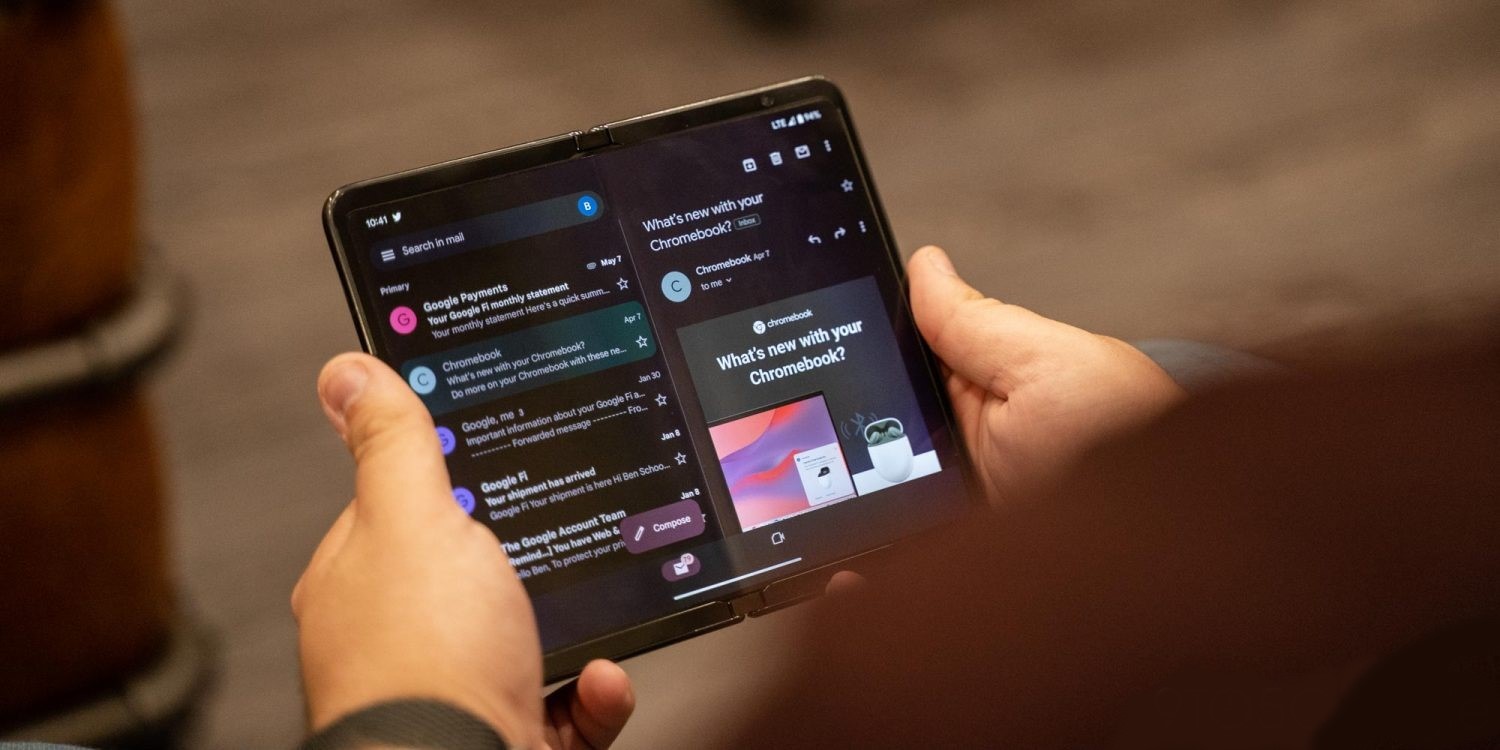
In Gmail for web, some users can experience Google’s Workspace Labs integration, which pulls Gemini’s AI functionality into the email site. One of the ways Gemini can operate is with the email summary feature.
In essence, Gemini can create a summary of email threads and content so you don’t have to dig through messages. It can prove to be rather helpful, but it’s still in the early stages of development.
According to PiunikaWeb, the email summary feature may also be coming to Gmail for Android. Hidden in an upcoming version of the app, the email summary tool was discovered. It comes as a button that sits right under the email’s subject, reading “Summarize this email.” Tapping would likely generate a summary at the bottom of the email, much like in the web version.
The tool doesn’t work in this infantile stage, but it showcases Google’s plans to bring Gemini to the mobile Gmail app rather than pioneer it solely on the web, which was unlikely. One could also argue that the feature would be even more useful in a mobile setting rather than on a desktop, where text and formatting are easier to make out.
Since this is a feature that shows signs it’s still being prepared Google hasn’t made any mention of when Android users can expect to see the Gemini-powered email summaries in Gmail. It’s also unknown as to whether the email summary feature from Gemini on mobile will be a limited rollout like the current version on the web.
Google is finally adding a native translate capability to Gmail for Android and iOS after long supporting it on the web client.
Update 8/21: Gmail’s translate feature is rolling out via a server-side update. We’re seeing it with version 2023.07.23.x. It’s not yet widely available, but one way to check is by tapping the second overflow menu in the message body for “Translate.”
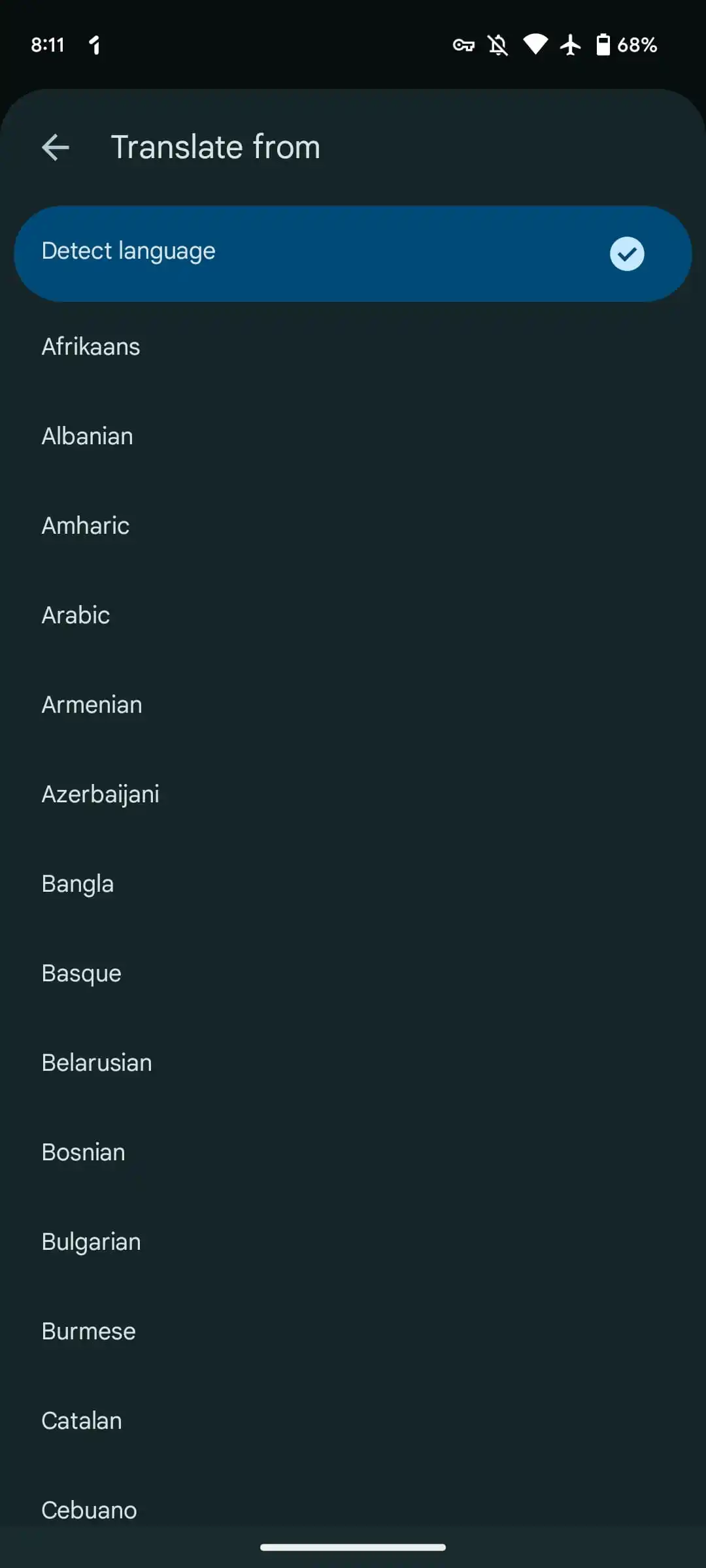
That option brings up a banner with the settings gear letting you select something other than “Detect language.”
Before the message body, Gmail will show a “Translate to” banner. Tapping updates what appears below with the ability to “Show original” again and “Automatically translate” a specific language going forward.
Press the settings gear to pick another output language, with over 100 supported. This prompt appears when the contents of an email doesn’t match your “Gmail display language,” which is the first dropdown menu in web app settings.
You can manually translate a language by going into the three-dot overflow menu in the top-right corner if an email was not recognized. The feature can also be disabled for a specific language by clicking ‘x’ on the banner and then “Don’t translate [language] again.”
Translations in Gmail for Android are rolling out from today onwards, while it will come to iOS in the coming weeks. This is a much-needed integration as users previously had to open an email on their computer, or taking a screenshot on mobile and send it to Google Lens or Translate.
Available to all Google Workspace customers and users with personal Google Accounts
Gmail encouraging users to enable Enhanced Safe Browsing
Over the past few days, Google has been prominently promoting Enhanced Safe Browsing in the Gmail apps.
Appearing just above your inbox on Android and the web, getting “additional protection against phishing” is the main benefit for Gmail users: “Turn on Enhanced Safe Browsing to get additional protection against dangerous emails.”
We first saw this message on Friday, and it’s seeing a wide rollout. Google touts:
Provide real-time security scanning to warn you about or block dangerous websites, downloads, and extensions.
Improve Google’s ability to detect and protect against phishing and malware for you and everyone on the web.
Give you better protection from dangerous links across Google apps.
In other security news, Google shared today that “70% of Google Accounts, owned by people regularly using our products, automatically benefit from second factor authentication that confirms their identity when a suspicious sign-in is detected.” The company is looking forward to wider passkey adoption.
What is Enhanced Safe Browsing
First introduced three years ago in Chrome, Enhanced Safe Browsing provides real-time web protections. The standard, non-enhanced version works by checking the URL of sites you visit against a local list that is downloaded/refreshed every 30 minutes (as of 2020). This list is widely used by many other apps and browsers.
Google created Enhanced Safe Browsing because “sophisticated phishing sites” got around the update period. “Uncommon URLs” are sent in real time to determine whether you’re about to visit a phishing site, with Chrome also sending a “small sample of pages and suspicious download,” while Gmail, Google Drive, and other apps you’re signed in to contribute data.
Later on, Enhanced Safe Browsing expanded to provide warnings about Chrome extensions, conduct in-depth file analysis, leverage ML models, and is now also available in Chrome for iOS.
It’s also accessible in Chrome settings: chrome://settings/security.
New Gmail ‘Offer times you’re free’ tool streamlines calendar scheduling
Google is rolling out a new Calendar tool in the Gmail web client that makes it easier and faster to schedule meetings.
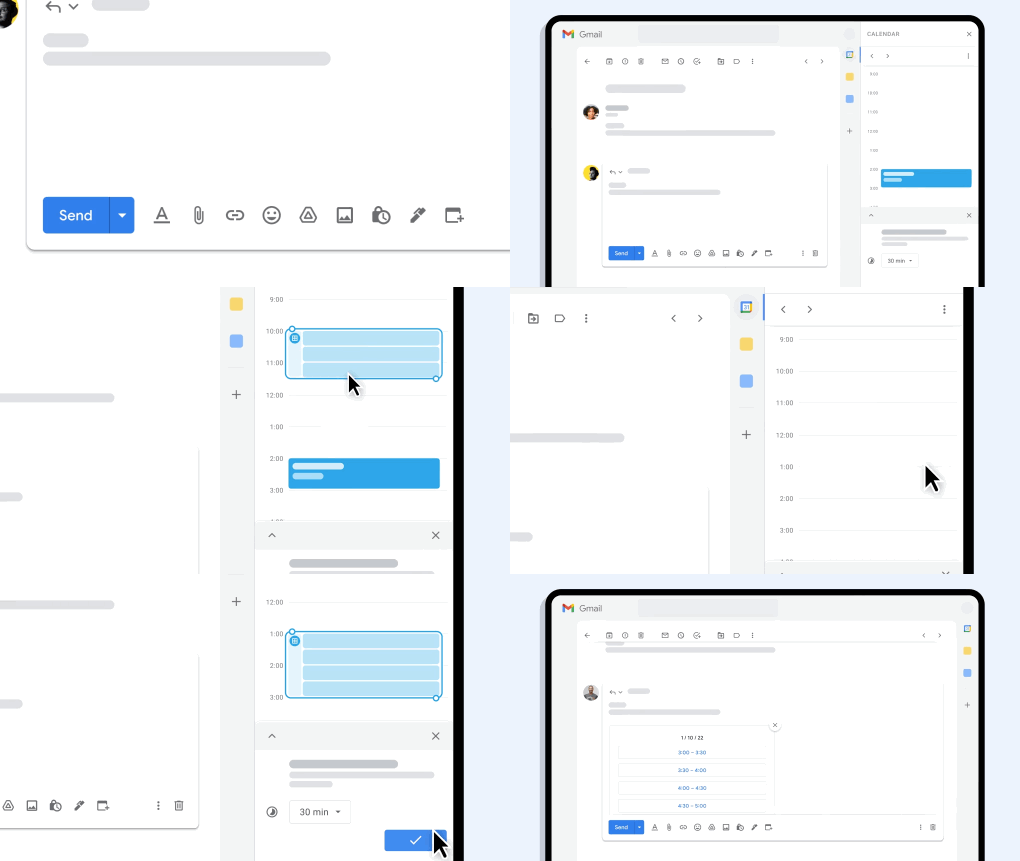
When composing an email on the web, the toolbar will feature a new Calendar icon at the right with two options:
Create an event: This functionality was previously accessed from the “three dot menu on top of the email conversation view.” Event title and recipients are pre-filled from the email. Gmail will also automatically insert an event summary into the email body for easy sharing.
Offer times you’re free: This new option opens the Calendar side panel, where you can “select and insert proposed meeting times” by highlighting what’s free in your primary calendar across multiple days. Recipients will be able to select one of the proposed times via an interactive email reply, and this will automatically generate a Calendar invite after confirming their name and email address.
At the moment, Offer times you’re free only works for 1:1 meetings: “If multiple people are included in the recipient list, only the first person to book an appointment will be added to the event automatically.”
Google hopes to make “scheduling much easier by reducing the back-and-forth in lengthy email threads when negotiating or scheduling meeting times.” This is rolling out over the coming weeks:
Available to all Google Workspace customers and users with personal Google Accounts
Google gave an overview of what generative AI features are coming to Workspace apps two weeks ago and is now beginning public testing in Gmail and Docs.
Today’s trusted test program spans consumer, enterprise, and education users (over 18) in the United States. This “small group,” invited to join by Google, must sign up and opt in, with the ability to leave the program at any time.
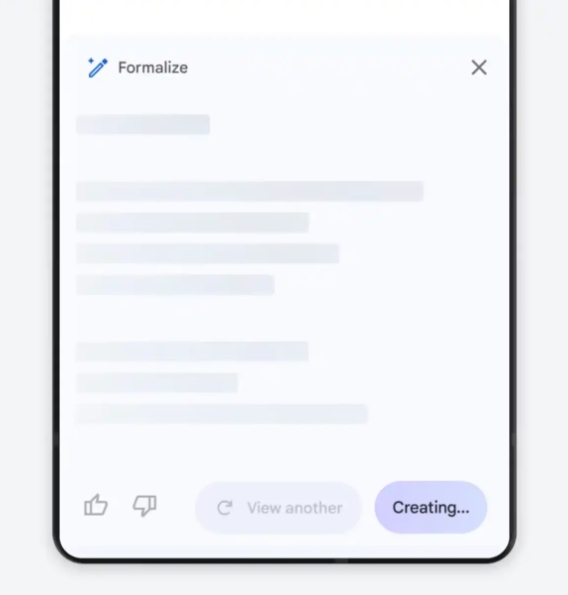
In Gmail, you can use generative AI to draft everything from a birthday invitation to a job cover letter. Users can also have Google take what they’ve written and make it more elaborate or shorten it, including down to bullet points. There’s also the ability to “Formalize” a message, while Google has shown off a whimsical “I’m feeling lucky” option that adds levity and makes other whimsical stylistic choices (e.g., emoji).
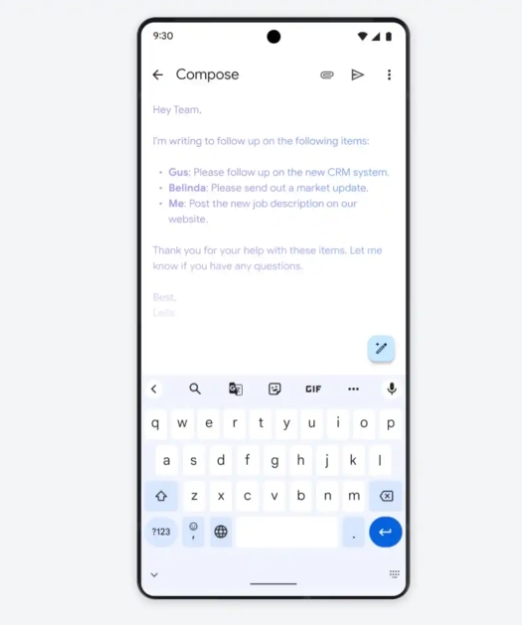
So far, Google has shared what the UI looks like in Gmail for Android, and we’ve spotted it in development. A floating action button (FAB) appears in the bottom-right corner of the Compose screen, revealing the options.
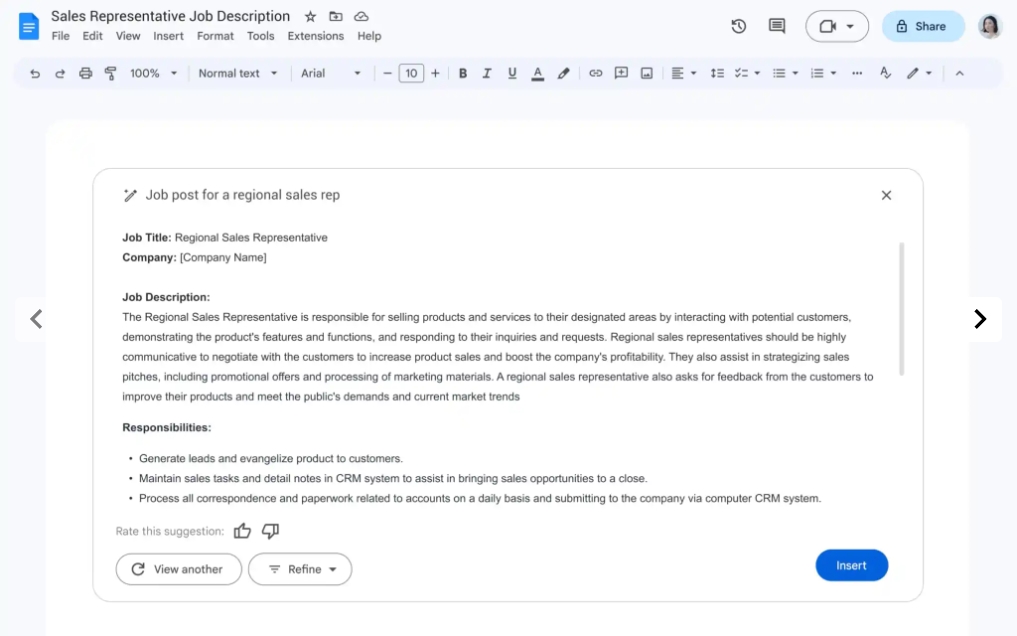
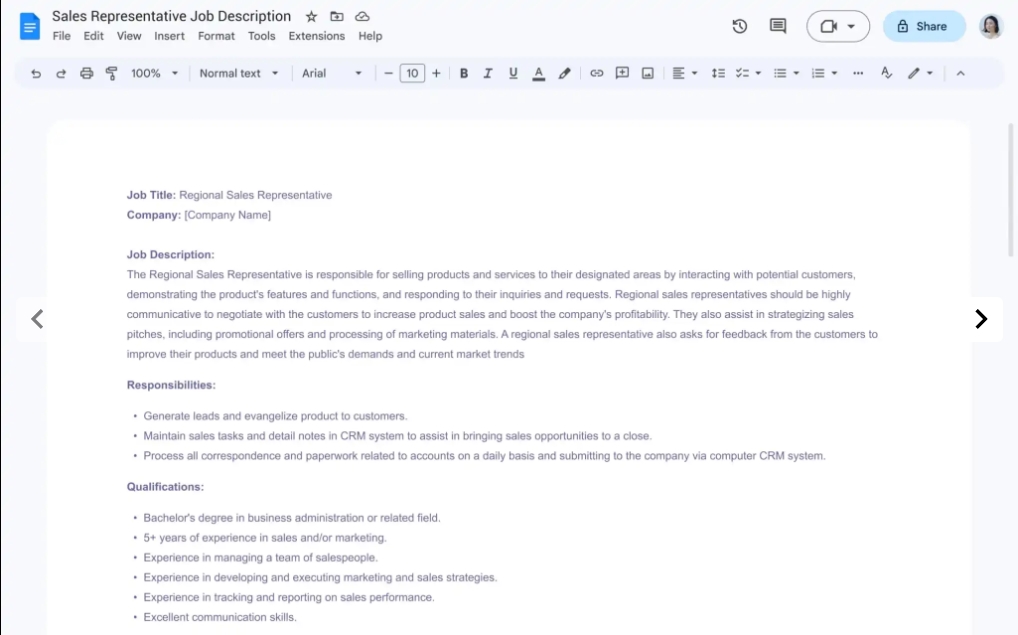
Similarly, AI in Google Docs can make text more detailed or rewrite it to be concise. It can also be used to draft blog posts or even write song lyrics. There will be a “Help me write” button on the web that expands when clicked to reveal a prompt input. Google then generates your request, with users able to thumbs up/down, generate/”View another,” and “Refine.” You can then “Insert” it into your current document and make edits.
Within Gmail and Docs, those enrolled in the test program will be able to submit feedback that Google will use to refine and iterate on the generative AI functionality. This will mark the first time that people outside of Google have access to these Workspace capabilities.
Google will be expanding availability “over time,” with those interested told to monitor a new landing page for opportunities to participate in the future. At the moment, there’s no Bard-esque waitlist to be joined.
The shape and color of Google AI
From what was shared earlier this week in Gmail and Docs, Google Workspace is using a pencil icon with a star in the top-left to brand its generative AI features. (The pencil or pen itself is a generic icon, and already used today in various FABs, like Compose in Gmail.)
So far, we’ve concretely seen it in:
Gmail (on mobile): FAB above your keyboard in the bottom-right corner. The sheet that slides up is titled “Help me write,” with Formalize, Elaborate, Shorten, Bulletize, I’m Feeling Lucky, and Write a draft. As the email is created, the gen AI icon remains in the top-left corner with the capability you selected next to it.
Google Docs (on desktop): Pill-shaped “Help me write” button with the icon. Tapping expands to a full-width text box to write your prompt.
Besides the icon, and what’s more interesting, is the blueish-purple hue color used throughout. In the Google Docs example, it’s the background of the button and expanded text field. As text is generated, it first appears in that color before switching to black. Similarly, the blue “Create” button turns to “Creating…” with a pulsating background as it’s working. This was also the case in Gmail for Android.
The “new era for AI and Google Workspace” has more examples of this, though the UIs shown here are presumably less finalized than Gmail and Docs. It’s an interesting hue, with this text loading effect being somewhat whimsical, while also masking that generative AI literally needs a second to work.
Previously argued that “Google Assistant” should be how the company brands AI features that users manually invoke. For the initial launch, Google is just associating the generative AI capabilities directly with each product rather than suggesting that a separate AI product/service has been added to Gmail, Docs, etc.
Microsoft is taking the opposite path. After renaming the Office suite to “Microsoft 365” last year, it’s adding “Copilot” (branding that the company has previously used in conjunction with GitHub) to Word, Powerpoint, Excel, Outlook, and Teams. It’s the equivalent of slapping an “AI” sticker on metaphorical software boxes.
Historically, Google has shied away from that flashier approach in its Workspace products. Features like Smart Reply and Compose just stand alone, even as they exist across Gmail, Docs, and Chat. It very much fits how Google names its products very plainly after their main function rather than coming up with a brand.
It remains to be seen which strategy wins out (i.e., attracts more users) for generative AI in productivity apps. Microsoft wants to make a splash and invigorate its (already widely used) tools. Inherently, giving something a name means people know what to call and credit it. Alternatively, it gives users something to blame. (Alas, poor Clippy!)
Meanwhile, Google is going for a somewhat timeless approach by framing the addition of gen AI tools as a continuation of how it iterates products to be helpful. In that sense, generative AI – once it becomes commonplace and widely adopted – could just be an evolution rather than a revolution in the long history of computing.
On the surface, Gmail seems like a basic email platform for simple sending and receiving. Under the hood, there are tons of functions you can make use of – schedule send, label organization, theme changes, and even Google’s Gmail chat. Read along to find out how each of these useful features works.
How to schedule send in Gmail
There are plenty of times when you have an idea, something to say, or a picture to send, but it’s way too early or late at night to do so. That’s when Gmail’s scheduled send really comes in handy. This feature allows you to delay sending an email until a preferred time in the future.
You can schedule an email to send well over a year in advance if you really want to. In fact, there doesn’t seem to be a limit on how far out you can schedule an email.
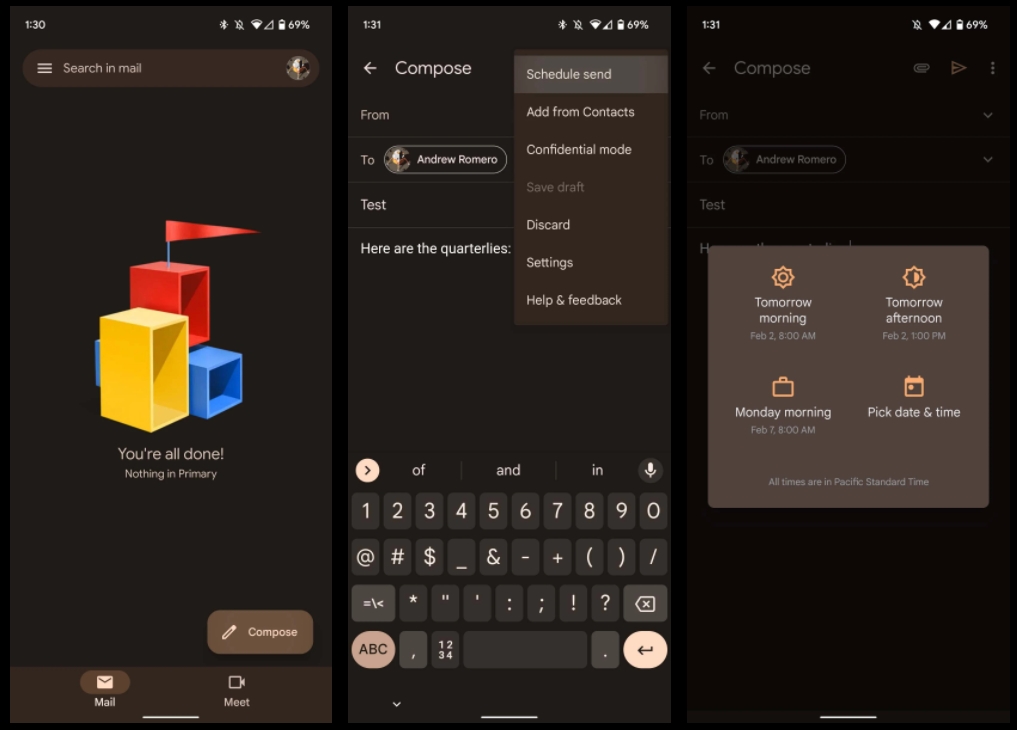
Find the Compose email button on the lower right side of your screen, and tap it.
Compose an email like you would normally.
When you’re done composing, tap the three-dot menu at the top right of the screen.
Tap Schedule send, and select your time.
You can choose between Google’s presets, or you can define your own timeframe by hitting Pick date & time.
Hit Schedule send to confirm and finalize your email.
Web
Head to gmail.com on your preferred browser, and sign in.
Look for the compose button. It should be located toward the top left of your browser screen. Click it.
Write out your email like normal. When you’re finished, click the dropdown arrow next to the Send button.
Click Schedule send.
Just like on mobile, you can choose a Google preset time, or pick your own time by hitting Pick date & time.
Click Schedule send to finish the email.
Both on mobile and web, you can cancel any email that you schedule in two different ways. First, you’ll notice a small notification at the bottom of the screen after you schedule an email. This notification has an Undo button on it. By hitting this, your email will cancel and revert to draft form so you can edit and try again.
The other way to cancel the email is to head into your Scheduled folder in Gmail, which appears after scheduling an email on web but is constantly there on mobile. Here, you can find your scheduled email and choose to delete it or cancel it by opening it and tapping Cancel send. Schedule send in Gmail can come in handy pretty often, so it’s a good function to know how to use.
Organizing by changing label colors in Gmail
Labels in Gmail act sort of like dynamic folders for the emails you want to organize and sort. You can add rules for new emails coming in to automatically sort into labels and change the color of the label in order to easily manage them. Changing the color is relatively easy to do and can liven up your inbox a little more. While this feature is only available on Gmail for web, it’s still an extremely useful organizational tool. Here’s how to change label colors in Gmail:
In the sidebar menu to the left of your screen, find a label you’ve created.
Note: If you don’t have any labels created, you can do so by scrolling down in the sidebar menu and clicking Create new label.
When hovering over a label with your mouse, you’ll see a three-dot menu appear. Click it.
Click Label color and choose among the preset colors Gmail has to offer, or create your own.
Automatically organizing emails
You can also create rules for emails in your Gmail inbox to automatically add labels. For instance, tax-related documents and receipts can be siphoned into one label for easy management. Not only that, but emails can automatically be forwarded, deleted, archived, and much more. Here’s how you can create incoming email rules:
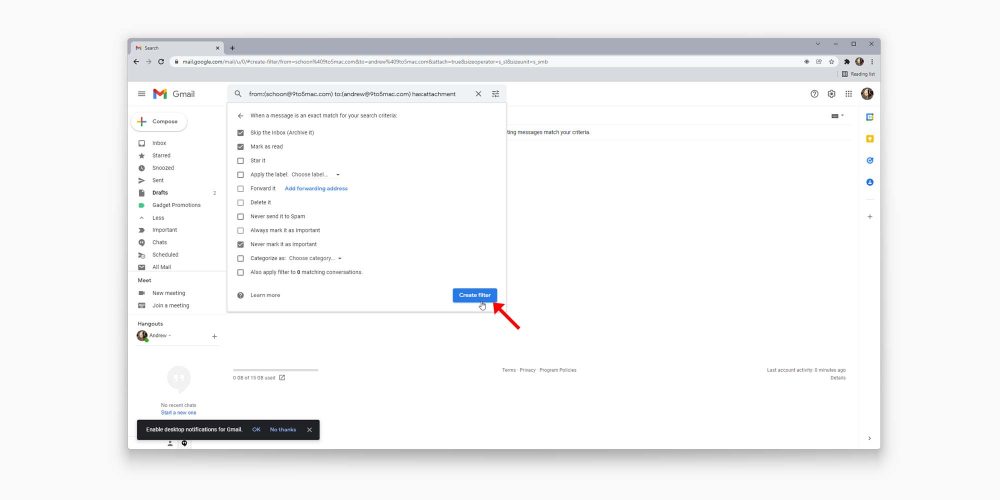
At the top of the page, click the adjustment icon in the search bar.
Fill out the parameters to your liking.
Note: Here, you can define a set of emails from certain senders as well as define emails including certain terms. This form can be filled out in a lot of different ways, and not all boxes need to be filled. You can test out your parameters by clicking Search to see what sort of emails come up.
Once you fill out the information to your liking, click Create filter.
Choose what happens to those emails.
Note: Here you can choose whether these emails get immediately deleted, starred, or moved into an existing or new label.
Once you’re done, hit Create filter again.
Creating rules for incoming emails is a Gmail feature that can help you stay organized a lot more easily. Play around with different rules to see what helps you out the most as this tool can be used a thousand different ways.
Unread message icon in Chrome
Another nifty little feature you can enable is the unread message icon. This icon will appear as a number in your Google Chrome tab icon, showing you exactly how many emails you haven’t read yet. Here’s how to enable it:
Look for and click the settings cog at the top right of the page, then click See all settings.
Find and click the Advanced section.
Scroll to the bottom, and find the Unread message icon. Click it.
Click Save changes.
Gmail will refresh after hitting Save changes. You’ll notice a small number appears on the Chrome tab if you have unread emails.
Gmail viewing modes
Whether you like your inbox to look condensed so all your information is right where you need it or spaced out, Gmail has you covered. By going into Settings, you can change Gmail’s density. There are three options:
Default
Comfortable
Compact
Play around with these different viewing densities, and choose one that fits your needs. Personally, I like default, since it allows the most information at a glance.
Changing your Gmail theme
Some Gmail features are purely there as quality-of-life settings. Themes fit right into that category. Rather than a dull white or black Gmail, you can develop or choose a theme that represents you a little better, or just lightens up your mood when replying to monotonous emails all day.
Gmail allows you to choose between preset photos, colors, and even your own Google Photos images to use. Here’s how to change your Gmail theme:
Look for the settings cog at the top right of the page and click it.
Look for the Theme section. You can choose from these few photos, or you can hit View all to choose from even more.
Once you hit View all, scroll through the page and find what really speaks to you. If nothing does, click My photos at the bottom left.
Choose between Featured, My photos, and Recently selected if you’re wanting to revert to a previous photo.
Note: If an image is over 20MB, you won’t be able to use it for your theme.
Once you find the photo you want, select it, and hit Save.
Once you save, you should see your new theme appear in the background of Gmail. There’s no limit on how many times you can change your theme, so go nuts.
Turning off Google Chat/Meet in Gmail
Some settings are fantastic when enabled, others are even better when disabled. One example is Google Chat and Meet. While these optional chat platforms can be useful for communication, it tends to clutter up Gmail, which is already prone to clutter.
Whether you should disable Google Chat and Meet is completely up to you and how you use Gmail. In case you never use these features and want to clean up your Gmail experience, here’s how to disable Chat and Meet:
Look for the settings cog at the top right of your screen.
Tap See all settings.
Look for and click the Chat and Meet section.
Next to Chat, select Off.
Next to Meet select Hide the Meet section in the main menu.
Click Save changes.
You don’t have to disable Google Chat and Meet in Gmail or even either of them. It all depends on your preferences for using Gmail. Once you hit Save changes, Gmail will refresh, and your changes will be reflected. Suddenly, you’ll find that the side menu is much less cluttered and easier to navigate.
These are just a few things you may not have realized you can do to change your Gmail experience. Whether you want to implement all of them or none of them is up to you. Either way, Gmail is a great tool and even greater when you know how to organize labels, change their color, and disable certain features.
Google is rolling out a trio of productivity updates to its iPhone and iPad productivity apps. Notably, Gmail will get a homescreen widget, while iOS Picture-in-Picture is now available for Google Meet.
Gmail is getting another widget on iOS after the original was quietly removed sometime in the past year. The screenshot Google shared today shows your inbox with three recent emails that note the sender and subject.
What account they originate from is highlighted in the top-left corner by your profile picture, while there’s a compose FAB at the left. Functionality-wise, it’s identical to the Android version, which is due for a Material You overhaul. The iOS widget will be available in Gmail over the “next few weeks.”
Meanwhile, Google recently added Picture-in-Picture support to Meet. It’s a fairly standard implementation with the ability to resize the window. A PiP is also coming to the integrated video calling experience in mobile Gmail over the “next few weeks.”
For example, you might want to forward an email, share a document or just look something up while you’re chatting. Simply navigate out of the Google Meet app, and your meeting will be minimized in a window that you can move around your Home Screen.
The last upcoming update will see Google Sheets add support for shortcuts — hold down the command key to see a list of available ones:
Shortcuts make it easier to complete common and advanced tasks on Google Sheets using a small keyboard — like selecting a whole row or finding and replacing certain values.
Gmail on the web is set to get a navigation revamp this summer, while the Android app is now beginning to roll out a Material You redesign.
It starts on the homescreen, with the top of the page seeing a pill-shaped search field that features a hamburger icon on the left and profile avatar/account switcher at the other end that fits the curvature. The layout of the navigation drawer is unchanged with this revamp, while various buttons in Gmail are now rounded.
At the bottom, we get a taller bottom bar — like we enabled in Google Play — that makes use of a pill-shaped indicator to highlight what tab you’re currently viewing. The selected icon is also filled out, while Gmail leverages a rectangular Compose FAB just above it — similar to the one in Google Contacts.
The other big change today is the use of Dynamic Color to hue the background of Gmail for Android. This includes the main email list, all tabs, and the compose screen. The bottom bar, search field, and buttons leverage a darker shade, while the overflow menu also sees some theming.
Gmail’s Material You redesign is coming with version 2021.08.24.394054613, as spotted by Artem Russakovskii and XDA this morning. That new release is rolling out via the Play Store, but it’s not yet available for all users.
Meanwhile, sideloading does not guarantee you’ll see these changes as there is a server-side component, but you might get lucky. This new update does seem to widely rename “Rooms” to “Spaces” — as expected — in the bottom bar.
The process of shutting down classic Hangouts for Workspace users is almost complete, as Google this week enables the integrated Gmail with Chat and Rooms for even more paid accounts.
Following on Google in late 2018 confirmed that it was shutting down classic Hangouts for Chat and Meet. The legacy service is being split into standalone messaging — with a group productivity focus that will soon have a new name — and video calling apps. This deprecation was always slated to happen first for enterprise G Suite, now Workspace, customers.
Google has a five-part plan for this, and we’re now in “Phase 4” where companies using the “Chat and classic Hangouts” setting will be moved to the “Chat Preferred” option by default. That started this week and will occur for “most organizations in Q3.”
Admins can opt out, but this is the last step before the mandatory upgrade currently set for “late 2021.” At that point, all customers will be migrated and Google will “fully replace classic Hangouts with Chat.”
In terms of what end users experience, the primary change occurs in Gmail. On the web, they will be prompted with a yellow banner at the top of the screen to reload the tab. Afterwards, they will see classic Hangouts in the left/right sidebar replaced by “Chat” and “Rooms,” which is Google’s Slack and Microsoft Teams competitor. Once capability lets you open Google Docs/Sheets/Slides directly in the page next to a message thread for live collaboration.
On Android and iOS, Google Workspace customers will be prompted with a “Chat and rooms are now in Gmail” banner to “Relaunch.” The app adds two tabs to the bottom bar. The Hangouts mobile apps and website will continue to work, but the classic service’s days are numbered.
Google has yet to announce when classic Hangouts will disappear for free Gmail users, but it’s under way. These users have been able to turn on the integrated Gmail since June.
Automatically forward Gmail messages to another account
You can choose to forward all of your new messages to another email address, or only forward certain types of messages.
Set up automatic forwarding
You can automatically forward your messages to another address. You can choose to forward all new messages, or just certain ones.
Note: You can only set up forwarding on your computer, and not on the Gmail app.
Turn on automatic forwarding
On your computer, open Gmail using the account you want to forward messages from. You can only forward messages for a single Gmail address, and not an email group or alias.
In the top right, click Settings .
Click Settings.
Click the Forwarding and POP/IMAP tab.
In the “Forwarding” section, click Add a forwarding address.
Enter the email address you want to forward messages to.
Click NextProceedOK.
A verification message will be sent to that address. Click the verification link in that message.
Go back to the settings page for the Gmail account you want to forward messages from, and refresh your browser.
Select Forward a copy of incoming mail to.
Choose what you want to happen with the Gmail copy of your emails. We recommend Keep Gmail’s copy in the Inbox.
At the bottom of the page, click Save Changes.
Turn off automatic forwarding
On your computer, open Gmail using the account you want to stop forwarding messages from.
In the top right, click Settings .
Click Settings.
Click the Forwarding and POP/IMAP tab.
In the “Forwarding” section, click Disable forwarding.
At the bottom, click Save Changes.
Thank you for using
Themify Popup
This is a sample pop up. Themify Builder or Builder Lite (free) plugin is recommended to design the pop up layouts.


















 .
. Proceed
