According to a fairly reliable source, Qualcomm’s upcoming Snapdragon 8 Gen 4 could be a lot more expensive.
In a post on Weibo, Digital Chat Station says that the price of Snapdragon 8 Gen 4 will “definitely increase significantly” alongside the cost of the wafer used in production. While no means of measuring the change is cost is provided, saying that the change is “significant” certainly has implications.
While the cost of the chip used in a smartphone or device doesn’t always directly translate to the product’s retail cost, it can play a considerable role. For instance, it was claimed that Snapdragon 8 Gen 3 was roughly 25% more expensive compared to its predecessor, but that price wasn’t felt everywhere. The Galaxy S24 Ultra saw a price increase, but the Galaxy S24 and S24+ did not. The OnePlus 12 also didn’t adjust its price.
Rumors, opinions, and price information of Snapdragon 8 series (835-8Gen3).
That’s to say that, at least for now, the alarm bells shouldn’t be ringing.
But it does make some sense that Qualcomm’s prices could shoot up this year. Snapdragon 8 Gen 4 is likely to adopt a 3nm process at TSMC and is already confirmed to use a new Oryon CPU. That new CPU is also being used in Snapdragon X Elite which is beating Apple Silicon in some early tests.
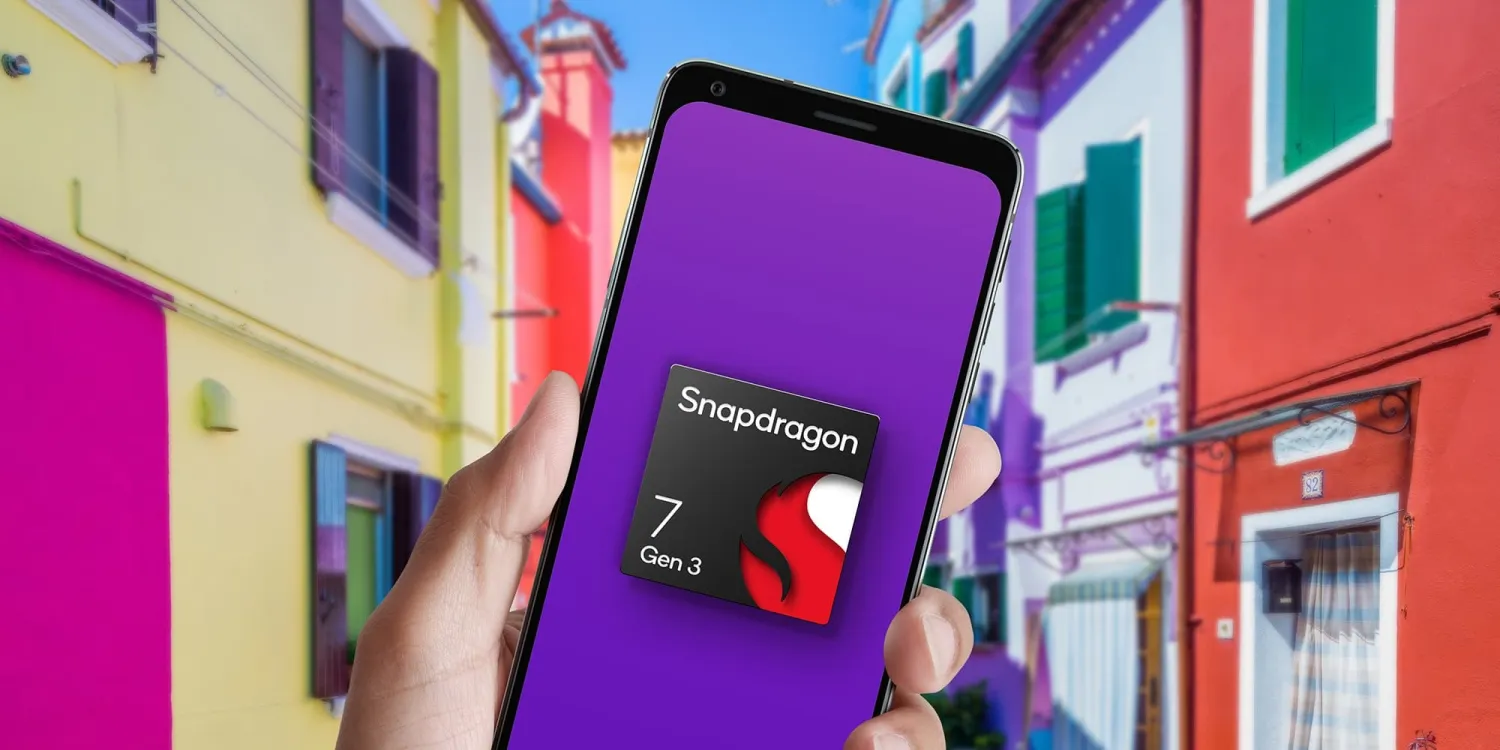
Qualcomm is following last month’s big announcement with the Snapdragon 7 Gen 3 November 16,2023. The goal remains bringing more flagship features down the chip lineup.
The 4nm Snapdragon 7 Gen 3 has one Prime core (up to 2.63 GHz), three Performance cores (2.4 GHz), and four Efficiency (1.8 GHz). Compared to the 7 Gen 1, Qualcomm touts a near 15% improvement in performance (based on Geekbench 6.1 Single Thread) and an over 50% jump for the GPU (Aztec Ruins 1080p), while offering 20% power savings.
Meanwhile, the AI Engine offers 60% better AI performance per watt, with INT4 precession support new for the 7-series. Qualcomm is also highlighting improved AI-based face detection in regards to challenging scenes and extreme combinations, like glasses and low-light conditions.
Another new addition to the Snapdragon 7-series this generation is spatial audio with head tracking, as well as multi-device Snapdragon Seamless experiences.
On the camera front, Qualcomm explicitly references mentions the Google Ultra HDR image format on Android 14. There’s also continued support for capturing from three cameras simultaneously. An “AI Remosaic” feature lets you “eliminate grainy discoloration for higher-res results” that have more vivid colors
There’s the Snapdragon X63 5G modem for up to 5 Gbps downloads, as well as 5G Dual-SIM Dual-Active (DSDA) in 5G+5G or 5G+4G SIM card configurations. Qualcomm is also touting triple frequency location support for improved accuracy even with a lower-quality GNSS antenna.
Honor and Vivo plan to use the Snapdragon 7 Gen 3, while the first commercial device is set to be announced this month.
Qualcomm is expanding its lineup for 2020-2021, bringing in newer SoCs that you can expect to see in your next smartphone. Back in May, Qualcomm launched the new Snapdragon 768G, bringing in improvements over the Snapdragon 765G. And earlier this month, the company launched the new Snapdragon 732G, which brings improvements over the Snapdragon 730G. Today, Qualcomm is announcing the new Snapdragon 750G as an interesting addition alongside these two new SoCs, providing OEMs and consumers with more options in the premium mid-end segment.
Qualcomm’s Snapdragon 7-series mobile platforms have become a very popular choice in the market, with more than 275 designs announced or in development across this series. Of these, a good 140 designs incorporate 5G, and the continued focus forward on this makes sense for OEMs and network partners alike. What the Snapdragon 750G does is carry along the Snapdragon X52 5G Modem-RF system from the 765G, allowing wider consumer reach for a solution that offers support for mmWave and sub-6GHz frequencies, SA and NSA networks, TDD, FDD, and Dynamic Spectrum Sharing (DSS), global roaming and global multi-SIM.
The 8nm Snapdragon 750G (SM7225) features a 64-bit Octa-core Kryo 570 setup with the two performance cores clocked at a max clock speed of 2.2GHz and the 6 efficiency cores clocked at a max speed of 1.8GHz. By nature of Qualcomm’s Kryo nomenclature, this is a big step up from the Kryo 470 cores on the Snapdragon 732G and the Kryo 475 cores on the Snapdragon 768G, and just a step down from the Snapdragon 865’s Kryo 585 cores. The 2 performance cores are indeed ARM Cortex-A77 based and not the ARM Cortex-A76 based like the ones found in the Kryo 4-series, though the 6 efficiency cores are still ARM Cortex-A55 based. While the CPU clock speeds of the performance cores are not as high as they are in the flagship Snapdragon 865 and Snapdragon 865 Plus, you should expect to get better CPU performance than you would from the Snapdragon 732G and even the higher-numbered Snapdragon 768G.
As far as specific performance improvements, Qualcomm claims that the Snapdragon 750G can deliver up to 20% improvement over the Snapdragon 730G. To better put this into context, the Snapdragon 765 barely offered CPU improvements over the Snapdragon 730; the “G” variants usually feature a higher clocked “Prime” core and GPU; and the 2020 SoC upgrades simply went up to bump the clock speeds on the Prime core and GPU further. So a 20% improvement over the Snapdragon 730G is actually exciting news, one that could possibly place the Snapdragon 750G as the SoC with a better CPU than the Snapdragon 768G.
The Adreno 619 GPU is claimed to enable up to 10% better graphics rendering compared to the Snapdragon 730G. In comparison, the Adreno 620 GPU on the Snapdragon 765G claimed to offer up to 20% better performance and efficiency compared to the Snapdragon 730G. We can thus conclude that the Snapdragon 750G is placed between the Snapdragon 732G and Snapdragon 768G in terms of performance.
The Snapdragon 750G also features select Snapdragon Elite Gaming features, including Qualcomm’s Game Color Plus, Adreno Updateable GPU Drivers, and Adreno HDR Fast Blend. The 5th generation Qualcomm AI Engine, meanwhile, distributes AI workloads across the compute blocks and claims to offer up to 4 Trillion Operations per Second (TOPS) for up to 20% improvement over the Snapdragon 730G.
Qualcomm is also boasting the inclusion of its always-on Sensing Hub in the SoC, which features a low-power AI Engine that “enables AI-based echo cancellation and background noise suppression to provide improved voice-chat gaming experiences, uninterrupted voice communication, and support for always-on voice assistants.” This is part of a growing trend of AI-based noise cancellation features, with NVIDIA offering RTX Voice for its GPUs and Krisp offering its software solution to apps like Discord. Qualcomm’s AI-based noise suppression solution will be hardware accelerated on devices with the Snapdragon 750G, enabling faster processing and thus lower latency.
The Snapdragon 750G, supports Bluetooth 5.1 and is “Wi-Fi 6-ready” if paired with Qualcomm’s FastConnect 6200 mobile connectivity subsystem. The new Spectra 355L Image Signal Processor lacks hardware acceleration for computer vision tasks and can process slow-motion video only up to 720p@240fps, but you get up to 32+16 MP dual camera processing with Zero Shutter Lag. For the display, it supports up to FHD+ resolution at 120Hz refresh rate. You also get support for India’s NavIC GNSS with the new SoC. Lastly, the SoC supports Qualcomm’s Quick Charge 4+ solution but not its latest Quick Charge 5.
Qualcomm Snapdragon 750G complete feature
Qualcomm AI Engine
Adreno 619 GPU
Qualcomm® Kryo™ 570 CPU
Hexagon 694 Processor
Hexagon Scalar Accelerator
Hexagon Vector eXtensions
Hexagon Tensor Accelerator
Qualcomm Sensing Hub
Ultra low power hub for audio, voice and sensors
Supports AI algorithms at low power
Support for fusing contextual data streams including sensors, audio and voice
Supports multiple voice assistants
Multi-mic far-field detection and echo cancellation
5G Modem-RF System
Snapdragon X52 5G Modem-RF System – Modem to antenna integrated system for 5G multimode
5G mmWave and sub-6 GHz, standalone (SA) and non-standalone (NSA) modes, FDD, TDD
GPS, Glonass, BeiDou, Galileo, QZSS, NavIC, and SBAS
Dual Frequency Support
Low Power Geofencing and Tracking, Sensor-assisted Navigation
Near Field Communications (NFC): Supported
General Specifications
Memory Speed: up to 2133 MHz, 12 GB RAM
Memory Type: 2 x 16-bit, LPDDR4x
Near Field Communications (NFC) support
DisplayPort over USB Type-C support
8nm Process Technology
Part Number: SM7255
The Snapdragon 750G is pin- and software-compatible with the Snapdragon 690. Commercial devices based on the Snapdragon 750G are expected to be commercially available by the end of 2020. Xiaomi is announcing that it will be the first OEM to deliver a smartphone with this new SoC, which is teased to be a new member of the Mi 10 series costing under €300.
G connectivity is finally seeing mainstream adoption in 2020 as more and more smartphones and mobile SoCs add support for the next generation of telecommunications technology. The push for 5G has been very widespread in recent months, although some key markets may not have consumer 5G ready until next year. Nonetheless, that hasn’t stopped chip makers from pushing the envelope forward with bringing 5G down to lower tiers. Now, Qualcomm has announced its plans to bring 5G to even wider segments of users, promising new Snapdragon 4-series chips with 5G support in early 2021.
Today’s announcement from Qualcomm is bereft of a fair few details. While we can expect the modem to be integrated like on Qualcomm’s current 7 and 6-series 5G chips, we don’t know the supported bands, the theoretical download and upload speeds, the sub-6GHz bandwidth, and whether or not the modem will support mmWave 5G and/or standalone (SA) 5G. There are also other specs and features to be aware of, such as whether or not the chipset supports Dynamic Spectrum Sharing (DSS), 5G dual SIM dual standby (DSDS), and Qualcomm’s proprietary 5G PowerSave, Smart Transmit, Wideband Envelope Tracking, and Signal Boost adaptive antenna tuning technologies. Whatever they do announce, though, heralds hope for a wider proliferation of 5G. Qualcomm’s promise of 5G connectivity support on its upcoming Snapdragon 4-series chips will bring 5G support to budget and lower mid-range smartphones across the globe.
“Qualcomm continues to pave the way for 5G commercialization at scale, and the expansion of 5G into our Snapdragon 4-series is expected to address regions that currently have approximately 3.5 billion smartphone users combined. The Snapdragon 4-series 5G Mobile Platform is designed to exceed expectations for the mass-market segment by bringing an assortment of predominately high- and mid-tier features to a broader audience. It will deliver on the promise of making 5G accessible to all smartphone users.”
Smartphones with the 5G Snapdragon 4-series are expected to arrive from OPPO, Motorola, and Xiaomi, but we suspect many other OEMs to also jump on board sooner or later. The first batch of smartphones with the 5G Snapdragon 4-series is expected to arrive in Q1 2021.
This is a very positive news among the court wars from different companies. Qualcomm and Oppo have some very nice plans in its campaign in China.
Company cooperation and agreement news for the tech fans all over the world, Qualcomm and OPPO are signing a patent license. This is great news especially for the future of tech in China.
OPPO has licensed Qualcomm’s 3G and 4G technology patents to be used in their future devices to be released for the Chinese market. This followed when Qualcomm filed some patent infringement complaints against Meizu about a month ago. All lawsuits were filed in Beijing and Shanghai intellectual property courts. All of these a move to make manufacturers talk about licensing terms back to the drawing board.
OPPO is yet to release some details about their next F1 lineup releases. However, it will be evident in the next couple of years that Qualcomm\’s presence in China will pave the way for Qualcomm to possibly expand and dominate the chip competition in the region.
Manufacturers can make their devices Tango compatible simply by equipping them with Qualcomm’s new and upcoming Snapdragon 800 and 600 SoCs. According to Ars Technica, the chipmaker has been working with Google for the past year-and-a-half to make its products ready for the tech titan’s augmented reality technology. See, when the big G showed off its Project Tango (as it was called back then) prototype, it had an extra computer vision chip. But the first Tango phone, Lenovo’s Phab2 Pro, doesn’t have one at all.
Phab2 Pro relies on its quad-core Snapdragon 652 processor to run Tango’s AR capabilities. Qualcomm even says that since its processors are optimized for the technology, Tango ends up using less processing power than a normal app and consumes less than two watts. By removing the need for extra hardware besides a depth sensor and a motion tracking camera, the partners are making it easy for phonemakers to adopt the AR tech. Tango, if you’ll recall, can superimpose images over the real world through a device’s camera. One of its applications is helping you visualize what your house would look like before you even start renovating or replacing your furniture.
Thank you for using
Themify Popup
This is a sample pop up. Themify Builder or Builder Lite (free) plugin is recommended to design the pop up layouts.