


❤ Samsung Galaxy S24 Plus

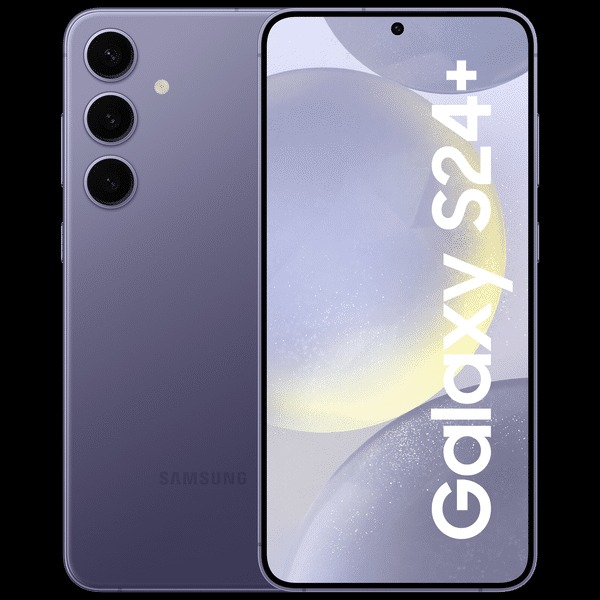
The Galaxy S Plus is probably the least popular device of the Galaxy S trio, but it has its fans. It caters to those who want a bigger Galaxy S screen and don’t want to overpay for Ultra features they will not use. Today, we will be meeting with the Galaxy S24+, which finally returns to its former glory with a Quad HD display!
Indeed, this has to be the biggest change since the Galaxy S21 series! The Galaxy S24+ brings back the 1440p OLED display we last saw on the Galaxy S20+ in 2020. And it’s as premium of a panel as it can get – a 6.7-inch LTPO Dynamic AMOLED 2X screen with 513ppi, 120Hz dynamic refresh rate, HDR10+ and up to 2,600 nits of peak brightness.
Quick note – we are reviewing the Exynos model of the Galaxy S24+ here.
The refreshed design is the next thing on the list of upgrades – the aluminum frame is now tougher, flatter and all matte! This makes the Galaxy S24+ look new and feel new, too.
Just like the Galaxy S24, the S24+ hardware varies depending on the market. The global models employ the Exynos 2400 chip with a 10-core CPU and new AMD graphics, while the US/Canada/China models run on the Snapdragon 8 Gen 3. The S24+ is available in 256GB and 512GB variants, both with UFS 4.0 chips and 12GB of RAM.
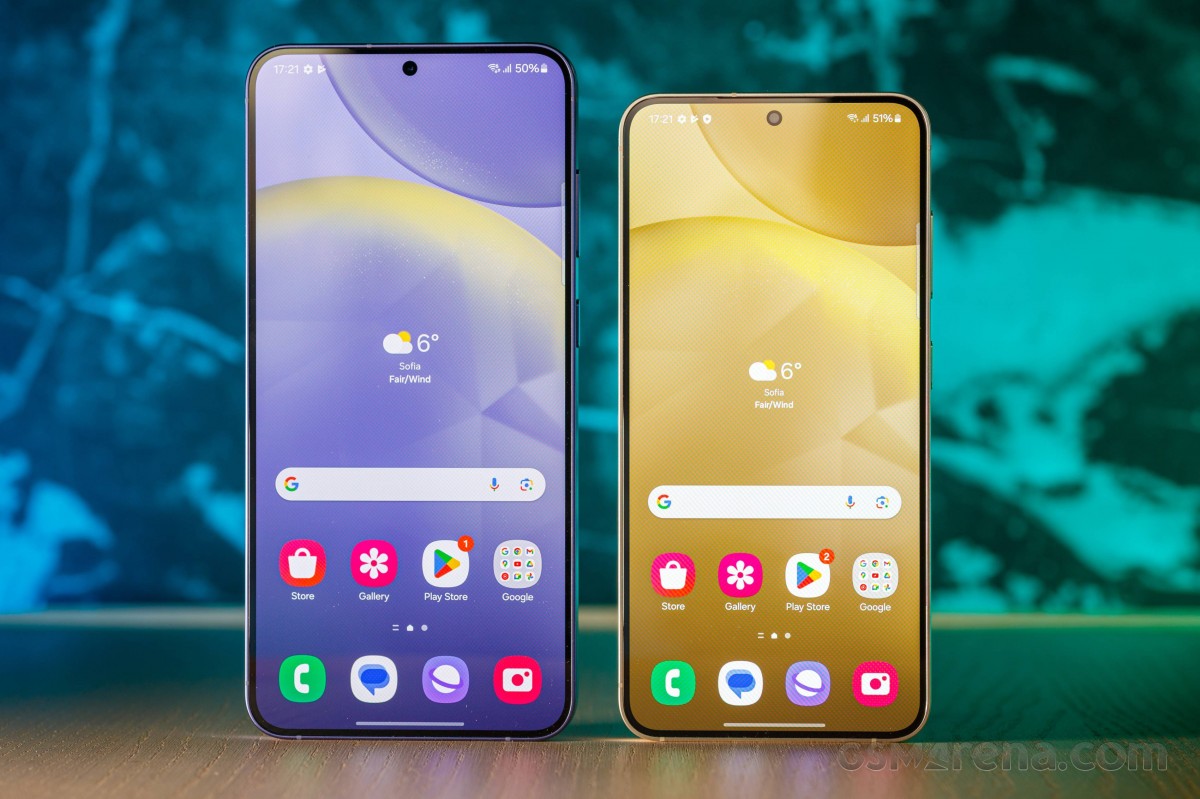
Left: Galaxy S24+ • Right: Galaxy S24
The camera system is identical to the one on the Galaxy S24, S23+ and S23. There are three cameras on the back – a 50MP OIS primary, a 10MP 3x telephoto and a 12MP ultrawide. The front camera is a 12MP shooter with autofocus and 4K capturing.
The Galaxy S24+ specs also include Ultra Wideband (UWB) support and a larger 4,900mAh battery with 45W wired and 15W wireless charging.
Samsung Galaxy S24+ specs at a glance:
| NETWORK | Technology | GSM / CDMA / HSPA / EVDO / LTE / 5G |
|---|---|---|
| 2G bands | GSM 850 / 900 / 1800 / 1900 – SIM 1 & SIM 2 (Dual SIM model only) | |
| CDMA 800 / 1900 & TD-SCDMA | ||
| 3G bands | HSDPA 850 / 900 / 1700(AWS) / 1900 / 2100 | |
| CDMA2000 1xEV-DO | ||
| 4G bands | 1, 2, 3, 4, 5, 7, 8, 12, 13, 17, 18, 19, 20, 25, 26, 28, 32, 38, 39, 40, 41, 66 – International | |
| 5G bands | 1, 2, 3, 5, 7, 8, 12, 20, 25, 26, 28, 38, 40, 41, 66, 75, 77, 78 SA/NSA/Sub6 – International | |
| SA/NSA/Sub6/mmWave – USA | ||
| Speed | HSPA, LTE (up to 7CA), 5G |
| LAUNCH | Announced | 2024, January 17 |
|---|---|---|
| Status | Available. Released 2024, January 24 |
| BODY | Dimensions | 158.5 x 75.9 x 7.7 mm (6.24 x 2.99 x 0.30 in) |
|---|---|---|
| Weight | 196 g or 197 g (6.91 oz) | |
| Build | Glass front (Gorilla Glass Victus 2), glass back (Gorilla Glass Victus 2), aluminum frame | |
| SIM | Nano-SIM and eSIM/ Dual eSIM or Dual SIM (2 Nano-SIMs and eSIM, dual stand-by) | |
| IP68 dust/water resistant (up to 1.5m for 30 min) Armor aluminum 2 frame with tougher drop and scratch resistance (advertised) |
| DISPLAY | Type | Dynamic LTPO AMOLED 2X, 120Hz, HDR10+, 2600 nits (peak) |
|---|---|---|
| Size | 6.7 inches, 110.2 cm2 (~91.6% screen-to-body ratio) | |
| Resolution | 1440 x 3120 pixels, 19.5:9 ratio (~513 ppi density) | |
| Protection | Corning Gorilla Glass Victus 2 | |
| Always-on display |
| PLATFORM | OS | Android 14, One UI 6.1 |
|---|---|---|
| Chipset | Qualcomm SM8650-AC Snapdragon 8 Gen 3 (4 nm) – USA/Canada/China Exynos 2400 (4 nm) – International |
|
| CPU | 8-core (1×3.39GHz Cortex-X4 & 3×3.1GHz Cortex-A720 & 2×2.9GHz Cortex-A720 & 2×2.2GHz Cortex-A520) 10-core (1×3.2GHz Cortex-X4 & 2×2.9GHz Cortex-A720 & 3×2.6GHz Cortex-A720 & 4×1.95GHz Cortex-A520) |
|
| GPU | Adreno 750 (1 GHz) – USA/Canada/China Xclipse 940 – International |
| MEMORY | Card slot | No |
|---|---|---|
| Internal | 256GB 12GB RAM, 512GB 12GB RAM | |
| UFS 4.0 |
| MAIN CAMERA | Triple | 50 MP, f/1.8, 24mm (wide), 1/1.56″, 1.0µm, dual pixel PDAF, OIS 10 MP, f/2.4, 67mm (telephoto), 1/3.94″, 1.0µm, PDAF, OIS, 3x optical zoom 12 MP, f/2.2, 13mm, 120˚ (ultrawide), 1/2.55″ 1.4µm, Super Steady video |
|---|---|---|
| Features | LED flash, auto-HDR, panorama | |
| Video | 8K@24/30fps, 4K@30/60fps, 1080p@30/60/240fps, HDR10+, stereo sound rec., gyro-EIS |
| SELFIE CAMERA | Single | 12 MP, f/2.2, 26mm (wide), dual pixel PDAF |
|---|---|---|
| Features | Dual video call, Auto-HDR, HDR10+ | |
| Video | 4K@30/60fps, 1080p@30fps |
| SOUND | Loudspeaker | Yes, with stereo speakers |
|---|---|---|
| 3.5mm jack | No | |
| 32-bit/384kHz audio Tuned by AKG |
| COMMS | WLAN | Wi-Fi 802.11 a/b/g/n/ac/6e, tri-band, Wi-Fi Direct |
|---|---|---|
| Bluetooth | 5.3, A2DP, LE | |
| Positioning | GPS, GLONASS, BDS, GALILEO, QZSS | |
| NFC | Yes | |
| Radio | No | |
| USB | USB Type-C 3.2, DisplayPort 1.2, OTG |
| FEATURES | Sensors | Fingerprint (under display, ultrasonic), accelerometer, gyro, proximity, compass, barometer |
|---|---|---|
| Samsung DeX, Samsung Wireless DeX (desktop experience support) Ultra Wideband (UWB) support |
| BATTERY | Type | Li-Ion 4900 mAh, non-removable |
|---|---|---|
| Charging | 45W wired, PD3.0, 65% in 30 min (advertised) 15W wireless (Qi/PMA) 4.5W reverse wireless |
| MISC | Colors | Onyx Black, Marble Grey, Cobalt Violet, Amber Yellow, Jade Green, Sandstone Orange, Sapphire Blue |
|---|---|---|
| Models | SM-S926B, SM-S926B/DS, SM-S926U, SM-S926U1, SM-S926W, SM-S926N, SM-S9260, SM-S926E, SM-S926E/DS | |
| SAR | 1.16 W/kg (head) 0.84 W/kg (body) | |
| SAR EU | 0.74 W/kg (head) 1.25 W/kg (body) | |
| Price | $ 613.70 / € 819.90 / £ 751.99 |
| TESTS | Performance | AnTuTu: 1290977 (v9), 1774819 (v10) GeekBench: 5987 (v5), 6926 (v6) 3DMark Wild life: 14082 (offscreen 1440p) |
|---|---|---|
| Display | Contrast ratio: Infinite (nominal) | |
| Camera | Photo / Video | |
| Loudspeaker | -25.0 LUFS (Very good) | |
| Battery (new) |
Disclaimer. We can not guarantee that the information on this page is 100% correct.
The Galaxy S24+ seems like it has it all. Maybe it deserved a better zoom camera, or at least one of higher resolution, so it can allow for lossless/hybrid zoom. But we guess this incremental update will now be reserved for the Galaxy S25 next year.
Unboxing the Samsung Galaxy S24+
The Galaxy S24+ ships inside a thin black box containing a USB-C cable and a SIM ejection tool.
Those who pre-ordered the S24+ also get a 25W power adapter, a 15W charger pad, and a clear case. Those extras are market-dependent, of course.

The cable that ships inside the retail boxes of the Galaxy S24 series is officially rated as 3A or up to 25W. This means if you buy a 45W charger or similar and it doesn’t include a proper cable, you will need to shop for a compatible cable so you can enjoy faster than 25W charging.
The competition
The Galaxy S24+ has gone up in price a bit in some regions compared to its predecessor. That being said, gone is the 8GB RAM, and you get to choose between a 12GB/256GB model and a 12GB/512GB one. And we’re not even mentioning some of the other great updates this year, like the brighter, higher-resolution LTPO display and the larger battery. As for any potential concerns regarding the Exynos 2400 chipset, it is comparable to a Snapdragon 8 Gen 3 with no obvious performance downsides.
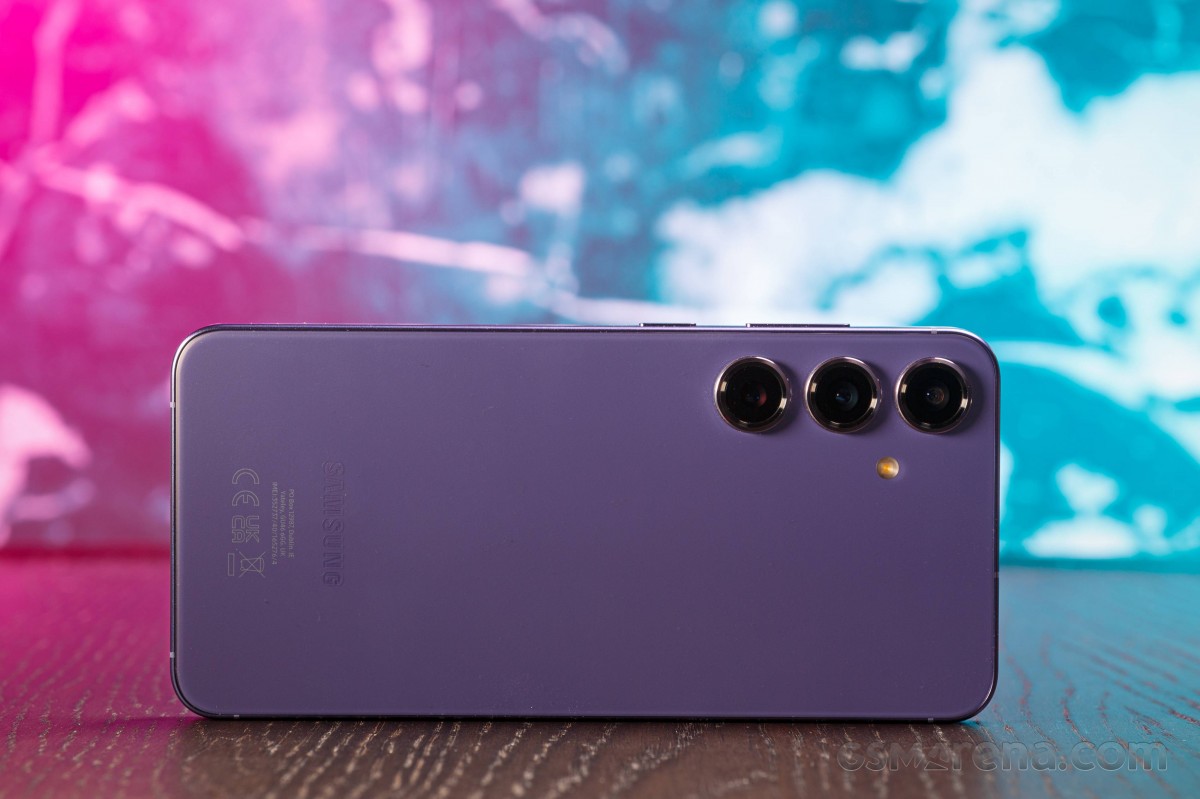
Even with the potential price hike in some regions, the savings of going for Plus instead of Ultra are quite notable. Other than the cameras and S Pen, this is closer to the Ultra than any S Plus model has been since the S20 generation. Many people on older Galaxy devices do seem to be considering the S24+ as a good upgrade path.
As far as actual pricing goes, at MSRP, a base 12GB/256GB unit should cost you around $1,000/€1,150/£1,000, and a 12GB/512GB one should set you back about $1,120/€1,270/£1,100. Of course, local pricing will vary, and so will packages and deals with retailers and carriers. However, let’s say that if you are looking into an S24+, you have a budget of about €1,300. That’s plenty to spend on a smartphone, and there are at least a few good options out there.
Here is an interesting idea: why not consider the Galaxy S23 Ultra? Sure, it is a generation older, and you won’t be getting quite the same performance. You will also notably be missing out on the seven years of OS updates and the Galaxy AI features, at least initially. Besides that, you get a comparable package, plus an S Pen, arguably a more versatile camera setup with a second telephoto and ultrawide with autofocus – all for a lower price than the S24+.

If you find yourself drawn by the allure of longer software support and AI features in particular, then perhaps the Google Pixel 8 Pro might be a good fit. It is notably cheaper at current pricing than the S24+, too. You will have to settle for lower overall performance, though, if that is something you particularly care about.
The OnePlus 12 is also a pretty popular choice. Pricing on the OnePlus 12 also makes it nicely competitive. The larger 6.82-inch display on the OnePlus matches most of the features of the Galaxy S24+ and even exceeds it by offering things like 10-bit color and higher brightness. The OnePlus 12 also arguably has a higher-quality camera setup, though that point can be argued. There is autofocus on the ultrawide, at least. The usefullness of the bigger 5,400 mAh battery is not up for debate, though. Neither is the much faster charging, both wired and wireless.
Finally, we should mention the options over at camp Apple, in case iOS is up your alley. While we would love to point you in the direction of the iPhone 15 Pro Max, it is a bit too pricey. The iPhone 15 Pro gets you the same top-tier chipset and a telephoto camera. However, it is on the small side and more of an alternative for the vanilla Galaxy S24 than the S24+. Enter the iPhone 15 Plus. You get a very comparable device size and features. No telephoto, as we mentioned, but notably better battery life on the iPhone, as per our testing.
Our verdict
While the vanilla Galaxy S24 is more or less a simple incremental upgrade over the S23, we would say that this year, the S24+ brings a bit more to the table. An argument can be made that it is now closer to the “Ultra” than ever.
The S24 Plus gets its QHD resolution back. Not to mention that the new panel is both slightly bigger and much brighter than last year. Gone are the 8GB of RAM from last year. The S24+ gets 12GB across the board. The battery has grown notably in capacity and now, at 4,900 mAh, is almost as much as the S24 Ultra has. However, our testing did show that the extra resolution does seem to eat into the actual endurance this year.
And sure, Samsung could have graced the S24+ with a better or at least higher-resolution telephoto this year so that it could pull off impressive digital zooms on top of the optical one. But other than that, and of course the S Pen and a few other smaller things like Wi-Fi 7, the Galaxy S24+ is almost all the way there to an “Ultra” this year.
To quickly fire off some other upgrades for 2024, we have moved to the stronger and more scratch-resistant Armor Aluminum 2 material for the now matte middle frame. And that’s on top of the excellent IP68 and dual-sided Gorilla Glass Victus 2 protection carried forward. Gorilla Glass Armor does remain an S24 Ultra exclusive this year.
Of course, we can’t fail to mention the allure of seven years of software support and One UI 6.1. It offers a nice incremental step up when it comes to general functionality, even if you ignore the major Galaxy AI injection, which, admittedly, is still an “acquired taste” for most users and will take some refinement and normalization before becoming an unquestionable and established value-add.

Now slightly louder, the hybrid stereo speaker setup remains a highlight of the multimedia experience. The same goes for the solid and versatile camera setup. Samsung didn’t make any sweeping changes in this department but arguably didn’t need to either.
As for the whole chipset situation, we see how returning to a two-chip, segmented approach rubs many people the wrong way. We acknowledge that Samsung’s own Exynos parts have a pretty bad reputation (deserved, at least in part). Still, from our first batch of testing the Exynos 2400 variants of the Galaxy S24 and S24+, we can at least say that this year, the Exynos 2400 does seem pretty close in overall performance to the Snapdragon 8 Gen 3.
We are not particularly impressed with how the Exynos-equipped S24 and S24+ handle heat over time. While the thermal-throttling is still perfectly reasonable, we are interested in seeing how the Snapdragon variants of these devices fair in the same department once we eventually get the chance to test those out as well.

That, however, might be a bit of a comparison for “scientific purposes” only since most people won’t get the chance to pick and choose their chipset. Plus, at least from an experience standpoint, there doesn’t appear to be any major difference one way or the other.
All things considered, there is a lot to like about the S24+. With its QHD display, 12GB of RAM, and seven years of software updates, it arguably makes more sense than its S23+ predecessor.
Then again, the Plus has never really enjoyed much attention from buyers, which is unlikely to change. While you definitely won’t be disappointed in any way by picking up a Galaxy S24+, there might be better options to consider. For one, the Galaxy S23 Ultra can offer an S Pen, notably better cameras and no Exynos uncertainty for less than what you would pay for the S24+. The Galaxy S23+ seems like an even better deal while offering much or less the same user experience.
Pros
- No-nonsense, sturdy, grippy design. The new matte finish looks great.
- Even better durability than last year with V2 aluminum frame and still Gorilla Glass Victus 2 and IP68.
- Outstanding OLED screen, QHD once again, slightly bigger and even brighter than last year.
- Awesome stereo speakers.
- Top-notch performance. RAM is upgraded to 12GB this year.
- Solid photo and video quality across the board with a camera carried forward from last year.
- Exciting One UI is now infused with plenty of AI; DeX support, and great connectivity options. UWB support.
Cons
- Shorter battery life than last year’s S23+, though still solid.
- Hardware fragmentation is back, with some markets getting Snapdragon 8 Gen 3 and some Exynos 2400 chips.
- No 10-bit color depth support for the screen.
- The CPU and GPU both throttle down in performance quite aggressively under load.
- No charger in the box and ships with a 3A Type-C cable, which cannot do 45W charging.

