This shouldn’t be too much of a surprise, but Samsung is working on an Android Oreo build for the Galaxy S8. Common sense, right? Manufacturers are pretty much always working on newer software for their flagship devices.
The big story here is that a Galaxy S8 running Android 8.0 has popped up on Geekbench, which means there’s definitely at least one, if not a few, of these devices at Samsung HQ stable enough to run benchmarks with new software. That’s good news for all of us waiting for an update.
Yep, definitely a Galaxy S8, definitely running Android 8.0. Performance doesn’t really seem drastically improved, but then again, it’s rare to see a massive difference just because of a newer version of software anymore.
While this doesn’t mean Samsung is pushing out an Oreo update right away, it does mean we can expect an update for their current round of flagship devices very soon. Fingers crossed the Galaxy S7 sees some love, too.
With the Galaxy S8 pushing the boundaries of the display by extending the bezels on the device it set the way for other manufactures to follow suit. Samsung followed with the Note 8 and even Apple got into the game with the iPhone X.
The subtle differences between the Samsung and Apple implementation of a bezel-less display saw Apple opt for a top notch to house the front facing camera and various sensors, while Samsung extended the top bezel the entire way across the device.
One concept that has surfaced suggests the Samsung may take a design cue from Apple when it comes to the Galaxy S9 and reduce the bezels of the device even further with the top cutout.
We’ve seen this design on the Essential Phone as well where the camera is cut out from an otherwise edge-to-edge display.
The latest Samsung Galaxy S9 concept comes from the YouTube channel DBS Designing that sees the top and bottom bezel almost completely eliminated.
At the top of the Galaxy S9 there’s a small cutout to house the camera, speaker, iris scanner, and other sensors. The iPhone X cutout is more pronounced than that of the Galaxy S9 concept but arguably the cutout on the iPhone is that size for a reason given the available technology it has to pack in that small space.
Other key points of the Galaxy S9 concept are the inclusion of the 3.5mm jack that the designer believes Samsung will retain. The concept also has dual front-facing cameras with a 18:9 aspect ratio Quad HD+ Infinity OLED display. The device is said to have 6GB of RAM, 128GB of internal storage and will be the first device to run the upcoming Snapdragon 845 SoC.
We’ve heard previously that Samsung may expedite the arrival of the Galaxy S9 to combat sales of the iPhone X that may see a January or February arrival, a few months before when it is actually expected.
While there’s no doubt Samsung will continue to push the boundaries of what is possible with display technology, it could be very possible Samsung reduce the bezels even further to mimic the design of the iPhone X. However, I think reducing the bezels to the amount shown in the concept simply isn’t possible with the available technology and the size of the components needed in that notch.
The European Imaging and Sound Association (EISA) has now announced its mobile device awards for 2017-2018. Perhaps unsurprisingly, Samsung took home top honors, with the company’s Galaxy S8 and Galaxy S8+ devices collectively winning the “Best Smartphone” award. According to EISA’s judges, who described the Samsung’s flagship devices as “formidable, do-it-all devices” that’s down to a great camera and camera features, the comfortable bezel-free Infinity display, and several other innovations. It’s worth noting that the award was provided to the Samsung Galaxy S8 and Samsung Galaxy S8+ that are powered by Samsung’s own Exynos 8895 S0C, as opposed to the Snapdragon variant of the devices
As to the other awards, Huawei snagged no fewer than three awards, starting with the Smartphone Camera award being granted to the company’s P10 and its Leica-branded dual sensor setup – which features a 20-megapixel monochrome sensor and a 12-megapixel color sensor, which enable enhanced portrait shots. EISA also cites the front camera as playing a role in the decision since the P10’s 8-megapixel selfie camera features Leica technology which automatically widens the angle to fit more people. Beyond the Huawei P10, the company also won in the best Wearable Device category with its Huawei Watch 2, thanks to its appealing aesthetics, battery life, and water-resistance. Meanwhile, the award for Best Consumer Smartphone also went to Huawei for its Honor 8 Pro. EISA judges referred to the device as a “seriously capable smartphone,” thanks to its 6GB of RAM coupled with 64GB of storage, backed by a Kirin 960 SoC and powered by a 4,000 mAh battery. They were equally impressed by Huawei’s generously proportioned 5.7-inch QHD screen.
Finally, and rounding out awards given to the best of the best among mobile devices, the comparatively unknown NOA Element H10Le won the award for Best Buy Smartphone because of its exceptional “price-to-performance ratio” thanks to its ten-core MediaTek Helio X27 SoC, coupled with 4GB of RAM and 64GB of storage. The EISA also points to the device’s 7.1mm thick “sleek metal unibody finish,” 5.5-inch AMOLED display, and cameras as justification for the award. Awards were also handed to manufacturers for other categories, including Best Mobile Audio Player, Wireless In-Ear Headphones, Mobile Speaker, Mobile Headphones, and Portable DAC/Headphone Amplifier.
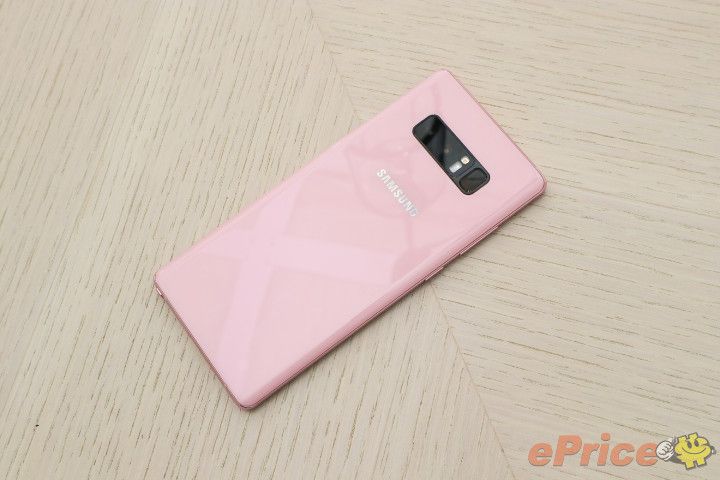
Samsung has a habit of offering exclusive color options for its flagship smartphones in select markets across the globe. Taiwan happens to be one of those markets. After launching the Pink Galaxy S8+ there earlier this year, Samsung has now launched a Star Pink color option for the Galaxy Note 8 in Taiwan.
The Galaxy Note 8 will be widely available in four color options – Midnight Black, Maple Gold, Orchid Gray and Deep Sea Blue. Star Pink appears to be exclusive to Taiwan. Samsung has a good reason for offering the handset in this color.
This is a particularly popular color with customers in Taiwan. According to a report, 30 percent of all smartphones sold in the country are touting some shade of pink. This is why it makes sense for Samsung to offer this color option in Taiwan.
The pink color isn’t just limited to the back panel. The metal frame is pink and so are all of the buttons. The same color has also been applied to the handset’s S Pen.
Everything else remains the same. It’s the same Galaxy Note 8 handset with its Exynos 8895 processor and exceptional 6.3-inch Super AMOLED Infinity Display.
The price remains the same as well. Customers in Taiwan can purchase the handset for TWD 34,200 or $1,075.
The Galaxy S9 should sport the same shape screen as the Galaxy S8, according to The Bell,which also claims that the firm has already placed an order for the 5.8-inch and 6.2-inch Infinity Display panels for the Galaxy S9 and Galaxy S9+, respectively.
Looking to the future, Samsung is also believed to have commissioned its screen-making division, Samsung Display, to start manufacturing the 6.3-inch Infinity Display that’s set to be on board the upcoming Galaxy Note 8 for the Galaxy Note 9.
In addition, the report notes that Samsung is working tirelessly to find a way to feature the on-screen fingerprint recognition technology that was scrapped from the Galaxy S8 at the last minute on the Galaxy S9 and Galaxy Note 9.
If a recent hands-on image is anything to go by, the company should have the optical scanner ready in time as the only technical hurdle it needs to overcome is matching the brightness of the area containing the sensor to the rest of the screen.
It’s a little too early to speculate about both the Galaxy S9 and Galaxy Note 9, though we expect them to feature a Snapdragon 845 processor, at least 6GB of RAM and a dual-camera. They should also ship running Android O.
[THE IVESTOR]Samsung Electronics‘ upcoming flagship smartphone Galaxy S9 is expected to use the same size and shape of the display screen as S8, The Bell reported on July 18.
Citing unnamed industry sources, the report said Samsung has recently informed Samsung Display, its display-making unit, of the S9’s display specifications.
The S9 will have a 5.77-inch display screen, while the bigger S9 Plus will come with a 6.22-inch screen. The same size as the S8 lineup launched in April.
The so-called “infinite” shape is also expected to curb the right and left sides with no home button.
The report said Samsung is likely to attempt again to feature on-screen fingerprint scanning that is missing from the S8 due to technical immaturity.
In the meantime, Samsung has also tentatively decided to use the same 6.32-inch display screen for the Galaxy Note 9 as the upcoming Note 8 that is expected to be unveiled on Aug. 23 in New York.
The report said Samsung is playing it safe with its flagship phones next year rather than taking too many risks.
Samsung Electronics today announced the commercial launch of the Galaxy Note8 to select markets around the world. The flagship smartphone is initially available in 42 countries including the US, Canada, Singapore, Korea and major European markets, and will continue rolling out to additional markets in the weeks ahead.
Equipped with a large, bezel-less Infinity Display, the Galaxy Note8 lets users see and do more, from watching their favorite TV show in HDR to multitasking more efficiently. Expanded screen space means they also have more room to write, draw and color with the enhanced S Pen, which offers new features like Live Message and improved Screen off memo functionality.
Samsung’s newest flagship smartphone also boasts two 12MP rear cameras – a wide-angle lens and telephoto lens with Optical Image Stabilization on both – which are capable of producing clear and crisp photos, even when shot at far distances.
Furthermore, the device is outfitted with the same great collection of cutting-edge features that Galaxy users have come to know and love including IP68 dust and water resistance, powerful performance with a 10nm process and expandable storage up to 256GB.
The launch of the Galaxy Note8 is complimented by an expanded ecosystem that features enhanced services and devices, including Bixby, Samsung’s intelligent interface, and Samsung DeX, which provides a desktop-like experience for the Galaxy Note8.
The commercial launch of the Galaxy Note 8 takes place today. Samsung has officially released the Galaxy Note 8in 42 countries initially. The handset will be rolled out in additional markets across the globe in the coming weeks.
The 42 countries where the Galaxy Note 8 has been released today include the United States, Canada, Singapore, South Korea and major markets in Europe. Other markets like China and India will see Samsung’s new flagship being released in the near future.
Featuring a 6.3-inch Super AMOLED Infinity Display, the Galaxy Note 8 features a Snapdragon 835 processor with 6GB of RAM. The IP68 water and dust resistant case houses a 3,300mAh battery, iris scanner, fingerprint scanner, the new S Pen and facial recognition.
The Galaxy Note 8 is Samsung’s first flagship with a dual camera system. It has two 12-megapixel sensors at the back and both are optically stabilized.
The new flagship is available with up to 256GB of internal storage but in most markets, Samsung will only be selling the 64GB model. Prices start at $950 in the United States and will vary by market.
As always, Samsung is offering decent pre-order incentives to those who placed a pre-order for its latest and greatest smartphone. However, the pre-order incentives aren’t that great for customers in Europe.
Check out our hands-on with the Galaxy Note 8 if you’re interested in this device. We’ll have a full review up soon.
Apple’s 2017 iPhones will inevitably influence the top end of the smartphone market. Here’s how it looks at the moment, with a number of key launches expected soon.
Smartphones are the focus of most people’s digital lives these days, and are likely to remain so until computing becomes truly ‘ambient’ — probably involving some seamless combination of wearables (particularly augmented reality [AR] goggles), IoT devices, cloud services and artificial intelligence (AI).
Following the launch of the iPhone 8, 8 Plus and X, it’s a good time to take stock of the current state of the smartphone market by examining the vital statistics of leading vendors’ flagship handsets.
Apple‘s new iPhones, and Samsung‘s Galaxy S8/S8+ and Galaxy Note 8, show the general direction in which top-end smartphones are heading: powerful, attractive (and expensive) handsets whose user experiences increasingly leverage AI and AR, integrated with an ecosystem of add-on devices and services in various sectors including gaming, AR and VR, smart home, healthcare, shopping and office productivity.
Following last year’s well-publicised Galaxy Note 7 debacle and strong fourth-quarter performance from Apple, Samsung briefly ceded first place to its main rival in the Q4 2016 smartphone market. However, the Korean company swiftly returned to the number-one spot in 2017 (see chart). Apple‘s new iPhones face stiff competition from Samsung, Huawei and other top-five vendors, and from several manufacturers in the ‘Others’ category — including Google, HTC, LG, Motorola, Nokia, OnePlus and Sony — that also offer premium smartphones.
“Despite some key launches in the second quarter from some well-known players, all eyes will be on the ultra-high-end flagships set to arrive this fall,” said Anthony Scarsella, research manager with IDC’s Worldwide Quarterly Mobile Phone Tracker, when the Q2 2017 figures were released at the beginning of August. “With devices like the iPhone 8, Pixel 2, Note 8, and V30 in the pipeline, the competition will be fierce come September. We expect all the key players to promote their latest and greatest flagships with an assortment of deals, bundles, and trade-in offers across a variety of channels in most key markets,” he added.
Here’s how the flagship smartphone market looks following Apple‘s 2017 iPhone launch, presented as far as possible in graphical form. (Note: we’ll update this article as new handsets from Google, Huawei, LG and any other leading vendors are released.)
DESIGN
Screen size & Pixel density
Screen size — measured in inches across the diagonal — is a smartphone’s defining design characteristic, and the range on offer from leading vendors is now very wide. BlackBerry‘s 4.5-inch keyboard-equipped KEYone is the smallest, while Samsung‘s Galaxy Note 8 currently leads the field at 6.3 inches, with 16 out of the 25 handsets covered here falling between 5.5 and 6 inches. Display technologies are split between IPS LCD (Apple, BlackBerry, Huawei, HTC, LG [G6], Sony) and various species of OLED (Apple [iPhone X], Google, HP, Huawei [Mate 9 Pro], LG [V30], Motorola, OnePlus and Samsung).
Recent developments in smartphone displays include curved minimal-bezel screens with on-screen home buttons, 18:9 aspect ratio, Gorilla Glass 5 screen protection and — in the HTC U Ultra — a small secondary screen for notifications and other useful information (an idea recently dropped by LG when updating the V20 to the V30). Samsung‘s Note 8 is the only handset covered here that offers a stylus (the S-Pen). Apple‘s 2017 iPhones add True Tone technology (first seen in the 2016 9.7-inch iPad Pro) that automatically adjusts colour temperature and intensity to the ambient light, while the iPhone X made more space for the screen by removing the home button (and Touch ID) altogether.
The other key statistic here is pixel density, measured as pixels per inch (ppi), which factors in the display resolution. The graph below shows that Samsung (Galaxy S8) and LG (G6) lead the mainstream field with pixel densities of 567 and 564ppi respectively. The outlier is Sony‘s 5.5-inch Xperia XZ Premium, which offers a maximum 4K resolution of 3,840 by 2,160 for a massive 807ppi. This looks extremely impressive, but note that, for much of the time, the Xperia XZ Premium works at 1,080p resolution to save battery life, resulting in a much more mundane 403.5ppi.
Not everyone is comfortable with a large-screen handset, but if you want a leading-edge device, that’s increasingly what you’re being offered. If you’re happy with a large screen (>5.5in.) and also want high pixel density (>500ppi), you should be looking at Samsung‘s Galaxy Note 8 and Galaxy S8+, LG‘s V30 or, if you’re happy to run Windows 10 Mobile, the HP Elite x3. If your hands are on the small side, the 5.3-inch Nokia 8 offers a good combination of moderate screen size and high resolution (550ppi).
Screen-to-body ratio & Thickness
Another key smartphone design metric is the screen-to-body ratio, which measures how much of a handset’s fascia is occupied by screen compared to non-display elements like bezels, camera lenses and control buttons.
If low screen/body ratios are ‘old-fashioned’, then Apple’s 2016 iPhone 7 and 7 Plus were showing their age at 65.5 percent and 67.5 percent respectively — and their 8 and 8 Plus successors have done nothing to change that. Apart from BlackBerry‘s KEYone, only four other handsets have sub-70 percent ratios: Google Pixel, HTC U Ultra, Nokia 8 and Sony Xperia XZ Premium. The 4.5-inch KEYone is an outlier at 55.9 percent because, of course, it has a hardware keyboard, which decreases the screen-to-body ratio (and also increases the thickness compared to touchscreen-only handsets — see below).
At the other end of the scale, Samsung‘s Galaxy S8, S8+ and Note 8 handsets, with their curved Infinity Display screens and on-screen home buttons, lead the field with screen/body ratios of 83-84 percent. LG‘s V30 and Apple‘s new iPhone X are the only other flagship handsets with screen/body ratios over 80 percent.
Smartphone vendors often make much of the slimness of their handsets, and it’s clear from the chart below that Huawei is particularly keen on this design feature. Conversely, Samsung and Google (and BlackBerry) deliver notably thicker handsets:
Motorola‘s modular Moto Z2 Force, at 6.1mm with no Mods fitted, is the thinnest handset here. There are trade-offs though: the camera lens housing protrudes from the rear, and the device’s body is too thin to accommodate a 3.5mm headset jack. With the increasing use of glass on both the front and back of premium handsets (to accommodate wireless charging), most people immediately put their expensive and shiny new handset in a protective case, which renders the quest for extreme slimness somewhat pointless.
Volume & Weight
As you’d expect, there’s a clear relationship between a smartphone’s physical volume and its weight, although the variation around the trendline is interesting.
For example, the handsets that are thick for their screen/body ratio — notably the HTC-designed Google Pixel and Pixel XL, HTC U Ultra and U11 — are also relatively light for their volume, suggesting that there’s plenty of room for components inside the case. Another handset that’s below the weight/volume trendline is Samsung‘s Galaxy Note 8 — evidence, perhaps, of design changes following the Note 7 debacle (especially as the Note 8 also packs a smaller-capacity 3,300mAh battery than its ill-fated predecessor, which ran on a 3500mAh unit). Conversely, it’s noteworthy how Apple‘s iPhone 8 Plus is particularly heavy (at 202g) for its volume, that the iPhone 8 and 8 Plus are slightly bulkier and heavier than their predecessors, and that the 5.8-inch iPhone X is considerably lighter and more compact than Samsung’s 6.3-inch Galaxy Note 8.
Dust and water resistance
Another key smartphone design factor is resistance to the ingress of foreign matter, as commonly indicated by a two-digit IP rating: the first number describes dust resistance on a 1-6 scale, while the second describes water resistance on a 1-8 scale. The highest rating among the flagship handsets covered here is IP68, where ‘6’ indicates that the device is ‘dust tight’ and ‘8’ signifies that it can withstand immersion in water (usually at least 30 minutes to depth of at least 1m).
An IP rating of 5 for dust means the device is merely ‘dust protected’, while 7 for water means it can withstand immersion in up to 1m for 30 minutes, 4 means it can resist ‘splashing water’ and 3 means it can handle ‘spraying water’, both of the latter for at least 10 minutes.
IP ratings are not available for the BlackBerry KEYone, Huawei (and Honor) handsets, HTC U Ultra, Motorola Moto Z2 Force (although it does claim a ‘water repellent nano-coating’) and OnePlus 5. However, two of the flagship smartphones — the LG V30 and HP Elite X3 — also boast a military-grade MIL-STD 810G ruggedness certification.
Somewhat surprisingly, Apple‘s 2017 iPhones did not bump up their IP ratings from IP67 to IP68, to match Samsung‘s Galaxy S8/8+/Note 8. Looking ahead, it will be surprising if Google‘s second-generation Pixel handsets don’t move beyond IP53.
PLATFORM
Chipsets, CPU & GPU performance
A flagship smartphone should do its job — launching, running and switching between apps, and displaying on-screen content — quickly and smoothly, without any delays or glitches that would mar the user experience. It shouldn’t become uncomfortably hot in operation either — or, of course, burst into flames.
Chipsets from four main vendors power the handsets covered here:
Apple‘s 4-core A10 Fusion (iPhone 7/7 plus) and 6-core AI- and AR-optimised A11 Bionic(iPhone 8/8Plus/X)
Samsung‘s 8-core Exynos 8995 in the Galaxy S8/S8+/Note 8 (worldwide versions)
Qualcomm’s mid-range 8-core Snapdragon 625 (BlackBerry KEYone); 4-core 820 (HP Elite x3) and 821 (Google Pixel/XL, HTC U Ultra, LG G6); and top-end 8-core 835 (HTC U11, LG V30, Moto Z2 Force, OnePlus 5, Galaxy S8/S8+/Note 8 [US/China versions], Sony Xperia XZ Premium)
HiSilicon’s Kirin 960 in the Huawei and Honor handsets.
Here’s how these platforms shape up in terms of processor and graphics performance, as measured by the Primate Labs’ multi-core Geekbench 4 (Gb4) and Futuremark’s 3DMark Ice Storm Unlimited (ISU) benchmarks respectively:
The top-performing chipset — on these measures at any rate — is the Qualcomm Snapdragon 835, with Gb4 and ISU scores of up to 6500 and 40000 respectively. Note that the Exynos 8995 versions of the Samsung S8 and S8+ deliver better CPU results but weaker GPU performance (benchmarks are currently only available for the Exynos 8995 version of the Galaxy Note 8).
Apple‘s A10 Fusion-powered iPhone 7 and 7 Plus were strong performers, with scores of around 5400 (Gb4) and 37000 (ISU), and the new A11 Bionic-powered iPhones are sure to see a significant speed bump when benchmarks appear (here’s a leaked report). At the 2017 launch, Apple claimed that the A11 Bionic’s two performance CPU cores are 25 percent faster than the A10, while its four high-efficiency cores are 70 percent faster. Apple‘s 2nd-generation performance controller is reportedly 70 percent faster for multithreaded workloads, while the A11’s GPU is 30 percent faster and delivers A10-level performance at half the power, according to Apple.
Also prominent are the Kirin 960-powered handsets from Huawei and Honor, which cluster around the 6000 (Gb4)/27000 (ISU) mark. Again, we expect to see a performance boost when the AI-optimised Kirin 970 chipset becomes available in the Huawei Mate 10 and Mate 10 Pro in October.
The remaining Snapdragon 821-powered smartphones on this chart — notably Google‘s Pixel and Pixel XL — are well behind the 2017 curve, and will certainly be updated with the 835 chipset in due course. Very much in last place in this company is BlackBerry‘s KEYone, which is powered by Qualcomm’s mid-range 8-core Snapdragon 625 SoC.
RAM & Storage
When it comes to memory, the clear leader of the pack is the OnePlus 5, which is currently unique in offering 8GB or 6GB of RAM. Next come seven flagship handsets with a maximum of 6GB, all of which bar the Samsung Galaxy Note 8 also have a 4GB variant. The most common RAM complement is 4GB, which is the only choice with 11 handsets and the maximum for BlackBerry‘s KEYone (which also comes with 3GB).
Apple has always fitted less RAM in its iPhones than the Android competition, and that hasn’t changed with its 2017 handsets: the iPhone X and 8 Plus have 3GB (like the iPhone 7 Plus), while the iPhone 8 has 2GB (like the iPhone 7).
As far as internal storage is concerned, Apple‘s 2017 iPhones stand out with their maximum complement of 256GB — a feature that betrays the company’s disdain for external storage expansion via a MicroSD card slot. Samsung‘s Galaxy Note 8 also offers a maximum of 256GB (in some territories), but has a MicroSD card slot too, making it the top choice for the data-hungry.
Google‘s Pixel handsets and the OnePlus 5 also lack MicroSD expansion and, like the previous-generation iPhone 7 and 7 Plus, provide up to 128GB rather than 256GB of internal storage.
The most common maximum internal storage complement is 128GB, which is offered by 13 of the 25 handsets covered here.
CAMERAS
Rear cameras
Cameras have become a key battleground for smartphone makers, and several approaches are currently on view among the flagship population. Although it wasn’t the first to do so, Apple kick-started a trend last year by offering dual rear cameras on the iPhone 7 Plus: a primary 12-megapixel (MP) camera with an f/1.8 wide-angle lens and optical image stabilisation (OIS), and a secondary camera with an f/2.8 telephoto lens with 2x optical zoom but no OIS.
As well as adding telephoto capability, Apple‘s dual-camera system allowed depth information to be calculated, enabling features like bokeh — sharp foreground and blurred background — to be supported on portrait shots that were previously the province of expensive digital SLR cameras with high-end optics.
Apple‘s 2017 dual-camera phones, the iPhone 8 Plus and iPhone X, remain at 12MP but the sensors are bigger, faster and deliver better low-light performance, according to Apple. The iPhone 8 Plus has the same basic lens specs as the 7 Plus (f/1.8 wa + OIS, f/2.8 tele), while the iPhone X has an f/2.4 aperture on the telephoto lens and implements OIS on both cameras. Apple also takes advantage of A11 Bionic chip’s machine-learning optimisation and custom ISP to deliver a (beta) Portrait Mode feature called Portrait Lighting: here, depth sensing and facial mapping are combined to deliver real-time analysis of the light on a subject’s face and provide alternative lighting schemes — either pre- or post-capture.
For dual-camera handsets, the top bar is the wide angle or colour camera, while the bottom bar is the telephoto or black-and-white camera.
Huawei‘s Leica-branded camera system pairs 12MP RGB and 20MP monochrome sensors with 27mm f/2.2 lenses (f/1.8 in the P10 Plus), supporting OIS on the primary colour camera. As well as enabling true monochrome shooting and adding detail to blended RGB/mono shots, the 20MP secondary camera supplies depth information for bokeh-style images. The Honor 8 Pro has a similar (non-Leica-branded) system, but the secondary mono camera is 12MP rather than 20MP and there’s no support for OIS.
LG uses two 13MP sensors on the G6, one coupled with an f/1.8 autofocus lens with OIS and the other with an f/2.4 wide-angle lens lacking both OIS and autofocus. The LG V30 takes a similar approach, but uses a 16MP primary sensor with an f/1.6 lens (with AF and OIS) and a 13MP secondary sensor with an f/1.9 lens (no AF or OIS).
Both Motorola and Nokia take the Huawei approach, with colour and monochrome cameras: the Nokia 8’s Zeiss-branded system supports OIS on the colour camera, but the Moto Z2 Force does not offer OIS on either.
OnePlus and Samsung (Galaxy Note 8) go for the wide-angle/telephoto dual camera design, OnePlus with 16MP (wa) and 20MP (tele) cameras and electronic image stabilisation (EIS) rather than OIS, and Samsung with two 12MP cameras, both with OIS. Samsung also introduces a couple of neat dual-camera features: Live Focus lets you adjust the bokeh effect pre- and post-capture, while Dual Capture simultaneously captures photos from both the wide-angle and telephoto cameras.
Single rear cameras are an increasing rarity among the flagship population, but are headed (in resolution terms) by Sony and HP, with 19MP and 16MP units in the Xperia XZ Premium and Elite x3 respectively.
Front cameras
The fashion for ‘selfies’ and authentication via face recognition means that front-facing cameras, once something of an afterthought with a nod to video calls, have seen significant recent evolution.
Samsung, for example, offers both face recognition and iris scanning on its Galaxy S8, S8+ and Note 8 handsets, as well as a capable 8MP camera, while the Nokia 8’s Dual Capture feature lets you take pictures with the front and rear camera simultaneously (a.k.a. ‘Bothies’). Even more recently Apple more than matched Samsung’s functionality with the front-facing TrueDepth camera system and Face ID on the new iPhone X:
Apple’s True Depth camera system occupies a notch at the top of the iPhone X’s OLED screen.
To analyse your physiognomy, the flood illuminator detects your face, the infrared camera takes an IR image, and the dot projector places than 30,000 IR dots on your face. These data are fed into a neural network (in the A11 Bionic chip) to create a mathematical model of your face, which is then checked against the stored model on the handset — all in real time. The True Depth camera also enables Portrait Mode selfies with Portrait Lighting, and animated emoji called ‘Animoji’.
Here are the front camera megapixel counts for the 25 handsets under consideration, 12 of which are 8MP units:
Video
Video capture is becoming an increasingly important smartphone camera feature — witness the fact that all bar one of the handsets covered here can record 4k (2160p) video with at least a frame rate of 30fps. The exception is BlackBerry‘s KEYone, which doesn’t support 4k video capture at any frame rate. Apple‘s new iPhones just upped the ante by supporting 4k video at 60fps, which will doubtless kick off another round of feature catch-up.
Slow-motion video is another popular feature, and Sony‘s Xperia XZ Premium leads the field here, supporting HD (720p) video capture at a startling ‘super-slo-mo’ 960fps. The current ‘standard’ for slo-mo video is 720p at 240fps, although Apple has again pushed the boundary by supporting full HD (1080p) video at 240fps in the iPhone 8, 8 Plus and X.
As resolutions and frame rates rise, image stabilisation — either optical or electronic — will become ever more important. It’s noticeably absent from Motorola‘s Moto Z2 Force, for example.
BATTERY
Battery capacity
As flagship smartphones pack in faster processors, more memory, larger and higher-resolution screens, and ever more functions, so the toll on the handset’s battery increases. There are multiple trade-offs here: no smartphone user wants to have to recharge during a typical day’s usage, but manufacturers cannot simply fit ever higher-capacity batteries into designs that need to be as lightweight and elegant as possible in order to keep buyers interested. Get it wrong and a vendor can have a Galaxy Note 7-style debacle on its hands.
The state of the art in smartphone batteries is currently around 4,000mAh, while 14 of the 22 handsets charted here have battery capacities between 3,000 and 4,000mAh. Apple has not divulged the battery specs for the iPhone 8, 8 Plus and X, and we’re awaiting the teardown analyses that will supply them.
Battery life
A bigger battery obviously means longer battery life, as the chart below clearly shows. But given that design and safety constraints preclude the shoehorning of big batteries into tight-fitting cases, manufacturers also need to make it as convenient as possible for users — especially ‘power’ users who subject their devices to heavy workloads — to recharge their handsets.
Following LG‘s decision to drop the removable battery when updating the V20 to the V30, this feature is now absent from all of the top-end smartphones covered here. Fast charging is supported on all but the now-outdated iPhone 7 and 7 Plus, while wireless charging is available on Apple‘s new iPhones (8, 8 Plus and X), HP‘s Elite x3, the LG G6 and V30, and Samsung‘s Galaxy S8, S8+ and Note 8.
PRICES
High-end smartphones are never going to be cheap, but Apple‘s newly launched iPhone X has broken new ground — the combination of Apple‘s historically high margins and a significant amount of new technology have seen to that. The entry-level 64GB iPhone X configuration costs $999, and if you must have the top-end 256GB model, be prepared to part with a princely $1,149 (and the same figure in UK pounds).
That’s a record for a mainstream flagship handset, although you can spend even sillier money on specialist secure/luxury devices like Sirin Labs’ Solarin if you really want to (although, as it turned out, few did).
Here are the list prices in US dollars for most of the premium handsets covered in this feature:
Notes: the LG V30 prices are converted from Korean won; the Nokia 8 price is converted from euros. The following handsets are not officially available in the US: Honor 8 Pro, Huawei Mate 9 Pro, Huawei P10 and P10 Plus. Where available, prices for entry-level and top-end configurations are shown.
Outlook
Recent launches from Samsung and Apple have highlighted the increasing importance of artificial intelligence and augmented reality in high-end smartphones, with the underlying chipsets and developer resources evolving appropriately. At least for now, the smartphone will remain the portable hub for your digital life, and the flow of new devices will continue apace.
We aim to keep this roundup updated as new products, specification details and benchmarks appear. The next big launches expected are Google‘s second-generation Pixel handsets, Huawei‘s Mate 10 and 10 Pro, and LG‘s G7. Check back for updated information on these and other devices.
Gaaaaaaaaah, it’s the Samsung Galaxy Note 8, in house! Finally! We’ll get to the review to you here shortly, but for now, it’s Galaxy Note 8 unboxing time.
Like the Galaxy S8 and Galaxy S8+ before it, the Note 8 ships in an all-black box with matching black accessories. You’ll find a USB Type-C cable, Fast Charging adapter, AKG-tuned earbuds, guides, and a couple of USB adapters depending on your needs. You’ve certainly got all you need here from Samsung, even if the accessories aren’t quite as nice as those included with the Essential Phone.
The phone itself, as you all know, is a massive one. It features that 6.3-inch QHD Super AMOLED Infinity display with 3300mAh battery, S Pen, and dual cameras, along with a whole bunch of other tech that few companies manage to cram into a single phone This particular version is the Verizon model in Midnight Black and man is it sleek. It’s huge, but sort of in a nice way.
In hand, the phone will remind you very much of the Galaxy S8+, only a bit more squared off on the edges. It also feels larger to me even though I know the two are similar in size. There is no mistaking this for anything but a Samsung phone, though, trust me on that.
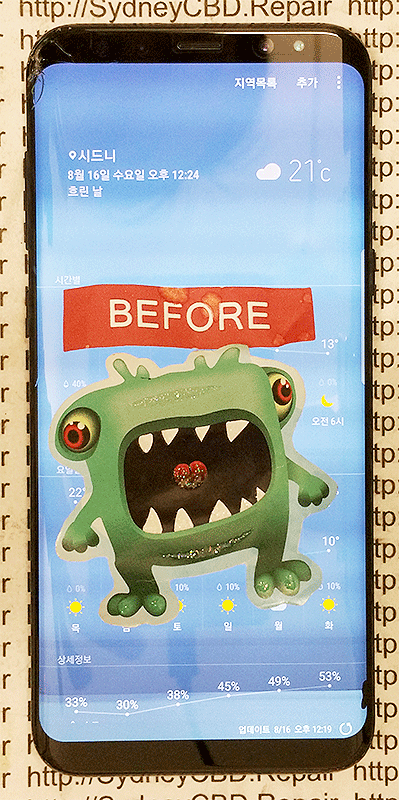
Now, There is Serious Samsung Galaxy S8 Screen Supply Shortage Globally! We have VERY Limited Stocks Therefore If you Really need it, Please contact us ASAP.
The Screen Replacement on Galaxy S8 requires the whole screen with the frame as well, therefore NOBODY has been offering this service. However We Do Take the High Risk. All Technicians from South Korea have been doing this THOUSANDS TIMES. So It’s been Easier for us. Yes ! 100% Guarantee Your Satisfaction. Take Action Now. Enjoy ‘Brand New Gangnam Style Repair Service’ in the Sydney CBD Repair Centre.
Samsung had unveiled the Galaxy A5 (2017) earlier this year running Android 6.0.1 (Marshmallow), but it looks like the phone will soon get the Android 7.0 update. The company received Wi-Fi certification for the Galaxy A5 (2017) running Android 7.0 earlier today, which means that the South Korean smartphone giant is close to releasing the Android 7.0 (Nougat) update to the smartphone.
The Galaxy A5 (2017) features a 5.2-inch 1080p Super AMOLED display with support for Always On Display. It comes with a 16-megapixel primary camera and a 16-megapixel secondary camera, both with f/1.9 aperture and 1080p video recording. The phone comes equipped with an octa-core Exynos 7880 processor, 3GB RAM, 32GB internal storage, a microSD card slot, and a 3,000mAh battery.
Samsung has already released the Android 7.0 update for various Galaxy S and Galaxy Note series of smartphones, and now it’s time for the Galaxy A series smartphones to get the Nougat update.
Both the Galaxy A5 (2017) and here available A7 (2017) are almost ready to update to Android 7.0.This is evident from the newly Vernieuwe certification of the devices in the Wi-Fi Alliance.
That we know of course exactly when Samsung will launch the update for the device. In the past, followed updates sometimes quite rapidly after certification, but it could also take weeks. However, we assume that the Android 7.0 update for the Galaxy A5 (2017) will first launch overseas. Appliances in the Netherlands then follow at a later time.
The Galaxy A5 (2017) came as any A-Phone so far, the market with a just-not-quite-new version of the Android operating system. So it was clear from day one that the device will be updated to Android Nougat. Last year, the Galaxy A5 (2016) the update to Android Marshmallow from late July . For the A5 (2017) is such a planning forecast , but it’s always wait and see how it goes in practice.
Yet in any case clear that the Nougat update for the Galaxy A5 (2017) is coming. Now we just have to wait – hopefully within the next several weeks – extent. Once the deployment begins, we will of course already a preview of the new software on the device.