❤ Apple’s Worldwide Developers Conference returns June 10, 2024
Entire conference available online for all developers, with a special event at Apple Park on June 10

![]() | |||||||
🎯 7 Years In A Row ! 👑🥇 Top 3 Mobile Phone Repair In SydneyClick Here to See CERTIFICATE of EXCELLENCE 2026💢 | |||||||
![]() | 🥇 The Best Phone Repair Store in City Of Sydney From Quality Business Awards in 2026🥇 The Best Phone Repair Store in City Of Sydney From Quality Business Awards in 2025 | ||||||
Entire conference available online for all developers, with a special event at Apple Park on June 10
According to a new analyst note from Jeff Pu at Haitong International Tech Research, Apple is planning changes to the A18 Pro chip specifically for on-device artificial intelligence. Pu also writes that Apple is ramping up A18 Pro chip production earlier than usual.
The news comes as we continue to learn more about Apple’s plans for AI features this year, including how it will balance on-device versus cloud-based solutions.
In the investor note, Pu, who is often a reliable source for Apple chip rumors, says:
According to our supply chain checks, we are seeing growing demand for Apple’s A18, while its A17 Pro volume has stabilized since Feb. We note Apple’s A18 Pro, the 6-GPU version, will feature a larger die area (compared to A17 Pro), which could be a trend for edge AI computing.
Increasing the die area of a chip means that it can accommodate more transistors and specialized components, generally allowing increased. On the other hand, as die size increases, so do the risks of defects and design flaws. It could also impact energy efficiency and heat dissipation. This is the balance Apple will have to strike as it ramps up A18 Pro production ahead of the iPhone 16’s launch later this year.
Edge AI computing, meanwhile, refers to artificial intelligence that is processed directly on device as opposed to in the cloud. Apple is believed to be taking a split approach to its AI features this year, relying on cloud infrastructure (potentially in partnership with Google) for some features, while running other features completely on device.
Here’s a great explanation of edge AI from IBM:
Simply stated, edge AI, or “AI on the edge“, refers to the combination of edge computing and artificial intelligence to execute machine learning tasks directly on interconnected edge devices. Edge computing allows for data to be stored close to the device location, and AI algorithms enable the data to be processed right on the network edge, with or without an internet connection. This facilitates the processing of data within milliseconds, providing real-time feedback.
This isn’t the first report to suggest Apple has changes to the A18 chip planned particularly focused on artificial intelligence. A report last month suggest that the A18 will “greatly increase the number of built-in AI computing cores” with a more powerful Neural Engine.
Both the iPhone 16 and iPhone 16 Pro are rumored to are expected to feature a version of the A18 chip this year. Currently, the iPhone 15 uses the A16 chip and the iPhone 15 Pro uses the A17 Pro chip. Jeff Pu’s report today seems to suggest that only the A18 Pro, destined for the iPhone 16 Pro and iPhone 16 Pro Max, will feature the AI-focused changes.
Last week, Apple released iOS 17.4.1 with rather vague release notes claiming to include important bug fixes and security patches. Now, two days later, the company has not yet added any specifics. This is unusual for Apple, which typically lists important security patches hours after a release, and suggests that the ones in iOS 17.4.1 could be significant or something else entirely.
The update comes two weeks after the release of iOS 17.4, which brought major changes to the iPhone in the European Union, mostly around the App Store, with support for alternative app marketplaces.
The release notes for iOS 17.4.1 simply say, “This update provides important bug fixes and security updates and is recommended for all users,” with a message to visit an Apple support page for additional information. The page, however, notes that details on the update are still “coming soon.”
This is not a coincidence. And could mean several things.
It’s possible Apple doesn’t want to disclose details about the iOS 17.4.1 security patches before the company has concluded its own investigation, which could point to something more significant. The update we received may have been a fix to prevent further exploitation.
On Sunday night March 17,2024 , Bloomberg reported that Apple is in talks with Google about licensing its Gemini technology to power some AI features coming to the iPhone. A new report from The New York Times today echoes those claims, citing “three people with knowledge of the discussions” between Apple and Google.
Today’s story corroborates what Bloomberg’s Mark Gurman was first to report on Sunday. The NYTimes reiterates:
Apple is in discussions with Google about using the search giant’s generative artificial intelligence model called Gemini for its next iPhone, as the company races to embrace a technology that has upended the tech industry.
The talks are preliminary and the exact scope of a potential deal hasn’t been defined, three people with knowledge of the discussions said. Apple has also held discussions with other A.I. companies, one of these people said, as it looks to tap into the power of a large language model capable of analyzing vast amounts of data and generating text on its own.
Citing “two people familiar with its development,” today’s report also says that Apple’s effort to “develop its own large language model” has been running behind the likes of ChatGPT and Gemini.
Bloomberg’s initial report included additional details about the scope of the talks between Apple and Google. Apple is preparing a wide array of new AI features for iOS 18, which is set to debut at WWDC in June. Bloomberg says we shouldn’t expect any announcement from Apple about a partnership until WWDC at the earliest.
Besides using Gemini to power features in its apps and services, Google offers its LLM to third-party developers. Apple is reportedly in talks with Google to license Gemini for the iPhone.
According to Bloomberg, there are “active negotiations to let Apple license Gemini, Google’s set of generative AI models, to power some new features coming to the iPhone software this year.” Apple has also talked with OpenAI, which powers Microsoft’s AI capabilities.
Apple is specifically looking to partner on cloud-based generative AI, with today’s report citing text and image generation as examples of what Gemini could be used for. At the same time, Apple is working on offering its own on-device AI models and capabilities with the upcoming iOS 18 release.
The discussions are still underway, and it’s unclear how the AI agreement will be branded. This would be a significant expansion of the existing relationship — default search engine — between the two companies.
Looking at the rest of the industry, Google announced a partnership with Samsung in February to have Gemini power summarization features in the Galaxy S24’s notes and voice recording apps, as well as keyboard. Samsung is also using Imagen 2 text-to-image diffusion for a generative editing feature in the photo gallery app. Those features all require server-side processing, but Samsung is also using an on-device version of Gemini.
Google offers Gemini in three sizes, with Pro being used by most first and third-party apps. Gemini 1.0 Pro powers the free version of gemini.google.com, while 1.0 Ultra is used in the paid Gemini Advanced tier.
Gemini 1.0 is available in stable, but Google in mid-February previewed Gemini 1.5 with a greatly expanded context window that allows for more information to be absorbed. This can make the “output more consistent, relevant and useful.”
Bloomberg does not expect a deal to be announced until WWDC in June, with Apple opting for OpenAI or even multiple providers offered as possibilities in today’s report.
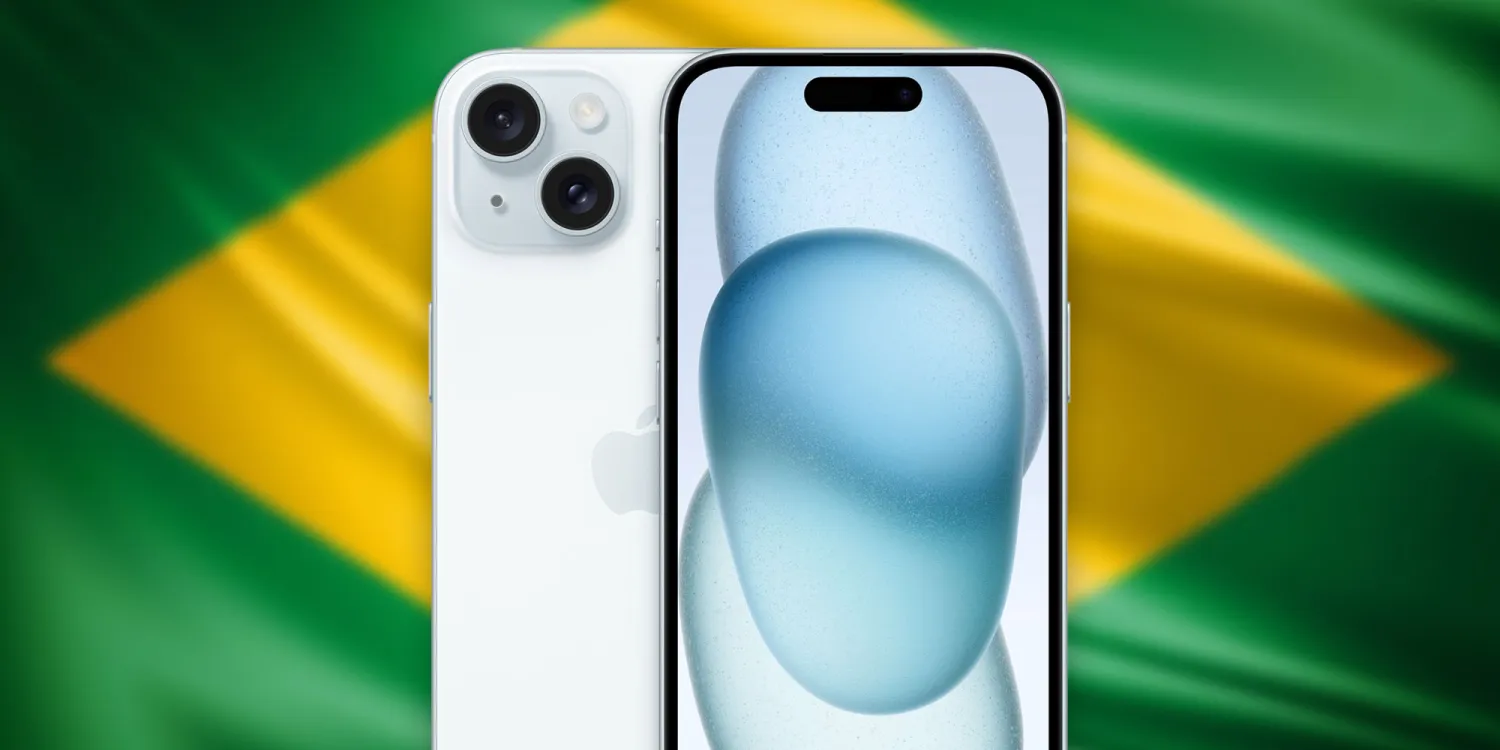
While China is still responsible for manufacturing most of Apple’s devices, the company does have some assembly facilities around the world. One of these facilities is Foxconn Brazil, located in São Paulo. There, Apple is now assembling the 6.1-inch iPhone 15.
As noted by the Brazilian blog MacMagazine, Apple seems to be shipping iPhone 15 units assembled in Brazil. The company has not confirmed the news and there’s no explicit evidence of this on Apple’s website. However, Apple’s online store in Brazil gives customers a clue as to which model they’re getting.
When checking the URL of the checkout webpage for the iPhone 15, customers will now notice the part number ending with “BR/A,” which is used to identify Apple products assembled in Brazil. Most products are identified with “BE/A” or “BZ/A” to indicate that they’ve been imported to be sold in the country.
Interestingly, Apple has once again chosen to only assemble the 6.1-inch iPhone model in Brazil. The iPhone 15 Plus and both Pro models sold in the country are still imported from China. This may be due to the entry-level model likely being the most popular in Brazil, given the high prices of the iPhone in the South American country.
Brazil imposes high taxes on imported products. For that reason, some companies invest in assembling their products in Brazil, as this grants a reduction in taxes to sell those products. The 128GB iPhone 15 was launched for R$7,299 (around $1,460) in Brazil, but can now be found for as low as R$5,399 (about $1,080) in certain retail stores.
While assembling iPhones in Brazil benefits Brazilian customers, it also benefits Apple – and not just because of the opportunity to sell more iPhones. Having assembly facilities in other regions allows Apple to depend less on China and can help the company avoid supply shortages in the local market.
In addition to Brazil, Apple has also been investing in its assembly facilities in India and Vietnam. Last year, Indian customers were able to buy iPhone 15 models assembled in India on the very first day of sales.
AirPods today offer a handful of different features related to hearing health and Accessibility. A new report today, however, says Apple has big plans for iOS 18: a new “hearing aid mode” for AirPods Pro.
In the latest edition of his Power On newsletter, Bloomberg’s Mark Gurman writes that AirPods Pro aren’t set to see any hardware changes in 2024. Instead, he says that the “big news will be a major new hearing aid mode, coming alongside iOS 18.”
AirPods already offer a feature called Live Listen, which launched as part of iOS 12 in 2018. This feature essentially turns an iPhone into a directional microphone, transmitting the audio captured by that iPhone to AirPods in real time. A handful of testimonials over the years have shown how useful this feature can be.
Apple also introduced a Conversation Boost capability to AirPods Pro in 2021, which boosts mic pickup from directly in front of you, to better hear someone talking to you. A study in 2022 showed that some of these existing AirPods Pro features already compare well to much more expensive dedicated devices.
Also notable: in 2022, the FDA established new guidelines to allow for a category of hearing aids that can be purchased over-the-counter. Hearing aids within this category can be sold directly to consumers in stores or online without a medical exam or a fitting by an audiologist.
More details on this new iOS 18 feature for AirPods Pro users are unclear. This isn’t the first time Gurman has written about Apple’s plans to bring new hearing health features to AirPods, though. Last year, he reported that Apple is also working on a hearing test feature for future AirPods as well.
Fans of manga got a pleasant surprise today, when Apple released a 19-Minute Takashi Miike film on its Japanese YouTube channel (shown below).
The film, shot entirely on an iPhone 15 Pro, is an adaption of a story by well-known Japanese manga artist Osamu Tezuka …
Hollywood Reporter has the details.
Titled Midnight, the mini-movie is an adaptation of a lesser-known work by legendary Japanese manga artist Osamu Tezuka. Much of the film takes place in neon-lit Tokyo at night, including a thrilling car chase sequence — a deliberate exercise on Apple’s part to showcase their device’s video capture capabilities in low lighting […]
The story centers on a late-night taxi driver named “Midnight” played by popular Japanese actor Kento Kaku, who roams the streets of Tokyo offering help to those in need. The film follows Midnight as he comes to the aid of a young woman, played by Konatsu Kato, who is struggling to take over her recently deceased father’s truck-driving business while fighting off a nefarious local gang, led by an evil boss played by the acclaimed character actor Yukiyoshi Ozawa.
The film was commissioned by Apple to showcase the low-light video capabilities of the iPhone 15 Pro. Miike, who has created more than 100 feature films, said that the project was both an honor and a challenge.
“Mr. Tezuka is something of a god among manga artists so it was an honor to take on the challenge of expressing his work using only iPhone. As we were shooting, I naturally began to challenge myself to think about how we could make a work unique to iPhone, beyond the usual approach to a film. I truly felt that the iPhone has the power to do things that a conventional movie camera can’t.”
He praised Action Mode in particular, calling it a magical feature. This is one of the features which really impressed me when I tried it. He also loved the ability to change the focus point after shooting.
I hope that game-changing features like this that are impossible with regular photography equipment will be added more and more.
Update March 04,2024 8:43am PT: Beats Solo 4 are not expected to launch for several more weeks, according to a source familiar with the matter. No word on when to expect new iPads.
Bloomberg’s Mark Gurman has reported that Apple stores are planning a minor refresh this week, but he believes it to be for a new accessory, rather than a major new product.
He says that a bigger refresh is expected the following week, and it sounds like that one may point to the new iPads we’re expecting to be announced any day now, alongside the just-announced M3 MacBook Air models …
Gurman doesn’t give any clue as to what the new accessory may be, but we recently found images of an unannounced Beats Solo 4 in the internal files of the latest build of iOS 17.4.
A few additional points: retail stores are low on MacBook Airs and iPad Pros; Stores are planning a minor refresh for this week (I think it's a new accessory rather than a new product); Stores are planning a larger refresh early next week (which sounds more product-related). https://t.co/kUkeYjT4rK
— Mark Gurman (@markgurman) March 4, 2024
Certainly an update to the Solo 3 is long overdue.
It’s been a long time since Apple introduced Beats Solo 3 – more specifically, it was unveiled in September 2016 alongside the first generation of AirPods. It was the first Beats headphone to feature Apple’s W1 chip for fast pairing with Apple devices.
The new model will include USB-C, and support Spatial Audio. The images we discovered suggest that the new model will be available in black, blue, and pink.
Gurman had earlier suggested that the new iPads we’re expecting will be announced via press release, rather than in a launch event. MacRumors said its own source backed this, with the announcements expected this week.
We’re expecting new iPad Pro models with OLED screens.
The biggest change to the new iPad Pro models will be a switch to OLED screens. Currently, the 11-inch iPad Pro uses an LCD screen with conventional backlighting. In fact, the 11-inch iPad Pro has used the same display panel since it was first introduced in 2018.
This year, the entire iPad Pro lineup will unify on OLED displays for the first time. This will also mark the first time that Apple has used OLED displays outside the iPhone and Apple Watch. The 12.9-inch iPad Pro might also get slightly bigger this year, with the screen size increasing to 13 inches.
This is expected to be accompanied by a new version of the Magic Keyboard for iPad, with a sturdier aluminum frame and giving a more MacBook-like look.
While the iPad Air will stick to LCD screens, we’re expecting to see a new 12.9-inch model – the first time it’s been possible to buy an iPad of this size without opting for the Pro model.
We’re also expecting a new camera bump, still with a single rear camera but with the addition of flash.
Apple is widely rumored to be working on a new fourth-generation iPhone SE with a modern design refresh. New CAD files obtained by 91mobiles this week claim to offer our clearest look yet at this update, showing an iPhone SE 4 with an iPhone 14-style design.
The current iPhone SE was released in 2022 and features a 4.7-inch display with a Home button, similar to the iPhone 8. It’s powered by the A15 Bionic chip inside, features Touch ID instead of Face ID, and retails for $429.
These CAD renders suggest the iPhone SE 4 will feature a 6.1-inch display with a notch along the top that houses new Face ID sensors and the front-facing camera. On the back, there is a single camera cutout alongside a flash sensor.
According to 91mobiles, the iPhone SE 4 will measure 147.7 x 71.5 x 7.7mm. The current iPhone SE measures 138.4 x 67.3 x 7.3 mm. These dimensions show just how bigger the iPhone SE 4 will get to accommodate the bigger 6.1-inch display.
Previous rumors have also suggested that the iPhone SE 4 will have USB-C instead of Lightning. There’s even been one rumor claim it will feature the Action button – which is currently exclusive to the iPhone 15 Pro.
There’s still no exact details on when Apple might release the iPhone SE 4, but the current expectation is that it likely won’t be until 2025. The device has been rumored off and on for the past 18 months. Ming-Chi Kuo reported last April that Apple had paused development of the iPhone SE 4.
It’s a sad day for everyone who had hoped the iPhone SE 4 would be based on the iPhone 12 mini and iPhone 13 mini form factor.