After a teaser earlier this year, Samsung is showing off the Galaxy Ring for the first time at MWC 2024. We were able to get a quick look at the upcoming health-focused wearable and pick up a few tidbits on the device.
The Samsung Galaxy Ring won’t be coming out for a while yet but the company is giving a first look at the product in Barcelona this week and, technically, “unveiling” the product more formally.
As a new addition to our wearables portfolio, Galaxy Ring will offer users an all-new way to simplify everyday wellness, empowering them with greater insights and more ways to understand themselves day and night. With Galaxy Ring, users can embrace an unrivalled experience during every step of their wellness journey, all while being delivered in lockstep with Samsung’s broader vision for a more connected, integrated and seamless digital wellness platform.
The launch of Galaxy Ring is just one of Samsung’s many initiatives that exemplifies this and delivers on our vision of improving the health and wellness of billions, starting at home, with you.
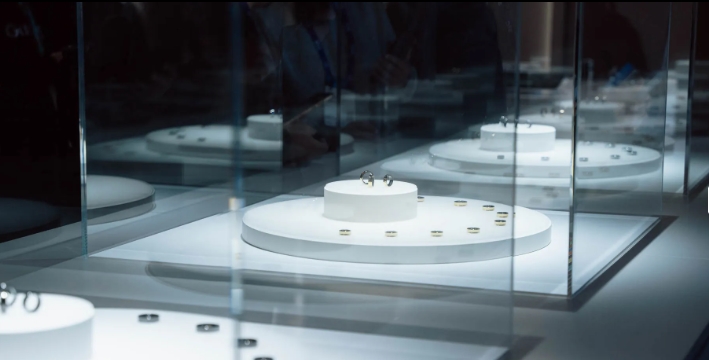
While we, unfortunately, weren’t about to get an opportunity to try the device on, we did get to take a quick look at Samsung’s booth.
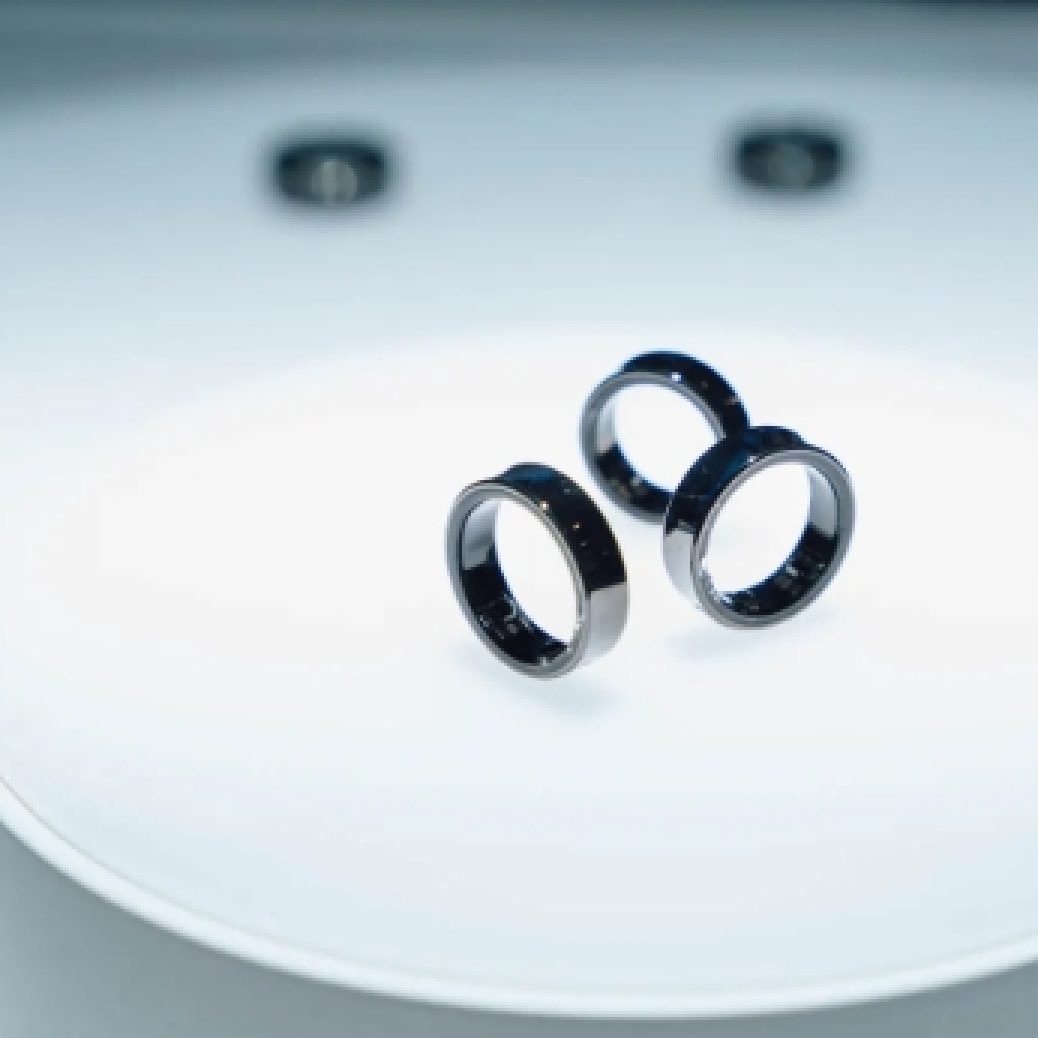
Galaxy Ring comes in three colors – silver, black, and gold. All three have a slick polished finish, almost a mirror on the silver and gold models. Just based on this first look, I’d certainly go for the black, and I do feel this particular shade of gold is a bit gaudy, but I do really hope Samsung expands color choices and maybe offers other finishes for the metal.
Each will be available in a total of nine sizes. These are categorized into small, medium, large, and extra-large, with two available of each, and three available for small. Presumably, when the Galaxy Ring goes on sale, Samsung will relate these sizes to traditional ring sizing. Samsung told The Verge that sizes range from 5 to 13 and also mentioned the wearable will support a new Samsung Health feature called “My Vitality Score” which will also come to Galaxy Watch (only when paired to Galaxy S24) alongside other health tracking (heart rate, sleep, cycle, and more).
The hardware looks like a normal ring from the outside, but inside is where you can see the smarts.
There’s a contact space for charging pins, and a heart rate sensor visible that very slightly juts out from the inner circle. It looks to be a more subtle implementation compared to something like Oura’s smart ring.
Samsung Galaxy Ring to have up to nine days of battery, launching second half of 2024
The Samsung Galaxy Ring is quickly on its way and new information keeps coming, including an official estimate on battery life.
Speaking to FNNews, Samsung has confirmed that the battery life of the Galaxy Ring will fall somewhere in-between five and nine days. That estimate puts Samsung’s ring in pretty good company, potentially beating the 4-6 day estimate of rings from UltraHuman and RingConn, while also potentially beating out the one-week estimate of the Oura ring.
This extended battery life falls in line with Samsung’s pretty obvious vision for this product, which is to have a health-tracking device that largely fades into the background.
Beyond that, though, Samsung also confirmed to The Elec that the Galaxy Ring will see its release in the second half of this year. That comes as no surprise, as previous reports have pointed at July 2024 for the launch, but it’s nice to have further confirmation nonetheless.
It was showcase the first look at the Galaxy Ring at MWC 2024 to check out its charging method, colors, and various sizes.
Samsung has struck gold with the Galaxy A73 5G– this phone comes as a really well-balanced package with great performance and a camera that blows almost every other mid-range phone out of the water, Sure, Samsung has made some compromises but those won’t be deal-breakers for most users.
The Samsung Galaxy A73 5G is one of the best mid-range phones we’ve looked at and has the best camera phone you can find in the mid-range segment with its impressive 108MP camera sensor.
When it comes to performance, you’ll get a capable Snapdragon 778 5G processor that’s more than capable of handling gaming and other heavy tasks. Samsung’s efforts in de-bloating One UI also have a hand as well in keeping the phone as fast as possible.
In addition to the high-performing chipset, you will also get a fantastic screen with good color reproduction and a smooth 120Hz refresh rate that will give you a pleasant experience in gaming and scrolling through web pages.
With a 108 MP main camera and 50 MP ultra-wide, you’ll be able to capture great shots in different lighting conditions, the camera’s prowess in this phone is really fantastic.
Where the phone falls behind is with charging speeds compared to other phones- it only supports 25 Watts charging and you’ll have to buy a charger separately as Samsung doesn’t bundle one in the box.
Disclaimer. We can not guarantee that the information on this page is 100% correct.
Design
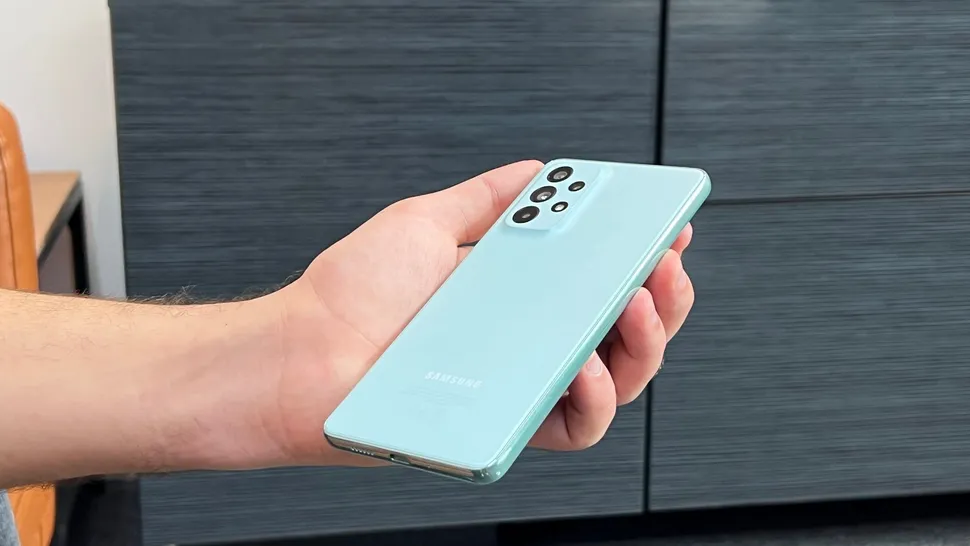
The Samsung Galaxy A73 5G is made entirely of plastic, as it’s the case with most Galaxy A series phones. The back of the phone comes in a matte plastic that prevents getting any fingerprints stuck on it. However, the sideband is made of shiny plastic that feels a little bit cheap.
With a thickness of only 7.6 mm, the Samsung Galaxy A73 5G is fairly impressive given the big battery it contains. Samsung has also done a really good job in hiding the camera bump that comes slightly thicker than the phone. With the smooth edges, the phone feels thinner in your hand than it actually is.
At just 180 grams, the Samsung Galaxy A73 5G is also easy on your hands even when used all day long.
The button layout on the Galaxy A73 5G is standard with what you’d find in most phones these days. The power and volume buttons are on the right-hand side of the phone and feel nice with a solid clicky feeling to them. The only thing we didn’t like is that the back of the phone feels a little hollow when you press on it.
The Samsung Galaxy A73 5G comes with a trusty IP67 dust/water resistant rating which means you’re safe to use it around water as it can withstand a dip in the water. You don’t see IP ratings on mid-range phones and we really like that Samsung is pushing this segment with the Galaxy A73 5G.
Display
With an AMOLED display that Samsung has perfected over the years, the Galaxy A73 5G gives you a very pleasant viewing experience. With a pixel density of 393 and a screen size of 6.7 inches, the phone is a joy to consume media, play games and surf social media.
The display’s design is nice and flat with nearly symmetrical bezels, The selfie camera’s punch hole is a bit wider than usual, however you get used to it easily.
Even though the display doesn’t support the higher 144Hz refresh rate that has made its way to some other mid-rangers such as Motorola Edge 30 and the Poco X4 GT 5G, we found the 120Hz refresh rate to be very smooth. The Snapdragon processor equipped on the Galaxy A73 5G coped up perfectly with no signs of sluggish performance or low frame rates.
The color reproduction in this display is nice buy a little bit oversaturated as is usual with all Samsung phones. The extra saturation makes the color pop and feel more punchy.
Outdoor viewability is great with this phone as it reaches up to 800 nits in HBM (High brightness mode) and we didn’t have any problem using the phone in direct sunlight.
Camera
Samsung went all out with the quad-camera setup on the Galaxy A73 5G that’s highlighted up with the 108MP flagship sensor and accompanied by a 12 MP ultrawide lens as well as a pair of 2 MP lenses that are used for zooming and macro.
The phone is capable of producing beautiful shots in well-lit environments as well as night shots. The phone uses pixel binning to take 9MP shots as standard, however you have access to a 108MP mode which is useful in zooming in and capturing more details.
Shutter lag on this phone is barely noticeable and we found it quite snappy to capture shots right away in well-lit scenes. It does took a little longer in night time or dimly lit scenes as the shutter needed to capture more light to the camera.
Thanks to both optical and electrical image stabilization, this phone produced some of the best night shots we’ve seen that blow all of the other mid-range phones out of the water. Even the video quality in low light was pretty good and usable.
Using the ultrawide lens was also a pleasant experience with the high fidelity camera that produces well-balanced pictures with good sharpness and colour reproduction.
With a 32 MP selfie snapper, the selfie shots come out with really good details and quality that approaches flagship cameras.
The TLDR of the camera’s on the Galaxy A73 5G is the best camera phone in any mid-range phones we’ve got our hands-on.
Performance and software
Using the Snapdragon 778 SoC paired with an 8GB of RAM, the Samsung Galaxy A73 5G is smooth. Samsung has done a good job optimizing One UI 4.1 that now gives you the option to opt out of installing third-party apps and not force them on you.
Even though the screen isn’t the fastest we’ve seen on a mid-range, the 120Hz display here is good enough for gaming and other tasks. The Qualcomm SoC keeps up in providing the phone with a stable supply of frames to make the most out of the 120Hz display.
Using the phone in multitasking, gaming and other heavy demanding scenarios we didn’t notice any signs of slowing down or sluggishness with the phone.
There are a lot of customization options available through the system to tweak the phone to your liking. The Always-on-display on Samsung’s phones, is one of the best experiences with many customizations and useful info you can find glancing on the phone.
Battery life and charging
Samsung has decided on ditching the bundled chargers which is good for the environment and makes sense on higher-end phones where its customers can easily afford buying an additional charger.
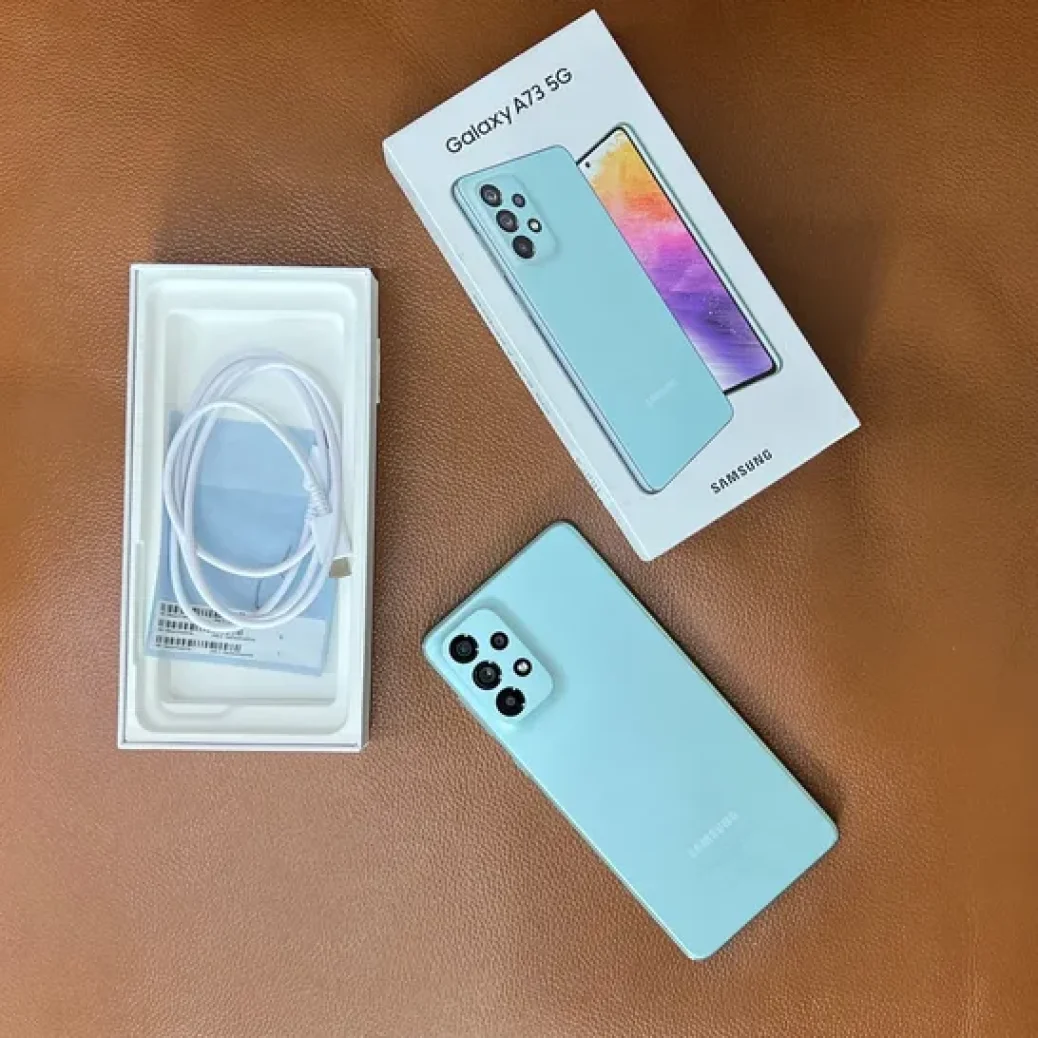
We’re not sure if that idea works on mid-range on budget phones as the target for these phones are consumers looking to save money. Inside the box, you only get documentation, a sim card remover tool, and a charging cable only.
On the bright side, the phone has an excellent 5,000 mAh battery that has an impressive life. We didn’t hold back on turning the high refresh rate along with the always-on-display and we still couldn’t drain the battery after a full day of usage. Dialing down the screen refresh rate and with moderate usage, you should easily get two days of battery life out of this phone.
While that large battery sounds great, it’s not all rainbows and unicorns as you’d be surprised on how much time it takes to fully charge this phone. The Galaxy A73 5G has a maximum charging speed of 25 watts which takes a while to juice the phone up. It took the phone close to an hour and half to fully charge which is not the worst thing but it could be much better.
Samsung has lagged behind when it comes to fast charging since the infamous Note 7 incident and has been really conservative to use fast chargers. The Korean giant really needs to step up their game with faster chargers as we see other companies are now supporting charging speeds upwards of 100 watts.
Needless to say that this phone doesn’t support wireless charging and you’ll have to settle for wired charging only to charge it.
Should I buy a Galaxy A73 5G?
Buy it if …
You want the best camera phone in the mid-range phone
The Galaxy A73 5G arguably has the best camera in the mid-range segment and blows the competition out of the water with its photography chops.
You need a large battery
The battery on the Galaxy A73 is as impressive on paper as it is in real-life usage. You can easily get over a day of usage from the battery on this phone.
You need a phone with a great display
Samsung continues to lead the industry in smartphones panels, and the Galaxy A73 5G is no different. It features a vibrant OLED display with 120Hz and great viewability outdoors with a peak brightness of 800 Nits
Don’t buy it if …
You can’t stand slow charging
This phone’s charging speed is mediocre at best and doesn’t cope with the modern charging speeds that are supported by other manufacturers.
You don’t want to spend extra on a charger
If you are already stretching your budget with the Samsung Galaxy S73 5G, you should think twice as you will also need to invest in a charger as Samsung doesn’t include one in the box.
Samsung is pretty widely rolling out its Android 14 update over the past week, but there’s a slight chance you should wait to actually install it, as it seems Samsung has left out a method that prevents burn-in from the status bar.
Burn-in on smartphone displays was once a major problem, with a few years on the same smartphone often resulting in display elements showing up nearly constantly on the screen. A common trick to prevent this is to slightly shift UI elements so they never stay in the same place too long. It’s nearly invisible to the user, but goes a very long way in preventing burn-in.
In One UI 6 (Android 14), though, it seems Samsung might have left this out.
Users on Reddit noticed that the status bar elements (time, battery, etc) no longer seem to shift over time. This was spotted by comparing screenshots over time, with the status bar elements perfectly aligning. Back in One UI 5 (Android 13), comparing screenshots over time showed that the elements would move a fair bit, resulting in an almost blurred effect when stacking screenshots on top of each other as seen below.
Notably, the navigation bar buttons still move, so Samsung doesn’t seem to have given up on this method entirely.
As for what exactly is going on here, it’s really hard to say. It’s entirely possible that Samsung has just adjusted screenshots to where they compensate for status bar elements moving, or that the company is using a new method for preventing burn-in. It’s also noteworthy that the comparison is made on two different devices – a Galaxy S23 Ultra on One UI 6 and a Galaxy Note 20 Ultra on One UI 5.
In any case, it’s at least a little worrying, and we’ll be curious to see if things change with further updates.
One UI 5 (1st photo) vs One UI 6 (2nd photo)
Samsung posts a new Android 14 update schedule for over 50 Galaxy devices
Samsung’s Android 14 rollout is well underway this week, and the company has now posted an updated schedule for the release, which details over 50 devices set to be updated over the next couple of months.
In Germany, Samsung has posted (as spotted by SamMobile) a new schedule via the Samsung Members app that details over 50 different devices set to get Android 14. The updated schedule shows updates going through February 2024, with the bulk of the work being done in November and December of this year.
Of course, we’ve heard this story before. Earlier this month, a roadmap posted by Samsung in another European country also detailed the company’s plans before being scrubbed from the web. But there are a couple of reasons to believe this latest roadmap is much more accurate. For one, it has far more devices, and it also lacks specific dates, which are always tough to hit. Beyond that, it’s being distributed through the Samsung Members app instead of the company’s forums, and the Members app is where we’ve seen this sort of roadmap released in the past.
Presumably, Samsung will add this same list to other countries in the days to come. It’s not live in the US as of now.
That’s not to say this is a concrete, definitive schedule. It’s still lacking plenty of lower-cost models, and things are always subject to change. But, that said, this is the closest we’re likely to get.
Samsung Android 14 update schedule
Smartphones
Galaxy S23 – Completed
Galaxy S23+ – Completed
Galaxy S23 Ultra – Completed
Galaxy Z Fold 5 – November 2023
Galaxy Z Fold 4 – December 2023
Galaxy Z Fold 3 – December 2023
Galaxy Z Flip 5 – November 2023
Galaxy Z Flip 4 – December 2023
Galaxy Z Flip 3 – December 2023
Galaxy S22 – December 2023
Galaxy S22+ – December 2023
Galaxy S22 Ultra – December 2023
Galaxy S21 – December 2023
Galaxy S21+ – December 2023
Galaxy S21 Ultra – December 2023
Galaxy S21 FE – December 2023
Galaxy A72 – December 2023
Galaxy A54 5G – November 2023
Galaxy A53 5G – December 2023
Galaxy A52 – December 2023
Galaxy A52 5G – December 2023
Galaxy A52s 5G – December 2023
Galaxy A34 5G – November 2023
Galaxy A33 5G – December 2023
Galaxy A23 5G – January 2024
Galaxy A14 – December 2023
Galaxy A14 5G – December 2023
Galaxy A13 – February 2024
Galaxy A13 5G – February 2024
Galaxy A04s – February 2024
Galaxy M53 5G – December 2023
Galaxy M33 5G – December 2023
Galaxy M23 5G – February 2024
Galaxy M13 – February 2024
Galaxy XCover 6 Pro – December 2023
Tablets
Galaxy Tab S9 – November 2023
Galaxy Tab S9 5G – November 2023
Galaxy Tab S9+ – November 2023
Galaxy Tab S9+ 5G – November 2023
Galaxy Tab S8 – December 2023
Galaxy Tab S8 5G – December 2023
Galaxy Tab S8+ – December 2023
Galaxy Tab S8+ 5G – December 2023
Galaxy Tab S8 Ultra – December 2023
Galaxy Tab S8 Ultra 5G – December 2023
Galaxy Tab S7 FE – January 2024
Galaxy Tab S7 FE 5G – January 2024
Galaxy Tab S6 Lite – November 2023
Galaxy Tab Active 4 Pro – January 2024
Galaxy Tab Active 4 Pro 5G – January 2024
Galaxy Tab A8 – February 2024
Galaxy Tab A7 Lite – February 2024
Again, the list here certainly isn’t definitive or all-inclusive, but it offers a much clearer picture of Samsung’s Android 14 update schedule compared to what we’ve had thus far.
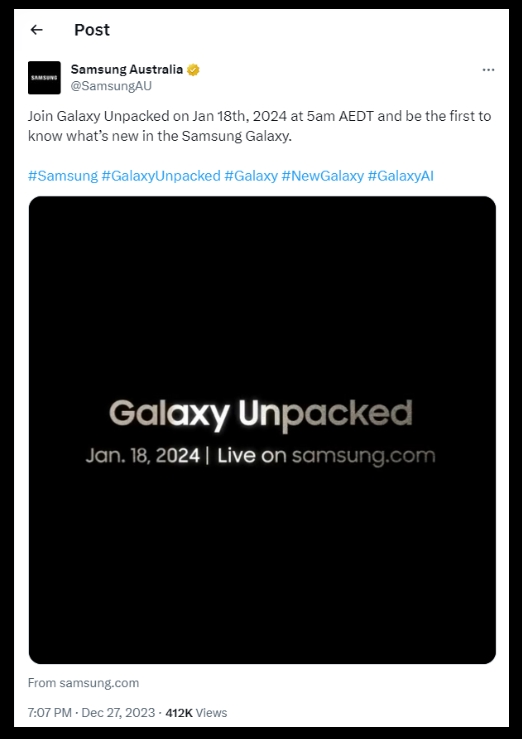
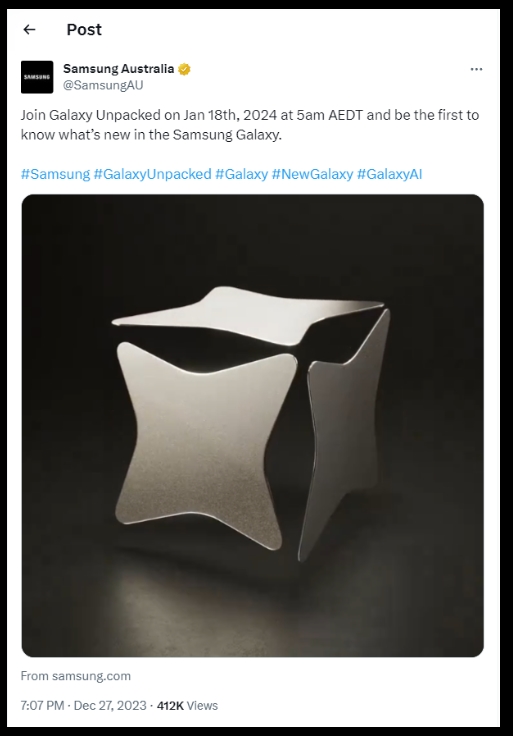
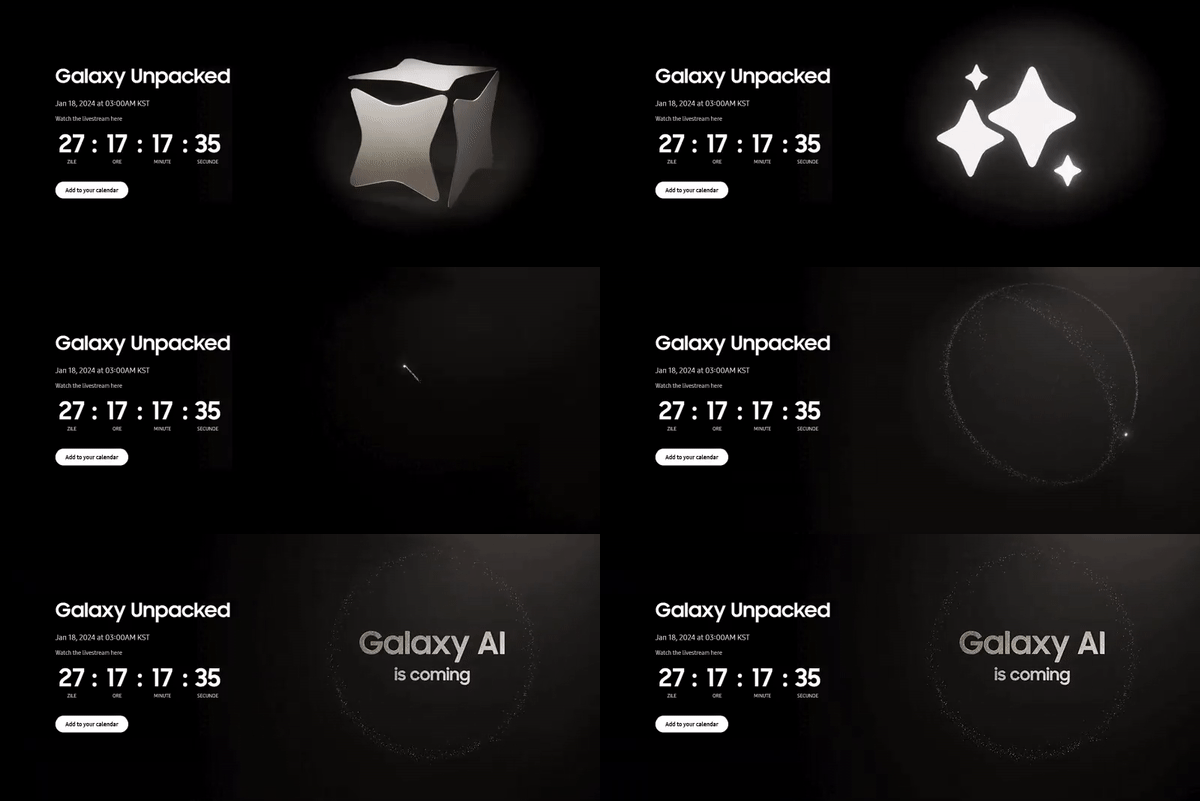
Samsung’s Twitter/X account in Australia has posted a brief video teaser that confirms the date of the next Galaxy Unpacked event for January 18, 2024. The time of the event, 5am local, translates to 10am PT. The post, crazy enough, has actually been live since December 27.
The video posted is brief, but definitely gets the point across that Samsung is heavily focusing on AI, with the tagline “Galaxy AI is coming.”
The teaser was posted solely to this account, as highlighted by SamMobile, and is probably being posted early in error, as Samsung typically makes this announcement across all of its accounts. The URL on the post also currently redirects to the Samsung.com homepage.
We’ve embedded the post below, but it will almost certainly be removed imminently.
Samsung officially confirms Galaxy S24 event on January 17, opens reservations with $50 credit
Samsung has just officially announced a January 17 Unpacked event which is expected to deliver the Galaxy S24 series among other releases, and also opened up reservations with a bonus credit.
A teaser image released today from Samsung confirms that the next “Galaxy Unpacked” event will take place on January 17, 2024. The event will be live-streamed via Samsung’s website as well as through YouTube.
The event itself takes place in person in San Jose, California, at 10am PT.
The teaser image doesn’t reveal much, but a video from Samsung, as seen below, offers up the tagline “Galaxy AI is coming” with a familiar set of symbols that represent AI. Reports and leaks have shown Samsung’s focus on AI including:
The Galaxy S24 series is likely to be the main focus of the upcoming Unpacked event, but there’s a good chance we’ll see other products too. Leaks suggest new Galaxy Buds 3 Pro are coming, a new fitness-focused tracker, and we also previously spotted evidence that a new fitness-focused smart ring is coming. We could also see a glimpse at Samsung’s mixed-reality headset, which is rumored to launch later in 2024.
For those looking to upgrade, Samsung is opening up reservations on its website today.
These reservations are completely free and just hold your place in line. You only need to enter your name and email address. When pre-orders actually open up, you’ll be able to get in and complete the order, or just skip it and lose nothing.
If you do end up pre-ordering any of Samsung’s new devices, though, you’ll get an additional $50 credit that comes with your pre-order. Notably, with the Galaxy Foldables released last year, Samsung allowed this credit to be used towards the cost of the device.
Samsung’s upcoming Galaxy S24 series is set to be announced in a few weeks, and as the event approaches, leaks are detailing the price of Samsung’s new lineup as well as the potential removal of satellite connectivity.
Two separate price leaks of the Galaxy S24 series have surfaced this week, both suggesting that Samsung will raise the price of the Galaxy S24 Ultra.
GalaxyClub reports that the Ultra will cost €1,449 in Europe for its base, 256GB model. That’s up from the €1,399 price of the Galaxy S23 Ultra. Roland Quandt of WinFuture adds that pricing in Sweden for the Galaxy S24 Ultra starts at 17,990 SEK, with the 512GB model coming in at 19,490 SEK. While Samsung’s website doesn’t list the 256GB price in Sweden currently, the 512GB model is priced at 18,990 SEK, slightly less than the incoming Galaxy S24 Ultra.
So, by all accounts, it certainly appears that the Galaxy S24 Ultra will see a higher price. Whether that translates to the US remains to be seen, though. Galaxy S23 Ultra starts at $1,199, and based on these prices out of Europe, $1,249 seems like a reasonable expectation.
Meanwhile, there are conflicting reports on the Galaxy S24 and Galaxy S24+ prices.
Quandt says that Galaxy S24 will start at 11,490 SEK in Sweden, the same price as the current S23. Galaxy S24+ would start at 14,490 SEK, also unchanged from the prior model. But GalaxyClub claims that, in the rest of Europe, the two lesser models could actually see lower prices compared to last year. Galaxy S24 would start at €899, down from €949. The S24+ apparently lands at €1,149, down from €1,199.
Part of the Ultra’s price increase, GalaxyClub speculates, could be because of more RAM with the base model now including 12GB rather than 8GB.
Meanwhile, ETNews reports that Samsung is in the midst of network testing in Korea and that the Galaxy S24 series apparently will not include satellite connectivity yet again. Satellite support has become a topic of discussion since Apple added the feature to its iPhone 14 series in 2022, but Samsung has surprisingly skipped over it thus far. With the Galaxy S23 series, Samsung said that it is waiting on the tech to be “ready,” but at this point, it’s unclear what the company is waiting on, especially now that its own cellular modems for Exynos chipsets support the tech (and Exynos is expected to be used in some capacity on the Galaxy S24 series).
In the larger Android landscape, Qualcomm recently pulled the plug on its efforts for satellite connectivity, and things have been pretty quiet in terms of new efforts for the technology.
Full Galaxy S24 series specs leak with 2,600 nit displays, Snapdragon 8 Gen 3, fake 10x tele on Ultra
Galaxy Unpacked 2024 is under a month away, and Samsung is expected to announce the Galaxy S24, S24+, and S24 Ultra. Before that, a complete specs leak gives an official look at each phone’s capabilities.
The last couple of days have proven to be a war zone of leaked information on the Galaxy S24 series. While leaks have somewhat trickled out in the past, the end of 2023 has them coming in full swing.
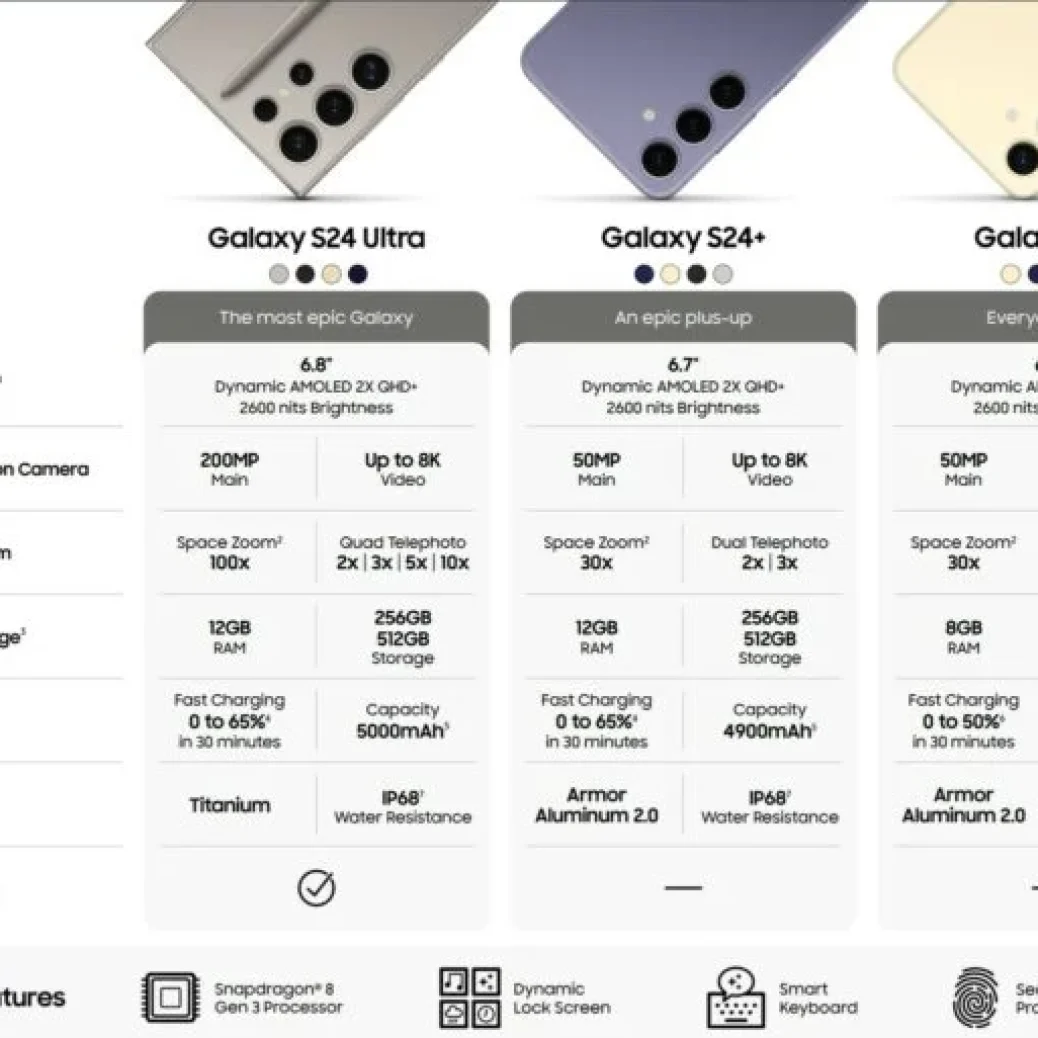
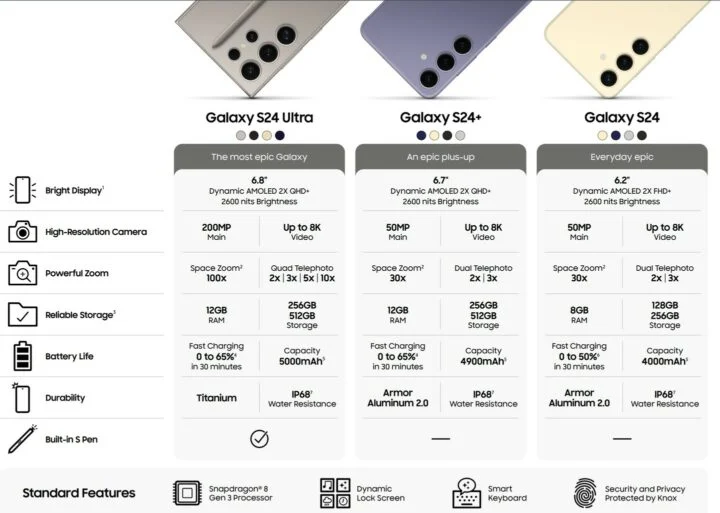
A new post by Evan Blass on Twitter/X showcases Samsung’s official marketing spec sheet for the Galaxy S24 lineup, which consists of the S24, S24+, and S24 Ultra. The sheet is broken down into a few key categories, starting with the display capabilities of each device.
At the base level S24, there is a 6.2-inch Dynamic AMOLED FHD+ display that can hit up to 2,600 nits of brightness. Across the board, each AMOLED screen is able to reach 2,600 nits in bright sunlight. Where it varies is in size and quality. The Galaxy S24+ will house a 6.7-inch screen that reaches QHD+. The S24 Ultra also hits QHD+ but brings a larger 6.8-inch screen.
According to the specs, the Galaxy S24 will also house a simple 50MP camera, the same as the S24+. The bigger Galaxy S24 Ultra will instead carry a 200MP unit, which is similar to what we saw last year, though the big change might come from software this time around. Each phone can handle 8K video, though how each does may vary from model to model. The S24 and S24+ can get up to 3x telephoto, but the S24 Ultra will be able to hit 10x utilizing sensor crop workarounds.
The Galaxy S24 base model shows its price in the memory department. At only 8GB of RAM, it’s coming in way under the S24+ and S24 Ultra’s 12GB of RAM. It also caps out at 256GB of storage, whereas the other two models hit 512GB, at least. The S24 also only carries a 4,000mAh battery compared to the 4,900mAh and 5,000mAh batteries in the S24+ and S24 Ultra, respectively.
There are two big takeaways from this leak. First, it conforms that each phone will use the Snapdragon 8 Gen 3 chip, at least in one region. It was originally thought that Samsung might cheap out on the base S24 and equip it with an Exynos 2400 instead.
The other big reveal within the Galaxy S24 spec sheet is that Samsung is still advertising that the Galaxy S24 Ultra carries a 10x telephoto lens capability when, in reality, the largest actual glass element cluster on the phone is capable of a 5x optical zoom. Beyond that, the 10x capability is done with sensor cropping and digital zooming.
There isn’t a lot that screams “huge improvement” over last year’s release. Samsung is seemingly hedging a lot on AI, as evidenced by a recently leaked teaser video for Galaxy Unpacked. That event will take place on January 17 at 1:00 p.m. EST.
Overshadowed by the Galaxy S24 Ultra, the Galaxy S24 hasn’t received much attention. Some recent leaks of the base model Galaxy S24 flagship show a minimal change over the S23 of earlier this year in its four main color options.
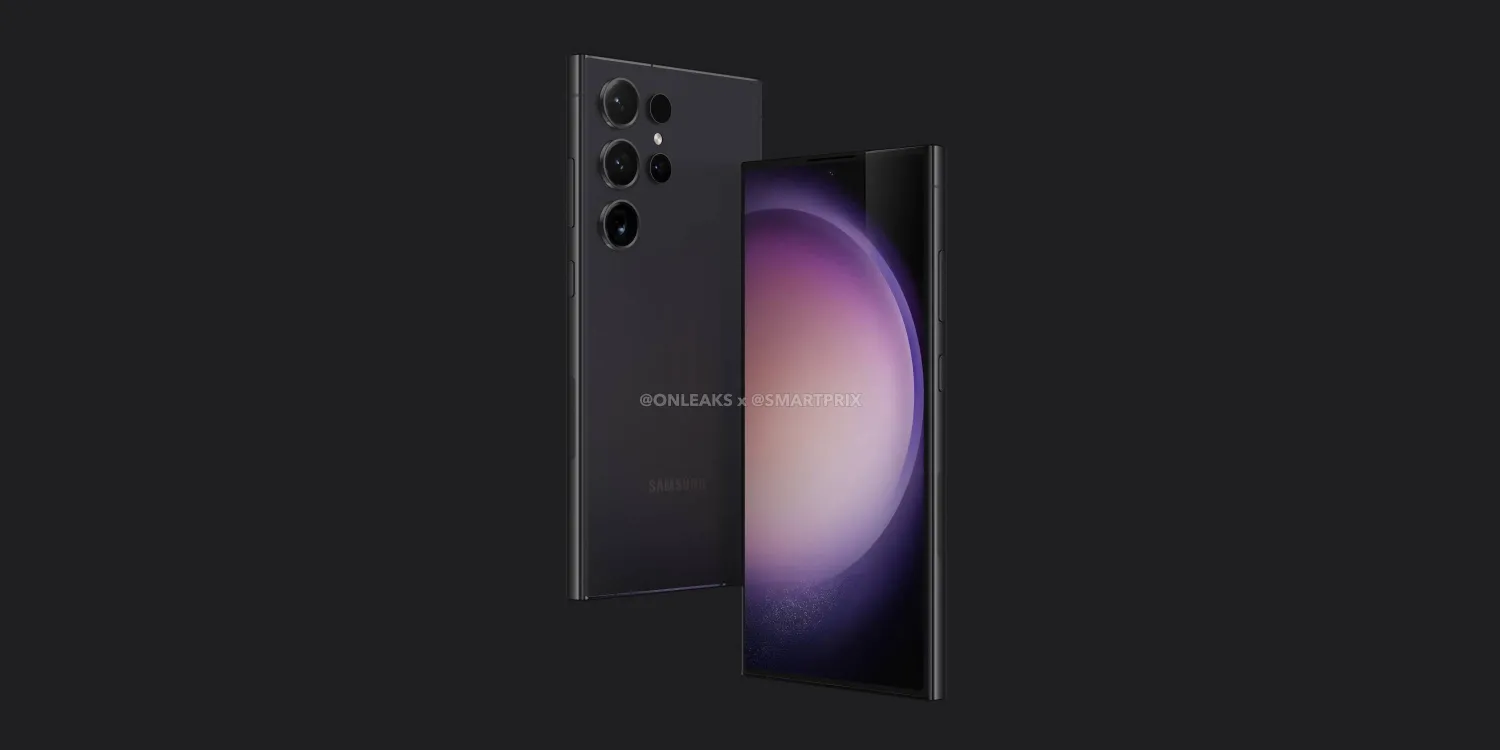
The Galaxy S24 lineup has seen its fair share of leaks. Most have revolved around the more expensive S24 Ultra, which packs better cameras and, supposedly, a much more premium build. As for the base S24 and S24+, there hasn’t been as much hype building around them.
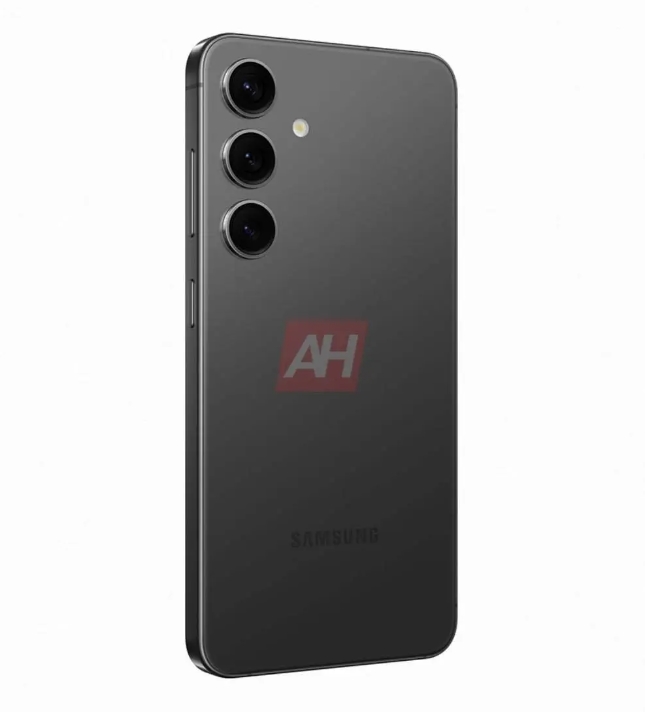
Previous leaks note that the Galaxy S24 won’t house a titanium body like the S24 Ultra. It will, however, retain an aluminum frame with several colors. The Galaxy S24 will come in “Onyx Black,” “Marble Grey,” “Cobalt Violet,” and “Amber Yellow” color choices.
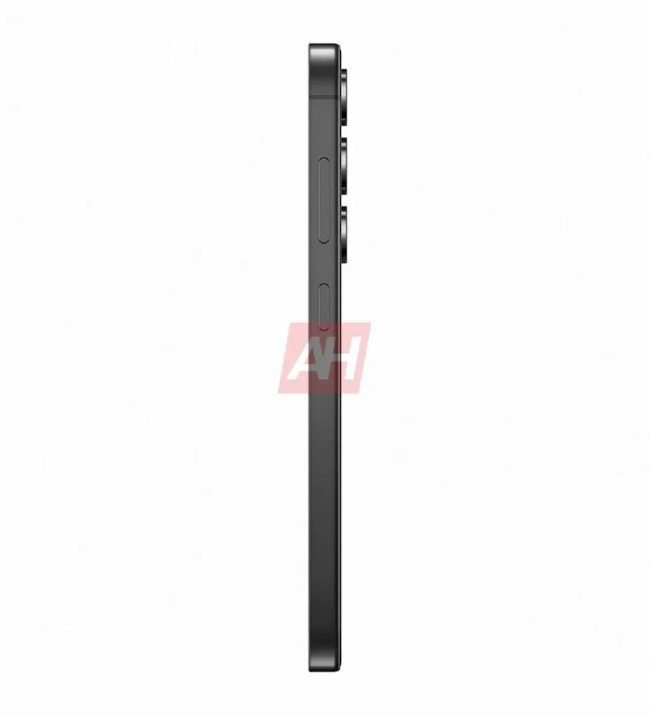
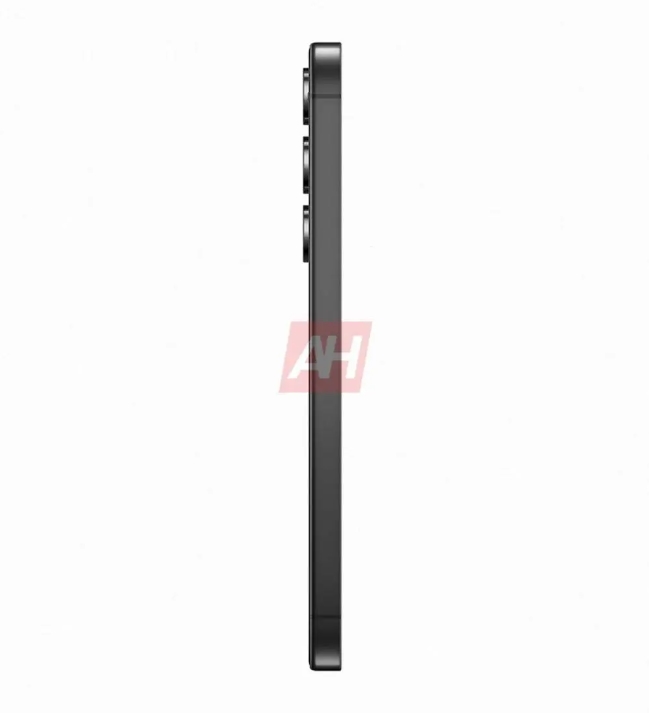
Per Android Headlines, new official-looking renders are available for the Galaxy S24. The renders showcase the colors listed above, as well as a high-definition look at the device from several angles.
Samsung S24 Series Unpacked sets on January 18,2024 3:00AM KST ( Korean Standard Time )
One of the biggest differences between the S24 and Galaxy S23 is the thickness and radius of the aluminum frame. The S23 had a thicker frame that imposed on the rear and front glass. It was also somewhat rounded. In this generation, the metal recedes a little more and gives the phone the appearance of a metal bezel. Each Galaxy S24 also carries a color-matched frame, which redeems the design a bit.
The Galaxy S24 also retains the same camera design, with no panel surrounding each lens. The phone also retains the same basic and sometimes boring look, at least from the back of the phone.
The Galaxy S24 is rumoured to house 8 GB of RAM starting at 128 GB, while the S24+ may house 12 GB of RAM. Respectively, the phones will carry a 4,000 mAh and 4,900 mAh cell. The Galaxy S24+ will house the same SoC as the Ultra – Snapdragon 8 Gen 3 – while the Galaxy S24 base model will carry an Exynos 2400 in some European markets and a Snapdragon 8 Gen 3 in the US.
Galaxy S24 launch event to happen on January 17, 2024, in the US
Leakster Evan Blass has published an image on X (formerly Twitter) that reveals the Galaxy S24 launch event’s date. According to the leaked image, the next Galaxy Unpacked event will be held on January 18, 2024, at 3:00 AM (1 PM EST/6 PM GMT/11:30 PM IST, January 17). The image also says, “Galaxy AI is coming.” Galaxy AI refers to the suite of AI-powered features that will debut with the Galaxy S24 series. The sparkles emoji animation (✨) on the invite is similar to Google Bard, which may mean that Google Bard-like features are coming to Galaxy S24 series smartphones.
Moreover, the model numbers of the carrier-locked and factory-unlocked versions of the Galaxy S24, Galaxy S24+, and Galaxy S24 Ultra were spotted on AT&T’s website. You can view them in the image embedded below.
Galaxy S24 Locked: SM-S921U
Galaxy S24 Unlocked: SM-S921U1
Galaxy S24+ Locked: SM-S926U
Galaxy S24+ Unlocked: SM-S926U1
Galaxy S24 Ultra Locked: SM-S928U
Galaxy S24 Ultra Unlocked: SM-S928U1
Galaxy S24 series to feature Galaxy AI with several AI features
AI will likely be the most important talking point of the Galaxy S24 series. Powered by the Exynos 2400 or the Snapdragon 8 Gen 3, both of which have on-device AI processing capabilities, Galaxy S24 series phones are expected to offer several AI features, including real-time language translation during calls, voice-to-text for up to 10 people in voice recordings, text conversion and summarization in Samsung Notes for both typed and handwritten text, image expansion, wallpaper generation, and more.
The Galaxy S24, Galaxy S24+, and Galaxy S24 Ultra have OLED screens with a 120Hz refresh rate, up to 2,600 nits peak brightness, and Gorilla Glass Armor. The Galaxy S24 and the Galaxy S24+ have aluminum frames, while the Galaxy S24 Ultra has a titanium frame. All three phones have an IP68 rating, an under-display fingerprint reader, Samsung Knox, Samsung Pay, and Wireless DeX. The Galaxy S24 Ultra also has a bundled S Pen.
The Galaxy A34 is here and is doing its best to continue building on top of a successful value formula. The A34 is not unlike the A33 5G before it, but there are a few noteworthy differences.
The A34 has grown noticeably. It now has a 6.6-inch diagonal, up from 6.4 inches in last year’s model, and it’s now got a larger and heavier body. This means the A34 is now bigger even than the current Galaxy A54.
The display on the new A34 is not only bigger but is now also faster at a 120Hz refresh rate. It is also shorter and wider at a 19.5:9 aspect ratio with smaller bezels.
Another notable change is the chipset. Instead of relying on an in-house Exynos chipset like last year, Samsung went for a MediaTek Dimensity 1080 chip this time. That’s one interesting development, given that the Galaxy A54 did get a new Samsung Exynos 1380 chip.
Disclaimer. We can not guarantee that the information on this page is 100% correct.
Aside from these changes, the Galaxy A34 makes sure to stick closely to an already-established formula without major deviations. Some important specs highlights still include an IP67 ingress protection rating and a stereo speaker setup. The Galaxy A34 also retains its large 5,000 mAh battery with 25W fast charging. Its camera looks mostly unchanged from last year, with a 48MP main camera, 8MP ultrawide, a 5MP macro cam and a 13MP selfie. No depth sensor this time around, though.
So, that’s the Galaxy A34 in a nutshell. The question now is whether it is as good as its predecessor and good value in general. Join us on the following pages as we try to find that out.
Unboxing
The Galaxy A34 comes in a thin two-piece cardboard box like its predecessor.
Samsung does not include a charger with the A34. That’s not exactly a new development, but one that still deserves mention, especially in the midrange.
You do still get a USB Type-C to Type-C cable in the box inside the thin paper compartment. The cable is compatible with Samsung‘s 25W fast charging, so that bit is covered.
Alternatives
The Galaxy A34 has a pretty reasonable launch MSRP of right around €400/INR 30,999/KRW499,400. That would be for a base 128GB 6GB RAM unit. As you can probably imagine, there is no shortage of competition in this price bracket.
An instantly viable option would be to consider an alternative Samsung device. While the Galaxy A52s 5G remains viable and a favorite of ours for its superior chipset, it is getting on in age at this point, and we would rather go for the Galaxy A53 5G instead. But only if you find a good deal on it since it is not decidedly any better specs-wise than the A34. It does offer a higher-resolution camera setup with arguably slightly better EIS, but that’s about it. And on the flip side, you will have to settle for briefer software support since it is a 2022 model.
One line that instantly comes to mind is Xiaomi’s Redmi Note 12. It has become fairly confusing with all of the models being released under it, but that should be okay with potential buyers since there is a lot of value to be had. The vanilla Redmi Note 12 is one option that can save you quite a big chunk of change since it retails for under €300. The Redmi Note 12 Turbo is another very popular device in our database that deserves a mention. It might, however, be harder to find at retailers. Hence, we are going to recommend the Redmi Note 12 Pro, which we have already reviewed. For a little over €300, it delivers features like IP53 ingress protection, Gorilla Glass 5 on the front, stereo speakers, a large 5,000 mAh battery with 67W charging, 6.67-inch, 10-bit, 120Hz, Dolby Vision and HDR10+ certified OLED display and a versatile camera system with a 50MP OIS snapper at the helm.
Samsung Galaxy A53 5G • Xiaomi Redmi Note 12 Pro • vivo V27 • Google Pixel 6a
The vivo V27 is another interesting direct competitor to the Galaxy A34. Retailing for about as much, it offers a 10-bit, HDR10+ certified display, a superior Dimensity 7200 chipset with more RAM (8GB) in its base tier and a more versatile camera setup, especially when it comes to video capture, where the V27 has gyro-EIS and 4K@60fps recording. Its 50MP selfie cam also has autofocus and a pair of front-facing LED flash modules, making the V27 a selfie powerhouse. The slightly smaller 4,600 mAh battery on the vivo is also capable of much faster 66W charging. On the flip side, however, you will be giving up on ingress protection by going with the vivo V27.
Why not consider the Google Pixel 6a as well? It offers a premium build with an aluminum frame and Gorilla Glass 3 front, complete with IP67 ingress protection, just like the Galaxy A34. It also comes packing stereo speakers and an HDR OLED panel. Though one that is just 60Hz and notably smaller. While far from a powerhouse, Google’s custom Tensor chipset also offers some nice features like 4K@60fps video capture and Wi-Fi 6e. The main camera on the Pixel 6a also comes with OIS, dual-pixel PDAF and pixel shift technology. It is also backed up by Google’s computational photography algorithms. And last but not least, there is the potential appeal of AOSP software, which is a major draw for many buyers.
The verdict
The Galaxy A34 is a great mid-range device. No question about that. It is not too dissimilar from its predecessor, which is frankly a good thing. Certain staples of the model are here to stay, like the IP67 ingress protection rating, the stereo speakers and the large battery.
This year, in particular, the A34 has grown considerably. With a 6.6-inch panel, it is now bigger than both its predecessor and the Galaxy A54. The new display is 120Hz as well, which is a nice little upgrade over last year’s 90Hz. Even though the A34 lacks automatic refresh rate switching, we still appreciate the jump-up in smoothness. Add the excellent maximum brightness to the mix, and the A34 manages to almost match the display of its more-expensive A54 sans the HDR capabilities.
The chipset choice on the Galaxy A34 is also seemingly working in its favor. While the new Samsung Exynos 1380 does manage to offer a bit higher performance on the A54, the Dimensity 1080 inside the Galaxy A34 holds its own. Plus, it offers great power efficiency, contributing towards the excellent battery life of the A34.
The Galaxy A34 doesn’t improve much over its A33 5G predecessor in the camera department, but it offers a very well-rounded mid-range camera experience. The triple main camera setup is versatile, too.
Struggling to find any major faults with the Galaxy A34. It is an excellent device that deserves plenty of praise and a hearty recommendation.
Pros
IP67-rated design, attractive & sturdy design.
Larger and brighter 120Hz AMOLED screen.
Excellent battery life.
Stereo speakers with good quality.
Latest Android and One UI.
Good performance for this price range and perfect thermal behavior.
Great photo and video quality, lossless 2x zoom, great selfie photos&videos.
Samsung has officially launched its Android 14 update, One UI 6, with new features, updated design, and more. Here’s everything that’s new, a list of Samsung Galaxy devices getting Android 14, and everything else you’ll need to know.
What’s new in Android 14 on Samsung Galaxy?
Android 14 is, in itself, a not-so-major update, but it does bring some key changes to the world’s most popular smartphone operating system. Those changes, which we’ve previously detailed, include additions such as support for UltraHDR, improvements to the share menu, lockscreen changes, official support for flash notifications, and more.
Many of the features new on Pixel phones, though, have been in place already on Samsung smartphones, such as the new lockscreens. So what’s new on Galaxy?
One UI 6 is Samsung’s latest Android skin, and built on top of Android 14 it brings some notable changes such as the new “Quick Panel” design for Quick Settings, an option to change the wallpaper based on the time of day or certain modes, expansions to the lockscreen customization options, a new camera widget, new weather widgets, as well as new emoji and a new default system font.
Samsung devices with Android 14 – The full list
On October 30, 2023, Samsung officially launched its Android 14 update to its current flagship phones, just 26 days after Google Pixel devices were updated. That’s six days after last year’s release, but much faster given Pixels were updated much earlier in 2022.
Here’s the full list of Samsung Galaxy devices that currently have Android 14.
This list will be continuously updated over the coming months with the latest additions marked in bold text. Check back regularly!
Galaxy S devices with Android 14
In October 2023, Samsung started pushing One UI 6 to the Galaxy S23, S23+, and S23 Ultra in select countries across the globe. This primarily started in Europe, but has since expanded globally including the United States. In mid-November, Samsung expanded the update to the Galaxy S22 series, as well as to the newly-released Galaxy S23 FE, but only on Exynos models, and the update has also shown up on Galaxy S21 devices.
Galaxy S23 – Available globally
Galaxy S23+ – Available globally
Galaxy S23 Ultra – Available globally
Galaxy S23 FE – Exynos models only
Galaxy S22 – Available globally
Galaxy S22+ – Available globally
Galaxy S22Ultra – Available globally
Galaxy S21 – Available in Europe
Galaxy S21+ – Available in Europe
Galaxy S21 Ultra – Available in Europe
Galaxy S21 FE – Available in Europe, US carriers
Galaxy Foldables with Android 14
On November 21, Samsung started rolling out Android 14 to its latest foldables, the Galaxy Z Fold 5 and Galaxy Z Flip 5, but only on Verizon Wireless in the US so far.
The first Galaxy A series device to get the One UI 6 update was the Galaxy A54, which picked up the update on AT&T in the US on November 21. A day later, the Galaxy A73 was updated in Iran, and the super-affordable Galaxy A34 and Galaxy A14 5G weren’t too far behind. Samsung has also since released Android 14 for the Galaxy A24 and Galaxy A53.
Galaxy A54 – Available on AT&T US
Galaxy A53 – Available in UK
Galaxy A34 – Available in Europe
Galaxy A24 – Available in Middle East, North Africa
Galaxy A14 – Available globally
Galaxy A73 – Available in Iran
Meanwhile, in Samsung’s Galaxy M series, the Galaxy M53 has been updated in Germany thus far.
Galaxy M53 – Available in Germany
Galaxy Tablets with Android 14
On November 22, Samsung released its first Android 14 update for a tablet, with the Galaxy Tab S9 series now eligible to be updated in most countries, as is the Galaxy Tab S8 series in select regions.
In December, Samsung has also released the One UI 6 update for its newest tablets, the Galaxy Tab S9 FE and Tab S9+ FE, as well as expanding it to other regions on Tab S8.
Galaxy Tab S9 – Available in Europe, US, Canada
Galaxy Tab S9+ – Available in Europe, US, Canada
Galaxy Tab S9 Ultra – Available in Europe, US, Canada
Galaxy Tab S9 FE – Available in Europe
Galaxy Tab S9+ FE – Available in Europe
Galaxy Tab S8 – Available in Europe, US, Korea
Galaxy Tab S8+ – Available in Europe, US, Korea
Galaxy Tab S8 Ultra – Available in Europe, US, Korea
Will my Galaxy device get Android 14?
Of course, not every Samsung smartphone or tablet will get Android 14. The update is being provided in line with Samsung’s current update policy. That means any flagship released since 2021 is eligible, as they all have at least four major Android OS updates. The 2020-released Galaxy S20 series, Galaxy Note 20 series, Galaxy Z Fold 2, and Galaxy Z Flip/5G however, will not be updated as Samsung has confirmed following a slip-up on the company’s part.
Generally speaking, any Samsung smartphone or tablet released in the past two years will be updated to Android 14. For slightly older devices, the update will still be available, but only to the more expensive hardware such as the Galaxy S, Galaxy Z, and Galaxy Tab S lineups.
Samsung Android 14 update schedule
The state of Samsung’s official schedule for Android 14 and One UI 6 updates has been a little hit or miss, with one schedule being removed early on. But, in November, the company posted a pretty official-looking schedule to its Samsung Members app in some countries, which gives us a good idea of what to expect.
The list below is based on Samsung’s official Android 14 schedule, and we’re constantly updating it as new devices are updated.
If last year’s Android 13 update is anything to go by, Samsung will likely blow through its core lineup well before 2024 rings in.
After a week off, Samsung is expanding its Android 14 update yet again, with OTAs hitting several Galaxy A devices as well as the Galaxy Tab S9 FE and Galaxy S21 FE.
Samsung has already launched Android 14 and One UI 6 for over a dozen devices, with more and more to come. This week that includes several more affordable devices, starting with the recently launched Galaxy Tab S9 FE.
The Galaxy Tab S9 FE series is seeing updates across both the smaller and larger Tab S9+ FE models, but only in Europe so far. Cellular models and other regions are sure to follow in the weeks to come.
Meanwhile, Samsung is giving another Fan Edition device a boost with Android 14, specifically with the Galaxy S21 FE getting One UI 6 this week. The update has appeared on the Verizon-specific Galaxy S21 FE in the US, with unlocked models and other regions likely around the corner as well.
Also, a bunch of Galaxy A devices are being updated. The Galaxy A52s is being updated in select European countries, as is the Galaxy A33. Following its 5G sibling getting the update in recent weeks, too, the Galaxy A14 LTE is now getting One UI 6 in Kazakhstan.
Samsung‘s journey toward updating all eligible Galaxy devices to One UI 6.0 continues, and the company has just added two new tablets to the list. The Galaxy Tab S9 FE and Tab S9 FE+ are now getting One UI 6.0.
The Android 14-based update is available for the Fan Edition tablets in Europe. Users can identify the update by firmware versions X516BXXU1BWK9 and X616BXXU1BWK9. The new release includes the November 2023 security patch.
The Galaxy Tab S9 FE and Tab S9 FE+ are Samsung’s first Fan Edition tablets in more than two years. They went on sale in October with Android 13 and One UI 5.1 out of the box, and One UI 6.0 is the first major OS update of the promised four.
The Fan Edition tablets barely got any use out of One UI 5.1
Samsung released its new tablets at an awkward moment in time, when One UI 5.1 was on its way out, and One UI 6.0 was readying for a widespread public release. It almost feels like one of the four promised OS upgrades went to waste. Nevertheless, One UI 6.0 is here and should enable an improved user experience.
One UI 6.0 brings better multi-tasking and redesigns some UI elements, such as the quick toggle area. Many Samsung apps have new features or slight UI enhancements.
If you own the Galaxy Tab S9 FE or Tab S9 FE+ in Europe, you should be able to download the One UI 6.0 update via the Settings app on the tablet. Navigate to “Software update” and tap “Download and install.” You can also download the official firmware files from our website and install the update manually using a PC.
AI has taken over just about every new tech product, and Samsung is officially joining in with “Gauss,” a generative AI model that will run on-device starting with the Galaxy S24 series.
Announced today in Korea, Samsung “Gauss” is a generative AI model that, as reported by The Korea Times, will launch the Galaxy S24 series in the “first half of 2024. The AI model was developed by Samsung Research and includes image generation alongside typical text generation, with use cases including editing photos, composing emails, and summarizing documents.
Samsung explains that the AI would be used for “core functions.”
We plan to apply generative AI to core functions used by customers daily. This is aimed at providing more meaningful and innovative experiences based on individual usage patterns and preferences starting from 2024.
The name “Gauss,” Samsung explains in a blog post, is inspired by Carl Friedrich Gauss, the “legendary mathematician who established normal distribution theory, the backbone of machine learning and AI.”
Where Samsung’s generative AI differs from the likes of Google Bard is in that, at least in part, it can run on-device for tasks such as summarizing small portions of text, correcting grammar, and more. “Gauss” would also be applied outside of smartphones, with Samsung saying it “will be expanded to a variety of Samsung product applications to provide new user experience in the near future.”
Samsung is expected to put a heavy focus on AI as a selling point of the Galaxy S24 series, with its own Exynos 2400 chip as well as the “Snapdragon 8 Gen 3 for Galaxy” touting stronger AI capabilities. This also comes after Google’s debut of the Pixel 8 series, which ships with a large list of AI features and more on the way. Many of Google’s AI features run through the cloud, but the company is set to expand on-device offerings.
The Samsung Galaxy S24 series is expected to debut in mid-January 2024.
Samsung Galaxy S24 series reportedly launches on January 18
Samsung might be moving up the release date of its next flagship, the Galaxy S24 series, to January of next year.
Over the past several years, Samsung’s launch events for Galaxy S flagships have moved around a lot. Prior to the COVID-19 pandemic, the launch events were largely in March, but have creeped up earlier in the year every year. Following last year’s Galaxy S23 series debuting in mid-February 2023, the Galaxy S24 series will apparently move into the earliest release date yet.
Ice Universe reports on Weibo that Samsung is aiming for January 18 as the release date (or at least the rough timing for the launch event) for the Galaxy S24 series. That’s a month earlier than last year, and a couple of weeks earlier than the last January launch for Samsung, the Galaxy S21 series.
Why the early date? Really, that’s not clear, but it is worth remembering that Samsung moved up the launch of the Galaxy Z Fold 5 and Galaxy Z Flip 5 by a few weeks to land in July, where the company’s foldables have traditionally debuted in August. Notably, this early date still doesn’t put Samsung within the timing of the annual Consumer Electronics Show (CES) in Las Vegas, which in 2024 will run from January 9 through January 12, but that doesn’t really come as a surprise – CES hasn’t really ever been about phones.
Translated Weibo post
Also rumored to launch with the Galaxy S24 series is the “Galaxy Ring” health tracker, and the event also presents Samsung with a fresh opportunity to show off its anticipated XR headset.