More than 5,000 plants from the City of Sydney’s stunning spring floral displays will be given away tomorrow for a gold coin charity donation.
Living Colour, the City’s twice-yearly floral exhibition, brightens up public areas at Martin Place, Green Square, Town Hall, Alfred Street and the forecourt outside St Mary’s cathedral
The current spring displays have been in place since September and will now be 100 per cent recycled – all plants either given away, reused in schools, day care centres or community gardens, replanted into City parks or composted.
Living Colour Kings Cross – City of Sydney
Lord Mayor Clover Moore said it’s a great opportunity for Sydneysiders to grab a splash of colour to brighten their own homes and gardens.
“We’re encouraging everyone to come along and take something home for their garden bed or balcony,” the Lord Mayor said.
“Our popular Living Colour displays bring life and colour to all corners of the city. Now that colour can live on in homes and gardens across the city.
“We have beautiful snapdragons, celosia, golden marjoram and curly parsley, petunias and bromeliads.”
People can pick up plants from St Marys Cathedral forecourt from 8am tomorrrow, Sunday 8 November.
Living Colour Martin Place
Large plants and perennial plants will be replanted in the City’s parks, while plants not suitable for giving away or replanting are composted into a high quality soil mix for use in the City’s parks and gardens.
A number of plants are also delivered to the City’s neighbourhood centres for residents to pick up.
Living Colour Kings Cross
A gold coin donation for the plants will support the Ovarian Cancer Research Foundation (OCRF). For more information on the Foundation, visit http://www.ocrf.com.au or phone 1300OVARIAN.
Living Colour plant giveaway When: Tomorrow, Sunday 8 November 2015. Time: From 8am – while stocks last. Where: St Marys Cathedral forecourt, College Street.
The City of Sydney is simplifying application processes and extending licence periods to encourage al fresco dining and create a more vibrant city.
The draft outdoor dining policy, guidelines and action plan, now online for public feedback, are designed to meet the needs of residents, visitors and businesses.
The plans also allow for more outdoor retail displays to increase passing trade and make the streets more attractive.
Lord Mayor Clover Moore said the City listened to accessibility advocates, businesses and other stakeholders to make sure the draft policy struck a balance between the differing community needs.
“Sydney’s renowned for its outdoor dining experiences,” the Lord Mayor said.
“When the weather’s so good, it’s no surprise people prefer to sit outdoors.
“There are around 480 outdoor dining areas across the inner city and with each one we need to ensure people with disability, vision impairment or other access needs can easily and freely navigate the footpath.
“The new policy allows a more flexible approach to outdoor seating taking into consideration accessibility, safety, topography, the width of the footpath, and how many pedestrians are using the area.
“Whether you own a business, live in the area or visit, I encourage you to check out the policy at sydneyyoursay.com.au and give us your feedback.”
Outdoor dining in Pyrmont
The draft policy includes an easier and more efficient application process for businesses, and approvals can be granted for up to seven years.
In developing this approach, the City sought feedback from Vision Australia, Guide Dogs NSW, local chambers of commerce, liquor accords, business groups, and the Council’s Inclusion (Disability) Advisory and Retail Advisory panels.
The City is also proposing allowing retailers to display goods and merchandise, such as flowers, books and other small items, outside their shops to make streets more appealing and encourage more business.
The City will develop a program to raise awareness of the needs of people with a visual impairment when navigating the footpath.
The City is also investigating the use of visual, tactile or technological cues that will identify a clear path of travel.
Contrasting visual or textural elements can be inserted in the footpath to mark out a clear path, or digital devices can be installed to warn people of impending objects, such as furniture on the footway.
According to Vision Australia, the preferred location of outdoor dining for people with a vision impairment is on the kerbside, but this is not always appropriate, and can pose a safety risk on streets with clearways and bus lanes.
Outdoor dining will not be allowed to impede the clear path of travel in any way, and the draft policy provides flexible guidelines so a solution can be found to meet everyone’s needs.
Tizen seems to be taking off quite well. Even though it has been such a short time since its release, it has managed to overthrow BlackBerry’s solution to become the fourth largest smartphone operating system in the world during Q3 2015.
Now, TizenExperts has published a new video that explains what this new operating system is all about. The video showcases that it has been derived from MeeGo, Limo, SLP, and Samsung’s Bada. It is also explained that the operating system is not just about smartphones and wearables, but it can also power a lot of other product categories such as televisions, in-car infotainment systems, and IoT products.
Samsung has a complete lineup of televisions that are powered by Tizen. The company has released a couple of smartphones and a bunch of smartwatches including the recently announced Gear S2, which are based on the secure and open source platform. Go ahead and check out the whole video if you want to know more about Tizen.
Multiple Android phone makers are promising monthly security updates, but there’s a big gotcha: they typically have to get approval from carriers, which means you’ll wait weeks before those updates arrive. BlackBerry won’t be making that compromise with the Priv, however. It’s not only planning to deliver monthly security updates, but won’t always have to go through carriers to do it — the company claims it can “directly patch” every Priv model, even if it’s locked to a specific network. The smartphone maker will work with its partners on pushing fixes when it can, but it’ll skip the queue and deliver an out-of-cycle patch if there’s a major vulnerability.
The company is also throwing a bone to IT managers, who’ve lost control over updates in the smartphone era. If you’re using a corporate-issued Priv, the company can decide just when you’ll get patches — that all-important company app won’t break just because you were a little too eager to get the latest Android flavor. This isn’t so hot if you always want to have the latest and greatest, but it could prevent some office chaos.
These policies won’t necessarily make you toss your existing Android phone, especially if you’re using a Nexus or some other unlocked device that isn’t beholden to carriers. However, they could be big deals if you regularly use your phone for work, especially if it’s a personally-owned device. Many companies tend to pick iOS over Android when choosing smartphones, in part because they can’t guarantee timely security updates. That shouldn’t be an issue with the Priv, where you may be protected against attacks well before most of your Android-toting peers.
Water-resistant phones are not everyone’s cup of tea (or java), but there is a market for them. Samsung’s Galaxy S5 was the result of high demand for its AT&T-exclusive Galaxy S4 Active, and the first Active phone (S4 Active) was an AT&T exclusive. The Galaxy S5 Active was also an AT&T exclusive, and Samsung keeps up its carrier-exclusive trend with the Galaxy S6 Active.
Of course, we’ll remind you here that the Galaxy S6 Active bears many marks of the Galaxy S6, including its 5.1-inch, Super AMOLED display with Quad HD screen resolution, its octa-core, 64-bit, Exynos 7420 processor, 3GB of LPDDR4 RAM, a 5MP front camera, 16MP back camera, and a minimum 32GB of storage, though there are some differences: whereas the Galaxy S6 has a fingerprint scanner embedded in the home button, the Galaxy S6 Active does not. Whereas the Galaxy S6 is made of metal and Gorilla Glass 4, the Galaxy S6 Active is made of a Gorilla Glass display but the body is composed of plastic. And, whereas the Galaxy S6 contains no water resistance, Samsung’s Galaxy S6 Active retains the water resistance of its predecessors – making the device one of Samsung’s most unique devices in its lineup.
The goal of this review is to point out the S6 Active’s unique profile among Samsung’s Galaxy S6 arsenal (including S6, S6 edge, S6 edge+). While some services and shared components will be discussed here, we suggest you visit our Galaxy S6 and S6 edge review for large-scale details on similar features.
Now, on to the task before us.
Build Quality and Design
The company known for releasing flip phones with smartphone specs has a trademark habit of taking what is old and transforming it. Samsung does this with its plastic build quality on the Galaxy S6 Active. Galaxy S6 and S6 edge users may disagree or dislike the build quality, but there’s no denying that plastic is fantastic. Since receiving my review unit several weeks ago, I’ve dropped (unintentionally, mind you) the device on the floor (both on its face and back) at least 5 times if not more – and the device doesn’t bear a single scratch or crack on the display or back cover.
The plastic build quality may seem dull to some, but Samsung’s got something going on with the design. The plastic build quality consists of a camouflage print on the back of the device, and is offered in white and gray, black, and blue colors. I have been testing the white and gray version with the camo print, and it has its appeal – even among some iPhone fans that saw me pull the device out of the box for the first time. It has a plastic frame around the device and bolts on the back cover (non-removable, for those who want to know), but it does have water resistance.
The S6 Active’s water resistance means that water won’t kill the device, but it also means that your wet hands won’t kill it, either. The water resistance is made possible by the device’s IP68 water and dust resistance rating, meaning that the device is fully protected against dust and foreign objects (the “6”), and can be submerged in about 5 feet of water (1.5 meters) for up to 30 minutes without damage (the “8). To be brief, the device is both “dustproof” and “water-resistant” (not waterproof; there’s a difference.). The Galaxy S6 and S6 edge are beautiful, but they won’t assuage your liquid fears. The Galaxy S6 Active also has been given an Mil-STD-810G rating for its ability to withstand dust, shock, vibration, temperature extremes, humidity, and high altitude, among the 18 total environmental categories in which the device was tested. For most consumers, the device is element-resistant as well.
One change that Active users will notice with the Galaxy S6 Active concerns the micro-USB port that no longer features the port flap of its predecessors, the Galaxy S5 Active and the Galaxy S5. Samsung has eliminated the flap, which had its share of complaints from S5 Active users last year. Some sort of invisible coat-protected sealing port is here.
The Galaxy S6 Active is no Galaxy S6 edge, but it will more than hold its own in the durability department. Of course, Samsung’s Galaxy S6 edge is rather durable with the tough Gorilla Glass 4. You no longer have to sacrifice beauty for functionality, but the Galaxy S6 Active is still a welcome player in the smartphone race. There’s more to it than meets the eye.
Display
Samsung’s Galaxy S6 Active display stands at 5.1 inches, with a screen resolution of 2,560 x 1,440p (Quad HD) and a pixel density of 577ppi (pixels per inch). The Korean manufacturer decided to trade out the LCD panel found in last year’s Galaxy S5 Active with the very best of its AMOLED panels for the S5 Active’s successor. The end result is that you not only get the punchy, in-your-face, vibrant colors that bring everything to life and makes objects more “living” than ever before, but you also see movies and TV shows in a different light.
For more details on Quad HD displays, cheek out our Galaxy S6 and Galaxy S6 edge review.
Bring on the Buttons!
Samsung’s Galaxy S6 Active takes the old-school and makes it cool again, not just in the plastic build quality but also in the physical touch buttons. You’ve always thought of the three physical touch buttons beneath the Galaxy S5 and S4 Active displays as buttons that perform three tasks: 1) home button, 2) the back button that allows you to revisit a previous webpage, and 3) the page settings button, but Samsung’s brought some surprise to the physical touch buttons in the Galaxy S6 Active. The page settings button has now been transformed into the task manager, a feature that is now compatible with Google’s decision to unify Android’s task managing capabilities so that users can find all their multitasking apps in one place instead of two. Apart from this slight cosmetic bump, Samsung’s physical buttons will make you clamor for physical hardware buttons once more.
Remember the days of dedicated camera buttons? Well, Samsung’s home button doesn’t have a camera icon over it for emphasis, but the home button, like the home button found on all Samsung’s Galaxy S6 flagships this year (and now the new S6 edge+ and Galaxy Note 5), can double as a dedicated camera button. Press it twice in quick succession, and the camera will open quickly.
There is another dedicated camera button on the Galaxy S6 Active: the volume rocker. You can set the volume rocker as the physical camera shutter button so as to take photos without touching the on-screen camera button each time, something all of Samsung’s regular devices support as well. Of course, the volume rocker snaps photos as quickly as the on-screen camera shutter button does. If you miss dedicated camera buttons, you’ll love the multiple buttons available that produce a similar effect in the Galaxy S6 Active.
The Active Key
The last significant button on the Galaxy S6 Active you need to know about is the Active key. The name of the button is fitting (“Active” key for the S6 Active), but the key will likely become “active” to you for a different reason. It is a blue key, right above the volume rocker on the left side of the smartphone. The Active key can be thought of as a “feature shortcut”: when you want to access an app quickly without finding it or tapping an app icon, simply press the Active key and launch the app or feature you desire.
There are two types of presses to launch the apps or functions you desire: a short press and a long press. You can set the short press and long press to a prescripted set of apps and functions. For example, you can set the short press feature to Samsung’s Milk Music Service, Flipboard, or even the Chrome web browser. You can set the long press to the same functions, or even launch the camera from the Active key if it’ll be easier to remember.
It does take some getting used to, though: not because the Active key is hard to press, or requires any extra steps – but due to the traditional habit of finding and tapping on an app icon to launch it. The Active key is very convenient, though, and fits Samsung’s goal with the Galaxy S6 Active’s physical touch buttons. Once you set the Active key with two functions you want to access at the tap of a button, you’ll grin with delight using the Active key each time. For those who want to access their functions with the Active key, you can enable the Active key to work, even while your screen is off and your phone is locked.
I wish this key was available on all Samsung smartphones, as capacitive touch buttons consume more battery than physical ones (I’ve disabled the capacitive touch buttons on my Galaxy Note 3 and Galaxy S5 for that very reason). I’m more of an old-school/new-school customer who likes a hybrid blend of both the nostalgic and the new, so the Galaxy S6 Active’s physical touch buttons don’t offend me; I embrace them. If you’re more of a capacitive touch button person, they’ll take some getting used to and you may prefer the more on-screen experience.
Cameras
The Galaxy S6 Active front and back cameras are every bit as good as those on the Galaxy S6, S6 edge, and now the Galaxy S6 edge+ and the Galaxy Note 5, seeing that the front 5MP camera and the 16MP back camera both have f/1.9 apertures. When it comes to up-close details, the Galaxy S6 Active is a winner, with the kind of sharp attention to detail that could almost deceive you into thinking that someone painted it (not captured it on camera). Images were stunning, and even in taking pictures across a campus yard, for example, I could still zoom in and read building names that I couldn’t read at a distance. In one particular instance, I remember being able to zoom in on the water bubbles of a water spring inside of a small gazebo area.
The Galaxy S6 Active’s back camera was able to take pictures of gorgeous scenes while maintaining precise attention to the details of cloud cover. The first picture below consists of cloud cover against a blue sky. Up close, it looks as though you can touch the sky with your bare hands. There are some pictures of leaves on the ground, a sign that Fall is here. The picture of the old, rusty steps has a certain strong yet old-fashioned appeal. Still, I’d say that the cloud cover photos are the most beautiful of nature I’ve ever taken. Simply put, the Galaxy S6 Active makes you a photography expert – even when you’re not.
Battery Life and Performance
The Galaxy S6 Active has a monster of a battery, and when you understand that it houses a 3,500mAh battery inside its thin and light body, it makes sense. To put its battery in perspective, the S6 Active’s battery is larger than that of the Galaxy S5 and S5 Active (2,800mAh battery), the Galaxy Note 4 (3,220mAh), the Galaxy S6 (2,550mAh) and Galaxy S6 edge (2,600mAh), as well as the Galaxy Note 5 (3,000mAh).
Now, numbers aren’t everything, so I can’t compare the Galaxy S6 Active to those phones. What I can tell you, however, is that the Galaxy S6 Active’s battery is superb. I spent most of my days testing the device while trying to exhaust the battery. I got bored with exhausting the battery because the battery was extremely long-lasting. When I turned the brightness up to 100%, the Galaxy S6 Active lasted 14-15 hours. When I turned the brightness down to anywhere between 25%-50%, I got over 20 hours on a single charge, and in many cases, 30 hours.
I didn’t get anything over 31 or 32 hours, but enabling Power Saving and Ultra Power Saving Mode will extend your device for long trips. If I could get somewhere between a day and a day and a half with frequent use, imagine how long the device charge would last for someone who uses it lightly? The highest screen on time (SOT) I got with the Galaxy S6 Active was around 13-14 hours.
Speaking of charging, the Galaxy S6 Active does come with fast charging, and the 3,500mAh battery housed in the device usually takes anywhere from 93-100 minutes to charge. The S6 Active takes only 15-20 minutes more (100 minutes total when going from “0″ to “100″) to charge than my Galaxy Note 3, so users shouldn’t notice long charging all that much. As with all devices, you may notice the device is hot when it’s fast charging. For those who have a tendency to pick it up and use it while it’s on the charger, don’t.
I’ve covered the battery life of the device, but you must also know that the device has recorded stellar on-screen time for the last four weeks I’ve been using the Galaxy S6 Active. I’ve gotten nothing below 8 hours SOT, but I have gotten as high as nearly 14 hours. Below are some examples of specific battery life and SOT stats I’ve received for the Galaxy S6 Active over the last month:
Total battery life: 13h 45m 45s; SOT: 10h 6m 21s
Total battery life: 10 h 53m 22s; SOT: 10h 30m 40s
There are a few charge stats here with battery life that seems to be better than others (the 24 or 29-hour days, for example), but a day or two involved the use of Ultra Power Saving Mode at bedtime. As for the SOT stats, multitasking was at play, checking Facebook online, Google+ by way of the native Google app, reading tech news and apps, using Samsung’s Milk Music radio service, watching videos by way of Milk Video, and so on. Also, my brightness was turned down to 25% or less 98% of the time, so brightness levels will play a role in your battery life. While it’s always been said that battery life “varies with usage,” the SOT stats are rather consistent with 10-hour endurance times, though you can expect more depending on how you conserve your battery life on the handset.
What these results tell us is that there’s nothing the Galaxy S6 Active can’t do, whether on the web browser, YouTube, or even Samsung’s Milk Music and Milk Video services. And for those who are wondering about battery life, Samsung’s put battery life in your hands: the Power Saving and Ultra Power Saving modes are there for you to use at your own time. In other words, the user has some responsibility here, too, with battery conservation and usage.
Final Thoughts
My fellow colleagues have gotten their hands on the Galaxy S6 and S6 edge, but I’ve been very fortunate to get my hands on the Galaxy S6 Active. I didn’t have a say in their review on Samsung’s Spring Beauties, but I can speak about Samsung’s Johnny-come-later as well as the company’s pre-installed services (Milk Music, Milk Video, and News Briefing) that have enhanced my experience.
Chief among these is Samsung’s News Briefing app that provides a Flipboard-style connected experience with the latest news in a good range of topics. Samsung’s News Briefing app provides limited topics for users, which is a good thing. Although Flipboard, Appy Geek, and others allow you to customize the experience, some users want a basic news app that provides updated information across a number of topics without having to decide the site or source of their news. The News Briefing app does that.
Samsung’s News Briefing app provides new animations to open articles and close them, what I’d call an “origami” folding-style animation. When you open and close an article, the animations mimic opening an origami-folded sheet of paper. This level of polish was not the case with the Galaxy S5’s News Briefing app, and Samsung’s contemporary graphics and origami-style folding animations make the News Briefing app an excellent place to stop in your smartphone experience.
The Theme Store is another favorite place to hang out within Samsung’s new TouchWiz experience. Themes are a new feature to TouchWiz that makes most other UIs (if not all of them) look bad, really bad. Of course, the company provides some dark and light Material Design themes for the vanilla Android fan, but the Material Design themes look too bare and only slightly attractive when stacked up against the Avengers themes, for example. There are some “kiddy” themes (like the pink-colored ones) that you’ll likely avoid, but, then again, themes are like smartphones: all do not appeal to everyone.
As can be seen above, I have nothing but admiration for the Galaxy S6 Active, and things such as the fixed, 32GB of storage, the non-removable battery, and the lack of a fingerprint scanner are tiny compromises when compared to the device’s durability, stellar cameras, and in-built functionality of the physical buttons. However, there is one drawback (and only one): the Galaxy S6 Active is an AT&T US exclusive.
The Galaxy S6 Active is too good of a smartphone to be available for only AT&T customers, when a number of old-fashioned customers on other US carriers (and worldwide carriers, too) would love to pick up this phone. I say these things as someone expressing her opinion, but I recognize Samsung’s right to make its own decisions about exclusive devices such as the S6 Active. I think that it would be a beloved device worldwide if it were given worldwide availability, but if the device has had much success at AT&T, then it’s a win for both AT&T and Samsung. The company has released a water-resistant Galaxy S5 for Sprint last year (called the Galaxy S5 Sport), so there’s hope that Samsung will release water-resistant devices for non-AT&T carriers in the future.
The Galaxy S6 Active is currently available at only AT&T for $129.99 with a two-year agreement (a price drop from when it was first announced), $23.17 with the AT&T Next 24 plan, $28.96 with the Next 18 plan, $34.75 with the Next 12 plan, or $695.10 off-contract, but it’s worth the price for what can be described as “a life companion.”
Finally, the SamMobile team would like to give a special thanks to Samsung for our Galaxy S6 Active review unit.
You’re probably well aware that many mobile apps want to share your data. They need your email address to set up an account, or your location to tag your photos. However, a research team has discovered that at least some of that software is sharing more than you might be comfortable with. On average, 110 Android and iOS apps sent data to three separate internet domains. That’s not necessarily a problem by itself, but that info sometimes goes to places you’d rather not send it (say, medical search terms sent to marketers). Also, this info sometimes arrives in combinations that could be used to track your behavior, like your name and location.
The nature of that info can vary wildly depending on the platform you’re using. On iOS, you’re most likely to fork over your location (47 percent of tested apps), followed by your name (18 percent) and email address (16 percent). Android apps tend to be much chattier, however — a whopping 73 percent of titles want your email address, and 49 percent ask for your name. About 24 percent also want hardware identifiers like your IMEI number.
It’s important to stress that you’re sometimes sending this info voluntarily. Many apps explain what they’re doing, whether it’s through a text field or through permission requests. The concern is that it’s not always clear where that info is going, or what it’s being used for. While many of these uses are likely innocuous, you won’t truly know until app developers are more explicit about their data gathering habits.
A recent report from Weibo claims that Samsung is trying to reduce the next launch price of its flagship device by 10%. This could heavily encourage sales but it comes as a response to the ever evolving smartphone market. The company’s Vice Chairman Kwon Oh-Hyun discussed the stagnating smartphone business and the difficulties that Samsung needs to embrace in order to stay afloat. He mentioned that if Samsung chooses to resist this change then it will never survive as a business, and this is why it’s crucial that they adapt to these conditions. This isn’t confirmed yet and it’s based solely on market analysis as well as Kwon Oh-Hyun’s recent statements, but it seems plausible.
Samsung’s economical future seems a pretty positive one despite the market worries, with the South Korean giant reporting the first profit growth in two years. While some analysts predict that Samsung will exit the smartphone business in 5 years, those claims seem unlikely but the truth is that the market is in a constant state of change and Samsung needs to constantly adapt if it wants to survive.
Samsung hasn’t been quick to release the Android 5.1.1 update for some of its tablets, the Galaxy Note 10.1 2014 is one of those tablets, but today said firmware is finally available for download. Recently T-Mobile released the same update for its variant of the Galaxy Note 10.1 2014 (SM-P607T) and today it has arrived for Wi-Fi only model (SM-P600).
Firmware details:
Model SM-P600
Model name GALAXY Note 10.1 Wi-Fi 2014 Edition
Country Spain
Version Android 5.1.1
Changelist 101969629
Build date Fri, 23 Oct 2015 08:45:16 +0000
Product code PHE
PDA P600XXUDOJ3
CSC P600OXADOJ3
Android 5.1.1 for Galaxy Note 10.1 2014 Wi-Fi is available now and can be easily downloaded from our firmware section.
Redfern residents are enjoying more of the great outdoors thanks to a new playground, picnic shelter and community gardens in a park upgraded by the City of Sydney.
Once a patchy turf strip between Chelsea and Charles streets, Chelsea St Park has been transformed into a well-lit community meeting point with a range of quality facilities for locals.
It features a new slippery dip, swings, climbing structure and cubby houses that are divided from a dog-friendly area by a timber picnic shelter and planter boxes built from sleepers in the middle of the 1,100sqm park.
Lord Mayor Clover Moore will officially open the park on Saturday 7 November.
“Many of the ideas for the Chelsea St Park came from Bourke Street Public School pupils and the local community,” the Lord Mayor said.
“Cleverly designed parks are becoming increasingly important as the City grows and more people live in dwellings without a backyard. Working with the community through the design process means the final park really matches their needs.
“There are more than 330 small parks and playgrounds throughout the City of Sydney area, and Chelsea Street is the latest in our updated program of works.”
More seating and places to relax, a barbecue, bike racks, water fountain and new plantings are part of the re-invented park, where a new path crosses between Chelsea and Rennie streets.
Six new garden boxes included in the $850,000 improvements are now beckoning green thumbs to grow vegetables, flowers and other plants.
“We are interested to talk to local residents who are interested in developing a community garden,” the City’s Community Garden and Volunteer Coordinator Raewyn Broadfoot said.
“There is a great opportunity to grow herbs and vegies and show their kids how food is grown.”
A Jacaranda tree was relocated within Redfern and four other trees that overshadowed the park were removed to improve pedestrian access, sight lines and ambient light levels so that parents can keep tabs on little ones.
The City will provide food and refreshments and entertainment to mark Chelsea Street Park’s re-opening from 11am to 2pm on Saturday.
The more and more that smart devices can do, the more important it is to make sure your device is functioning at its best. This means preserving the battery life, but also managing storage and RAM and keeping everything safe from security threats.
In the beginning of the year, Samsung introduced the Smart Manager, which helps users scan and optimize their smartphone, all at once. Available since the launch of the Galaxy S6 and S6 edge, the performance of Smart Manager and the devices that support it has been improving. The Galaxy S6 edge+ and Note5 come preloaded with improved battery usage, including app optimization, and security features.
Opening the Smart Manager app shows its four main components: Battery, Storage, RAM and Security. You can view and optimize your device through closing running apps and uninstalling unnecessary apps. The Security menu scans your phone for malware and other security threats. My Knox is also available to download for even more security. To boost your device’s speed and performance in a single click, use “Clean All.”
Long Live Your Battery
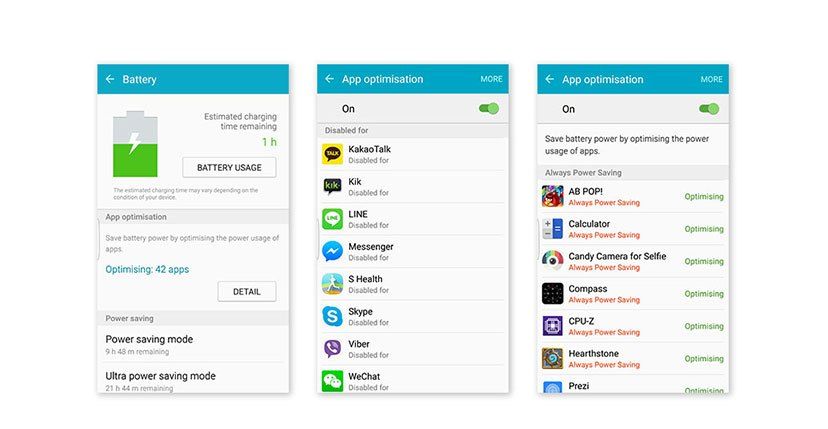
Smartphone users don’t always realize they can remove apps which are infrequently or never used. Sometimes apps are running in the background, consuming battery power. After selecting Battery within the Smart Manager, users can prevent wasting battery power through “App Optimization.”
For each app, users can choose between “Always Optimizing,” “Automatically Optimizing” or “Disable For.” “Always Optimizing” stops the app from using battery power. You can also select how often the apps will be optimized (every 3, 5 or 7 days). If you choose the “Automatically Optimizing” for every 3 days, the app will stop using battery power from the last usage for three days. Once the app is set for “Disable For,” you will stop receiving alerts from the app. If you don’t want to miss notifications from instant messaging apps, it’s best not to select “Disable For.”
The Battery screen also displays the percentage of remaining battery power and how long it is expected to last. By selecting Battery Usage, you can view the processes that have been running since your last full charge. Power Saving Mode and Ultra Power Saving Mode also display expected length of battery life if you need to conserve battery power. To view battery consumption of each application, select Detail.
Clean Up
To free up storage space from temporarily stored files, Smart Manager automatically scans and deletes any unnecessary data. After opening the Smart Manager app, select Storage. You can see how much of your available storage has been used. The Details button at the top of the screen shows more information about your device’s total space, available space, system memory, used space, cache data and miscellaneous files.
You can also manually delete data stored on your device. Users can check the current storage status by selecting “User Data” within the Storage menu. This displays how much space each type of files is using. If you choose the applications, you can find which apps are used more frequently. Viewing by frequency of use makes it easy to disable or uninstall unnecessary applications.
RAM
RAM is where temporary files are stored when your device runs an application. Clearing the RAM on your device will improve your device’s performance, freeing space so your device can run faster.
The RAM screen displays the percentage of used RAM, the active applications and how much RAM they are currently using. You can see how many background apps are currently using RAM space, so it helps you choose which applications to close. You can also select “End All”.
Protect Yourself
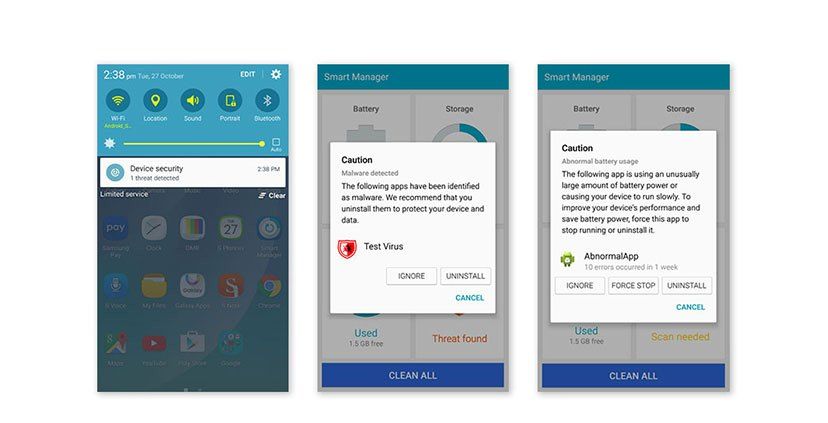
It’s possible for users to install apps or viruses unknowingly. This could lead to a breach of personal information or damage of the device. In less extreme cases, the unauthorized apps could slow down the device performance or use too much battery power.
Smart Manager automatically scans for malicious software, apps that use unusually high amounts of battery power, apps that make unusual errors and provide solutions for these issues. Users can ensure comfort and security by removing or closing unwanted apps. Samsung devices with Smart Manager provide anti-malware solutions through a partnership with Intel Security.
Take Control
With Smart Manager, Galaxy smartphone users can feel reassured that their devices are safe and secure, and running optimally. By having access to usage, storage, memory and security data, users can take matters into their own hands to know that they have a safe and comfortable space to work and play. Smart Manager is currently available for the S6, S6 edge, S6 edge+, S5, S4, Note5, Note4 and Note3, and the available devices will be expanded.