In addressing a Pixel feature that’s disappeared, Google has confirmed that the Pixel 8a is on its way.
Back in Android 14’s QPR1 update, Google added a new extension of battery stats, which showed charging cycle counts and the date the battery was manufactured. This was a welcome addition, but also limited in how useful it actually was. In the March 2024 update for Pixel phones, though, this feature disappeared.
According to Google on a bug tracker page, that’s intended behavior, as this page was never meant to show up on existing devices.
Rather, Android’s new battery stats are only supported to be showing on Pixel 8a and other future Pixels. Google says:
We only enable this page on Pixel 8a and beyond, so this is WAI(Working as Intended)
So, now we know a feature that’s coming to future Pixels, as well as getting Google’s first official confirmation of the Pixel 8a coming.
Exactly why the feature was showing on existing Pixels in the first place, and for as long as it’s been available, is unclear, but the stats themselves were often not particularly accurate. It also opens up the possibility that Google intends to build on this feature going forward, perhaps even adding proper battery health information.
The Pixel 8a is expected to launch in the next couple of months, most likely around Google I/O in May 2024.
During the Q&A portion, a Google engineer on the Android generative AI team said that Gemini “Nano will not be coming to Pixel 8 because of some hardware limitations.”
Google is otherwise “working to bring Nano to more devices.” Specifically, more “high-end devices in the near future.”
This does not bode well for older/existing devices getting Gemini Nano. Specs-wise, the difference between the Pixel 8 and 8 Pro is RAM at 8 GB versus 12 GB. In terms of whether the Pixel 8 could run Gemini Nano at a technical level, it probably is capable as evidenced by how the entry-level Galaxy S24 also has 8 GB of RAM and uses it for on-device Magic Compose in Google Messages.
That said, running an intensive model — for a handful of features — might have other performance impacts on the rest of the user experience that Google does not think is worth making.
On the Pixel 8 Pro, Gemini Nano powers Recorder’s Summarize capability (more on that below) and on-device Gboard Smart Reply in WhatsApp, Line, and KakaoTalk.
Meanwhile, Google detailed a bit more about how Gemini Nano powers the “Summarize” feature in the Pixel Recorder app. When Google started experimenting with such a capability in 2022, it was looking at cloud-based models:
User privacy is a top priority and we really wanted our most privacy-centric users, which for Recorder is roughly half of our users, to be able to use such a highly requested feature. This caused us to pause the project at the time.
Recorder then switched to Gemini Nano and a smaller team was able to implement it in 4 months:
We were pleasantly surprised with Gemini Nano’s reduced latency and with how capable the model was despite it being much smaller than what we used during prototyping.
If Gemini Nano is not coming to older Pixel devices, Google really should implement a cloud-based summarization for the other half of users that want this “highly-requested feature.” After all, Recorder already introduced a cloud-powered “Transcribe again” feature in December that makes possible speech-to-text in a lot more languages. Just make cloud summaries something users have to manually trigger for each recording and then delete that audio.
Titled Midnight, the mini-movie is an adaptation of a lesser-known work by legendary Japanese manga artist Osamu Tezuka. Much of the film takes place in neon-lit Tokyo at night, including a thrilling car chase sequence — a deliberate exercise on Apple’s part to showcase their device’s video capture capabilities in low lighting […]
The story centers on a late-night taxi driver named “Midnight” played by popular Japanese actor Kento Kaku, who roams the streets of Tokyo offering help to those in need. The film follows Midnight as he comes to the aid of a young woman, played by Konatsu Kato, who is struggling to take over her recently deceased father’s truck-driving business while fighting off a nefarious local gang, led by an evil boss played by the acclaimed character actor Yukiyoshi Ozawa.
The film was commissioned by Apple to showcase the low-light video capabilities of the iPhone 15 Pro. Miike, who has created more than 100 feature films, said that the project was both an honor and a challenge.
“Mr. Tezuka is something of a god among manga artists so it was an honor to take on the challenge of expressing his work using only iPhone. As we were shooting, I naturally began to challenge myself to think about how we could make a work unique to iPhone, beyond the usual approach to a film. I truly felt that the iPhone has the power to do things that a conventional movie camera can’t.”
He praised Action Mode in particular, calling it a magical feature. This is one of the features which really impressed me when I tried it. He also loved the ability to change the focus point after shooting.
I hope that game-changing features like this that are impossible with regular photography equipment will be added more and more.
This leveraged the Amazon Appstore, with Android applications integrated into the Windows experience, including the Start menu, taskbar, and windowing options. After a long testing and preview period, it officially launched in October of 2022 in 31 markets with over 50,000 Android apps touted.
Since then, WSA has seen updates to Android 12.1 and Android 13, as well as more features that apps can take advantage of. That said, the last major update was in June of 2023.
As of March 06, 2025, Windows 11 users “will not be able to search for Amazon Appstore or associated apps from the Microsoft Store.” Developers can still update their apps, but won’t be able to submit new ones.
Existing apps already on your PC will continue to work until March 5, 2025.
Meanwhile, Amazon today said its “Appstore will continue to be available and supported on other surfaces, including Fire TV, Fire Tablet, and Android devices.” Looking at the landscape, ChromeOS offers more Android apps via the Play Store on Chromebooks, while iOS apps can run on the Mac.
Update March 04,2024 8:43am PT: Beats Solo 4 are not expected to launch for several more weeks, according to a source familiar with the matter. No word on when to expect new iPads.
Bloomberg’s Mark Gurman has reported that Apple stores are planning a minor refresh this week, but he believes it to be for a new accessory, rather than a major new product.
He says that a bigger refresh is expected the following week, and it sounds like that one may point to the new iPads we’re expecting to be announced any day now, alongside the just-announced M3 MacBook Air models …
New accessory may be Beats Solo 4 headphones
Gurman doesn’t give any clue as to what the new accessory may be, but we recently found images of an unannounced Beats Solo 4 in the internal files of the latest build of iOS 17.4.
A few additional points: retail stores are low on MacBook Airs and iPad Pros; Stores are planning a minor refresh for this week (I think it's a new accessory rather than a new product); Stores are planning a larger refresh early next week (which sounds more product-related). https://t.co/kUkeYjT4rK
Certainly an update to the Solo 3 is long overdue.
It’s been a long time since Apple introduced Beats Solo 3 – more specifically, it was unveiled in September 2016 alongside the first generation of AirPods. It was the first Beats headphone to feature Apple’s W1 chip for fast pairing with Apple devices.
The new model will include USB-C, and support Spatial Audio. The images we discovered suggest that the new model will be available in black, blue, and pink.
New iPad Pro models
Gurman had earlier suggested that the new iPads we’re expecting will be announced via press release, rather than in a launch event. MacRumors said its own source backed this, with the announcements expected this week.
We’re expecting new iPad Pro models with OLED screens.
The biggest change to the new iPad Pro models will be a switch to OLED screens. Currently, the 11-inch iPad Pro uses an LCD screen with conventional backlighting. In fact, the 11-inch iPad Pro has used the same display panel since it was first introduced in 2018.
This year, the entire iPad Pro lineup will unify on OLED displays for the first time. This will also mark the first time that Apple has used OLED displays outside the iPhone and Apple Watch. The 12.9-inch iPad Pro might also get slightly bigger this year, with the screen size increasing to 13 inches.
This is expected to be accompanied by a new version of the Magic Keyboard for iPad, with a sturdier aluminum frame and giving a more MacBook-like look.
New iPad Air
While the iPad Air will stick to LCD screens, we’re expecting to see a new 12.9-inch model – the first time it’s been possible to buy an iPad of this size without opting for the Pro model.
We’re also expecting a new camera bump, still with a single rear camera but with the addition of flash.
Apple is widely rumored to be working on a new fourth-generation iPhone SE with a modern design refresh. New CAD files obtained by 91mobiles this week claim to offer our clearest look yet at this update, showing an iPhone SE 4 with an iPhone 14-style design.
The current iPhone SE was released in 2022 and features a 4.7-inch display with a Home button, similar to the iPhone 8. It’s powered by the A15 Bionic chip inside, features Touch ID instead of Face ID, and retails for $429.
These CAD renders suggest the iPhone SE 4 will feature a 6.1-inch display with a notch along the top that houses new Face ID sensors and the front-facing camera. On the back, there is a single camera cutout alongside a flash sensor.
According to 91mobiles, the iPhone SE 4 will measure 147.7 x 71.5 x 7.7mm. The current iPhone SE measures 138.4 x 67.3 x 7.3 mm. These dimensions show just how bigger the iPhone SE 4 will get to accommodate the bigger 6.1-inch display.
Previous rumors have also suggested that the iPhone SE 4 will have USB-C instead of Lightning. There’s even been one rumor claim it will feature the Action button – which is currently exclusive to the iPhone 15 Pro.
There’s still no exact details on when Apple might release the iPhone SE 4, but the current expectation is that it likely won’t be until 2025. The device has been rumored off and on for the past 18 months. Ming-Chi Kuo reported last April that Apple had paused development of the iPhone SE 4.
Verdict
It’s a sad day for everyone who had hoped the iPhone SE 4 would be based on the iPhone 12 mini and iPhone 13 mini form factor.
Satellite connectivity for smartphones has proven valuable on Apple’s iPhone, but it’s a feature that’s struggling to get out the door on Android devices. This week, though, a new “Satellite SOS” feature has started appearing on Google Pixel phones, and we’ve got a sneak preview of what it will be able to do.
If you dive into Settings > Safety & emergency on a Pixel phone today, you’ll very likely see “Satellite SOS” appear between Emergency SOS and Car Crash Detection. Google, seemingly in an error, has rolled out the setting widely to virtually all Pixel device through a recent update to Adaptive Connectivity Services.
But, right now, the feature doesn’t do anything. Tapping “Satellite SOS” on a Google Pixel device doesn’t open any menus, but it will soon.
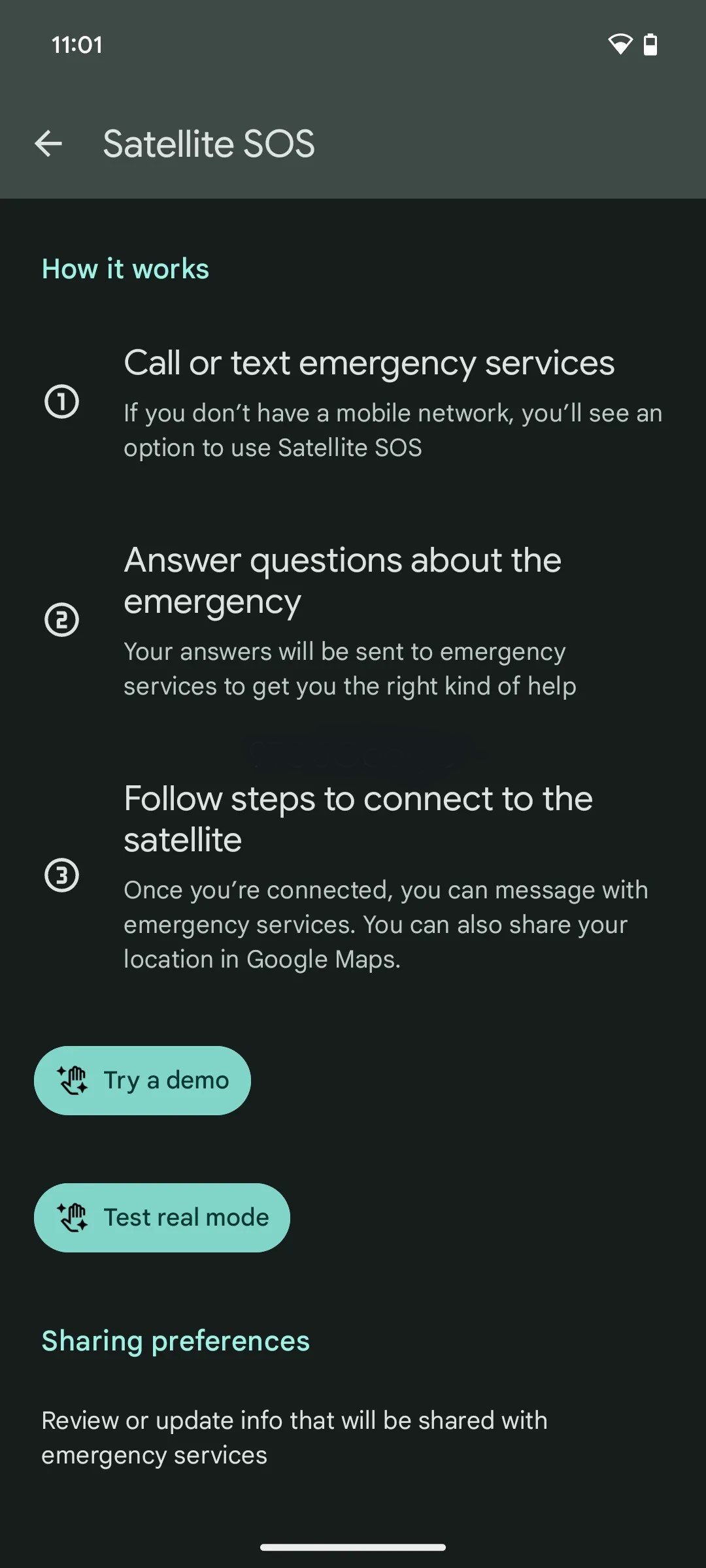
Through a rooted Pixel, we were able to access the menu Google is preparing for this feature. The Satellite SOS page explains:
With your Pixel, you can message with emergency services and share your location when you can’t connect to a mobile or Wi-Fi network.
The page explains that you can call or text emergency services, share your location using Google Maps, and answer questions about your emergency. There’s no word if you’ll be able contact anyone outside of emergency services, but Google also details that it will share your name and phone number from your Google account, as well as contact details for up to three emergency contacts.
Google reiterates what details are shared at the bottom of the page:
When you connect with emergency services by satellite, your name, email, phone number, location, device information (IMEI, language, model, battery level), and emergency information are share with emergency services and satellite service providers.
The page links out to a Google support page about what countries are supported by Satellite SOS, but the page unfortunately is not yet live. There’s also a link to a Garmin Search and Rescue Insurance plan. Notably, Google Messages previously showed signs of using Garmin services for satellite connectivity.
There are demos for satellite connectivity, but neither “Try a demo” or “Test real mode” are currently working.
It’s unclear when Google intends to push this functionality live, but the fact that the shortcut is appearing widely on Pixel phones today combined with how fleshed out this behind-the-scenes settings menu is suggests that it’s not too far off.
The Pixel 8 series brings some big improvements to Google’s flagship series, and it’s also now bringing in awards, as the duo has now won the 2023 Phone of the Year award at MWC.
Each year at Mobile World Congress (MWC), the GSMA hosts the “Global Mobile Awards.” The event includes a series of awards for the mobile industry such as “Best Mobile Technology Breakthrough,” “Best Mobile Network Infrastructure,” and more. In the “Device” category, one of the biggest awards is given to “Best Smartphone.”
The Best Smartphone award combines outstanding performance, innovation and leadership as determined through assessment of smartphones on the market during the period January 2023to December 2023, by world leading independent analysts, journalists and influencers.
Candidates this year included the iPhone 15 Pro series, OnePlus Open, Samsung Galaxy S23 series, and Samsung Galaxy Z Flip 5, as well as the Google Pixel 8 series.
And, as announced at the event, the Google Pixel 8 series took the crown and ended up being named the “Best Smartphone” of 2023 by the GSMA. Rick Osterloh posted about the win on Twitter/X this evening.
Notably, Apple’s iPhone 14 Pro took the title in 2023, with the iPhone 13 Pro Max winning the year prior. In 2021, the Galaxy S21 Ultra won, but this is the first time Google has taken the title. The Pixel 6 Pro was on the shortlist in 2021 while the Pixel 3’s Night Sight feature won a GSMA award for “Disruptive Device Innovation” in 2019.
Google reportedly hit a new milestone on the back of Pixel 8 this year, shipping 10 million total devices in 2023.
Thrilled about Pixel 8 winning another important Phone of the Year award at MWC! @madebygoogle thank you to the entire Pixel user community for helping us get there, and congratulations to our team for great progress! pic.twitter.com/zIN75YHSmS
iOS 17.4 is a massive new iOS update for iPhone users, and includes new features to support European Union regulations, which makes it possible for to use alternative app marketplaces. However, the recent changes aren’t just limited to those who fall under EU jurisdiction. iOS 17.4 has tons of new changes and features, like new emoji, new Apple Music and Apple Podcasts updates, an updated “Hello” screen, and much, much more.
Notable iOS 17.4 updates
Podcast transcription
My favorite iOS 17.4 change relates to the Podcast app. I appreciate it even more since I recently launched a brand new podcast called 9to5Mac Overtime with my colleague Fernando Silva. The Podcast app now has text transcriptions that work similarly to the lyrics view in Apple Music. As the hosts talk, you’ll see each word from the transcription highlighted, and the highlights will adjust in real-time based on playback speed.
Another nice thing about text transcription in Apple Podcasts is the ability to search for a term quickly and jump directly to a specific part of the show with just a tap. I’m impressed with the accuracy of podcast transcription, and I was surprised at how well it accommodated my Kentucky twang.
iOS 17.4 RC changes and features
Apple Cash virtual card numbers and Safari autofill
Apple Cash gets more valuable thanks to the new virtual card numbers that can be regenerated on the fly in iOS 17.4. These numbers let you use your Apple Cash balance at merchants that don’t use Apple Pay. It also includes the ability to autofill card numbers in Safari and will even reflect your Apple Cash balance on the autofill button so that you know if you’ll be able to cover the balance in advance.
Music recognition
Updated integrated Shazam music recognition can now add a song directly to your Apple Music library or a specific playlist. Music recognition will also let you add classical music songs to Apple Music Classical.
Stolen Device Protection update
Stolen Device Protection gains additional security in iOS 17.4 thanks to a new option that lets you enforce the 1-hour delay at all locations before you can access critical areas of your iPhone. In previous versions of iOS, the security delay was only enforced when not in a familiar location.
Battery Health
Apple updated battery health by decoupling Battery information from Charging Optimization. It also instituted a new, more straightforward Battery Health status, similar to what Mac users have. In addition, pertinent battery information like cycle count, manufacture date, and first usage date now reside directly within Settings → Battery → Battery Health.
Full list of what’s new in iOS 17.4
Updated “Hello” Screen
New emoji
18 new right-facing body emoji
City Digital Clock Widget
Apple Podcasts full episode text
Apple Podcasts transcripts
Podcast app Home tab replaces Listen Now
Music recognition update
Music app “Home” tab replaces “Listen Now”
Apple Music Classical Music Recognition
Updated Lock Screen song title animation
Siri announces messages in any supported language
Stolen Device Protection update
Battery Health decoupled from charging
Battery Health Status
Additional Battery data
Passkeys Access for Web Browsers
Apple Cash virtual card numbers
Apple Cash autofill in Safari
Updated dialer background for unknown calls
Quantum Computer Protection for iMessage
Support for game streaming apps
Updated TV app channel links
Updated “How to Watch” in TV app
Updated iCloud glyph in Files app
Updated App Store user settings
Other iOS 17.4 bug fixes
CarPlay Updates
Beats Solo 4 Headphones
iOS 17.4 isn’t all about EU regulatory changes, but there are noteworthy updates that all users, regardless of location, will benefit from. Highlighted a few in this post, but as you can see from the bullet point list above, there are tons of new changes and features in iOS 17.4, not to mention the various bug fixes and security updates.
iOS 17.4 RC was stable in my brief hands-on time with the release. This is likely the version that Apple will launch next week. We’ll know if next week’s release sports the same 21E217 build number.
Qualcomm is following last month’s big announcement with the Snapdragon 7 Gen 3 November 16,2023. The goal remains bringing more flagship features down the chip lineup.
The 4nm Snapdragon 7 Gen 3 has one Prime core (up to 2.63 GHz), three Performance cores (2.4 GHz), and four Efficiency (1.8 GHz). Compared to the 7 Gen 1, Qualcomm touts a near 15% improvement in performance (based on Geekbench 6.1 Single Thread) and an over 50% jump for the GPU (Aztec Ruins 1080p), while offering 20% power savings.
Meanwhile, the AI Engine offers 60% better AI performance per watt, with INT4 precession support new for the 7-series. Qualcomm is also highlighting improved AI-based face detection in regards to challenging scenes and extreme combinations, like glasses and low-light conditions.
Another new addition to the Snapdragon 7-series this generation is spatial audio with head tracking, as well as multi-device Snapdragon Seamless experiences.
On the camera front, Qualcomm explicitly references mentions the Google Ultra HDR image format on Android 14. There’s also continued support for capturing from three cameras simultaneously. An “AI Remosaic” feature lets you “eliminate grainy discoloration for higher-res results” that have more vivid colors
There’s the Snapdragon X63 5G modem for up to 5 Gbps downloads, as well as 5G Dual-SIM Dual-Active (DSDA) in 5G+5G or 5G+4G SIM card configurations. Qualcomm is also touting triple frequency location support for improved accuracy even with a lower-quality GNSS antenna.
Honor and Vivo plan to use the Snapdragon 7 Gen 3, while the first commercial device is set to be announced this month.