OxygenOS 11.0.10.10 is now rolling out for the OnePlus 8 and OnePlus 8 Pro without Android 12 but with a host of fixes for the former flagship duo alongside the December 2021 security patch.
While owners await the full, stable release of Android 12 with OxygenOS 12 on their OnePlus 8 series devices, the Chinese firm has pushed a new update that resolves a few lingering problems affecting Android 11 on the duo. Confirmed over on the official OnePlus Forums, for those hoping for an expanded changelog, it’s fairly light on major details.
OxygenOS 11.0.10.10 most notably adds the December 2021 security patch, some display UI and Settings interface tweaks, fixes an issue with the Google Assistant, and resolves some minor WhatsApp crashes. All in all, it’s a nice little bonus before the end of 2021, but still not quite Android 12 that many would have hoped for. You can check out the full changelog below:
OxygenOS 11.0.10.10 for OnePlus 8/8 Pro update changelog
System
Optimized the UI display of Settings interface
Fixed the issue that Google Assistant and Gpay doesn’t display as expected in the Setup Wizard
Fixed the low probability issue of WhatsApp crash
Updated Android security patch to 2021.12
The OxygenOS 11.0.10.10 OTA update has started rolling out but comes in a few flavors based upon the region you live in – as you can see below:
OnePlus 8
India: 11.0.10.10.IN21DA
Europe: 11.0.10.10.IN21BA
Global: 11.0.10.10.IN21AA
OnePlus 8 Pro
India: 11.0.10.10.IN11DA
Europe: 11.0.10.10.IN11BA
Global: 11.0.10.10.IN11AA
As is often the case with OnePlus updates, the actual OxygenOS 11.0.10.10 OTA file is heading out in an incremental fashion. You may be able to grab it and sideload on your device using Oxygen Updater though.
If you don’t have the Community app installed on your device, feel free to download it HERE. You can check here for more information on the integrated Feedback tool.
As always, this OTA will be incremental. The OTA will reach a small percentage of users today, and we’ll begin a broader rollout in a few days.
Your feedback is appreciated. We may not always be able to respond to every comment in the forums, but please be assured that we take your comments and feedback seriously. Hope you enjoy and let us know how you feel about the update in the comments below.
OnePlus looks to be working on yet another limited-edition device – this time a Pac-Man-themed version of the affordable Nord 2.
We’ve seen the Chinese firm produce a number of tie-in devices over the years including with cultural juggernaut Star Wars, high-end boutique designers and my personal favorite, the Cyberpunk 2077 OnePlus 8T. Sticking with gaming, OnePlus appears to have a limited Pac-Man Nord 2 in the works.
Evidence is mounting as code digging into the recent OxygenOS A.11 update for OnePlus Nord CE devices by the team behind the fantastic Oxygen Updater has unearthed some interesting tidbits (via XDA). After delving into the Settings APK file, the team behind Oxygen Updater uncovered a new fingerprint animation that features titular character Pac-Man chased by ghosts “Blinky” and “Inky” above a maze-styled lock icon.”
Several other code strings also include various references to stickers that can be unlocked after completing various tasks including charging this proposed Pac-Man OnePlus Nord 2 device for 256 minutes. This is a reference to the last level in the original arcade game — which is also the “kill screen” for the game.
Other hardware notables include wireless charging, which is missing on the Vanilla Nord 2. The MediaTek 1200-powered device could also receive a chipset change to the Qualcomm Snapdragon 778 according to other code-strings found in this initial report.
At first, none of this information really indicated a great deal in terms of new hardware. However, OnePlus tipster Max Jambor has since teased an image to indicate that this indeed could be a special edition or limited Nord 2 device with Pac-Man theming. Just why a Pac-Man edition of the device would be needed is anyone’s guess but if done well it could be a nice option.
Security updates are designed to keep Android devices as secure as possible, but you’re only as safe as your latest update. OnePlus does promise regular updates for its smartphones for at least two years, so let’s see how they’re handling the September 2021 security update.
OnePlus September 2021 security update — What’s new?
Google released the September security patch way back on September 7, but as is often the case nowadays, market leader Samsung started to see the update almost a week before it “officially” arrived on Android with the Pixel rollout. As a part of this month’s patch, Google issued a few key fixes, mostly of moderate severity — as is often the case.
Rightly criticized for update consistency, OnePlus started rolling out the September patch 11 days after Google, but a whopping 18 days after Samsung started updating almost all of its core device lineup. It’s worth noting that this is a bit of an improvement over the August patch update schedule, but it still feels as though OnePlus is letting things slip after a rally earlier in the year. While it’s very close to October, we’re still seeing a rollout to select devices.
Those devices that have already started to see the latest update have also been on the receiving end of a few new features. As is often the case, there’s no discernable pattern to the company’s additions. We’ve said for some time that the overreliance on the Open Beta path is something that OnePlus has to move away from. It’s worth noting that the OxygenOS Open Beta has ended for a few devices over the past few weeks ahead of Android 12 coming soon.
On OnePlus 9 and OnePlus 9 Pro, the September patch not only includes a number of common bug fixes including stability and device performance, but it also adds a brand-new XPan camera mode that was made famous by Hasselblad cameras. It’s unclear if this feature will ever come to other non-Hasselblad-certified devices from the firm, but it’s a neat new option for those with 2021’s flagship devices.
OnePlus devices with the September 2021 update
OnePlus 9 Series
OnePlus confirmed that we are unlikely to see a 9T model this year. This means that until the OnePlus 10 arrives, the 9 series will be more prominent — and hopefully gain greater software support. As the flagship series, the OnePlus 9 and 9 Pro were the first from the Chinese OEM to gain access to the September 2021 security patch.
This has arrived in a couple of flavors. Firstly, it is available as part of the OxygenOS 11.2.9.9 update. As we have mentioned, this includes a number of substantial camera tweaks and the new XPan camera mode. For those happy to run what amounts to pre-release software, the recent Android 12 Developer Preview 2 for the OnePlus 9 and 9 Pro also comes with the latest September 2021 security patch. However, it isn’t mentioned in the changelog, but we can confirm that it is included as part of this update.
Although an India exclusive device, the OnePlus 9R is also able to grab the latest security patch with OxygenOS 11.2.5.5. This patch includes a number of tweaks and fixes for some problems many owners saw with app crashes, and even problems with Warp Charge not activated correctly.
OnePlus 6 Series
Now approaching four years old, the oldest OnePlus devices in the entire lineup still receiving support now have access to the September 2021 security patch. It’s hard to be massively critical of OnePlus for this particularly update, especially as many other devices from a similar time period — save some Samsung flagships — have ceased being supported.
The OxygenOS 11.1.1.1 patch does not bring any new features, but does add some important software fixes and tuning to ensure your device runs smoothly. Plus on top of that, you have the September patch to protect your OnePlus 6 series handset.
Devices still awaiting the September patch
While we’re seeing a relatively small pool of devices get the latest patch, a larger selection of the OnePlus hardware lineup is now running the outdated August 2021 security patch. We’re not entirely sure if or when we could see the devices updated, but we are hoping that they are patched soon.
OnePlus 8 series
OnePlus 8
OnePlus 8 Pro
OnePlus 8T
OnePlus 7 series
OnePlus 7
OnePlus 7 Pro
OnePlus 7T
OnePlus 7T Pro
OnePlus Nord series
OnePlus Nord
OnePlus Nord CE
OnePlus Nord N100
OnePlus Nord N10 5G
OnePlus Nord 2
How can I get the September 2021 security patch on my OnePlus device?
OnePlus has a habit of rolling out updates for devices in a staged manner. That means that the initial release and subsequent confirmation on the OnePlus Forums doesn’t always indicate when you’ll be able to grab an OTA file and get your device updated/patched.
Our advice is to use a third-party application to get updates in a timely manner. The community-run Oxygen Updater allows you to sideload official update .zip files as soon as they are available publicly. While this will ensure you get updates right away, if you encounter problems, you may need to revert to an older build. This may require a device reset if problems are major.
OnePlus usually pushes out Oxygen OS updates to the OnePlus 8 Pro and One Plus 8 together, but availability may be affected by variant, carrier, and region.
Current stable version: Android 11
When will the OnePlus 8 series get Android 12? Early to mid-2022 (Estimated)
Latest OnePlus 8 Pro and OnePlus 8 updates
August 17, 2021: Oxygen OS 11.0.8.8 is a bumper update for the OnePlus 8 and 8 Pro. The patch brings a lengthy changelog, including a host of new features for the always-on display. Bitmoji AOD now features, while there’s now also a new screenshot feature for the display, too.
OnePlus is also adding its Store app to the devices, while camera fixes and navigation gesture tweaks are also incoming. Finally, the August 2021 Android security patch is the cherry on top.
See the full changelog below.
System
Newly adapted OnePlus Buds Pro and brought new powerful features
Newly added the screenshot feature for AOD
Fixed the failed issue of Navigation gestures in some scenes
Improved system stability and fixed known issues
Updated Android security patch to 2021.08
Camera
Optimized the portrait mode effect of the front camera
OnePlus Store
An intuitive and convenient way to manage your OnePlus account, get easy-to-access support, discover exciting members-only benefits, and shop for OnePlus products. (Please note that it can be uninstalled)
Ambient Display
Newly added Bitmoji AOD, co-designed with Snapchat, which will liven up the ambient display with your personal Bitmoji avatar. Your avatar will update throughout the day based on your activity and things happening around you (Path: Settings > Customization > Clock on ambient display > Bitmoji)
The update is available to users in Europe first, but will disseminate to India and North America “soon.”
As always, this update will be rolled out via OTA incrementally. Don’t be too concerned if you haven’t yet received it. To check if an update is available, head to Settings > System > System updates on your device.
Previous OnePlus 8 Pro and OnePlus 8 updates
June 9, 2021: Oxygen OS 11.0.7.7 brought fixes to the devices’ camera, specifically addressing the 48MP sensor’s shutter button issues. The June 2021 Android security patch was also included.
May 26, 2021: Oxygen OS 11.0.6.6 is now rolling out to the OnePlus 8 Pro and OnePlus 8. The patch brings improvements to the 8 Pro’s wireless charging experience, a number of bug fixes to both devices, and the May 2021 Android security patch. Also included are fixes to Gallery, Phone, and Messages bugs.
April 22, 2021: The ninth Oxygen OS 11 beta build rolled out to the OnePlus 8 and 8 Pro. Open Beta 9 included a lengthy changelog that mainly touched on system improvements. It also brought the April 2021 Android security patch.
March 29, 2021: Oxygen OS 11.0.5.5 failed to bring any new features to the OnePlus 8 Pro or 8, but did iron out several system bugs. The March 2021 Android security patch arrived in tow.
March 22, 2021: OnePlus started disseminating the eighth Oxygen OS 11 open beta build for the OnePlus 8 and 8 Pro. Alongside the March 2021 Android security patch, the beta update also brought a number of fixes for the system, camera, and other aspects of the OnePlus 8 and 8 Pro.
February 27, 2021: OnePlus rolled out the seventh Oxygen OS 11 open beta build for the OnePlus 8 and 8 Pro. It added the February security patch to the phones and fixed several system issues.
February 3, 2021: The sixth Oxygen OS 11 open beta brought a lengthy changelog, which included the Android Security Patch for January 2021, and a host of tweaks to Weather, Shelf, and Gaming Space apps.
December 22, 2020: OnePlus pushed out the fifth open beta update, bringing Rewind Recording for Game Space, selfie camera animation tweaks, and addressing a Bluetooth call bug. It also brought the December 2020 security patch to the table.
Last month, OnePlus released the first beta of Android 11 for the OnePlus 6 and OnePlus 6 T, allowing power users to test drive the new software ahead of the stable release. This was followed by the second beta release towards the end of July, which optimized the overheating control management and enhanced 5G and Wi-Fi connectivity. Now both phones are receiving a new beta update which further refines the software experience.
The third beta OxygenOS 11 beta, is rolling out to the OnePlus 6 and 6T as OnePlus continues to patch issues and iron out annoying bugs. The new update promises to improve the smoothness of YouTube videos, fixes a bug related to the Work-Life Balance feature, and optimizes background process management for improved battery life.
System
Optimized background process management mechanism to improve battery life
Improved the smoothness of YouTube playing videos
Improved system stability and fixed known issues
Network
Fixed the failed issue of enabling VoWiFi
Work-Life Balance
Fixed the issue that the feature doesn’t work when the screen is locked
OxygenOS 11 Open Beta 3 has already started rolling out to OnePlus 6 and 6T units. If you’re running the second beta, you should receive the latest build as an OTA shortly. As always, we have also provided direct download links to incremental and full OTA zip packages for both devices below. If you’re coming from the stable version, download the full OTA; grab the incremental update if you’re on Open Beta 2. Once downloaded, put the update package in the root directory of your internal storage. Next, navigate to Settings > System > System Update > “Local Update“ and select the downloaded package from the internal storage to start the installation process.
Download OxygenOS 11 Open Beta 3 for the OnePlus 6 and 6T
OnePlus thrives when it comes to smartphone sales, but that doesn’t mean its products are the best on the market. In fact, just about every OnePlus smartphone launched on the market is getting dozens and dozens of updates to further optimize the software and address issues that have just been discovered.
The good news is OnePlus continues to support its smartphones for many years, so we’re not surprised that the OnePlus 7 and OnePlus 7 Pro are getting new updates almost every month. Not only that, but these updates aren’t just adding new security patches, but also meaningful improvements meant to further enhance user experience.
OxygenOS 11.0.2.1 is the most recent update for the OnePlus 7 and OnePlus 7 Pro. As the title says, the update is supposed to reduce power consumption in certain scenarios, but it also fixes some annoying crashes:
System
Reduced Power consumption
Improved overheating control management
Fixed the issue of not being able to play high-definition videos on some video platforms
Upgraded Android Security Patch to 2021.06
File Manager
Fixed the crash issue of the application
Camera
Fixed the issue that the camera is blurred when shooting on fullscreen size
Improved the stability
Phone
Optimized the dial-pad UI display effect
As always, OnePlus is rolling out this update in stages, so OxygenOS 11.0.2.1 will only be available to a limited number of users today, but a broader rollout will kick off in just a few days after making sure there are no critical bugs.
The OnePlus Nord is kind of a big deal. Or, at least, that’s what OnePlus has been working hard to convey. The PR “hype machine” has been working over-time and the results are definitely showing. For better or worse, everybody seems to be discussing the Nord and a lot is actually riding on its success as a result.
Going off of the company’s own commercial message, the OnePlus Nord is intended to mark a new beginning, a bold start of a whole family of Nord devices. Another stab at the mid-range market and an attempt to break ground where the OnePlus X failed. And when the makers of the original “flagship killer” phone, the masters of guerilla marketing, the proverbial “underdogs” from a wilder, past Android realm start saying such things, people tend to listen and then expect nothing short of a market splash.
It’s frankly hard to think of a harder and tighter position to put one single phone in on today’s cutthroat mobile scene. And the most baffling bit is that OnePlus singlehandedly self-engineered the entire predicament. Sure, if anyone has the resources, market standing production and supply chain to pull-off a new “messiah” phone, it has to be the mighty BBK corporation. And in all fairness, the OnePlus Nord is a solid and well-rounded product. It’s important to get that on the record right away.
OnePlus Nord specs
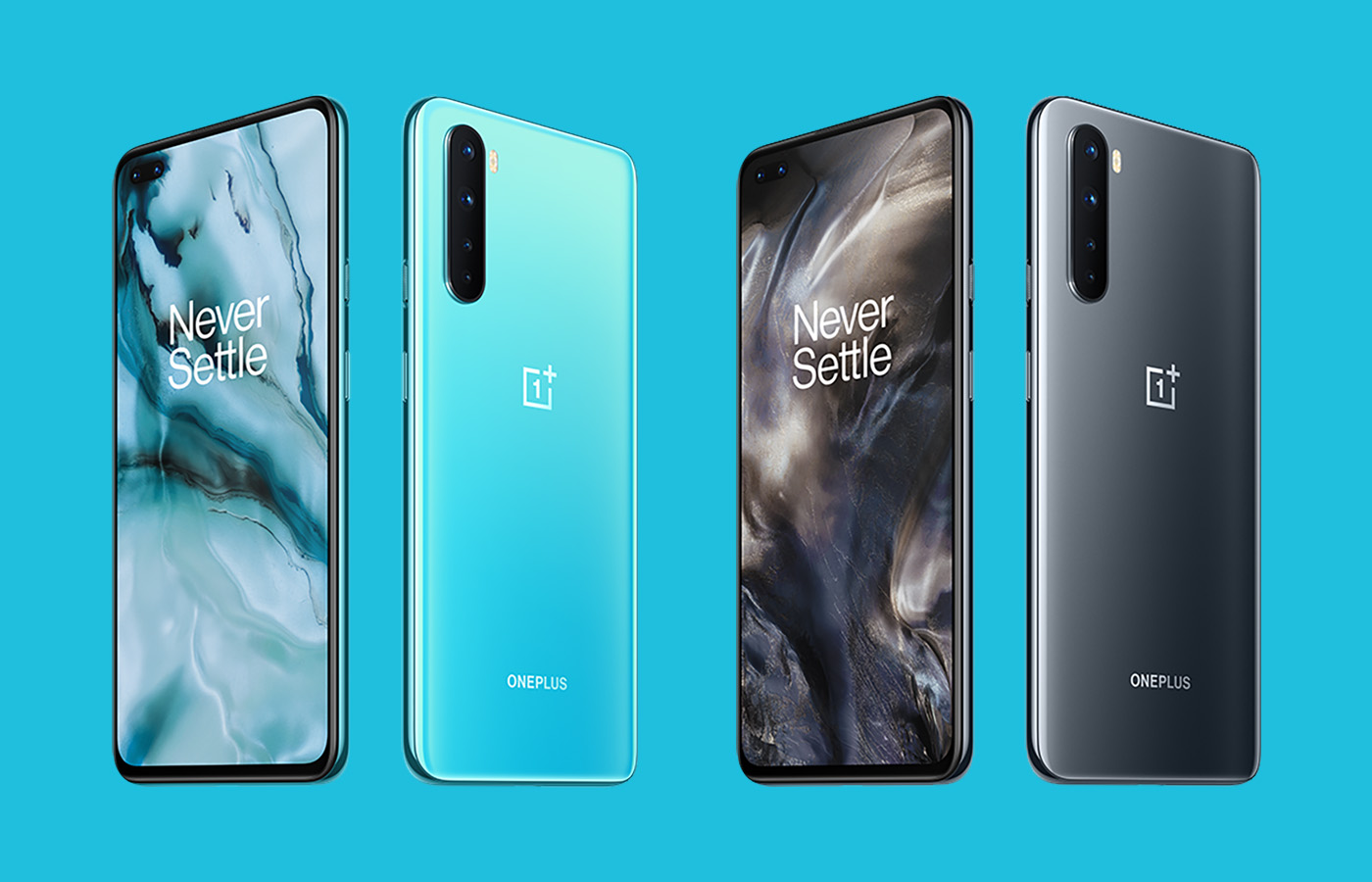
Body: 158.3×73.3×8.2mm, 184g; Glass front (Gorilla Glass 5), glass back (Gorilla Glass 5), plastic frame; Colors: Blue Marble, Gray Onyx.
It’s just that “good” or even “great” was never going to be enough to stop this particular hype train. Now the OnePlus Nord finds itself in a rather unfortunate, even if entirely predictable situation. Ever since it has hit shelves, the reception has been universally lukewarm. A big chunk of that response has been coming off as emotional, more than anything else. You’ll get none of that on the following pages, since the Nord deserves an evaluation on equal grounds, just like any other device we take a deep dive into.
That being said, the Nord, or rather OnePlus, won’t be getting a pass on some of its polarizing decisions in recent devices. Objective things, like the persistent absence of a telephoto camera, which still has fans harking back to the OnePlus 7T and a broader debate on the changing nature of a “value” that the brand and the 2020 mobile industry, as a whole, are now offering.
Unboxing OnePlus Nord
Presentation is vital if you are building a proper brand image. Ever since its early viral-marketing days, OnePlus has been among the best in the entire Android realm at selling ideas and feeling. A lifestyle brand, if you will. At least in some sense. Hence, it comes as no surprise that the Nord has its own, distinctive twist on the OnePlus look. Teal or aquamarine, depending on how much light is present, are the new accent colors. At least, going by the sturdy, two-piece box on the OnePlus Nord, as well as the accompanying “welcome letter”. Like we said, OnePlus knows its way around designing a lifestyle brand.
The thick rubber USB Type-A to Type-C charging cable in the box is still colored in the familiar bright red. Aquamarine on the cable would have really shown some extra care and attention to detail. The 30W wall charger is the same as on other OnePlus phones.
Cost-effective is not the worst thing to be accused of, though, especially since we can’t outright say OnePlus was stingy with the accessory bundle. You also get a nice and thick, frosted-look silicone case in the box. Complete with a rather odd geometrical pattern on the back. The latter is probably meant to mimic a compass arrow, which is the original inspiration for the Nord name. The only notable omission, in our mind, is a USB Type-C to 3.5mm dongle, since the Nord lacks a 3.5mm jack.
Competition
There are plenty of Nord alternatives in the incredibly saturated midranger market, regardless whether you are keen on getting 5G connectivity.
Since the entire segment is all about delivering just the right value formula, it is really tough to suggest any “overall better” alternative to the Nord. It all depends on your personal priorities. The closest you can actually get to the Nord, while getting a quantifiably better experience in many respects is the OnePlus 7T. The 7T offers the coveted 12MP telephoto, stereo speakers, a sturdier aluminum build, and what is a comparable or better Snapdragon 855+ chipset. You do have to live with certain compromises, though. Chief among which – the older hardware without 5G and slightly weaker battery. Plus, despite its age, the OnePlus 7T still sells for slightly more than the OnePlus Nord.
If Oxygen OS is high up on your priorities list, you have to look at the OnePlus lineup. If, however, you are willing to concede to a simpler, but even cleaner AOSP experience, the new Google Pixel 4a comes to mind. You will definitely be sacrificing on raw hardware specs, compared to the Nord, though. In some cases, quite severely, since the Pixel 4a only has a single main camera. Sadly, the more-capable Pixel 4 and 4XL are out of budget. Not to mention the fact that Google appears to be discontinuing them on many markets.
Motorola deserves an honorable mention when discussing vanilla and close-to vanilla Android. Both the Moto G 5G Plus and the One Fusion+, competing in the same price segment as the Nord come with compromises, like LCD displays.
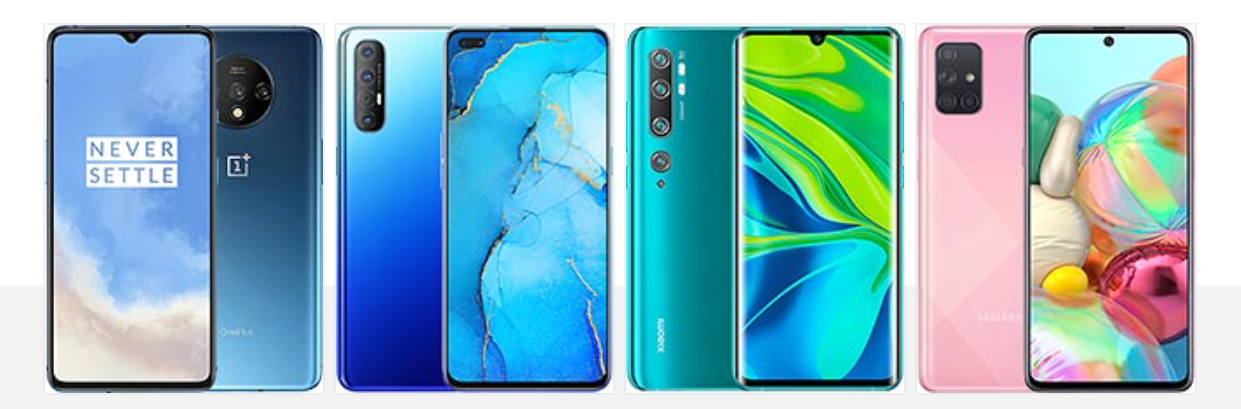
OnePlus 7T • Oppo Reno3 Pro • Xiaomi Mi Note 10 • Samsung Galaxy A71
It would be shortsighted not to look at the rest of the BBK Electronics collective lineup for alternatives to the Nord too. The Realme X3 SuperZoom stands out immediately, because of its actual periscope telephoto camera. But it is a bit older now, with its Snapdragon 855+ chipset and has an LCD panel. Making the list instead, will be the Oppo Reno3 Pro. Technically, not the latest in the Reno line, either, but arguably better value than its successors. The device turnover in Oppo’s ranks has been crazy lately.
In competitor Xiaomi’s ranks, we can instantly spot the Poco F2 Pro, which is a amazing value device, sporting an actual flagship Snapdragon 865 chipset. Technically, it costs about as much as the OnePlus Nord too, but it is far from globally available and kind of hard to get. Making the list in its place, we have the Xiaomi Mi Note 10. It bumps the chipset down to a mid-range Snapdragon 730G, but its amazingly-versatile camera setup more than makes up for that in the overall value calculation.
Last, but not least, as a more “name-brand” alternative, Samsung will more than readily sell you the Galaxy A71, for right around the same price as the Nord. OneUI, among other things, makes for a significantly different Android experience though. If 5G is high on your wish list, you can look at the Galaxy A51 5G instead.
The verdict
The OnePlus Nord is a solid 5G-enabled mid-range offer. One combining a well-balanced specs sheet, with the excellent, class-leading experience of Oxygen OS. Thanks to thoughtful engineering and a large infusion of familiar OnePlus DNA, the Nord manages to transcend the simple label of just another BBK Electronics rebranded device. BBK owns and ensures healthy technology sharing among its subsidiaries Oppo, vivo, Realme and OnePlus but after all is said and done, each company runs its own phone business in a different way.
The Nord was introduced with a lot of fanfare, alongside bold promises to usher in a new beginning for the Android midrange niche. A great PR move, on paper, but one that put the Nord under a lot of heat and with frankly unrealistic expectations. After all, it’s OnePlus and you can’t blame fans for extrapolating that, just like the original “flagship killer”, the new one should at least have the dedicated telephoto camera from the OnePlus 7T, a headphone jack, a metal frame. And that’s just the more reasonable demands and complaints being tossed around and severely scrutinized.
Despite OnePlus efforts to make the device stand out, the Nord is, at its core, only a midrange device. As such, it has to play by the same market rules as everybody else in the midrange. The 2020 smartphone scene doesn’t leave a lot of room for a “flagship” killer, in the original OnePlus One sense. Even the mighty and vast BBK can’t include true flagship specs in the Nord, while also preserving its EUR 400 MSPR while funding a massive advertising campaign.
What it can and has successfully done with the Nord, though, is to give it the proper OnePlus treatment, through and through. For many prospective buyers, that’s going to be enough of an added value to choose the Nord over a slightly better-spec’d, but less prominent and refined alternative.
Pros
Clean, functional design, infused with familiar OnePlus controls, like the Alert Slider.
Super bright, accurate and smooth 90Hz OLED display, with HDR10+ support and clever auto refresh rate management.
Optimal performance is extracted from the Snapdragon 765G chipset.
Excellent battery life even in 90Hz mode.
Competitive fast charging.
Oxygen OS with more features than ever. Still one of the snappiest Android experiences available.
Excellent main camera performance for the class.
Cons
Plastic frame; dual selfie cam means a large punch hole.
No 3.5mm audio jack, no microSD card slot and no notification LED.
Single bottom-firing speaker with unimpressive performance.
The 2x zoom is no match for a proper telephoto and the ultra-wide is barely satisfactory.
Up to this point, OnePlus has climbed its way up from the high-end budget phone to the fully-fledged flagship. The brand once called its phone the “Flagship Killer”, and the OnePlus 8 Pro has become the very thing that the company initially aimed to dethrone.
Surely, the smartphone landscape has changed over the past several years. There are now so many contenders in the sub-$500 and sub-$400 price that the company has shifted its focus to creating a more prestigious brand name. With this iteration, the company has presented itself with an updated all-CAPS “ONEPLUS” typeface and tweaked “1+” logo.
Now with the OnePlus 8 Pro, the company thinks it has what it takes to compete in the flagship category at the $1000 price mark. Well, technically – the OnePlus 8 Pro starts at $900. The OnePlus 7 Pro was a strong seller, but will OnePlus have just as much success in a higher price bracket?
The 8 Pro has an impressive spec sheet: high-end CPU, 10-bit high-end AMOLED screen, Warp Charge 30T, and for the first time from OnePlus: support for wireless charging and even reverse-wireless charging for sharing juice with an accessory or a to give some juice to a friend.
OnePlus 8 Pro specs:
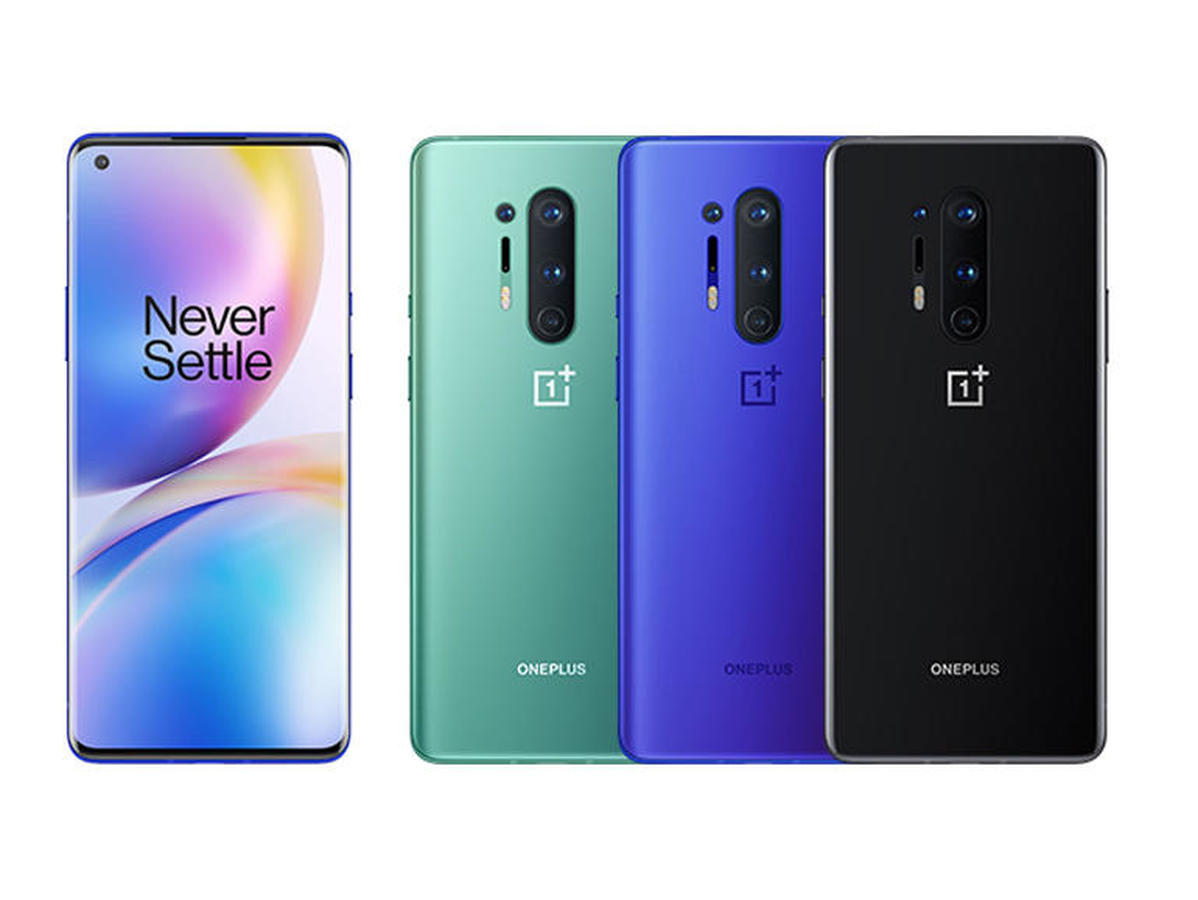
Body: 165.3 x 74.35 x 8.5 mm; 199g; metal frame; “3D Corning” Gorilla Glass 5 back
That high-end display is of the 120Hz variety – and it’s a panel made by Samsung. OnePlus is promising near-perfect color accuracy, over 1 billion colors, and the brightest output of any display it has ever put in a smartphone. The smoothness of the still-higher refresh rate display is the company’s way of staying ahead of the trends – which could be an advantage in markets like the US where the company has a presence.
There’s a new camera system with the notable larger Sony IMX 689 sensor behind the quad-camera’s main lens. The ultrawide camera gets a larger sensor as well, but the telephoto camera remains pretty much the same as the OnePlus 7T. OnePlus has a new “Color filter camera” whose long-term usefulness remains to be seen.
OnePlus has further refined its Android skin, Oxygen OS with new icons, and its revamped its UI’s animations for the 120Hz experience. Oxygen OS offers a stock-Android like experience, close to that of a Google Pixel, and OnePlus is known for its speedy turnaround when it comes to firmware updates.
OnePlus is the only high-end Chinese brand available from three of the four major US carriers – and many American consumers might be clueless of the brand’s existence in a market where Apple, Samsung, and Google are the most known (and most advertised) brands.
Unboxing
We always praise OnePlus for its packaging. The high-quality cardboard materials, and soft-touch red finish make a very good first impression. Our review unit doesn’t have the new all-CAPS name on the side, but it does have the updated “1+” logo.
Taking the lid off the long red box, we’re greeted by the OnePlus 8 Pro in Ultramarine Blue with a pre-installed factory screen protector. A notice on the plastic wrapper recommends using official OnePlus screen protectors for best compatibility of the in-display fingerprint scanner.
The cardboard cradle that holds the 8 Pro in place is also a box where the phone’s documentation is held, along with a SIM tool, welcome letter, and quick start guide. The words “Never Settle” sit below the smartphone as you unbox it – reminding us of the company’s long-time motto. Beneath this phone cradle is an included clear case to show off that deep blue color, and the Warp Charge 30T adapter and cable.
Now that we’ve seen what’s inside the box, head to the next page where we’ll spend some time talking about the phone’s design, ergonomics, and build quality.
The competition
This is the first time OnePlus has ever made any of its devices this expensive. As such, we’ll try to pair it up against other flagships that are near or over a grand. In the US, the only way to purchase the 8 Pro is unlocked from OnePlus (the OnePlus 8 is sold directly from carriers) and that’s not a great strategy if it is trying to convince consumers that they should buy OnePlus over Samsung or Apple.
In any case, let’s look through alternative devices. Starting with the LG V60, both devices are priced similarly at $899, but the 8 Pro is more equipped with features than the V60. Both are about the same in video quality, but LG’s camera experience is certainly more polished and offers far more advanced video and audio controls.
The iPhone 11 Pro Max is the largest iPhone that Apple makes and the display on the 8 Pro is superior in almost every way. Of course, iOS is a completely different landscape with similar image quality – though the iPhone doesn’t use a high-resolution camera sensor. The iPhone’s ultrawide camera doesn’t have autofocus either.
Cameras and software aside, it would be difficult to convince an iOS user to switch to a OnePlus device, unless they are already looking outside of the iOS ecosystem from boredom or desire for something more exciting.
The Galaxy S20+ might be a worthy alternative for the 8 Pro, though it’s certainly more expensive. Ironically, Samsung’s flagship no longer has a dual-curved display while the 8 Pro has the curviest display yet. Samsung’s One UI Android skin can be an acquired taste for some who might prefer a more stock-Android appearance like that of a Google Pixel phone.
Though they are distant cousins, the Oppo Find X2 Pro and the 8 Pro have similar DNA (the two brands are sister companies, after all). Although its more expensive, the Oppo Find X2 Pro has a stronger emphasis on photography prowess with its periscope telephoto camera. There’s also the luxurious Vegan leather option, as well.
If you’re in the US, chances are you’ve never heard of Oppo before – since the company has no presence in the American market.
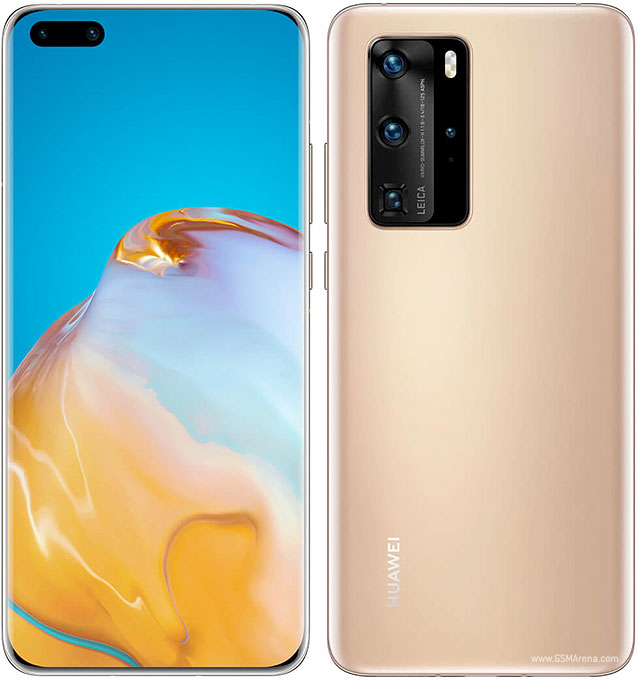
Another device you won’t find the US, the Huawei P40 Pro is the latest flagship from Huawei, also with an emphasis on photography and imaging. Still cursed with last year’s US-Huawei ban, the brand makes a compelling phone that can’t be used with Google Services – which could be a deal breaker for many consumers in Western markets.
Xiaomi’s latest flagship is in a similar situation as the 8 Pro: it has shed away its midrange, high-value image and presents itself as a proper flagship with a flagship price to match. The Mi 10 Pro 5G is certainly well-spec’d on paper and its 108MP camera rivals the 8 Pro‘s overall camera experience.
The OnePlus 8 Pro‘s predecessors are still worthy alternatives to the 8 Pro. Depending on the market, the 5G version of the OnePlus 7T Pro (McLaren Edition @ T-Mobile in the US) is just as expensive as the 8 Pro’s entry price, but if you’re looking for a much cheaper option, the OnePlus 7 Pro is a great smartphone that’s aged very well over the last year.
It can be found around half the price of the 8 Pro, which is a nice trade-off if 5G isn’t a priority. The 7 Pro was one of our favorite smartphones of 2019 around the office.
The OnePlus 8 Pro is now a fully featured flagship worth a pretty penny. This is certainly a departure from OnePlus‘ original image of high-performance for low cost. With every passing iteration, OnePlus continued to build on its previous device’s success and even if it did sometimes hype our expectations, it has consistently improved in many areas throughout the years.
The OnePlus 8 Pro is a solid smartphone packed with a well-improved camera and all the top features that you’d expect from a flagship like reverse wireless charging, stereo speakers, and a top-of-the-line display with 120Hz refresh rate. Top performance from the Snapdragon 865 and 5G connectivity are must-haves in this space, but where OnePlus is no longer competing is in the very space it began.
Pros:
Bright and beautiful smooth display
Premium design and build quality with IP rating and soft-touch finish
Great camera all-around
It has the fastest Snapdragon chipset on board
Oxygen OS is snappy and gets frequent updates
Loud stereo speakers
Warp Wireless charging is super-fast
Cons:
MEMC Motion smoothing feature is inconsistent
Warp wireless charger is expensive
Still no always-on display out of the box
No expandable memory
Not available directly from US carriers
Color filter camera is meh
Ultrawide camera’s low-light performance is not great
OnePlus is a perfect example of the notion: “if you can’t beat ’em, join ’em,” and this is exactly what the company has done with the 8 Pro. It’s managed to become the very thing the company initially set out to defeat. It did call its phones “Flagship killers” for a while. These days, there is so much more competition in the category that OnePlus first started in, that it would rather compete at the flagship level with the big boys.
And they have succeeded in this endeavor. The OnePlus 8 Pro is a high-end smartphone worth considering. The company’s attention to detail in software, packaging, and design make their brand worth being a fan of.
Launching at €599, the OnePlus 8T is shaping up as an excellent premium mid-ranger with a slew of flagship features – a 120Hz Fluid AMOLED, the latest Snapdragon 865 chip, a promising quad-camera with improved low-light performance, stereo speakers, and probably OnePlus best achievement yet – a larger battery with blazing-fast Warp Charge at 65W.
At the company’s fall event this year, a Pro model was a notable absentee. This is because the company keeps the 8 Pro as its ongoing flagship device, and it won’t be getting a refresh until 2021.
The OnePlus 8 needed the update, so we won’t object to this strategic move. We doubt many OnePlus 8 owners are thinking of switching, but it makes the two current offerings that much more desirable for anyone in the market for a new phone.
If we compare it with the OnePlus 8, the 8T is getting a 120Hz OLED vs. 90Hz. At the same time, its main camera gets a brighter aperture for the main camera, an even wider ultra-wide lens, and an additional depth camera. Finally, you get a 4,500mAh battery with 65W charging vs. 4,300mAh and 30W charging. Okay, these are not the wildest upgrades we’ve seen, but for they are enough to make the cheaper OnePlus devices in the duo desirable again.
The €600 smartphone segment is already oversaturated, and it is the place where the flagship killers come to win big or die trying. With the OnePlus being the company that coined the term, its cheaper non-Pro models are burdened with the impossible task to defend the title. As long as they don’t kill the company’s own flagship, of course.
The OnePlus 8T is the first phone to come with the OxygenOS 11 based on Android 11 out of the box. Many of the recent OnePlus phones are getting the update, too, but being first is a title that only the 8T can claim.
Let’s take a closer look at the specs sheet. There aren’t many changes, but it is a flagship-like list, and we like what we are seeing.
OnePlus 8T specs:
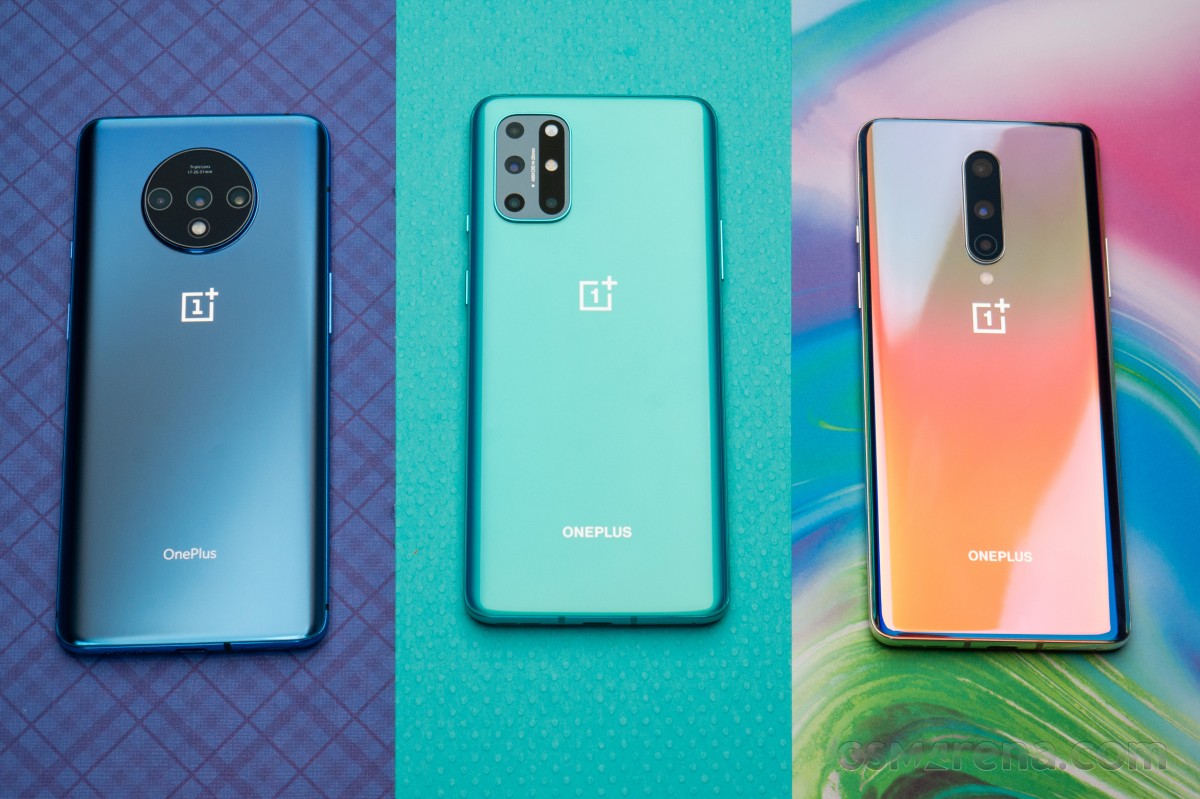
Body: 160.7×74.1×8.4mm, 188g; Glass front (Gorilla Glass), glass back (Gorilla Glass), aluminum frame; Colors: Aquamarine Green, Lunar Silver.
The OnePlus 8T is not water-resistant, not unless you are getting the T-Mobile exclusive OnePlus 8T+ 5G model, which is the same phone but with IP68 certification. Don’t sigh just yet – the OnePlus 8T does comes with many, if not all, seals and protections the T-Mobile model has. It will most probably survive a water drop, too.
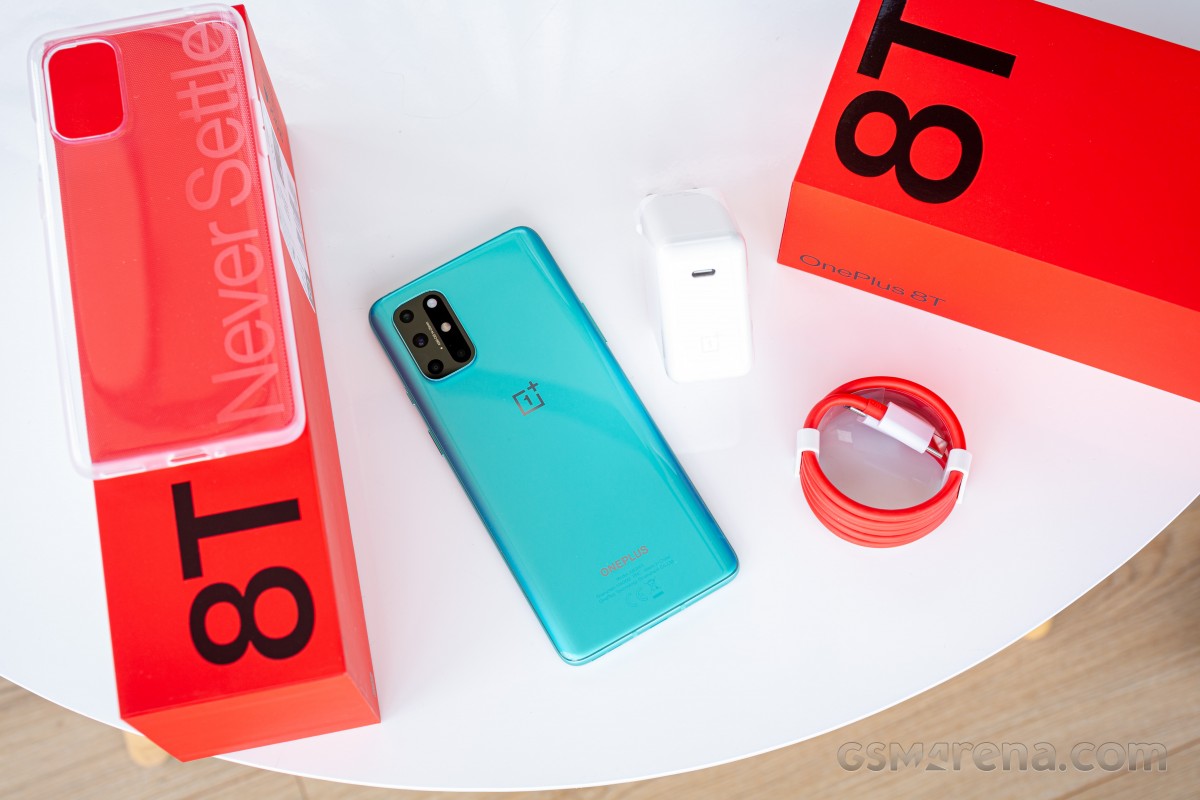
The bright red Never Settle box is already here, and the excitement is building up. The OnePlus 8T may not be among the more interesting updates this year, but c’mon – look at this sweet reviewers’ package!
And now that you’ve seen what we got, here is what you are getting if you choose to buy the OnePlus 8T.
Unboxing the OnePlus 8T
The OnePlus 8T comes packed in what’s already a signature long red box. Inside, you will find your new 8T, be it the glossy Aquamarine Green or the frosted Lunar Silver, and a transparent Never Settle case.
Digging deeper, you will also see the 65W Warp Charger and its thick and red USB-C-to-C cable. The charger also supports USB-PD, so you can use it to charge other devices such as laptops, consoles, tablets, and smartphones.
Finally, there is this paper compartment, where you’d find some paperwork and a bunch of OnePlus stickers.
Wrap-up
The OnePlus 8T has enough novelties to be worthy of the T insignia. We are impressed with the new 65W Warp Charge, and we love the new 120Hz screen. The Fluid AMOLED is 100% worthy of its name, and the new Oxygen 11 is truly a feast for the eyes. Once you see how smooth and fast it runs, you just can’t go back.
And that’s about it. The rest is pretty much OnePlus 8 material – same chipset, speakers, fingerprint scanner, camera. Indeed, even with the minor updates, the camera isn’t on par with the recent premium mid-rangers we’ve seen, let alone the flagship crop. It is a good setup, yes, but the quality hasn’t been improved that much since the Series 7, and the lossless zoom is probably the only thing that deserves praise.
The OnePlus 8T is a terrific deal – it is reasonably priced at €600, and there is a good chance many will choose an 8T (€600) instead of the 8 Pro (€780). But we don’t see many OnePlus 8 owners switching to the T. And that’s fine. The T series are mid-season updates that usually targets last-year buyers.
Alternatives
The recently launched Xiaomi Mi 10T Pro is the biggest threat to the OnePlus 8T and vice versa. Both devices cost €600 and offer HRR screens, the latest Snapdragon 865 chips, UFS3.1 storage, high-end cameras, and large batteries. The Mi 10T Pro has a 144Hz display, but it’s an LCD unit. It also offers a higher-resolution main camera with 8K video capturing and better quality across the board. Meanwhile, the 8T has a 120Hz OLED and faster charging. MIUI or Oxygen? LCD or OLED? 33W or 65W? It’s up to you, but we can bet you will be happy with either.
The Samsung Galaxy S20 FE is also a great alternative with an equally impressive 120Hz OLED, similar performance, and battery life. However, it is IP68-rated for dust and water resistance and offers better camera quality and a proper 3x tele camera. The FE may not be that fast to charge, but it also trumps the 8T with wireless charging and reverse charging options (both wired and wireless). The 4G Galaxy S20 FE is priced like the OnePlus 8T, while its 5G version is €100 more.
Xiaomi Mi 10T Pro 5G • Samsung Galaxy S20 FE 5G
The verdict
The OnePlus 8T is one of these offers we usually call a smart choice. It is a premium mid-ranger at an attractive price that offers a superb pick of flagship features – the screen, the SoC, the charging. The camera may not seem like a winner – it is not disappointing, but it’s not ideal either.
OnePlus has just started offering IP68-rated designs, but this is reserved only for its Pro flagships for now. At least the 8T has some protection, which will give you some peace of mind.
Our only real issue is that OnePlus is forcing a 60fps cap on most of the games and all video players and services. Whether this is done for performance, or heat protection, or battery saving – it doesn’t matter – the user should have had more control over this high refresh rate feature.
Other than that, while not perfect, the OnePlus 8T is easily likable. It might even be love at first sight if you spent 10 minutes with its fluid Oxygen and fluid screen. We can’t recommend it to any OnePlus 8 user, but we can encourage everyone else looking for a €600 or so phone – it is definitely among our top three picks, along with the Mi 10T Pro and the Galaxy S20 FE.
Pros
Excellent 120Hz AMOLED display
Likable design
Incredibly fast charging, versatile bundled fast charger
Dependable battery life
Flagship-grade performance
Powerful speakers
Versatile camera, good day and night quality
Excellent UI performance
Cons
No water/dust resistance rating
No wireless charging
Most games locked to 60Hz
The camera processing could benefit from some improvements
The OnePlus 8 phones have been rendered and shown off several times already. As early as October last year, we saw images of a phone with a punch-hole display. A OnePlus phone was sighted in the wild and illustration of the Pro soon surfaced. We were told it would come with quad rear cams. Image renders and a 360-degree video of the OnePlus 8 Lite also appeared. Already confirmed is the 120Hz OLED screen technology (120Hz Fluid Display) that offers the 120Hz screen refresh rate.
No doubt new OnePlus phones will be coming. Iron Man himself, Robert Downey Jr, was caught holding a mysterious OnePlus phone. We’re just curious if all OnePlus variants will really come with 5G support and if it will be a Verizon or Amazon exclusive.
Sometime in April, OnePlus will reveal two Android phones–the OnePlus 8 and the OnePlus 8 Pro. The two follow last year’s OnePlus 8 and the OnePlus 8 Pro. Both will be equipped with 5G connectivity so we can add them to our shortlist of 5G phones.
Expect the two to arrive with a newer design. The screen is improved with the 120Hz Fluid Display tech. The batteries and camera systems will also be improved.
The latest image renders and video have been shared by Jermaine Smit (Concept Creator). They look believable and most likely, the final design will look like these.
The OnePlus 8 Pro is expected to come with a 6.5-inch Fluid AMOLED display, ToF camera, 120 Hz refresh rate, 1440 x 3120-pixel resolution, HDR10+ DCI-P3, 88.3% screen-to-body ratio, 128GB or 256GB onboard storage, and a 32MP selfie camera under a punch-hole. The phone will run on Adreno 650 GPU, Qualcomm Snapdragon 865 chipset, and 8GB or 12GB of RAM.
The eagerly-anticipated OnePlus 8 and OnePlus 8 Pro are right around the corner now. After more than a few setbacks and uncertainties, OnePlus finally seems to have settled on announcement dates for the phones. You can tune in for the global event live stream on YouTube on April 14 at 3PM UTC. As per a new official Weibo post, the OnePlus 8 generation will make a debut in its home country on April 16. Understandably, with another live online event. This one scheduled for 7PM local time.
As for the OnePlus 8 Lite, which we now know could come under the OnePlus Z moniker, it is still expected a bit later than its flagship siblings. We can’t really speculate on what other potential devices OnePlus intends to show at its Chinese event either. We do, however, have teasers, suggesting the global April 14 event will see the OnePlus TV 55 Q1 Pro’s international market release.
Both the OnePlus 8 and the OnePlus 8 Pro have been frequenting the rumor mill for quite some time now.
Official renders are already available and so are specs. The vanilla OnePlus 8 is expected to feature a 6.55-inch, FullHD+ Fluid AMOLED display, with a 90Hz refresh rate.
The OnePlus 8 Pro will bump that refresh rate up to 120Hz on a 6.78-inch QHD+ panel, as a headlining feature. As per the latest insider scoop on the camera department, the OnePlus 8 Pro will use the Sony IMX689 48MP, f/1.78 sensor for its main snapper, just like the Oppo Find X2 Pro. Alongside it will be Sony IMX586, 48MP f/2.2 ultrawide unit and an 8MP f/2.44 telephoto camera.
On the flip side, both phones are expected to pack the same flagship Snapdragon 865 chipset, complete with 5G connectivity. 8GB RAM plus 128GB storage and 12GB RAM with 256GB storage are the likely memory tiers.
The two phones are expected to stick to OnePlus 30W Warp Charge tech on 4,300 mAh and 4,510 mAh batteries, respectively. The Pro could also feature wireless and reverse wireless charging, although, rumors have been a mixed bag on that front. Same goes for official IP68 ingress protection rating.