The Find My Device network will be able to find the Pixel 8 and 8 Pro “if they’re powered off or the battery is dead.” The former might help when a device is stolen. “Specialized Pixel hardware” is credited as making this possible.
Google tells us that support for this is already available without owners needing to take any action. It will be working with other OEMs and chipmakers on expanding this capability to premium Android devices.
Meanwhile, Google last year said that “Pixel Buds” will be updated to support the new offline Find My Device capabilities. Google confirmed today that this is coming to the Pixel Buds Pro in the future. JBL and Sony will release similar updates “soon.”
This support for headphones is coming after the initial launch for phones and tablets. Support for Bluetooth tracker tags will coincide with some product launches in May.
The Find My Device network is first rolling out in the US and Canada, with end users prompted by email and on-device alerts.
After “hardware limitations” were cited as the reason that the Pixel 8 isn’t getting Gemini Nano earlier this month, Google announced today that the on-device LLM is coming after all.
The Pixel 8 will get Gemini Nano, in developer preview, to power Summarize in Recorder and Gboard Smart Reply. The latter allows for “higher-quality smart replies” that have “conversational awareness” and should be generated faster. On the Pixel 8 Pro, it works with WhatsApp, Line, and KakaoTalk. Meanwhile, Summarize can take a recording and generate bullet points.
RAM — 8 GB versus 12 GB — is the main hardware difference between the two Tensor G3 phones. Google today says “running large language models on phones with different memory specs can deliver different user experiences, so we have been testing and validating this on Pixel 8.”
It looks like Google found a way to run the LLM on less RAM without impacting the rest of the user experience, with the smaller Galaxy S24 doing the same. As a reminder, Google only ever said Gemini Nano was coming to the Pixel 8 Pro in December. Meanwhile, the comment earlier this month came from an engineer outside the Pixel team.
Gemini Nano is coming to the Pixel 8 with the next Pixel Feature Drop, which should be Android 14 QPR3 in June (if previous timelines remain in place). Besides end users getting those two Google app features, developers with the Pixel 8 will be able to use AICore for their own applications.
During the Q&A portion, a Google engineer on the Android generative AI team said that Gemini “Nano will not be coming to Pixel 8 because of some hardware limitations.”
Google is otherwise “working to bring Nano to more devices.” Specifically, more “high-end devices in the near future.”
This does not bode well for older/existing devices getting Gemini Nano. Specs-wise, the difference between the Pixel 8 and 8 Pro is RAM at 8 GB versus 12 GB. In terms of whether the Pixel 8 could run Gemini Nano at a technical level, it probably is capable as evidenced by how the entry-level Galaxy S24 also has 8 GB of RAM and uses it for on-device Magic Compose in Google Messages.
That said, running an intensive model — for a handful of features — might have other performance impacts on the rest of the user experience that Google does not think is worth making.
On the Pixel 8 Pro, Gemini Nano powers Recorder’s Summarize capability (more on that below) and on-device Gboard Smart Reply in WhatsApp, Line, and KakaoTalk.
Meanwhile, Google detailed a bit more about how Gemini Nano powers the “Summarize” feature in the Pixel Recorder app. When Google started experimenting with such a capability in 2022, it was looking at cloud-based models:
User privacy is a top priority and we really wanted our most privacy-centric users, which for Recorder is roughly half of our users, to be able to use such a highly requested feature. This caused us to pause the project at the time.
Recorder then switched to Gemini Nano and a smaller team was able to implement it in 4 months:
We were pleasantly surprised with Gemini Nano’s reduced latency and with how capable the model was despite it being much smaller than what we used during prototyping.
If Gemini Nano is not coming to older Pixel devices, Google really should implement a cloud-based summarization for the other half of users that want this “highly-requested feature.” After all, Recorder already introduced a cloud-powered “Transcribe again” feature in December that makes possible speech-to-text in a lot more languages. Just make cloud summaries something users have to manually trigger for each recording and then delete that audio.
The Pixel 8 series brings some big improvements to Google’s flagship series, and it’s also now bringing in awards, as the duo has now won the 2023 Phone of the Year award at MWC.
Each year at Mobile World Congress (MWC), the GSMA hosts the “Global Mobile Awards.” The event includes a series of awards for the mobile industry such as “Best Mobile Technology Breakthrough,” “Best Mobile Network Infrastructure,” and more. In the “Device” category, one of the biggest awards is given to “Best Smartphone.”
The Best Smartphone award combines outstanding performance, innovation and leadership as determined through assessment of smartphones on the market during the period January 2023to December 2023, by world leading independent analysts, journalists and influencers.
Candidates this year included the iPhone 15 Pro series, OnePlus Open, Samsung Galaxy S23 series, and Samsung Galaxy Z Flip 5, as well as the Google Pixel 8 series.
And, as announced at the event, the Google Pixel 8 series took the crown and ended up being named the “Best Smartphone” of 2023 by the GSMA. Rick Osterloh posted about the win on Twitter/X this evening.
Notably, Apple’s iPhone 14 Pro took the title in 2023, with the iPhone 13 Pro Max winning the year prior. In 2021, the Galaxy S21 Ultra won, but this is the first time Google has taken the title. The Pixel 6 Pro was on the shortlist in 2021 while the Pixel 3’s Night Sight feature won a GSMA award for “Disruptive Device Innovation” in 2019.
Google reportedly hit a new milestone on the back of Pixel 8 this year, shipping 10 million total devices in 2023.
Thrilled about Pixel 8 winning another important Phone of the Year award at MWC! @madebygoogle thank you to the entire Pixel user community for helping us get there, and congratulations to our team for great progress! pic.twitter.com/zIN75YHSmS
While the jump from the Pixel 6 to the Pixel 7 series was somewhat modest, the 8 series‘ launch is defined by a slew of new features and upgraded hardware. There’s also an interesting shift in strategy with the smaller Pixel, which is the subject of this review. One of the most notable changes in this year’s vanilla Pixel 8 is its size. The Pixel 8 is now sensibly smaller than the previous one, mainly thanks to the smaller 6.2-inch display, but other design changes have also helped bring down the weight and reduce dimensions.
The heart of the new Pixel 8 series is the new Samsung-made 4nm Google Tensor G3 chipset, promising better efficiency and higher performance compared to its predecessors. It’s also said to produce considerably less heat, which has been an issue in the past for some users. The chip is joined by Google’s Titan M2 security chip and improved NPU, responsible for AI-related tasks.
The display department also gets a lot of attention this year, and although Google’s Actua-branded LTPO OLED panel is reserved for the Pro, the vanilla 8 offers a substantial upgrade over its predecessor. It’s no LTPO but bumps up the refresh rate to 120Hz (welcome to 2020, Google), and the display is advertised as reaching 2,000 nits of peak brightness.
Disclaimer. We can not guarantee that the information on this page is 100% correct.
The camera system has always been a centerpiece feature for Pixel phones, and the 8 series is no exception to the rule. While there’s no change in the main camera, which isn’t bad because the 50MP f/1.9, 1/1.31″ shooter takes excellent stills, the ultrawide snapper is new. It’s still 12MP and is not the 8 Pro’s ultrawide level, but it now supports autofocus, enabling sharper overall photos and macro-level photography. Additionally, the lens offers a wider field of view.
There’s also a modest uptick in battery capacity, now 4,575 mAh. The cell supports 27W of wired and 18W wireless charging, which is rather odd because that means a respectable upgrade in the wired charging and a small downgrade in the wireless. Last year, the Pixel 7 supported 20W wireless charging.
Last but not least, Google is stepping up its game when it comes to software support. Starting with the Pixel 8 series, Google is promising 7 years of OS and security updates. That’s more than any other smartphone maker right now, even Apple’s latest iOS 17 is only available to iPhones that are no more than 5-year-old.
While it all sounds good on paper, the devil is in the details, so keep reading to find out how the Pixel 8 fares against the competition in various scenarios and whether the 8 Pro is worth the extra bucks over the vanilla 8.
Unboxing the Google Pixel 8
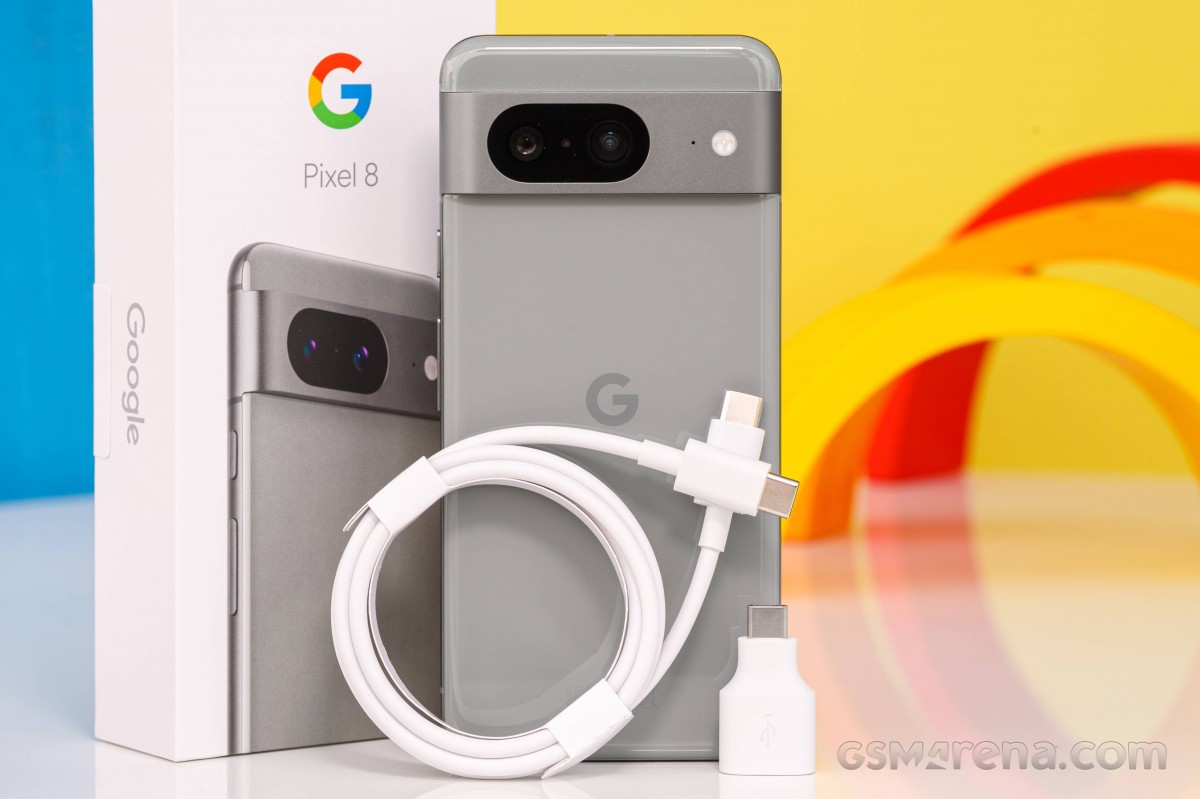
The Google Pixel 8 ships in a modest retail box containing the bare essentials. It has the user manuals inside along with a USB-C to USB-C, Power Delivery-ready cable and a USB-C to USB-A adapter, in case you need it for charging or data transfers.
As is usually the case with some of today’s phones, the charger isn’t included, so you’ll have to get a compatible 27W or faster PD-compliant charger.
Competition
2022 vanilla Pixel 7 was an interesting device as it launched with a fairly competitive price tag, but this year, Google thinks the upgrades are worth about €150 more. The handset asks $700 in the US and €800 in the EU. In the context of the rather limited US market, the Pixel 8 remains competitive enough by undercutting Apple’s iPhone 15 and Samsung’s Galaxy S23. Although, the latter may be found for about the same price as the Pixel 8.
Pixel 8 vs. Pixel 8 Pro
Either way, the iPhone 15 and the Galaxy S23 remain the Pixel 8’s natural competitors. That’s, of course, if you consider the iOS ecosystem. In this case, the iPhone 15 will surprise you with generally better battery life, a considerably more powerful chipset and a slightly better display (it supports Dolby Vision and it’s brighter). However, the Pixel 8 is more in line with 2023’s trends and offers a 120Hz refresh rate, faster charging, uses a bigger sensor for its main camera, and, for the first time ever, it has the upper hand regarding software support. Google promises 7 years of full software support as opposed to Apple’s 5-year support cycle.
We could argue all day about which phone of the two is better for photography, and we think it depends. It all boils down to processing, as the Pixel 8 produces more vibrant images, while the iPhone 15 tends to stay closer to the natural type of processing. Two things stand out in this comparison, though – the iPhone 15 records better videos, while the Pixel 8’s ultrawide camera is much better at handling more lighting scenarios and offers autofocus.
Apple iPhone 15 • Samsung Galaxy S23
The Samsung Galaxy S23 has several advantages over the Pixel 8. It has a dedicated 3x telephoto camera, longer overall battery life (but with similar screen-on runtimes), a more powerful chipset, a slightly better build with Gorilla Glass Victus 2 and a more feature-rich OS with most of its functionalities available to all regions. We are not saying the Pixel 8’s proprietary version of Android 14 isn’t customizable or lacks features, but most of the cool ones are region-locked. Speaking of software, the Pixel 8 edges out the Galaxy S23 with 7 years of full software support and more timely updates. Moreover, the Pixel 8 should be considered for its camera prowess as it outperforms the Galaxy S23 in pretty much every scenario.
Xiaomi 13 • Asus Zenfone 10
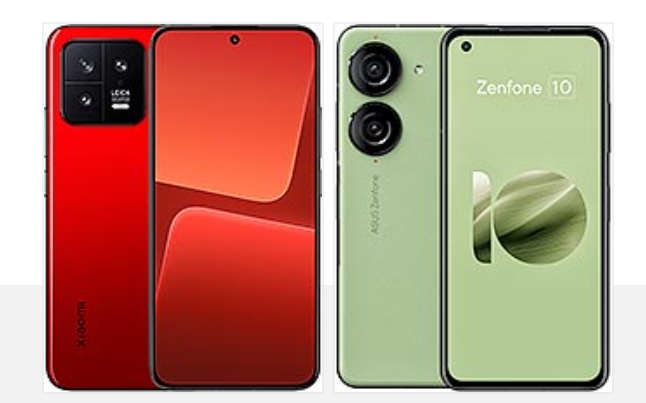
Two other viable Android options are the Asus Zenfone 10 and the Xiaomi 13. If you are in the market for a small flagship phone, the Xiaomi 13 should definitely be on your list. The device’s build may not be particularly impressive, but it packs excellent hardware inside that chassis — a display with comparable quality with Dolby Vision support and a much more potent Snapdragon 8 Gen 2. Additionally, battery life is longer, charging is much faster, and the camera hardware is more versatile as it has a dedicated 3.2x optical zoom camera. In terms of overall camera quality, it’s hard to say which one is better, but in some cases where processing is the deciding factor, the Pixel 8 usually wins.
Pixel 8 vs. Pixel 8 Pro
Lastly, we got the Zenfone 10 under the “compact 2023 flagship” label, but to be perfectly honest, it doesn’t offer anything more compelling than the Pixel 8. Skimming through the spec sheet reveals a faster 144Hz display, a more powerful chip, quicker charging (on paper, 27W vs. 30W) and it has a grippy texture back, which is a rare find these days. However, most of these advantages don’t necessarily mean a better user experience. We will give the Zenfone 10 credit for its longer battery life, but the Pixel 8 comes out on top with actually faster charging, a considerably better camera experience, a brighter screen and longer software support.
Verdict
Despite its considerable price hike, the Pixel 8 remains rather competitive, especially for US consumers. Its MSRP is below its natural regional competitors, offers an improved viewing experience in line with 2023’s industry standards, excellent camera experience, faster charging, and 7 years of software support, and timely major OS updates.
But the Pixel 8 isn’t without its flaws. For instance, a 3x telephoto unit would have been greatly appreciated as well as a more competitive chipset with better thermal control and wider availability for its smart features. After all, many of the Pixel’s clever software features can’t be utilized to its fullest in many markets. Charging and battery life aren’t particularly impressive either, although somewhat okay in Pixel terms. We also wonder why Google decided to skip the autofocus feature on the selfie camera and the support for Pro camera mode on the smaller Pixel.
Bottom line, the Pixel 8 is an easy recommendation because, despite its issues, it’s a significant upgrade over the previous generation and manages to pack competent hardware into a compact body.
Pros
Compact and premium build, easy to handle, dust- and water-resistant.
Bright and color-accurate 120Hz OLED panel.
Improved charging.
Overall, great camera quality with an unmatched character that has a loyal following.
Superb stereo speakers.
Android from the source, exclusive feature set, 7 years of software support.
Cons
Some software features are limited to certain countries.
No AF on the selfie camera, no Pro camera mode.
Ultrawide camera is underwhelming in low light.
A dedicated telephoto camera would have been nice.
Unimpressive battery life and no charger in the box.
The 50 MP main camera sensor on the Pixel 8 and Pixel 8 Pro has been a bit of a mystery, but it seems we might finally have an answer.
Ahead of the Pixel 8 launch, early rumors claimed that Google would switch to the Samsung ISOCELL GN2 camera sensor. But, as the launch approached, that seemed less and less likely. Most notable was a spec leak that lined up much more closely with the ISOCELL GN1 from Pixel 6 and Pixel 7 than it did the ISOCELL GN2.
During the Made by Google event earlier this week, Google directly said that Pixel 8 and Pixel 8 Pro use a “new main sensor” that has up to 21% better performance in low-light scenarios but still at the same 50 MP as the Samsung GN1 sensor that was used in Pixel 6 and Pixel 7. However, Google neglected to mention what that sensor actually was.
We did ask Google what sensor the Pixel 8 series is using earlier this week, but the company wouldn’t comment on specifics. Google lists Pixel 8’s main camera sensor with a 1/1.31-inch sensor, 1.2 μm pixel width, and f/1.68 aperture.
According to Ben Sin of XDA-Developers, though, the most likely answer to the question of what camera sensor the Pixel 8 series is using is the Samsung ISOCELL GNV, not the GN2.
The ISOCELL GNV is another 50 MP sensor, but one that Samsung doesn’t publicize. However, it has been used on multiple Android devices over the past couple of years. Most notably, it was found in the Vivo X80 Pro, which launched in mid-2022. Kimovil, a smartphone comparison website, also mentions this sensor for Pixel 8 and 8 Pro, but it’s unclear where that’s being sourced from.
Officially, we still don’t know for a fact what sensor the Google Pixel 8 and Pixel 8 Pro are using. That said, with Google having explicitly confirmed that there is a new sensor being used and the specs not pointing to GN2, Samsung ISOCELL GNV seems like the most likely explanation. We’ll likely find out more in the inevitable teardowns.
Google will provide 7 years of repair parts for Pixel 8 and Pixel 8 Pro, too
One of the biggest new features of the Google Pixel 8 and Pixel 8 Pro is the new update commitment – seven years of software support including Android OS upgrades. And, to further sweeten that commitment, Google also says that it will provide spare repair parts for Pixel 8 and Pixel 8 Pro for seven years.
Google’s new update schedule for Pixel phones is quite literally unprecedented, as the highest promise prior to this came from Samsung. The company’s commitment came with four years of OS upgrades and five years of security patches, which in itself was and still is quite good. But Google’s new commitment blows even Apple out of the water – iPhone X, for instance, was just killed off after six years of software support.
But, what’s all that software support worth if the hardware can’t keep up? Everyone still has plenty of questions on how Tensor G3 will hold up to seven years of use, but the physical hardware is also going to be tested to its limits in that time.
Google has confirmed to Android Authority that, through the full seven years of software support, the company will also provide spare repair parts for Pixel 8 and Pixel 8 Pro.
Google explains:
Parts will be available for seven years. That’s part of our commitment as we go to the seven years (sic) that we need to make our parts available so you can keep your hardware alive for that long.
The parts will presumably be available through Google’s partner, iFixit, which carries existing Pixel parts and also publishes in-depth guides to detail how to actually perform the repairs. Google also briefly touted that partnership during the Pixel 8 launch event.
Hands-on: Pixel 8 and Pixel 8 Pro are Google’s most promising phones yet, but it all depends on Tensor G3
Google has seen moderate success with its reboot of the Pixel series in the “Tensor” era, but Pixel 6 and Pixel 7 series phones ultimately ended up earning a less-than-stellar reputation for issues such as overheating and signal. But with the new Pixel 8 and Pixel 8 Pro, Google is debuting what are easily the most promising Pixel phones since the original, but it all rests on whether Tensor G3 is actually the improvement it claims to be.
Pixel 8: A more well-rounded flagship for everyone
The first device we’ll talk about is the smaller Pixel 8, which continues in the legacy of being a more affordable device with the same flagship chip, but a trimmed-down experience otherwise. And, this year more than any other, I think Google has really nailed the balance.
Pixel 8 brings a few really key upgrades to the table, starting with the display. The “Actua” display is a fancy marketing word for a 120Hz panel – an overdue upgrade for sure. The 6.1-inch panel is compact and truly a delight to hold, and the quality of the display is truly wonderful despite its 1080p status. The bezels are also noticeably smaller this year, in an improvement even I, as someone who doesn’t really care about bezels, can appreciate. Something I appreciate a lot less is the continued use of glossy rear glass but, honestly, I don’t really mind at this point, especially because I know fully well that almost everyone who owns this device is going to use a case.
And, something else that’s changed this year is just the look. The Pixel 8 and Pixel 8 Pro look practically identical from the front, which I think is a good move on Google’s part. The Pixel 6 and Pixel 7 both had clear inspiration from the Pro, but they always felt very different, and not in a good way. Pixel 8, from any angle, really does feel like it’s the “little brother” to the Pro, rather than a completely separate entry in the series.
On the camera front, the new camera sensor will have to prove its worth in a full review, but things feel more on par with the Pro here in terms of hardware than we’ve seen in a while. The Pro gets a telephoto camera and Pro features, but the regular phone has the same main sensor and the addition of auto-focus on the ultrawide, which opens the door to macro photography.
Pixel 8 feels like not just an upgrade, but a better phone than Pixel 7
The upgrades on Pixel 8 just make it feel like a more well-rounded device, rather than being a clear step down. It does, however, just throw an even bigger wrench in the whole $300 price difference.
But, let’s talk more about the other end of that spectrum.
Pixel 8 Pro: Finally earning its ‘Pro’ name
The Pixel 8 Pro. This one… it feels special.
Google’s latest Pro device brings a pretty surprising number of upgrades and exclusive features. Let’s do a quick rundown.
5x telephoto camera
48MP ultrawide camera
Auto-focus & secure face unlock for the selfie camera
Manual camera controls
50MP mode for camera
“Super Actua” display with 1-120Hz variable refresh rate
Gorilla Glass Victus 2
Up to 1TB of storage
Coming: “Video Boost” processing
That’s a pretty good list of features that separate the Pro from its “little brother.” Are some of these still a little less hardware dependant than they should be? Of course. Pro controls especially seems like a weird thing to just block entirely from the smaller phone, but at the same time, I’m still not convinced Pixels should have this anyway – an unpopular opinion I’m sure.
But, all of that said, what is it actually like to use?
I only spent a small amount of time with the Pixel 8 Pro, but I was happy with every second of it. The updated hardware with its matte back, rounded design, and long overdue flat glass “Super Actua” display feels like some of the most compelling Android hardware I’ve used in quite some time. It also feels like the most “Google-y” hardware the company has done since the Pixel 4 series. The matte glass here isn’t quite as good as it was on the Pixel 4 series, but it’s extremely close.
And, to close out, let’s spend a brief moment on the colors of the Pro. The Pixel 8 Pro comes in fairly tame “Obsidian” and “Porcelain” colors (both are pretty crowd-pleasing) but also the apparently divisive “Bay.”
The fairly vibrant blue is striking in person, and hard to translate to pictures. It’s a unique color for a smartphone, and one that I immediately fell in love with. It’s also one that stands out in any lighting conditions, and will absolutely have me questioning if I want to use a case.
Oh, and it has a thermometer. No, you shouldn’t care about that at all.
Symmetrical bezels and way better displays
Another aspect that both Pixel 8 and Pixel 8 Pro share is their general display design. The bezels across both devices are symmetrical across the sides and top and bottom. It’s a design trait that enthusiasts love and the iPhone has fully embraced and, while it’s not all that important in terms of functionality, it looks aesthetically great.
More important is the display itself. Google is launching new “Actua” displays on the Pixel 8 series, which is a fancy marketing term for just better overall displays. The panel has the same clean look that you seen on iPhones and Galaxy phones, but not as much on Pixels. The regular Pixel 8 is smaller and lacks variable refresh rate, but it’s 120Hz and is 40% brighter than Pixel 7. The Pixel 8 Pro, meanwhile, has a variable refresh rate at up to 120Hz and the same size as previous Pros, but this time with flat glass on top – finally.
As mentioned, we’ve only spent a little bit of time with the Pixel 8 and Pixel 8 Pro, but I walked away with a great impression of the displays.
The Android phone that’s finally matching iPhone on updates
Both Pixel 8 devices are seeing $100 upcharges over their predecessors, but if the new hardware doesn’t make you feel that extra cost is worthwhile, the extended software support might.
Google is providing Pixel 8 and 8 Pro with a whopping seven years of security, Feature Drop, and Android OS upgrades. That’s unprecedented in the Android space in terms of a concrete promise, blowing the Pixel’s previous 3-year/5-year promise, and even Samsung’s 4-year/5-year promise, out of the water. It also comes up to Apple’s typical support timeline, as iPhones tend to get iOS updates for around 6-8 years depending on the model and, well, how Apple feels about updating that device. In any case, it’s a major point in Pixel’s corner, and could have lasting benefits.
Even if you don’t plan to use your phone for that long – I really don’t think many people should – this extended update policy leaves the chance for Google to keep selling its phones for longer (like Apple does) and, maybe, drive up resale value by ensuring that Pixels will still have a life after they’ve been sold to someone else.
How a Pixel actually ages over seven years, we’ll have to wait and see, but this is an ambitious promise on Google’s part.
Really, it just all comes down to Tensor G3. If Google can finally get the chip right, I think Pixel 8 and Pixel 8 Pro will easily be the best Android phones on the market. But that’s a huge if.
Tensor’s legacy thus far has been plagued with issues, heat, and just tons of problems. I genuinely hope that the underlying upgrades – Google’s won’t share specifics aside from “ARM v9” – actually stick the landing, especially given the lifecycle of these devices.
What do you still want to know about Pixel 8 and Pixel 8 Pro?
Google has pre-orders open now for Pixel 8 and Pixel 8 Pro, with prices landing at $699 and $999 respectively. Stay tuned for our full reviews right around the corner but, in the meantime.
Just hours after Google shared the date for its fall Pixel hardware event, two of the devices we’re expecting to see, the Pixel 8 and Pixel 8 Pro, have been filed for approval by the FCC.
On Wednesday afternoon, the FCC published paperwork filed by Google for the approval of five new devices with model numbers GKWS6, G9BQD, GZPF0, GPJ41, and G1MNW. Earlier this year, that same GKWS6 model appeared in a filing for the “Pixel 8” that revealed some wireless charging information.
The FCC e-label instructions in all five filings make mention of looking for “About phone” in Android settings. While Google should only be releasing two distinct models this fall, the Pixel 8 and Pixel 8 Pro, it’s normal for these phones to have multiple variants. For example, flagship Pixel phones are typically offered with and without mmWave 5G connectivity, and variants sold internationally are often also slightly different and still receive FCC approval.
To that end, the paperwork for GZPF0 says that it’s internally identical to G9BQD and GKWS6 except for the removal of mmWave connectivity. Meanwhile, the paperwork for GPJ41 makes direct reference to the same GKWS6 model. All four of these lack any mention of UWB connectivity, meaning they’re likely tied to the standard Pixel 8. Meanwhile, the odd model out, G1MNW, includes UWB, making it likely to be the Pixel 8 Pro.
Update 8/31: Overnight, two additional listings surfaced at the FCC for model numbers GC3VE and G39DP. According to the included paperwork, GC3VE is a variant of the Pixel 8 Pro with mmWave disabled, while G39DP is the non-US model of the Pixel 8 Pro.
This brings the total up to seven distinct models of Google’s latest Pixel flagships, four for the Pixel 8 and three for the Pixel 8 Pro.
Otherwise, these FCC listings for the Pixel 8 series reveal exactly what you’d expect from Google’s next phones, with full support for Bluetooth, Wi-Fi 6E, and both Sub6 and mmWave 5G.
Pixel 8 connectivity (Image: FCC)
Pixel 8 Pro connectivity (Image: FCC)
These filings come just a few weeks after similar FCC listings for the Pixel Watch 2, which we also expect to be unveiled in October. Google also appears to be readying a new Fitbit tracker to be released in the near future, as we spotted recently.
Google announced that its annual Pixel hardware event will be on Wednesday, October 4.
Like last year, the event is taking place in New York City. The “Made by Google event” and keynote will be at 10 a.m. ET. Google will livestream the October 4 Pixel event on YouTube and the Google Store website.
The event itself is being announced just over a month before it takes place. (It also comes 24 hours after Apple shared its iPhone 15 event.) In 2022, Google waited until the one-month mark before sending out invites, though that would fall on a holiday (Labor Day) next week.
Google Pixel 8 will get more OS updates with longer lifespan than Samsung
Pixel 8 Pro borrows premium color tones from Pixel Fold
Pixel 8 Pro and (probably) Pixel Watch 2 briefly appear on the Google Store
Pixel 8 Pro promo video leaks ‘Audio Magic Eraser’ and light blue color
The Pixel 8 and 8 Pro have leaked quite a bit in recent months, including this week, while we’ve reported in-depth about the Pixel Watch 2:
Pixel Watch 2 gets major battery life boost with switch to Snapdragon chip
While the Pixel 6 ushered in three years of major Android OS version updates and an additional two for security patches, that’s still nowhere near the longevity of the iPhone. Google hopes to change that on the Pixel 8 and 8 Pro with noticeably more OS updates.
Looking at the mobile Android landscape, three years of OS updates – which was also the case on Qualcomm-powered Pixel phones from 2017-2021 – is less than Samsung’s promise of four, which started last year with the Galaxy S21, S22, Flip 3, and Fold 3 and continued through devices released this year, including some of the company’s more affordable releases.
Other Android-powered devices like the Nvidia Shield are up to eight years of updates in large part because Nvidia wholly controls the (aging) Tegra X1 and X1+ chips. Google is moving in that direction with Tensor, though the first three generations of Tensor are heavily based on Samsung Exynos.
Google touts “5 years of Pixel updates” on existing Tensor-powered devices as, after Android 13, 14, and 15 (for example), the Pixel 6 will get two more years (24 monthly security patches) that should let you comfortably keep using your phone albeit without major operating system updates during those last two years. Of course, many new features on Android are delivered via app updates and Google Play services, so your phone will not be left too far behind.
Then there’s Apple, with the iPhone XS released in September 2018 with iOS 12 that will get iOS 17 this fall. The iPhone 6S (and 7) from 2015 is still getting security releases on iOS 15 and currently stands at just shy of 8 years of updates.
Android’s update story paling in comparison to the iPhone has been an easy knock, and Google is working to address that with the Pixel 8 and 8 Pro. We’re hearing that Google plans to competitively boost how many years of OS updates the Pixel 8 series and presumably future devices will get.
From what we’re hearing, Pixel 8’s update promise should surpass Samsung’s current policy on flagships and meaningfully match the iPhone. Of course, the devil is in the details, especially in those later years. For example, the Galaxy line has, in the past, adopted a quarterly approach towards the end. Even a bump to just five years of OS updates for Pixel would be enough and let the Google phone be at the top of the ecosystem, with anything beyond that squarely going after the iPhone’s record.
Google says last 2021 that Pixel 6 and Pixel 6 Pro stick with 3 years of major OS updates, 5 years of security
The new Pixel 6 series delivers the company’s in-house Tensor chip which is supposed to upgrade how long these phones last. While it does do that, it’s a bit disappointing to see that the Pixel 6 and Pixel 6 Pro will only get 3 years of major Android OS updates.
Confirmed to Ron Amadeo at ArsTechnica, Google says that the Pixel 6 and Pixel 6 Pro will get 3 years of major Android updates, on par with the company’s current Qualcomm-powered Pixels. That’s not to say there won’t be any upgrades past then, as Google will be offering 5 years of security updates.
We build Pixel phones to get better over time with software and feature updates, so starting with Pixel 6 and Pixel 6 Pro Pixels will now receive security updates for at least 5 years. Users will still get at least 3 years of OS updates, after which we’re committing to ensure that Pixels will stay up-to-date and secure. The frequency and categories of updates will depend on the capabilities and needs of the hardware.
On a support page, Google provides more specific dates.
While this is still a bit disappointing, it’s still in stark contrast to the rest of Google’s competition on Android. Most OEMs are hesitant to provide long-term support. Samsung, for instance, only offers a maximum of 4 years of support for its devices, and that’s a new policy that only applies to a select few devices.
Hopefully, Google will expand this policy in future generations.
According to a new rumor today, the Pixel 8 and 8 Pro will both get five case colors each in a continuation of the trend introduced by the Pixel 7a.
SnoopyTech shared the following lineup this morning on Reddit (the account appears to have been removed from Twitter):
Pixel 8: Carbon – Haze – Jade – Peony – Real Red
Pixel 8 Pro: Carbon – Jade – Porcelain – Real Red – Sky
Carbon should be black or gray, while Jade (green) and Real Red (coral) are shared between both sizes. Haze on the Pixel 8 could be a light blue, while Peony sounds like a pink. Porcelain should be something light, while Sky is likely blue on the Pixel 8 Pro.
Google Pixel 7 case vs Google Pixel 7a case
Google’s previous high was four with the Pixel 6 Pro before going back to three apiece last year. With the Pixel 8 case colors out of the way, the big question is whether Google is going for soft-touch silicone — like the 7a, Fold, and Tablet — or a harder plastic again. The trend is certainly toward the former.
Pixel 8 Pro leaks in live images
Following renders in March and the short video in the temperature sensor leak this May, we now have an even better “in hand” look at the Pixel 8 Pro.
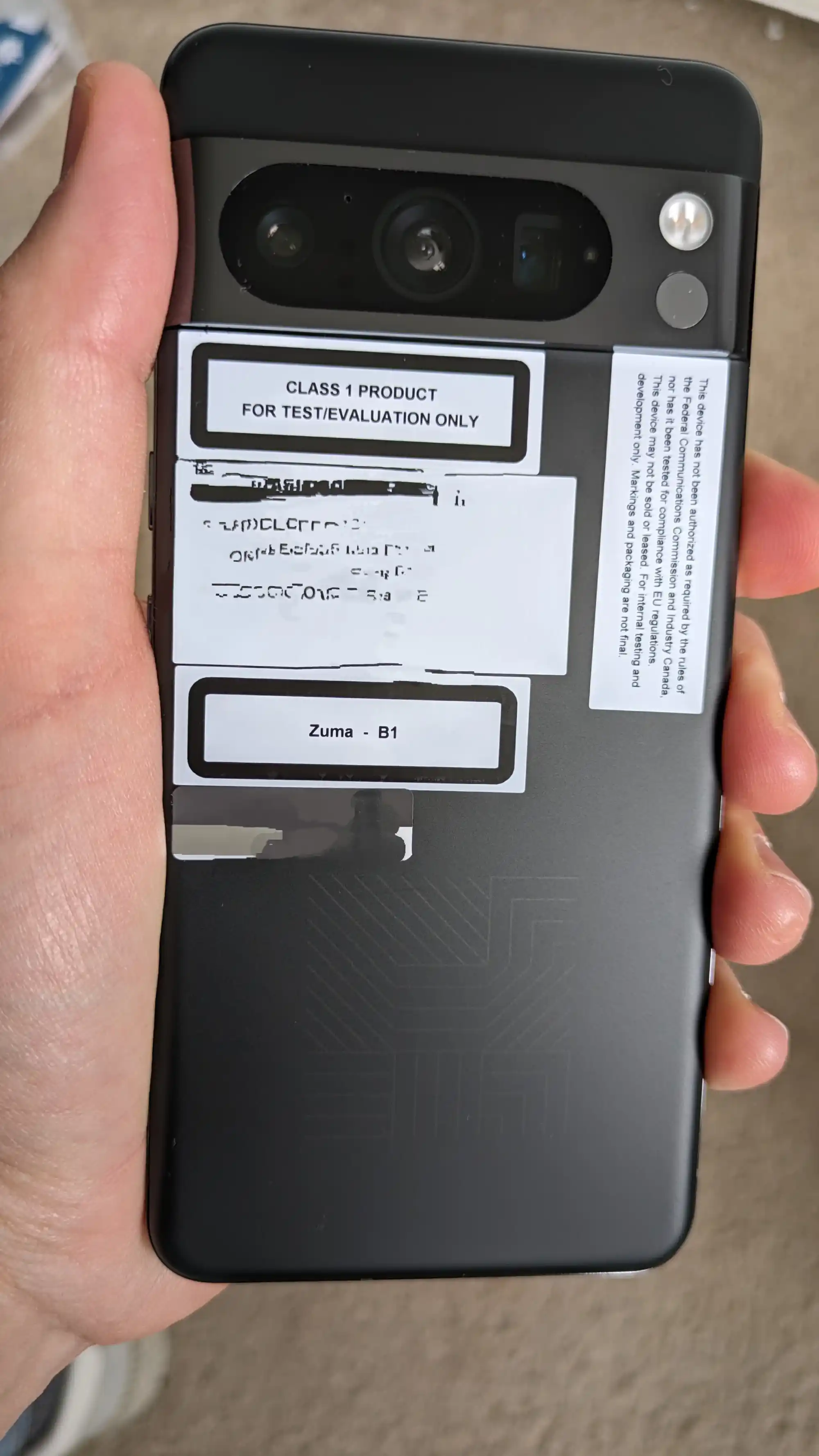
Somebody on Reddit (via Droid-Life) shared a Pixel 8 Pro prototype yesterday, as evidenced by the identifying pattern in place of the “G” logo. They apparently got it “from the device team in Google for testing.”
The bootloader screen confirms the “husky” code name and “ripcurrent” bootloader, while there’s a “Zuma” sticker, which is the Tensor G3 code name, on the back. Other specs on this particular unit include 12GB Samsung LPDDR5 RAM and 128GB SKHynix storage.
We see the increased corner radius in this leak, while the Pixel 8 Pro camera is what really stands out. The unified pill housing all three cameras takes up more of the bar compared to last year. It certainly looks taller with less space to the edge of the bar. The microphone cutout is in-between the first and second cameras, with other sensors below it. You then see the flash and IR temperature sensor.
The image of the front screen shows the Pixel 8 Pro in a case, but we do see the flat screen.
Pixel 8 Pro will apparently still start at 128GB of storage as 256GB becomes the norm
The Google Pixel 8 series is just a couple of months away from its debut, and a new leak is now detailing storage options and more.
WinFuture reports that Google Pixel 8 Pro will offer three total storage options, starting at 128GB. Beyond that buyers could select from 256GB and 512GB options.
That’s unchanged from last year’s Pixel 7 series and the Pixel 6 before it, but it comes at a notable time. Over the past year, more and more flagship devices have moved over to 256GB as the minimum storage tier. Samsung’s Galaxy S23+ and S23 Ultra, the OnePlus 11, and many others have made the switch, often for the same price as the previous 128GB models. Of course, a big part of that is the new UFS 4.0 storage class supported with the Snapdragon 8 Gen 2 processor, which currently isn’t widely available in 128GB sizes. The Pixel 8 series would be powered by Tensor G3, which does reportedly support that newer storage option, but it seems Google may not be using it fully. Samsung also uses UFS 3.1 on the base Galaxy S23 to offer a lower-cost 128GB model.
Notably, a previous Pixel 8 Pro leak showed 128GB of storage on that device.
Whether or not this lower storage offering comes as a problem is unclear, but it certainly makes the Pixel stick out. With rumored price increases, too, it only makes the gap between Google’s device and competitors smaller.
Beyond that, this latest report also reiterates color options, with “Licorice,” “Porcelain,” and “Sky” on the Pixel 8 Pro, and “Licorice,” “Peony,” and “Haze” on the regular Pixel 8.