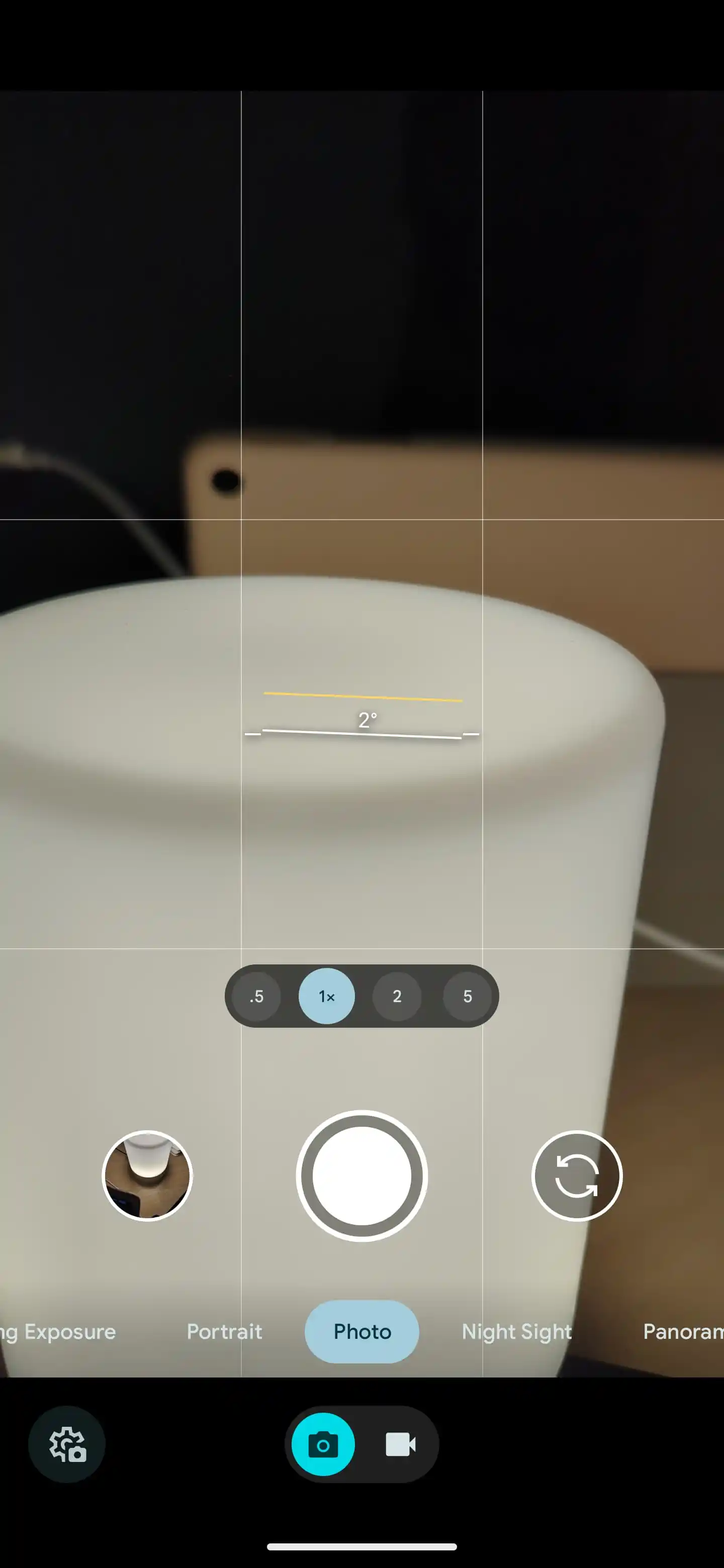
Google is starting to roll out a big redesign of the Pixel Camera app with version 9.0 which notably requires Android 14.
With this redesign, you get a Photo/Video switcher at the bottom of your screen. To the left of that pill is how you access the settings panel, which can also be opened by swiping up (instead of down) in the viewfinder. Continuing upward is the carousel of available camera features:
Photo (L-R): Action Pan, Long Exposure, Portrait, Photo, Night Sight, Panorama, Photo Sphere
Video: Pan, Blur [Cinematic], Video, Slow Motion, Time Lapse
Google Camera 9.0
Camera 8.9
One nice tweak here puts Night Sight a swipe away, while video controls are now more spread out. Camera 9.0 removes “Modes” from the very end, while the switcher is sticky and remembers what Photo or Video mode you were last using.
Meanwhile, for whatever reason, this redesign flips the camera roll preview — long-press for Locked Folder — and front/rear lens switcher positions. There’s no longer any UI at the top of the screen, given the bottom strip, but you don’t get to use that freed up space since it’s used to hide the front-facing camera.
Besides the reorganization to place the vast majority of controls at the bottom of your screen for easier one-handed access, there are no other drastic visual changes. Meanwhile, the themed icon has been updated and is now larger.
Google Camera 9.0.115.561695573.37 requires Android 14 and will not install on Android 13 or older. As such, this update looks to be for Pixel users on the Beta Program. We’ve got it working on a Pixel 7 Pro running Android 14 Beta 5.3.
The new version started rolling out on September 7, but is not yet widely available in the Play Store. First spotted by the Google News group on Telegram, it can be downloaded now from APKMirror today. Notably, this ongoing rollout means the redesign isn’t first debuting on the Pixel 8 series after all.
For the third time this cycle, Google is rolling out another bug fixer with Android 14 Beta 5.3 for all Pixel devices. With this patch, it does seem the stable release might be further off.
There are nine fixes with UPB5.230623.009 for Pixel phones, as well as the Pixel Fold and Tablet. It’s notable that Google has moved back to a single build. Looking ahead, this update is still running the August 2023 security patch, with another release bringing September’s seeming likely.
Fixed an issue where apps crashed in some cases after a CallStyle notification was posted.
Fixed various issues that could cause call or carrier service interruptions.
Fixed an issue where the system was using an inefficient path when placing CPU restrictions on apps running in the background.
Fixed issues with SurfaceFlinger that were causing a loss in system performance.
Fixed an issue on Pixel Fold and Pixel Tablet devices where the taskbar sometimes turned invisible while interacting with it.
Fixed an issue on Pixel Fold and Pixel Tablet devices where the animation on animated wallpapers stuttered when launching apps.
Fixed an issue on Pixel Fold devices where the interface layout was misaligned while customizing the Home screen.
Fixed an issue on Pixel Fold devices where the clock on the lock screen was flickering while animating.
Fixed various issues that were impacting system stability and performance.
If you’re currently enrolled in the Android Beta Program and running the latest Beta 5 builds, you will automatically get offered an over-the-air (OTA) update to Android 14 Beta 5.3.
Android 14 Beta 5.3 with the August 2023 security patch is available for the Pixel 4a 5G, Pixel 5, Pixel 5a, Pixel 6, Pixel 6 Pro, Pixel 6a, Pixel 7, Pixel 7 Pro, Pixel 7a, Pixel Tablet, and Pixel Fold, as well as the Android Emulator.
Instead of the stable release of Android 14 for Pixel phones, as well as the Fold and Tablet, we got a series of Google app updates and updated branding this morning. While unexpected, this isn’t Google’s latest OS release just yet.
With Beta 5 at the start of last month, Android 14 looked on track for a stable launch as soon as mid-August, which would have mirrored Android 13’s August 15th rollout. At the time, Google said the “official release” was “only weeks away.” Beta 5 was followed by 5.1 and 5.2, with no other release this cycle seeing a second patch. While Beta 5 was the “last scheduled update in our Android 14 beta program,” Google doesn’t consider patches to be scheduled, so there’s nothing unexpected about those bug fixers.
With no launch in August, the next window shifted to September 5th (since the first Monday of the month is a holiday in the US). Considering that window has now also passed, let’s look at the recent history of Android launches:
The latest launch in recent memory is Android 12, which had an AOSP release in early October followed by an October 19 Pixel launch tied to the Pixel 6 and 6 Pro announcement. However, in the case of Android 12, the last beta milestone (5) came a month before (in September). Before that, Google has launched in August or September since 2016.
The fact we don’t have a stable yet is complicated by the fact that Android 14 does not seem to be a major release from a visual or new features perceptive. Given the Material You redesign, it made sense why Android 12 took so long.
Android 14’s stage presence during the I/O 2023 keynote in May was unusually limited. We’ve been beta testing lockscreen clock and customization shortcuts for some time now, while generative AI wallpapers hardly seem like a showstopper (and are something I’d expect to debut first on the Pixel 8 anyway before coming to older phones with the December 2023 Feature Drop).
Speaking of Pixel Feature Drops, there clearly wasn’t one today. There also wasn’t one in September of 2021 or 2022, with Google waiting until December both years.
For those waiting, Android 14 Beta 5.2 is quite stable on the Pixel 7 series, Tablet, and Fold. I’ve been using it as my daily driver for several weeks now without issues, thus adding to the intrigue of why it isn’t out yet.
It will be interesting to see whether there will be Android 13 or Android 14 Beta 5.3 with the September security patch at this point. Depending on how many bugs are addressed in the latter, that could signal how far away we are from a stable launch.
Google updates the Android brand with new logo and 3D robot
Following our previous report, Google is officially unveiling a new 3D logo for Android. The broad goal of this updated branding is to “help connect Android to Google,” and it follows the previous modernization in 2019.
Each time we overhaul our branding, we evaluate not only changing needs, but also future goals. We know people today want more choice and autonomy, and we want our brand to be reflective of Android: something that gives people the freedom to create on their terms. As an open platform, it’s important that both our technology and brand are an invitation for people to create, connect and do more with Google on Android devices.
Google says it drew “inspiration from Material design to complement the Google brand palette, as well as be adaptable.”
It starts by moving away from Android’s “longstanding lowercase stylization” to help elevate the logo and add “more weight to its appearance when placed next to Google’s logo” (as seen above in the top-left corner).
While we’ve added more curves and personality unique to Android, the new Android stylization more closely mirrors Google’s logo and creates balance between the two. We hope these small but significant updates to the Android typeface will better communicate the relationship between Android devices and the Google apps and services people already know.
The other big aspect is the Android robot, which, since 2019, has appeared alongside the wordmark. In going 3D, Google gave the bugdroid “more dimension, and a lot more character.” It can be depicted with different materials, colors, and even accessories.
As a visual signifier of our brand, we wanted the bugdroid to appear as dynamic as Android itself.
Google has also updated the full-body appearance to “ensure it can easily transition between digital and real-life environments, making it a versatile and reliable companion across channels, platforms and contexts.” The body is now a domed capsule instead of having a flat bottom and legs protruding from it. With the last branding update, it seemed that Google was moving away from this version.
The updated logo, 3D bugdroid, and brand identity will “appear on Android devices and in more places starting this year.”
Redesigned Assistant At a Glance widget rolling out to all Android phones
Android is rolling out its quarterly drop of new features today, with a redesign of the Assistant At a Glance widget being the highlight.
The current widget available on all Android phones was never updated when the fixed Pixel Launcher version was updated with Android 12. Now, it features a Material You redesign in which the weather is prominently shown in an M3 shape at the right, while text appears at the left. Two lines of text are supported, while a three-dot overflow menu provides additional options, as we previously enabled.
This At a Glance redesign is available for all Android 9+ devices and is rolling out starting today.
In terms of new app features, Google is rolling out the ability to ask questions – by voice or typing – about images with Lookout. Announced back in May, this uses a visual language model to describe images that do not have alt text. Lookout is also adding support for 11 new languages (including Japanese, Korean, and Chinese) for a total of 34.
Google Wallet is also rolling out the previously announced ability to import/upload passes with QR codes or barcodes. This could be used with some library or gym cards, parking passes, and tickets.
You can add what time you slept and how many hours (from Google Fit or Fitbit) to your Google Assistant “Good morning” Routine.
Rounding out the app front are Android Auto apps from Zoom and Webex that will let users join conference calls (by audio) and browse meeting schedules. Google says all “active calls are managed through Android Auto,” with the ability to mute your microphone as needed.
Just hours after Google shared the date for its fall Pixel hardware event, two of the devices we’re expecting to see, the Pixel 8 and Pixel 8 Pro, have been filed for approval by the FCC.
On Wednesday afternoon, the FCC published paperwork filed by Google for the approval of five new devices with model numbers GKWS6, G9BQD, GZPF0, GPJ41, and G1MNW. Earlier this year, that same GKWS6 model appeared in a filing for the “Pixel 8” that revealed some wireless charging information.
The FCC e-label instructions in all five filings make mention of looking for “About phone” in Android settings. While Google should only be releasing two distinct models this fall, the Pixel 8 and Pixel 8 Pro, it’s normal for these phones to have multiple variants. For example, flagship Pixel phones are typically offered with and without mmWave 5G connectivity, and variants sold internationally are often also slightly different and still receive FCC approval.
To that end, the paperwork for GZPF0 says that it’s internally identical to G9BQD and GKWS6 except for the removal of mmWave connectivity. Meanwhile, the paperwork for GPJ41 makes direct reference to the same GKWS6 model. All four of these lack any mention of UWB connectivity, meaning they’re likely tied to the standard Pixel 8. Meanwhile, the odd model out, G1MNW, includes UWB, making it likely to be the Pixel 8 Pro.
Update 8/31: Overnight, two additional listings surfaced at the FCC for model numbers GC3VE and G39DP. According to the included paperwork, GC3VE is a variant of the Pixel 8 Pro with mmWave disabled, while G39DP is the non-US model of the Pixel 8 Pro.
This brings the total up to seven distinct models of Google’s latest Pixel flagships, four for the Pixel 8 and three for the Pixel 8 Pro.
Otherwise, these FCC listings for the Pixel 8 series reveal exactly what you’d expect from Google’s next phones, with full support for Bluetooth, Wi-Fi 6E, and both Sub6 and mmWave 5G.
Pixel 8 connectivity (Image: FCC)
Pixel 8 Pro connectivity (Image: FCC)
These filings come just a few weeks after similar FCC listings for the Pixel Watch 2, which we also expect to be unveiled in October. Google also appears to be readying a new Fitbit tracker to be released in the near future, as we spotted recently.
Google announced that its annual Pixel hardware event will be on Wednesday, October 4.
Like last year, the event is taking place in New York City. The “Made by Google event” and keynote will be at 10 a.m. ET. Google will livestream the October 4 Pixel event on YouTube and the Google Store website.
The event itself is being announced just over a month before it takes place. (It also comes 24 hours after Apple shared its iPhone 15 event.) In 2022, Google waited until the one-month mark before sending out invites, though that would fall on a holiday (Labor Day) next week.
Google Pixel 8 will get more OS updates with longer lifespan than Samsung
Pixel 8 Pro borrows premium color tones from Pixel Fold
Pixel 8 Pro and (probably) Pixel Watch 2 briefly appear on the Google Store
Pixel 8 Pro promo video leaks ‘Audio Magic Eraser’ and light blue color
The Pixel 8 and 8 Pro have leaked quite a bit in recent months, including this week, while we’ve reported in-depth about the Pixel Watch 2:
Pixel Watch 2 gets major battery life boost with switch to Snapdragon chip
While the Pixel 6 ushered in three years of major Android OS version updates and an additional two for security patches, that’s still nowhere near the longevity of the iPhone. Google hopes to change that on the Pixel 8 and 8 Pro with noticeably more OS updates.
Looking at the mobile Android landscape, three years of OS updates – which was also the case on Qualcomm-powered Pixel phones from 2017-2021 – is less than Samsung’s promise of four, which started last year with the Galaxy S21, S22, Flip 3, and Fold 3 and continued through devices released this year, including some of the company’s more affordable releases.
Other Android-powered devices like the Nvidia Shield are up to eight years of updates in large part because Nvidia wholly controls the (aging) Tegra X1 and X1+ chips. Google is moving in that direction with Tensor, though the first three generations of Tensor are heavily based on Samsung Exynos.
Google touts “5 years of Pixel updates” on existing Tensor-powered devices as, after Android 13, 14, and 15 (for example), the Pixel 6 will get two more years (24 monthly security patches) that should let you comfortably keep using your phone albeit without major operating system updates during those last two years. Of course, many new features on Android are delivered via app updates and Google Play services, so your phone will not be left too far behind.
Then there’s Apple, with the iPhone XS released in September 2018 with iOS 12 that will get iOS 17 this fall. The iPhone 6S (and 7) from 2015 is still getting security releases on iOS 15 and currently stands at just shy of 8 years of updates.
Android’s update story paling in comparison to the iPhone has been an easy knock, and Google is working to address that with the Pixel 8 and 8 Pro. We’re hearing that Google plans to competitively boost how many years of OS updates the Pixel 8 series and presumably future devices will get.
From what we’re hearing, Pixel 8’s update promise should surpass Samsung’s current policy on flagships and meaningfully match the iPhone. Of course, the devil is in the details, especially in those later years. For example, the Galaxy line has, in the past, adopted a quarterly approach towards the end. Even a bump to just five years of OS updates for Pixel would be enough and let the Google phone be at the top of the ecosystem, with anything beyond that squarely going after the iPhone’s record.
Google says last 2021 that Pixel 6 and Pixel 6 Pro stick with 3 years of major OS updates, 5 years of security
The new Pixel 6 series delivers the company’s in-house Tensor chip which is supposed to upgrade how long these phones last. While it does do that, it’s a bit disappointing to see that the Pixel 6 and Pixel 6 Pro will only get 3 years of major Android OS updates.
Confirmed to Ron Amadeo at ArsTechnica, Google says that the Pixel 6 and Pixel 6 Pro will get 3 years of major Android updates, on par with the company’s current Qualcomm-powered Pixels. That’s not to say there won’t be any upgrades past then, as Google will be offering 5 years of security updates.
We build Pixel phones to get better over time with software and feature updates, so starting with Pixel 6 and Pixel 6 Pro Pixels will now receive security updates for at least 5 years. Users will still get at least 3 years of OS updates, after which we’re committing to ensure that Pixels will stay up-to-date and secure. The frequency and categories of updates will depend on the capabilities and needs of the hardware.
On a support page, Google provides more specific dates.
While this is still a bit disappointing, it’s still in stark contrast to the rest of Google’s competition on Android. Most OEMs are hesitant to provide long-term support. Samsung, for instance, only offers a maximum of 4 years of support for its devices, and that’s a new policy that only applies to a select few devices.
Hopefully, Google will expand this policy in future generations.
Following the last patch a week ago, Google is rolling out Android 14 Beta 5.2 as another bug fixer, especially for the Pixel Fold and Tablet.
There are nine fixes with UPB5.230623.006 for Pixel phones, and UPB5.230623.006.A1 on the Pixel Fold and Tablet.
Fixed various issues that sometimes caused devices to stall when rebooting.
Fixed issues that could interrupt cellular connectivity for devices that utilize E-UTRAN New Radio – Dual Connectivity (ENDC) when those devices were connected through 5G NR low-band frequencies.
Fixed an issue on Pixel Fold and Pixel Tablet devices that caused the fingerprint sensor to be unresponsive in some cases.
Fixed an issue on Pixel Fold devices that caused Perfetto trace data to be incomplete.
Fixed an issue on Pixel Fold devices with stuttering animations when viewing or tapping the notification for an ongoing call.
Fixed an issue on Pixel Fold devices that sometimes caused the system UI to crash after using the fingerprint sensor.
Fixed an issue on Pixel Fold devices that sometimes caused the screen to briefly flicker when unfolding the device.
Fixed an issue on Pixel Tablet devices that sometimes caused a colored bar to display or flicker after unlocking the device.
Fixed an issue on Pixel Tablet devices that caused the system to play incorrect sounds when docking or undocking the device.
If you’re currently enrolled in the Android Beta Program and running Beta 5 or 5.1, you will automatically get offered an over-the-air (OTA) update to Android 14 Beta 5.2.
Android 14 Beta 5.2 with the August 2023 security patch is available for the Pixel 4a 5G, Pixel 5, Pixel 5a, Pixel 6, Pixel 6 Pro, Pixel 6a, Pixel 7, Pixel 7 Pro, Pixel 7a, Pixel Tablet, and Pixel Fold, as well as the Android Emulator.
Ahead of the public launch, Android 14 is getting a Beta 5 for Pixel phones, the Tablet, and Fold. It comes a month after the last major release and is the final scheduled update.
With the official release of Android 14 only weeks away, today we’re bringing you Beta 5, the last scheduled update in our Android 14 beta program. It’s the last chance to make sure your apps are ready and provide feedback before non-beta users start getting Android 14.
GOOGLE
This is the third Platform Stable Android 14 release for final app testing and addresses a number of issues:
Fixed an issue where after unlocking a device using a PIN, TalkBack provides incorrect audio.
Fixed an issue where Wi-Fi scanning was consuming too much battery.
Fixed an issue where some pictures would glitch with extra shadow blocks.
Fixed an issue where in some cases, the fingerprint sensor icon wouldn’t appear as expected.
Fixed an issue where voice over Wi-Fi wasn’t enabled by default.
Fixed an issue on Pixel Fold devices where the device loses antenna ranging session information and cannot recover it.
Fixed an issue where an extraneous white bar would appear in some apps.
Fixed a background color issue with the UI used to add a shortcut to the home screen.
Fixed a launcher issue that was causing frequent crashes and other quality issues.
Fixed an issue on Pixel tablets where user interaction during the transition from screen saver to low-light clock causes a SysUI crash.
Fixed a Pixel Fold issue where tapping would fail to wake the device.
Fixed a Pixel Fold issue where the system buttons would have inconsistent positions after folding and unfolding.
Fixed an issue causing SysUI crashes when removing an app pair in landscape.
Fixed an issue the launcher doesn’t fully render after setup.
Fixed an issue where the system displayed an incorrect mobile connection type.
Fixed an issue where navigating back to exit an app leads to users no longer being able to open the app.
Fixed an issue where wallpaper previews were sometimes blank.
Fixed an issue where the system theme changes from yellow to pink after rebooting.
Fixed an overscroll issue with ScrollView.
Fixed an issue where certain color palettes were difficult to see when the lock screen was activated.
Fixed an issue where users couldn’t enable battery sharing if a work profile exists on the device.
Fixed an issue where a tablet screen inappropriately turns off when docked.
Fixed an issue where the device policy manager was preventing notifications from appearing.
Fixed an issue where group notifications couldn’t be expanded.
Fixed an issue where the lockscreen didn’t properly display the clock.
Fixed various camera issues that were causing crashes and reductions in quality.
Fixed an issue with power consumption during video playback.
Fixed a Weather clock rendering issue.
Fixed an issue where the lock screen customization preview didn’t match the end result.
Fixed an issue that was causing the wallpaper selection screen to crash.
Fixed an issue where Pixel devices weren’t connecting with some routers.
Fixed a toast search result issue where the color was too similar with the background color.
Fixed an issue where tapping a notification before using facial unlock does not open the notification.
Fixed an issue on Pixel Fold where two clocks were displayed at the same time when in widescreen.
Fixed an issue where widgets would overlap and stack incorrectly.
Fixed an issue where closing the PiP window doesn’t stop YouTube playback.
Fixed an issue with switching call audio sources.
Fixed an issue where after unlocking a device, only the background appears.
Fixed an issue with dragging folders to remove them.
Users can submit problems via Android Beta Feedback on Pixel devices. Access it from the app drawer or via Quick Settings to file bugs in the Google issue tracker. There’s also the Android Beta community on Reddit.
Android 14 Beta 5 (UPB5.230623.003) with the August 2023 security patch is available for the Pixel 4a 5G, Pixel 5, Pixel 5a, Pixel 6, Pixel 6 Pro, Pixel 6a, Pixel 7, Pixel 7 Pro, Pixel 7a, Pixel Tablet, and Pixel Fold, as well as the Android Emulator.
Most people will be installing via the Android Beta Program, but you can also flash or sideload. If you need help, here’s our full guide on installing Android 14.
With the Pixel 7 and 7 Pro last October 2022, Google reintroduced Face Unlock to its phones after abandoning the Pixel 4’s approach.
At the launch event, it was announced as such:
And the front camera has another role to play. Pixel 7 and 7 Pro’s front camera uses our advanced machine learning models for face recognition, to power Face Unlock. So you have the faster, more secure under-display fingerprint reader, and now you have the convenience of unlocking your phone with a glance.
Instead of using a dot projector, flood illuminator, and IR cameras in conjunction with the Soli radar, Google turned to a front-facing camera that supports DPAF (dual-pixel auto-focus) to presumably create a depth map to be used with the aforementioned ML models. I find it slightly weird that Google has yet to detail the technology behind this Face Unlock approach in an AI/Research blog post, like it did before.
For the most part, the experience has been fine. It’s not better than the dedicated hardware of the Pixel 4 or Face ID on the iPhone. That approach lets face recognition operate in all lighting conditions, including the absence of any. My usage of the fingerprint sensor definitely picks up at night, resulting in a two-tiered security experience throughout the day.
Of course, the more stark tiering is how face recognition is not considered a secure unlock method by Android for things related to payments, passwords, and passkeys. In that regard, today’s Face Unlock is less secure than what came before in an unfortunate and uncharacteristic step backward. Assuming Google decided to continue the Pixel 4 lineage rather than reorienting, the Pixel 5 would have probably not had a hole punch and instead opted for an iPhone-esque cutout in order to avoid a thick upper bezel. The design would have presumably shrunk by now. That’s one big shame with the Pixel restart.
Going back to reality, the Face Unlock we do have today on the Pixel 7, 7 Pro, 7a, and Fold is best summarized as a convenience. I’ve been using it a bit more with the Pixel Fold as a way to transition from an under-display to a side-mounted fingerprint sensor. Having used the former for two generations now, I’ve come to like how you’re literally interacting with the UI for unlocking. I’m amused at the hardware/software synergy.
In optimal conditions, Face Unlock on the Fold works quite fast and lets you start doing things on your phone pretty quickly, which is arguably what’s most important.
That said, the security and environmental conditions will always stop it from becoming ubiquitous. I wonder whether the primarily software-driven approach to Face Unlock is something that has a future. The roadmap behind the IR approach that Apple uses is more straightforward in that ideally all those components can be placed and work underneath the display.
Namely, for Google, will the recognition algorithms get foolproof enough that it cannot be tricked and gets elevated to a secure unlock method? Does this require a front-facing camera upgrade, more on-device processing, or another innovation entirely?
Or will the future of Face Unlock on the Pixel be a return to IR? That would be great from a security and convenience perspective but would make the current feature feel one-off.
Following the last update just over a week ago that did not introduce any new features, Google is rolling out Android 14 Beta 5.1 as another bug fixer.
While Beta 5 was said to be the “last scheduled update” and that the “official release is next,” Google does not consider .1 patches to be milestones. A similar thing happened during last year’s preview cycle.
There are just four fixes with UPB5.230623.005 for Pixel phones and UPB5.230623.005.A1 on the Pixel Fold and Tablet. Notably, Google has disabled the trademark live wallpaper on the Pixel Fold for performance reasons.
Fixed an issue that caused the system to stop detecting a SIM card if Fixed Dialing Number (FDN) features were enabled.
Fixed an issue that caused connectivity interruptions for devices with carriers using 5G standalone (SA) mode.
Fixed an issue for some devices where a blank home screen displayed after unlocking the device.
Fixed a performance issue by temporarily disabling feather-styled live wallpaper on Pixel Fold. The live wallpaper version will be re-enabled after the other underlying issues are fixed.
Android 14 Beta 5.1 with the August 2023 security patch is available for the Pixel 4a 5G, Pixel 5, Pixel 5a, Pixel 6, Pixel 6 Pro, Pixel 6a, Pixel 7, Pixel 7 Pro, Pixel 7a, Pixel Tablet, and Pixel Fold, as well as the Android Emulator.
Ahead of the public launch, Android 14 is getting a Beta 5 for Pixel phones, the Tablet, and Fold. It comes a month after the last major release and is the final scheduled update.
With the official release of Android 14 only weeks away, today we’re bringing you Beta 5, the last scheduled update in our Android 14 beta program. It’s the last chance to make sure your apps are ready and provide feedback before non-beta users start getting Android 14.
GOOGLE
This is the third Platform Stable Android 14 release for final app testing and addresses a number of issues:
Fixed an issue where after unlocking a device using a PIN, TalkBack provides incorrect audio.
Fixed an issue where Wi-Fi scanning was consuming too much battery.
Fixed an issue where some pictures would glitch with extra shadow blocks.
Fixed an issue where in some cases, the fingerprint sensor icon wouldn’t appear as expected.
Fixed an issue where voice over Wi-Fi wasn’t enabled by default.
Fixed an issue on Pixel Fold devices where the device loses antenna ranging session information and cannot recover it.
Fixed an issue where an extraneous white bar would appear in some apps.
Fixed a background color issue with the UI used to add a shortcut to the home screen.
Fixed a launcher issue that was causing frequent crashes and other quality issues.
Fixed an issue on Pixel tablets where user interaction during the transition from screen saver to low-light clock causes a SysUI crash.
Fixed a Pixel Fold issue where tapping would fail to wake the device.
Fixed a Pixel Fold issue where the system buttons would have inconsistent positions after folding and unfolding.
Fixed an issue causing SysUI crashes when removing an app pair in landscape.
Fixed an issue the launcher doesn’t fully render after setup.
Fixed an issue where the system displayed an incorrect mobile connection type.
Fixed an issue where navigating back to exit an app leads to users no longer being able to open the app.
Fixed an issue where wallpaper previews were sometimes blank.
Fixed an issue where the system theme changes from yellow to pink after rebooting.
Fixed an overscroll issue with ScrollView.
Fixed an issue where certain color palettes were difficult to see when the lock screen was activated.
Fixed an issue where users couldn’t enable battery sharing if a work profile exists on the device.
Fixed an issue where a tablet screen inappropriately turns off when docked.
Fixed an issue where the device policy manager was preventing notifications from appearing.
Fixed an issue where group notifications couldn’t be expanded.
Fixed an issue where the lockscreen didn’t properly display the clock.
Fixed various camera issues that were causing crashes and reductions in quality.
Fixed an issue with power consumption during video playback.
Fixed a Weather clock rendering issue.
Fixed an issue where the lock screen customization preview didn’t match the end result.
Fixed an issue that was causing the wallpaper selection screen to crash.
Fixed an issue where Pixel devices weren’t connecting with some routers.
Fixed a toast search result issue where the color was too similar with the background color.
Fixed an issue where tapping a notification before using facial unlock does not open the notification.
Fixed an issue on Pixel Fold where two clocks were displayed at the same time when in widescreen.
Fixed an issue where widgets would overlap and stack incorrectly.
Fixed an issue where closing the PiP window doesn’t stop YouTube playback.
Fixed an issue with switching call audio sources.
Fixed an issue where after unlocking a device, only the background appears.
Fixed an issue with dragging folders to remove them.
Users can submit problems via Android Beta Feedback on Pixel devices. Access it from the app drawer or via Quick Settings to file bugs in the Google issue tracker. There’s also the Android Beta community on Reddit.
Android 14 Beta 5 (UPB5.230623.003) with the August 2023 security patch is available for the Pixel 4a 5G, Pixel 5, Pixel 5a, Pixel 6, Pixel 6 Pro, Pixel 6a, Pixel 7, Pixel 7 Pro, Pixel 7a, Pixel Tablet, and Pixel Fold, as well as the Android Emulator.
Most people will be installing via the Android Beta Program, but you can also flash or sideload. If you need help, here’s our full guide on installing Android 14.
After years of being the lone option, Samsung finally has some foldable competition in the US, and that partially takes the form of Google’s Pixel Fold, which comes in at the same price as Samsung’s brand-new Galaxy Z Fold 5. But after using both devices, there’s a clear better option.
Galaxy Z Fold 5 vs. Pixel Fold: How they compare on paper
When you look at the spec sheet alone, Google’s Pixel Fold and Samsung’s Galaxy Z Fold 5 are rather similar. Both have 7.6-inch inner displays, plenty of RAM and storage and hinges that are rated for at least 200,000 folds.
The differences really come down to the details. The Pixel Fold has a wider aspect ratio to both of its displays. The 17.4:9 ratio of the outer display is short and wide compared to the Fold 5’s 23.1:9 ratio, which is extremely tall and narrow. The Pixel is also considerably thinner at 12.1mm to the Fold 5’s 13.4mm. Despite that, Pixel Fold also has a bigger battery at 4,821 mAh.
Google Pixel Fold
Galaxy Z Fold 5
Outer display
5.8 inch, 17.4:9 ratio
6.2 inch 23.1:9 ratio
Inner display
7.6 inch, 6:5 ratio
7.6 inch, 21.6:18 ratio
Processor
Google Tensor G2
Snapdragon 8 Gen 2 for Galaxy
Storage/RAM
256GB/512GB UFS 3.1 + 12GB RAM
256/512GB/1TB UFS 4.0 + 12GB RAM
Hinge rating
200,000 open/close
200,000 open/close
Thickness
12.1mm folded/5.8mm unfolded
13.4mm folded/6.1mm unfolded
Battery
4,821 mAh
4,400 mAh
Cameras (rear)
48MP/10.8MP 5x/10.8MP UW
50MP/10MP 3x/12MP UW
Price
$1,799
$1,799
How the two compare, though, really comes down to actually using them.
The Galaxy Z Fold 5 is boring in the best way
If you’ve looked into a foldable before now, you’ve likely looked at the Galaxy Z Fold series. And through that eye, the Galaxy Z Fold 5 doesn’t seem all that new, and that’s because it isn’t. The design of the device hasn’t really changed much at all over the past three years, and compared to the Galaxy Z Fold 4 before it, the Fold 5 really only has a new hinge, and that’s about it.
But the lack of major upgrades in Samsung’s flagship foldable has led to something perhaps more important.
Samsung’s foldable tech has just gotten really, really polished over the past couple of generations. The company has spent its time addressing the little problems, like improving the screen brightness, extending battery life, and improving the hinge, rather than hitting bigger issues like the display crease and cameras. In Samsung’s eyes, it seems, those aspects are “good enough,” where others still need work. And after using the Fold 5 for a few weeks, I mostly agree. The Galaxy Z Fold 5 really just feels like it’s as good as this particular form factor can get without bigger changes. And if you like this overall package, it’s really just a great refined product.
Beyond that, another strength of the Galaxy Z Fold 5 is its software. While One UI is a heavy skin on top of Android, it’s packed with features that are useful on the Fold 5’s bigger display and ones that Google’s cleaner Android build just doesn’t have.
Of course, none of this is to say the Galaxy Z Fold 5 isn’t without its flaws. The tall and narrow outer display isn’t great for typing and doesn’t play very well with some apps. The inner display’s taller nature also means that a lot of apps never trigger a tablet interface, which makes some apps feel less optimized for the form factor.
Pixel Fold is undeniably good – it’s just not as good
That’s why the Pixel Fold falls – death by a thousand cuts.
The Pixel Fold’s downsides really just outweigh the good. The Tensor chip inside is plenty powerful, but it’s prone to overheating very easily, which is a really hard pill to swallow at this price point.
The screens also aren’t nearly as bright as Samsung’s, and Google’s crease isn’t any better either. Samsung’s crease still isn’t good, and it’s very noticeable, but Google’s is wider and thus felt more often.
There’s also the hinge. While I stand by the opinion that the Pixel’s hinge not easily sitting at 180 degrees isn’t a problem, I’ve much enjoyed not having to apply the bit of extra pressure on the hinge when using the Fold 5. It’s just a much more consistent feel. Similarly, the Fold 5’s inner display is much easier to type on because Google’s phone is just way too wide.
Battery life is also another sore point for the Google device. Whereas Samsung’s latest generation has pulled off some kind of miracle by upping endurance significantly compared to the last model, the Pixel Fold suffers from mediocre battery life. Often I find the device struggling to make it through a long day, whereas the Galaxy just seems to keep on chugging along.
Really, the perks of Pixel Fold come down to just two aspects.
Firstly, there’s the aspect ratio. Google’s device has a short and wide outer display that makes way for a very wide inner display. This means that the outside is far more usable than Samsung’s, and the inner display triggers more tablet apps. I still think this leads to too many poor app experiences (like Instagram, Reddit, and so on), but when it works, it just works really nicely.
Google Weather on the Pixel Fold
The other point is, of course, the camera. Google’s Pixel line has built its entire legacy on the camera, and that translates wonderfully to the Fold. The 48MP primary camera takes shots that look great and that, more importantly, I can trust. The Galaxy Z Fold 5 will pump out a good shot now and then, but it’s not consistent enough. Two shots taken back to back can look drastically different, for example. Plus, the Pixel Fold has a much better 5x telephoto camera that absolutely destroys the Galaxy Z Fold 5’s camera setup at range. There’s just no competition there: Google has the way better camera.
Tensor is a real problem in a pricey foldable
Google’s Tensor processor is unique to Pixel phones, and it’s not a terrible chip. It has plenty of power, and Google uses its AI strengths to optimize a few features and the camera experience too. However, Tensor is just not as good as a modern Snapdragon chip.
Tensor tends to overheat quickly and struggles with battery efficiency when on a cellular network, especially if signal is spotty. The Snapdragon 8 Gen 2 in the Galaxy Z Fold 5, though, is as good as it gets in an Android phone. It’s exceptionally powerful and extremely efficient, which leads to great battery life on the Fold 5.
Personally, I’m usually willing to put up with Tensor’s deficiencies because Pixel phones are usually a lot cheaper than the competition, but that’s not the case with the Pixel Fold. Google’s foldable costs $1,799, the same as Samsung’s device, and Google doesn’t offer the same discounts and trade-ins to go with that. Tensor shouldn’t be a deal-breaker for a normal Pixel phone, but it is absolutely a valid killer on the Fold.
Galaxy Z Fold 5 is the better foldable
Where the Pixel’s aspect ratio and cameras are genuine improvements in many ways, the Galaxy Z Fold 5 makes strides where it counts. The screen is brighter and better. The hinge is smoother and tougher. The chip inside is stronger and much less prone to overheating. And there are perks Google just can’t match, like stylus support and a much more fleshed-out accessories ecosystem.
Don’t think it can be argued. Objectively, the Galaxy Z Fold 5 is the better foldable.
But…
Why some still using the Pixel Fold
Despite the Pixel Fold’s many shortcomings, it’s the one some going to keep using. Why? It really boils down to one thing – the camera.
Samsung’s Galaxy Z Fold 5 gets a whole lot right, but its camera is a deal-breaker for me. It’s too unreliable, and as such, I’ve always dual-wielded a Pixel phone alongside a Galaxy Z Fold device for the past three years. But now that I have the option to get a foldable Pixel, that’s what I choose to carry because, most of the time, I only want to carry one device.