In recent weeks and months, Apple has been catching some heat for its App Store rules, particularly as they apply to gaming apps. Not only has Apple come under fire from Epic for the fact that it takes a 30% cut from each in-app purchase, but the company has also drawn criticism from Facebook and Microsoft, as its App Store policies have made it impossible to get their game streaming apps – Facebook Gaming and Project xCloud, respectively – on iOS devices. Today, Apple updated its App Store guidelines, and while the new rules cover a number of different apps, there are a few specifically for game streaming.
Apple’s updated App Store guidelines can be read in full over on the company’s developer site, but as that spans pages and pages of text, it’s probably easier to look at a changelog for this update that Apple published elsewhere. Apple has implemented new rules regarding App Clips, widgets, extensions and notifications, requiring that those all be related to the content or functionality of the app they belong to. Apple also now requires that “all App Clip features and functionality must be included in the main app binary,” and says that App Clips can’t contain advertising.
Apple has also relaxed some rules about in-app purchase requirements for apps that offer person-to-person experiences, which have become much more important in the age of COVID-19. Apple’s new rules say that apps which offer one-on-one services can charge using payment methods other than in-app purchases. Those that offer “one-to-few” and “one-to-many realtime experiences,” however, have to continue using in-app purchases to charge users.
With these changes, Apple is now allowing web-based tools to offer free standalone companion apps without the need for in-app purchases. So, your web provider can give you access to a standalone email app or VOIP app without rolling some kind of in-app purchase into that app. Furthermore, Apple has put in place new rules regarding in-app pop-ups that make you watch ads, request that you review the app, or click on advertisements:
3.2.2(vi): Apps should not require users to rate the app, review the app, watch videos, download other apps, tap on advertisements, enable tracking, or take other similar actions in order to access functionality, content, use the app, or receive monetary or other compensation, including but not limited to gift cards and codes.
Apps offering personal loans are now subject to some rather big restrictions too, with Apple saying that they can’t charge a maximum APR higher than 36% and can’t require that people pay back their loan in full in 60 days or less. The company also says that these apps must “clearly and conspicuously disclose all loan terms, including but not limited to equivalent maximum Annual Percentage Rate (APR) and payment due date.”
Arguably the biggest changes Apple made today apply to game streaming. Facebook has made clear its frustrations with App Store restrictions regarding its Facebook Gaming app, while Microsoft hasn’t been able to bring Project xCloud to iOS because of those same restrictions. Even Google Stadia has bumped up against these guidelines, which means there’s a distinct lack of game streaming present on the iOS App Store.
While these new guidelines are meant to ease game streaming restrictions, we’re not sure how much they’re going to help. Apple’s new rules for game streaming are as follows:
3.1.2(a): Games offered in a streaming game service subscription must be downloaded directly from the App Store, must be designed to avoid duplicate payment by a subscriber, and should not disadvantage non-subscriber customers.
Elsewhere in its changelog, Apple says that “Each streaming game must be submitted to the App Store as an individual app so that it has an App Store product page, appears in charts and search, has user ratings and review, can be managed with ScreenTime and other parental control apps, appears on the user’s device, etc.” Game streaming apps can offer a catalog app separately that points to these App Store listings, but if Microsoft and Stadia were looking to offer one, all-inclusive app that features their entire streaming catalogs, it looks like they won’t be able to do that.
According to Microsoft, Project xCloud will offer 100+ games when it launches as part of Xbox Game Pass Ultimate next week, so in order for Microsoft to publish that app on iOS, it would not only need some kind of mainline Xbox Game Pass app for iOS, but also an individual App Store listing for each of the 100+ games on the service so Apple can review and approve each one. It seems those App Store listings don’t necessarily have to host the full game, but CNBC notes that they’ll need some kind of basic functionality.
It’s hard to imagine Microsoft, Google, or Facebook opting to bring their services to iOS even after these updated guidelines. While Stadia has a traditional storefront that wouldn’t see much in the way of rotation, it still seems like a huge endeavor to publish listings for each game it sells. When you consider that games rotate in and out of the Game Pass library each month, maintaining App Store listings for each game on the service becomes even more of a chore for Microsoft.
Still, services like Game Pass and Stadia now have a way to get on the App Store, but the question now is whether Google, Facebook, and Microsoft will think getting their streaming services on iOS will be worth the trouble of complying with Apple’s guidelines. Apple has indeed given these companies an in regarding the App Store, but it’s done so in a very complicated way, seemingly to ensure that it has granular control over what’s offered on iOS for better or worse.
iOS 14 allows for third-party web browsers and email clients to become the default, so if you really don’t like Safari and Apple Mail, you now have other options.
With the latest update to Google Chrome, now available on the App Store, you can change your default browser from Safari to Google Chrome, on iPhone and iPad. Here’s how to do it …
With iOS 14, Apple has added system support for third-party web browsers and email apps. In the future, they may open even more categories.
The default web browser will be used when tapping on a link in any application. Until iOS 14, you could have an alternative browser like Google Chrome but link actions would always open in Safari. Here’s how to change that on iPhone and iPad in iOS 14.
How to set Google Chrome as your default browser on iPhone
Download the latest version of Google Chrome from the App Store.
Open the Settings app and open the settings page for Google Chrome.
Tap ‘Default Browser App’.
Tap ‘Chrome’.
With this set, any app that triggers a standard open URL activity will now direct the system to open Google Chrome, rather than Safari.
If you ever change your mind, you can go back into Settings and change the Default Browser App back to Safari. If you want to use a different third-party browser that isn’t Chrome, you will have to wait for the developer to update their application. The same goes for changing email apps: so far, we haven’t seen any compatible email app expose this feature.
Obviously, this all requires iOS 14 or iPadOS 14 to be installed. Right now, we are at iOS 14 developer beta 8. Apple is expected to release iOS 14 publicly for all users later in September, with a release date likely announced as part of next week’s Apple Event.
Apple is delaying its new rules around in-app tracking in iOS 14, postponing the controversial disclosure requirement that set it at odds with Facebook. Announced at WWDC 2020, the new feature was intended to make explicit that software could use data to deliver personalized adverts, and indeed track users across multiple apps and websites.
Users would be presented with the option to allow such tracking, or ask the app not to track them. At the time, Apple was praised by privacy advocates for taking the step, which could prevent iPhone and iPad users from unwittingly having their digital lives tracked and comprehensive profiles built on them for more specific advertising purposes.
However it was less popular with ad providers and networks. In August, Facebook called out the iOS 14 feature as having the potential to undermine its partner ad business. The change could leave its so-called Audience Network system “so ineffective on iOS 14 that it may not make sense to offer it on iOS 14,” Facebook said at the time.
Clearly someone at Apple has been listening to the feedback. Now, while iOS 14 will still support the new notification and the prompt to permit in-app tracking, developers won’t be penalized if their apps don’t show it. Instead it won’t be until sometime early in 2021 before Apple makes supporting the notification a requirement.
“We believe technology should protect users’ fundamental right to privacy, and that means giving users tools to understand which apps and websites may be sharing their data with other companies for advertising or advertising measurement purposes, as well as the tools to revoke permission for this tracking. When enabled, a system prompt will give users the ability to allow or reject that tracking on an app-by-app basis. We want to give developers the time they need to make the necessary changes, and as a result, the requirement to use this tracking permission will go into effect early next year”Apple
The technology relies on IDFA, or Identification for Advertisers, which sees each iOS device being given a unique code. That can be shared with advertisers, and used to personalize campaigns shown to a user across different software and websites. Audience Network, for example, is used in numerous apps and sites, and many people may not realize that they’re all keeping track of visits and sharing that data in aggregate in the background.
Making it more visible, Facebook and others have warned, could pull the rug out from under effective campaigns. Without a comprehensive user profile, targeted promotions will be trickier to finesse. “Like all ad networks on iOS 14, advertiser ability to accurately target and measure their campaigns on Audience Network will be impacted,” Facebook explained last week, “and as a result publishers should expect their ability to effectively monetize on Audience Network to decrease.”
Apple’s decision comes as it faces criticism from multiple quarters about its policies. In August, Epic Games led a revolt around in-app purchases and the so-called “Apple tax” applied to developer revenues made through the App Store. Apple responded by pulling Fortnite from its store, with Epic going on to sue the Cupertino firm – and Google – over the situation.
Apple says it will have more information on when, exactly, app publishers will need to start asking permission around tracking, later this year. “More information, including an update to the App Store Review Guidelines, will follow this fall,” the company told developers.
The iPhone XR was the first commercial success that came on the second attempt for making a more affordable iPhone. The iPhone 5c failed to impress in 2013, and we thought we’d never see the maker give this idea another try. Well, last year the iPhone XR was more than well received being the best selling iPhone of the trio, so this year we welcome its sequel – the iPhone 11.
The iPhone XR was indeed a cheaper, toned-down version of the XS generation, with an LCD screen, one camera short, and promised some excellent battery endurance. Well, when we say cheaper, we are not saying cheap, as those words mean something different in Apple’s universe.
But truth be told, this year the iPhone 11 is even cheaper than the XR on launch – now priced at $700 instead of $750. The good news is that nothing has been left out and there are a few welcome additions to the low-tier iPhone.
So, the iPhone 11 keeps absolutely the same form factor and screen as the XR’s. It employs the same 6.1″ IPS LCD screen with 326ppi and a notch on top that contains the Face ID tech. The screen specs are unchanged – same contrast, brightness, Haptic Touch, and whatnot.
The iPhone 11 boasts the new Apple A13 Bionic chip – the same SoC that powers the flagship iPhone 11 Pro duo. It also gets a second camera, and it’s the new 12MP ultra wide-angle snapper, also brought from the Pro models. Features like Crop Out of Frame are available as well, and also shooting 4K videos with all cameras at once.
The new 12MP selfie camera has made it to the iPhone 11, too. It’s another 12MP shooter with 23mm wide lens, and it can do regular 4K clips at 60fps, or 4K at 30fps videos with expanded dynamic range. Cinematic stabilization is available on the front cam on all modes.
Apple managed to squeeze a larger battery in the same body as last year – now the iPhone 11 gets a 3,110mAh battery compared to 2,942mAh unit within the XR.
The iPhone 11 supports 18W charging, but it is not bundled with a fast charger in the box as the Pro models.
So, a new camera and new chip, among some new cool software tricks, are what’s new in the iPhone 11 over the XR. Oh, and Apple is offering the 11 in some new colors like Green and Purple (the latter we have here for review).
Apple iPhone 11 specs
Body: Aluminum frame, Gorilla Glass front with oleophobic coating, Gorilla Glass back with glossy finish, IP68 certified for water and dust resistance. Black, Green, Yellow, Purple, White, and Red color options.
Screen: 6.1″ IPS LCD screen of 828 x 1792 px resolution, 326ppi, 625 nits, 120Hz touch sensing, wide color gamut. True Tone adjustment via a six-channel ambient light sensor.
OS: Apple iOS 13
Chipset: Apple A13 Bionic chip (7nm+) – Hexa-core (2×2.66 GHz Lightning + 4×1.8 GHz Thunder) Apple CPU, four-core Apple GPU, 8-core Apple NPU 3-gen
Memory: 4GB of RAM; 64/128/256GB of internal storage
Camera: Dual 12MP camera: 26mm main wide-angle, F/1.8, OIS, Dual Pixel AF; 13mm ultra wide-angle, F/2.4, 120-degree field of view; quad-LED flash with slow sync
Video recording: 2160p@60/30fps, 1080p@30/60/120/240fps video recording with wider dynamic range and spatial sound, OIS + EIS
Selfie: Dual camera – 23mm 12MP F/2.2 front-facing camera with HDR mode + 3D TOF camera; 2160p@60/30fps, 1080p@30/60/120fps video recording with wider dynamic range and spatial sound, EIS, depth detection for Portrait mode
Connectivity: Dual SIM, 4G LTE (1 Gbps); Wi-Fi a/b/g/n/ac/ax; Bluetooth 5.0; Lightning port; GPS with A-GPS, GLONASS, GALILEO, QZSS; NFC; Apple U1 chip ultrawideband
Battery: 3,110 mAh battery, 18W fast charging, Qi wireless charging
Misc: Face ID through dedicated TrueDepth camera, stereo speakers, Taptic Engine
The iPhone 11 also brings better water protection and may or may not have tougher glass on its back and front. We guess only time and drop accidents will confirm the latter.
Anyway, we are ready to unbox this iPhone 11, so let’s get this review started, shall we?
Unboxing the iPhone 11
The iPhone 11 box is white and just a little bit larger than the phone itself. Inside, you will find the iPhone 11 bundled with a regular Lightning cable, a pair of EarPods ending on a Lightning plug, and the ancient 5W charger.
Apple is no longer shipping the iPhones with a 3.5mm adapter.
While the iPhone 11 supports 18W fast charging through USB Power Delivery, it is not bundled with the new 18W Apple charger that comes with the Pro models. Then again, the iPhone 11 is $50 cheaper than the XR, and we guess with those savings you can buy the said 18W charger ($29), the required USB-C-to Lightning 1m cable ($19) and the 3.5mm adapter ($9).
Design
The iPhone 11 looks like any recent iPhone at the front – a large screen with two horns and nothing else. Over that the back Apple adopted the new square for the camera even though it’s a dual-setup on the iPhone 11 instead of a triple as on the Pro models.
Apple used the same screen from the XR on the iPhone 11 and it has no improvements in contrast or brightness. It’s a 6.1″ IPS LCD panel with a big notch for the Face ID, the selfie snapper, and top speaker. It is protected by the “toughest glass on the planet”, which is a custom Gorilla Glass made by Corning. The glass has minor 2.5D finish around the edge, but we can safely call it flat.
Apple has always used these minor curves around it glass panels to make the iPhones look thinner and prettier, but it has never gone to extremes such as curved or waterfall screens.
The iPhone XR was the first to retire the 3D Touch, but with the iPhone 11 generation – it is gone for good. Its functions were handed over to the Taptic Engine and this is how the Haptic Touch was born. It is just a long tap, but thanks to the taptic feedback – it feels a lot like 3D Touch. And this is what the iPhone 11 offers as 3D Touch replacement, just like the iPhone 11 Pro models.
The notch is not going away anytime soon and it is as big as on the other models. It contains the 3D TOF sensor, the earpiece that also doubles as a speaker, the new 12MP selfie cam, and a bunch of other sensor for True Tone, brightness, and proximity.
We are glad Apple finally upgraded the selfie camera and it’s now a 12MP shooter behind wide 23mm f/2.2 lens. It still lacks autofocus, but now it can do 4K at 60 and 30fps videos with always-on cinematic (fancy word for digital) stabilization. And thanks to the wider lens, the Face ID will supposedly work from wider angles.
The front glass has the usual oleophobic coating that makes fingerprints and smudges harder to stick and when they do, it is very easy to clean – you can do it with one swipe of your (clean) hand or short. We wish more makers use the same coating.
The iPhone 11 has noticeably bigger screen bezels than the Pro models and the same as on the iPhone XR. Its display is an LCD one instead of OLED and this type of panels have a few hardware restrictions that result in such bezels. But they are cheaper, ergo the cheaper iPhone price.
iPhone 11 between the iPhone 11 Pro and iPhone 11 Pro Max
The iPhone 11 has an aluminum frame with a brushed finish – the models before iPhone X had such and the XR offers one as well. All premium iPhones use stainless-steel with glossy finish instead.
Well, the aluminum is still better than plastic and we liked the brushed finish as you can’t see any smudges on it. It is also not as heavy as steel.
The iPhone 11 has the usual stuff on its sides – the silent switch and the volume keys are on the left, the Lightning port with the second speaker and the mouthpiece – at the bottom, and the power key and SIM slot – on the right.
The back of the iPhone 11 looks different than the XR, XS and X, as it is more in line with the new 11 Pro series. It is also protected by a custom version of Gorilla Glass, lost the iPhone inscription in favor of a bigger and centered Apple logo.
The purple color looks really nice on the iPhone 11 and is a cool addition to the series. The back is not textured as on the iPhone 11 Pro, but glossy as it was on any other phone to come before series 11. Smudges stick, but are still easy to wipe clean.
What is textured though is the new square glass at the top left corner that houses the two main snappers and the flash. It’s a bit hard to see that this piece is matte until you touch it, but it is still a nice accent.
The hump looked less than ideal on the press images, but in real life the protrusion is much thinner than we expected from those pictures. In fact, we like it better than the giant knobs the iPhone X and XR had on their backs.
Apple iPhone 11 Pro Max, 11 Pro, and 11
The iPhone XR had just one camera, but now the 11 has two – the regular 12MP main one with OIS, and the new 12MP ultrawide shooter. There is no zoom camera on the iPhone 11.
The iPhone 11 measures 150.9 x 75.7 x 8.3 mm – identical to the XR and it weighs 194g – also same as the XR.
One detail that eyes can’t see is the improved water resistance. The iPhone 11 is IP68-rated for dust and water resistance (up from XR’s IP67) and it can survive in 2m deep (not salty) water for 30 mins.
Handling the iPhone 11 is as iPhone experience as it can get. It is somewhat slippery but thanks to the brushed frame – the grip is not a disaster. And since its size is in between the compact iPhone 11 Pro and the large iPhone 11 Pro Max, it is good in most cases for operating with one hand, though not all of them. We like the glass design and the aluminum frame – it’s a very traditional formula, and we hope this custom Gorilla Glass is as tough as Apple claims it to be. And note that this means it is tough to break, not tough to scratch – a very important detail we’d say.
The iPhone 11 is cheaper, but not cheap. It costs as much as many of the current Android flagships. But in the Appleverse, it is the one you get if you are on the budget. And the maker made sure you will want to get it.
The first step was to ditch any signs, which may diminish its value. Like the letter R meaning it’s no longer a special edition – it’s just the regular iPhone 11 now, and it was the show opener at the launch event. That’s a statement the iPhone 11 is now a fully-fledged member of the flagship iPhone 11 series.
And a flagship it is. The iPhone 11 is the bearer of Apple’s latest and most powerful chip – the A13 Bionic. It also has a dual camera that shows signs of the somewhat forgotten software magic with that expanded viewfinder, crop out of frame options, and multiple camera video recording. Not only that, but the new chip also makes wonders when it comes to dynamic range and digital stabilization in videos. And the new Night Mode is great in both speed and quality.
Apple has also improved a few bits and pieces since the iPhone XR. The sequel has better ingress protection, tougher glass panels, a larger battery, improved audio, and a new selfie camera.
The screen has stayed the same, which is probably iPhone 11‘s only potential deal-breaker. The size is still 6.1″ as on the XR – very thoughtfully positioned between the smaller and bigger Pro, but it has the same 326ppi like the iPhone 8 and the older smaller iPhones. It’s not bad, the text is sharp, and videos look great, but it’s hardly something you’d call 2019.
And yet the iPhone XR sold a lot with that same screen, so we see no reason why the iPhone 11 can’t repeat the same success. It’s got insanely powerful hardware under the hood, it takes some amazing pictures and videos, it excels in the audio and battery departments, and it’s just one zoom camera short of matching the Pro models. Well, that and a fast charger.
The verdict
The iPhone 11 is a very thoughtful upgrade over the XR. It has everything new from Apple, but it costs less, and the tradeoffs seem to be just right.
We aren’t saying you should jump from XR on this one without thinking twice, but once again Apple has made just enough upgrades to make you want to do so. And we won’t judge you for that.
Pros
Tougher and water resistant design, glossy back.
The screen has excellent brightness and contrast.
Apple A13 Bionic is the fastest smartphone chip on the planet.
Excellent battery life, fast charging support.
Stereo speakers with great quality.
iOS provides smooth user experience.
The main camera produces very good photos, Night Mode works as advertised.
Amazing video quality and stabilization across the board.
Excellent selfie photo and video quality.
The calibration between the two snappers is excellent and allows for Crop Outside Frame, simultaneous video capturing, and smooth switching during recording.
Cons
The notch is still enormous, and so are the bezels.
A higher resolution screen would have made it more competitive.
Comes bundled with a meager 5W charger in the box.
No 3.5mm jack, and limited NFC implementation.
The file management and file transfer in iOS is unnecessarily complicated.
Update: As of right now, iOS 13.7 is only available to developers. We will update this post if that changes today. Initially, iOS 13.7 appeared to be rolling out to all users, but we’ve since confirmed that it is a beta release for now.
Apple is releasing iOS 13.7 to developers today with a key focus on expanding the COVID-19 Exposure Notification API. According to Apple, this update will allow users opt-in to COVID-19 Exposure Notifications without the need to download an app from your local public health authority.
Here’s what Apple says about iOS 13.7 for iPhone users:
iOS 13.7 lets you opt-in to the COVID-19 Exposure Notifications system without the need to download an app. System availability depends on support from your local public health authority. For more information see covid19.apple.com/contacttracing. This release also includes other bug fixes for your iPhone.
When Apple and Google announced their partnership on the COVID-19 Exposure Notification API, the companies detailed two phases of the technology. The first phase, which is what we ultimately saw released with iOS 13.5, required that users first download an app from their public health authority to opt-in to Exposure Notifications.
At the time, Google and Apple also teased “phase two” of the technology. This is what is being released as part of iOS 13.7, and it allows users to opt-in to COVID-19 Exposure Notifications without installing an app. In order to verify a positive case, however, you still will need an app from a public health authority to confirm a positive COVID-19 case.
Ideally, this change could expand the availability of the COVID-19 Exposure Notification API. Currently, just a few states in the US are taking advantage of the platform, as are several other countries around the world. Unfortunately, Apple says that the availability of COVID-19 Exposure Notifications will still depend on support from local public health authorities, even as the ability to opt-in is now built directly into iOS 13.7.
Apple has also released iPadOS 13.7 today, which includes bug fixes and performance improvements for iPad users.
Apple has officially released iOS 14 beta 5 and iPadOS 14 beta 5 to developers. This week’s update brings a few small but notable changes to the iOS 14 experience, including the return of the scroll wheel for picking times and a new Apple News widget option.
iOS 14 beta 5 and iPadOS 14 beta 5 are fairly large updates in terms of download size, coming in at nearly 2GB and nearly 4GB respectively for most users. The updates feature the build number 18A5351d.
In addition to the fifth developer betas of iOS 14 and iPadOS 14, Apple also released watchOS 7 beta 5 to developers today. There is no new macOS 11 Big Sur developer beta quite yet, but it could come as soon as later this afternoon. Furthermore, we expect new public betas of iOS 14, iPadOS 14, macOS 11 Big Sur, and watchOS 7 later this week.
What’s new in iOS 14 beta 5?
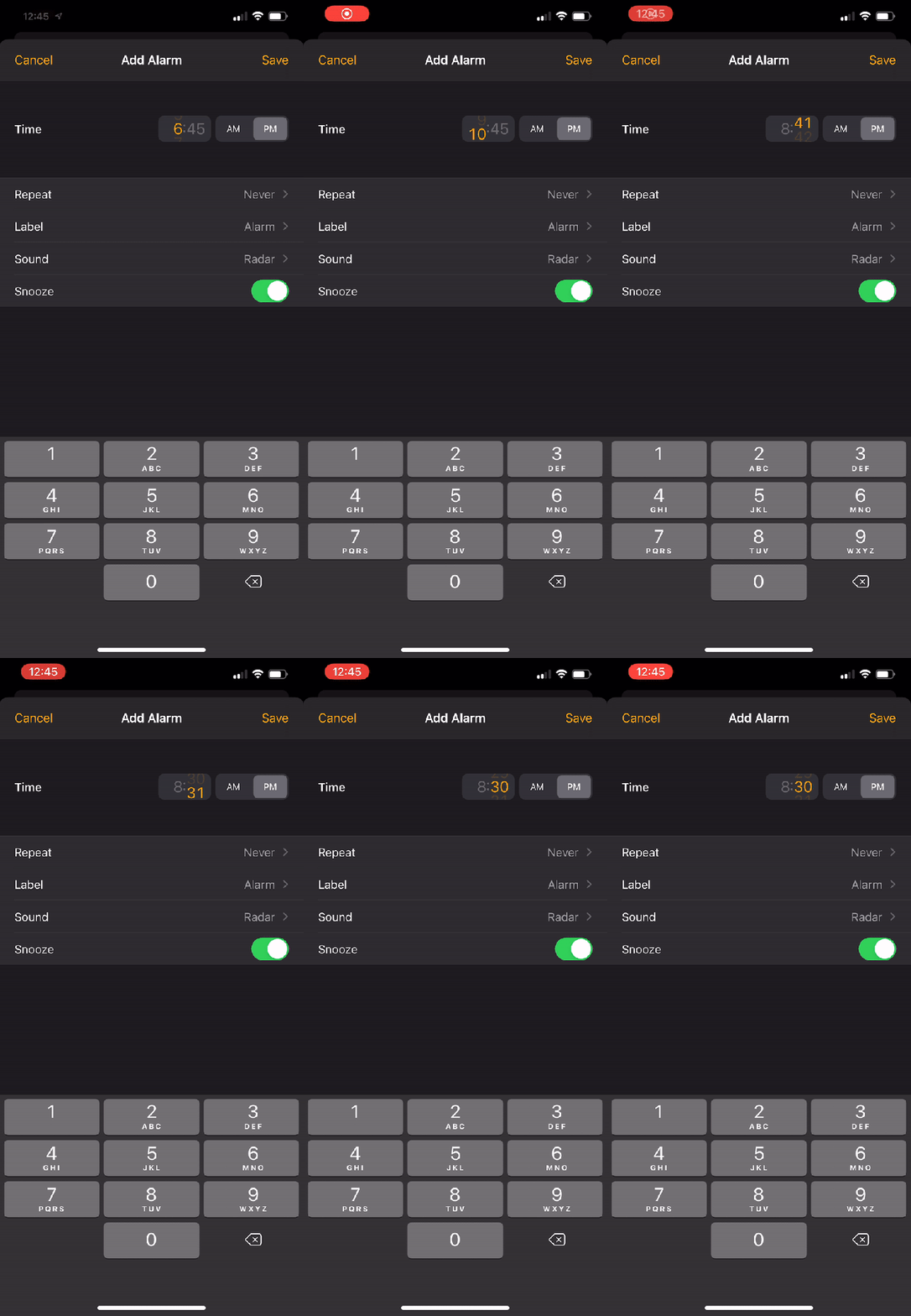
One of the changes introduced in iOS 14 is the new time picker that ditches the iconic scrolling wheel. iOS 14 beta 5 brings the wheel back…kind of. Here’s how it looks in action:
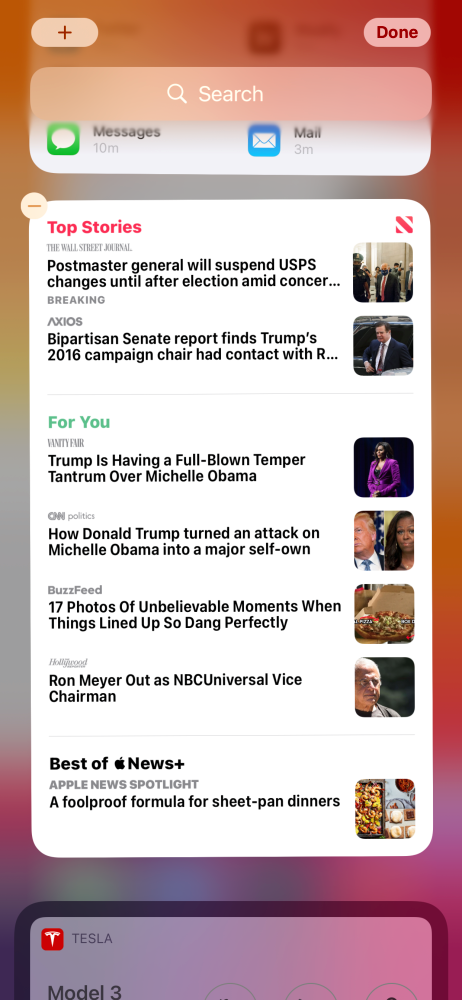
There is also a new “Tall” widget for Apple News in iOS 14 beta 5. This widget is exclusively for the “Today” screen on the far-left of iOS or iPadOS. It can’t be added to your home screen. This widget increases the number of Apple News widgets to seven and it headlines for Top Stories, For You, and Best of Apple News+.
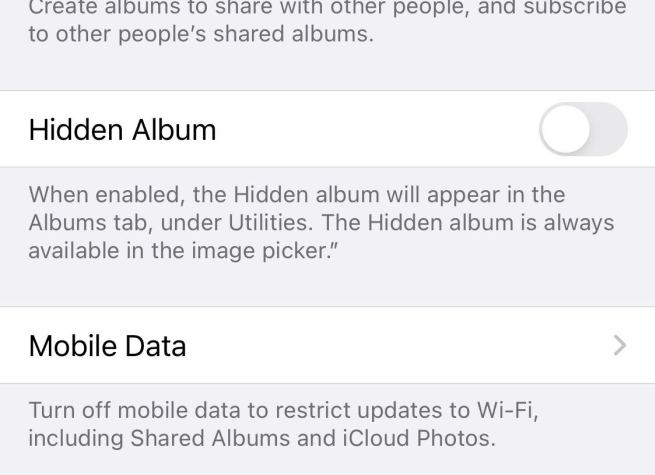
In the Settings app, you can now disable the Hidden Album in the Photos app. Open Settings, scroll down to Photos, and look for “Hidden Album.”
Apple says: “When enabled, the Hidden album will appear in the Albums tab, under Utilities. The Hidden album is always available in the image picker.”
New “Availability Alerts” for COVID-19 Exposure Notifications
Apple says: “Receive a notification if Exposure Notifications are available in your current region. Your region is determined by your iPhone and does not leave your device.”
New on-boarding process for COVID-19 Exposure Notifications in the Settings app:
New App Clip testing options for developers in Settings
New location access request for widgets:
Shortcuts app has a new “What’s new?” splash screen upon first launch:
Widgets are now blocked when a parent app is blocked with Screen Time
Among the more modest tweaks to the iPhone’s UI with iOS 14 is a redesigned Clock app. While it is nice to see the rotating dial replaced with a more efficient number pad, there are some confusing aspects to the new interface. Read along for how to use the new iPhone alarms in iOS 14 and where the Bedtime tab has moved.
The Clock app on iPhone with iOS 14 is simpler in some ways but also a bit counterintuitive in others. Below we’ll look at how to best use iPhone alarms as well where the Bedtime tab now lives and more.
Note: iOS 14 and iPadOS 14 are available as free public betas as well as developer betas for iPhone and iPad.
How to use new iPhone alarms in iOS 14
Open the Clock app
Tap the Alarm tab at the bottom
Tap the orange “+” icon in the top right corner or hit Edit in the top left corner and tap an existing one to modify it
Use the number keypad at the bottom of the screen to enter your full alarm time (don’t tap the small orange time near the top, if you do, you’ll just be editing the hour)
You can leave out the 0 for hours between 1-9 (e.g. type 730 instead of 0730)
Don’t forget to check the AM/PM toggle (light gray box signals what is selected)
One way to opt-out of the interface is to use Siri to set your alarms
Here’s how the new UI looks and works with some more details and tips:
After you tap to add a new alarm or edit an existing one, make sure to start with the on-screen number keypad at the bottom.
Don’t forget to check the AM/PM toggle. Unfortunately, it defaults to whatever the current time is. So if you’re adding or editing alarms 12 PM or later, make sure to switch it to AM for morning alarms.
What happens when you tap the orange time
The new UI becomes confusing if you start by tapping the orange alarm time at the top of the edit/new alarm screen as it selects just the hour to be editable or just the minutes as shown below. That leads to a counterintuitive and clunky experience.
However, with the default that displays the entire time in orange (showing the current time) you can use the number pad at the bottom of your screen to quickly enter the hour and minutes for your alarm. So make sure to head straight for the number pad at the bottom.
Where’s the Bedtime tab?
You probably also noticed that the Bedtime tab that used to be in the clock app is gone. You’ll still see the Sleep | Wake Up alarm that is scheduled in the Alarm tab of the clock app but you’ll find that what used to be the Bedtime settings now live in the Health app.
Here’s what it looks like to edit your sleep schedule in iOS 14:
Have you spotted this comet that’s been making headlines this month? If you’re in the northern hemisphere and want to catch the photogenic comet in the night sky before it disappears, read on as we explain the best way to hunt down NEOWISE with your iPhone.
NASA describes the comet as a “fuzzy star with a bit of a tail” so you have an idea of what to chase.
For those hoping to catch a glimpse of Comet NEOWISE before it’s gone, there are several observing opportunities over the coming days when it will become increasingly visible shortly after sunset in the northwest sky. If you’re looking at the sky without the help of observation tools, Comet NEOWISE will likely look like a fuzzy star with a bit of a tail, so using binoculars or a small telescope is recommended to get the best views of this object.
Have an iPhone 11 or iPhone 11 Pro? You may also try your luck at capturing the comet using Night Mode on iPhone 11. Just hold your phone firmly or use a tripod for best results, and don’t expect professional results like those produced by multiple images stacked from astronomical photographers. An iPhone shot still makes for a neat souvenir, of course!
What’s NEOWISE?
Comets are icy bodies from deep in the Solar System that create a trail called a coma when they near the Sun. This is caused when the comet warms and gasses are released in what’s called an outgassing phase.
Comet C/2020 F3 was discovered on March 27 through infrared images from the Near-Earth Object Wide-field Infrared Survey Explorer telescope, thus its common name NEOWISE.
The NEOWISE project was founded by NASA’s Planetary Science Division to measure and catalog asteroids and comets. Over 980,000 infrared measurements of 37,009 solar system objects have been made so far — and now the C/2020 F3 comet is one of them.
Observers in the Northern Hemisphere have been able to see the NEOWISE comet with the naked eye this month, and you still have a chance to see it if you can find a clear night sky.
With the help of neowise.whatsupin.space, an online resource developed by Tony Rice, you can enter your city or ZIP code to find the right range of hours when the the NEOWISE comet will be visible in the sky. The tool shows upcoming days and the estimated local times when the C/2020 F3 comet can best be seen.
Comet NEOWISE is seen, upper left, before sunrise over Washington, Sunday, July 12, 2020. Source: NASA
iPhone apps
There are also fantastic iPhone apps that can guide you to find the comet using location and augmented reality to show you where to look. These apps have topped the free and paid App Store charts because of NEOWISE.
Other high-ranking apps climbing the charts because of the the C/2020 F3 comet include Stellarium PLUS (#13) for viewing a realistic night sky and NightCap Camera (#14) for night photography on the iPhone.
Weather apps including Dark Sky (recently acquired by Apple) are also useful for determining weather conditions before heading out to a viewing site with a clear view of the sky.
Source: NASA
Viewing tips
NASA has also shared recommendations for those who want to see the Comet NEOWISE before disappears for 6,800 years. This includes finding a location away from lights and looking to the northwest sky:
Find a spot away from city lights with an unobstructed view of the sky
Just after sunset, look below the Big Dipper in the northwest sky
If you have them, bring binoculars or a small telescope to get the best views of this dazzling display
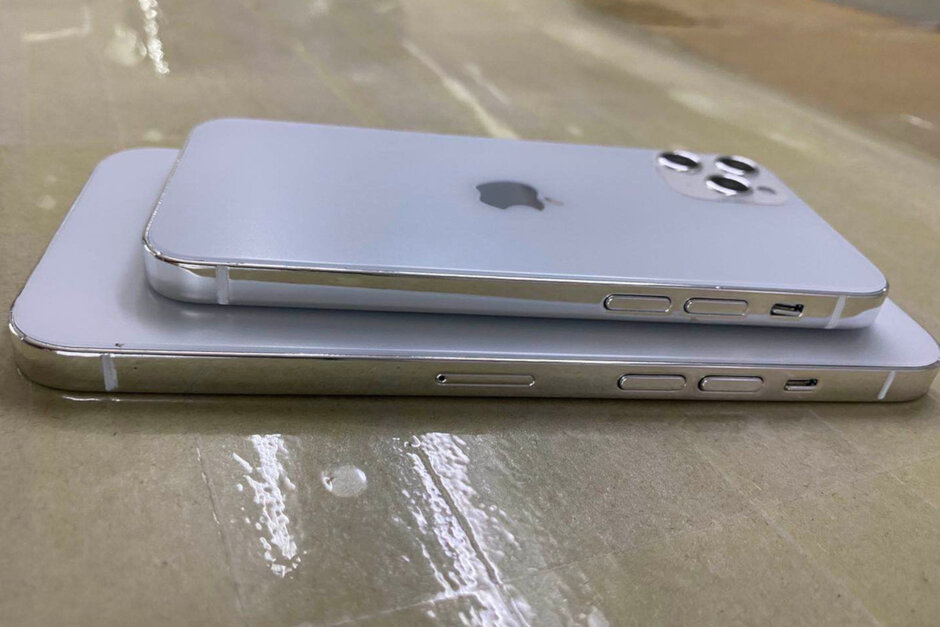
When you think of Apple iPhone dummies, you think of Sonny Dickson. The Australian burst onto the scene as a teen back in 2013 sharing images of iPhone 5s and iPhone 5c mock-up units and has passed along reliable information since. Today, Dickson tweeted the first dummy models of the three iPhone 12 screen sizes (5.4-inches, 6.1-inches, and 6.7-inches). Of course, we still expect Apple to launch four 5G phones in September including the iPhone 12, iPhone 12 Plus, iPhone 12 Pro, and iPhone 12 Pro Max. We get four phones out of three screen sizes because the iPhone 12 Plus and iPhone 12 Pro will both have 6.1-inch displays. The difference between the two will probably be the camera setups and perhaps a larger battery, more memory, and a better battery life on the iPhone 12 Pro.
Dickson’s iPhone 12 dummies “confirm” the throwback design for the iPhone 12 series
The dummies show off the flat sides that the new iPhones will reportedly sport giving the 2020 models a throwback look that resembles the iPhone 4. With the edge-to-edge screen and the notch, the iPhone 12 line will have a higher screen-to-body ratio than the iPhone 4 giving the upcoming handsets a sleeker and more modern look. We should point out that Dickson himself isn’t 100% sure about the rear cameras and the size and look of the notch, but is confident about the chassis of the dummy models
Apple iPhone 12 series dummy models tweeted by Sonny Dickson
WWDC 2020 is about to kick off in less than 24 hours and while Apple is expected to make big waves this week, the iPhones that some might be waiting for are still months away. Of course, if Apple is to meet its self-imposed deadlines, the design of its first batch of 5G iPhones should now be set in stone. Or in this case, metal and plastic models that will give accessory makers as well as the public a preview of what to expect come September’s event.
We’ve already seen the molds that would be used to print out dummy models and now we’re seeing those dummies courtesy of Sonny Dickson. The leaker warns that the notches (not seen here) and cameras might not be their final design which is probably not relevant for these dummies anyway. The molds, after all, are used to inform case makers about the external design of the phone.
To that extent, the chassis that we’re seeing now may be close to final, including the size and shape of the camera bumps which are thankfully still not obscenely thick. The dummies also give the three sizes of the four phones (two 6.1-inch models in the middle) to get a better idea of how they will compare with each other, at least by their appearance.
The locations of the buttons and holes at the very flat edges should also be final, given those are critical parts of a case’s design. The show the volume rocker buttons on the same left (facing the screen) edge as the ringer switch and SIM card tray on the larger iPhone 12 while the opposite edge gets the lone power button. Curiously, there is also another indentation on that side on the 6.7-inch iPhone, perhaps for the mmWave 5G antenna that’s unique to it.
That leaves just the question of the cameras, which some point out are depicted wrong in dummies. Only the largest of the four iPhones is expected to have three cameras, though it isn’t yet certain whether it will indeed be a LIDAR sensor similar to this year’s iPad Pro.
All four phones should be powered by the 5nm A14 Bionic chipset with 15 billion transistors in each chip. The A13 Bionic, the component currently used by Apple on the iPhone 11 series, is produced by TSMC using its 7nm process and contains 8.5 billion transistors. The more transistors inside a chip, the more powerful and energy-efficient they are. The two Pro models should feature the ProMotion display with a 120Hz refresh rate. This means that the screen will update 120 times in a second delivering smoother scrolling and enhanced video game animation.
The Pro models are also believed to come with 50% more memory (6GB of LPDDR5 RAM) than the standard handsets and for the first time, the basic configuration of the iPhone will include 128GB of storage. Rumors pertaining to the rear cameras have been unsettled with some tipsters calling for the inclusion of the time-of-flight based LiDAR depth sensor on all four phones. Others point to a recently leaked CAD image to prove that only the iPhone 12 Pro Max will offer the additional sensor. Introduced on the 2020 iPad Pro tablets, the LiDAR sensor computes the time it takes for an infrared beam to bounce off the subject and return to the sensor. Armed with this data, the sensor can offer users enhanced AR capabilities and improved bokeh blurs on portrait shots.
The new iPhones will supposedly feature the Qualcomm Snapdragon X60 5G modem; the chip supports both sub-6GHz and mmWave 5G signals. However, some analysts believe that only the Pro models will work with the faster 5G mmWave signals. This means that T-Mobile subscribers who want a 5G iPhone this year might be limited to buying the lower-priced standard models. That’s because only a small part of T-Mobile’s 5G network is using mmWave spectrum at this time. And only a small part of the country can use Verizon’s 5G network right now. While there will always be consumers who have to own the latest and greatest iPhone models, and faster 5G speeds are impressive, not too many 5G iPhone users will get the opportunity to download a video in the blink of an eye this year.
The combination of 5G and the ProMotion 120Hz refresh rate is sure to be a battery killer. Apple will reportedly hike the battery capacities on the 2020 iPhones with the iPhone 12 Pro Max rumored to sport a 4400mAh battery. That would be a 10.8% hike over the battery in the iPhone 11 Pro Max; the latter has already delighted users with its remarkable longevity.
Whether you want to take advantage of the 0% interest offers for iPhone, iPad, Mac, and more or have been wanting to get Apple’s credit card for while for another reason, follow along for how to apply for Apple Card on iPhone and iPad.
Apple Card offers a variety of compelling features like its Daily Cash program, strong focus on security and privacy, no fees, a clean, optional Titanium physical card, and a great software experience to track spending and more on iPhone.
While Apple has offered free iPhone financing to Apple Card users for some time, a new addition is the ability to get 0% interest financing for iPad, Mac, AirPods, and more. The interest-free period ranges from 6-12 months depending on the product you’re buying. There’s also a $50 sign up bonus promotion through 7/31/2020.
Here are some of the requirements for Apple Card eligibility:
Be 18 years or older, depending on where you live
Be a U.S. citizen or a lawful U.S. resident with a valid, physical U.S. address that is not a P.O. Box. You can also use a military address
Have a compatible iPhone with the latest iOS version (iPhone 6 or later)
Using two-factor authentication with your Apple ID and be signed in to iCloud with your Apple ID
Apple works with Goldman Sachs to provide the financial end of Apple Card.
How to apply for Apple Card on iPhone and iPad
On iPhone open the Wallet app (on iPad head to Settings > Wallet & Apple Pay > Add Card)
You might see an offer at the top to apply for Apple Card (if not tap the + icon in the top right corner)
Choose Apply for Apple Card
Read the terms and conditions, tap Continue
Confirm your Apple ID, name, date of birth, and phone number, tap Next
Enter your address (no P.O. boxes)
Enter the last four digits of your social security number
Enter your total annual income (required by Goldman Sachs)
Agree to the terms and conditions
It will just take a few moments and you’ll see if you’re immediately approved or not
In some cases, Apple/Goldman Sachs may ask for you to share a photo of your driver’s license or State ID.
Here’s how the process looks:
Once your application is submitted, you should see a screen that lets you know if you’re approved or not. Check out our previous hands-on coverage of using Apple Card, tracking spending, and more with iPhone, iPad, and Apple Watch.