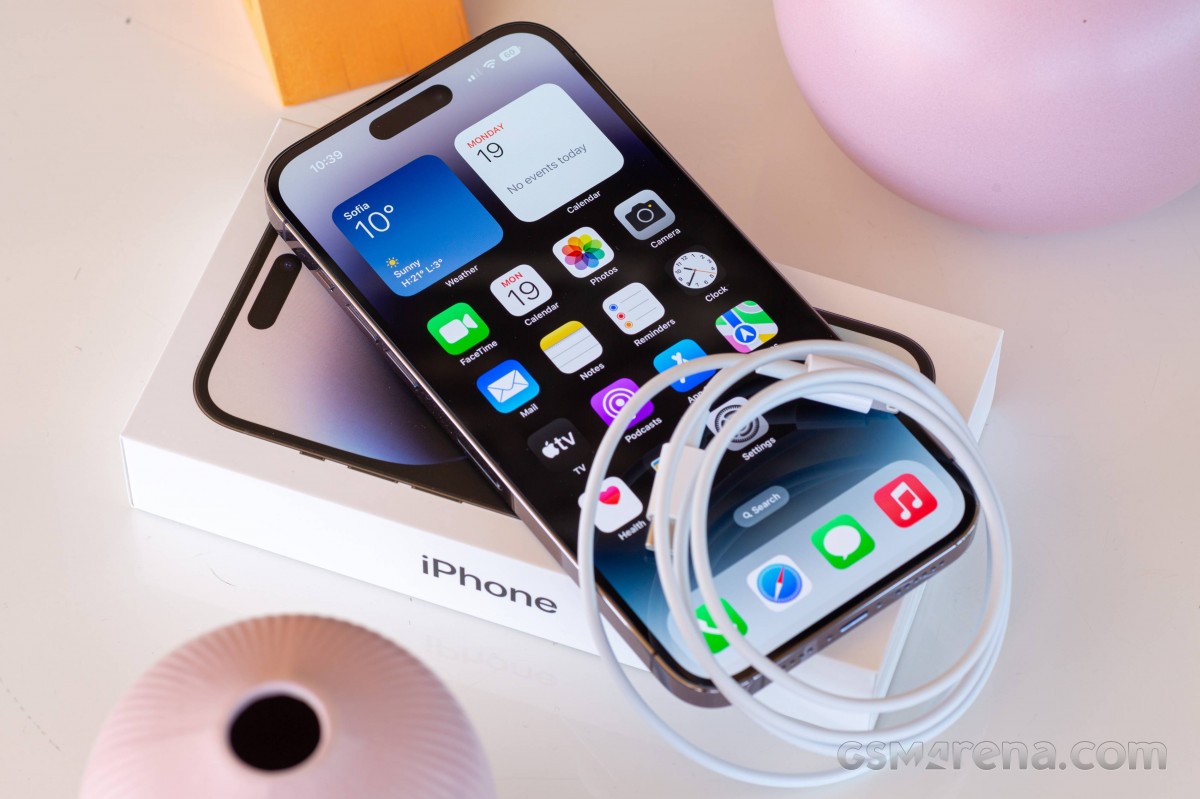
Apple has officially released iOS 17.5 to the general public. The update brings a handful of new features and changes for iPhone users. Head below for everything we know right now.
iOS 17.5 is now available
iOS 17.5 is now available to the public. You can head to the Settings app on your device, then choose General, then Software Update to install the update.
What’s new in iOS 17.5?
While iOS 17.5 isn’t quite as big of an update as other iOS 17 updates, it still includes its fair share of new features and updates.
Web Distribution in the EU
Within the European Union, the latest iOS 17.5 update introduces the capability to install applications directly from a developer’s website. Apple unveiled this new “Web Distribution” feature last month, explaining that it allows developers to distribute their iOS apps straight from their own websites.
To utilize this functionality, developers must opt into the updated App Store business terms, which requires paying a Core Technology Fee of €0.50 for every first annual installation exceeding one million in the preceding 12 months.
Any application disseminated through the web will still need to adhere to Apple’s notarization guidelines. Apps can only be installed from a website domain that the developer has registered in App Store Connect. Apple will also provide a range of APIs for developers to integrate with system functionality.
New Quartiles game for Apple News+
In the Apple News app, Apple News+ subscribers in the United States and Canada will find a new “Quartiles” word game after updating to iOS 17.5. The game prompts players to select from a grid of tiles to form words.
Quartiles is the third game to come to Apple News+, following the addition of daily crossword and crossword mini-games that were added last year.
iOS 17.5 also adds Game Center integration to all three of the Apple News+ games. With this feature, you can now see leaderboards for each of the three games for Daily Solve Time and Daily Score stats.
Apple News offline
Also for Apple News+ subscribers, iOS 17.5 introduces a new “Offline Mode.” This feature “makes it easy to access the hundreds of magazines, newspapers, narrated articles, and more included in a News+ subscription — no matter where you are,” according to Apple.
Apple News+ subscribers can now enjoy Offline Mode on iPhone and iPad to automatically download Top Stories, Apple News Today audio briefings, full magazine issues and narrated articles from News+ publishers, and puzzles to access later, without Wi-Fi or a cellular connection. When the device is back online, downloaded content will automatically refresh, and downloads will be optimized to maximize space on the device.
Design changes
iOS 17.5 also includes a few small design changes that are worth pointing out:
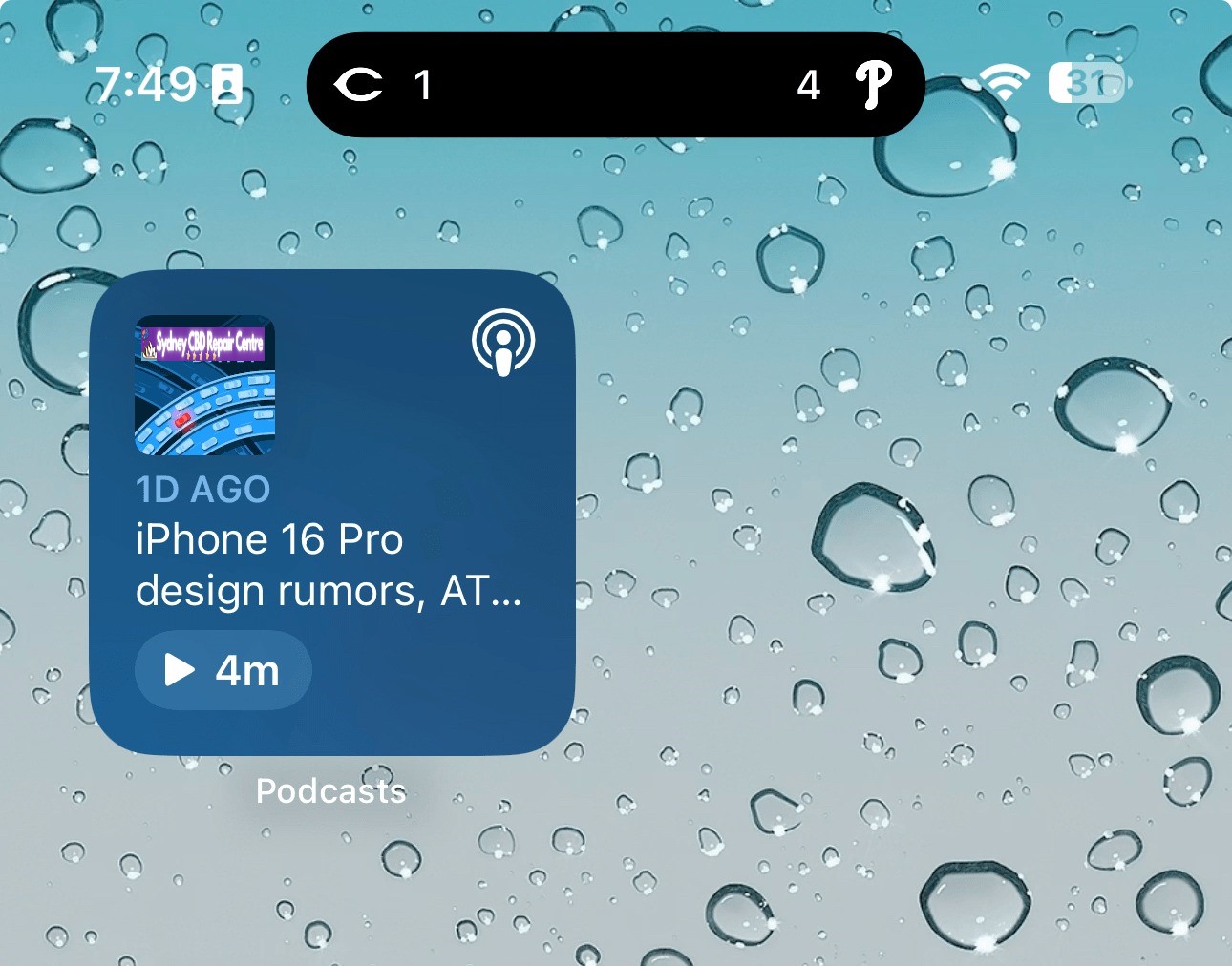
The Podcasts widget has been updated to have a new dynamic color that changes based on the artwork of the podcast you’re currently playing.
In the Apple Books app, Apple has redesigned the “Reading Goal” icon in top navigation bar.
In the Settings app, there is a new glyph for the “Passkeys Access for Web Browsers” menu under “Privacy & Security.”
New Pride wallpaper
iOS 17.5 also includes a new Pride Collection of wallpapers for iPhone and iPad users, as is tradition. The new dynamic wallpapers come as part of Apple’s goal to “champion global movements to protect and advance equality for LGBTQ+ communities.”
As explained by Apple, iOS 17.5 includes a new system centered around anti-stalking capabilities for accessories like AirTags. This development follows Apple’s announcement last year of a partnership with Google to collaborate on a new “industry specification to combat unwanted tracking.”
Strings added to the Find My app reveal that iOS will be able to identify tracking accessories, even those that are not Apple or Find My certified, and assist users in disabling them.
One of the new strings states, “This item lacks certification on the Apple Find My network. You have the option to disable this item and prevent it from sharing its location with the owner. To proceed, follow the instructions provided on a website by the manufacturer of this item.”
These changes come as Google started rolling out its new Find My Device network for Android on April 8.
New ‘Repair State’
Also in iOS 17.5, Apple has added a new “Repair State” feature to Find My. This feature lets users confirm with their Apple ID and password that they’re about to send their iPhone in for a repair. As a result, Apple technicians can confirm that the person owns the iPhone and then proceed with the repair without the need to turn off Stolen Device Protection and Find My.
Essentially, this ensures that users can still track their device using Find My while it’s being repaired. Previous, Apple required users to disabled Find My altogether.
iOS 17.5’s security fixes
Finally, in addition to all the new features and changes, iOS 17.5 also includes 15 notable security patches for iPhone users. Notably, none of the 15 vulnerabilities were reported as previously exploited.
You can find the full list of these changes in our dedicated coverage. Even if none of the new features in iOS 17.5 are tempting for you, we recommend updating as soon as possible for those security fixes.
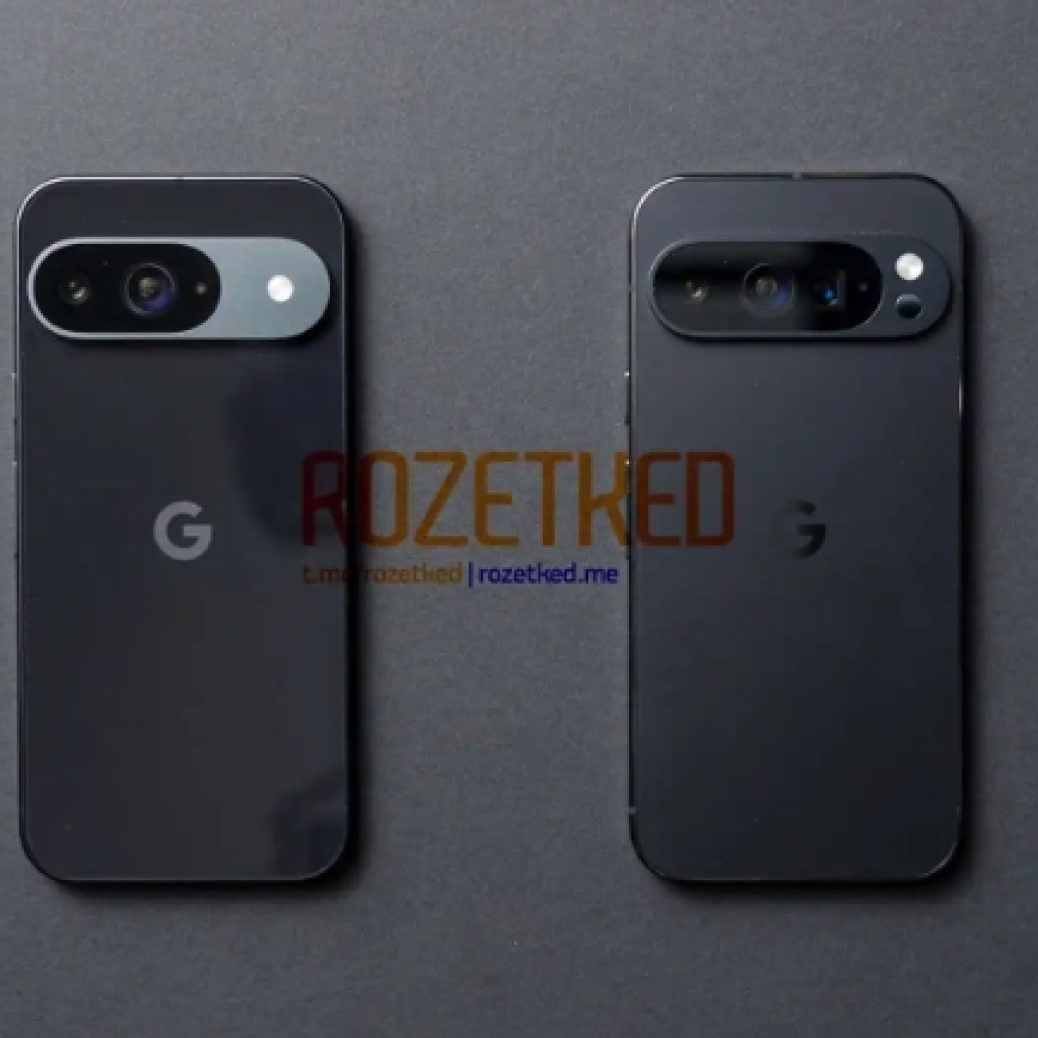
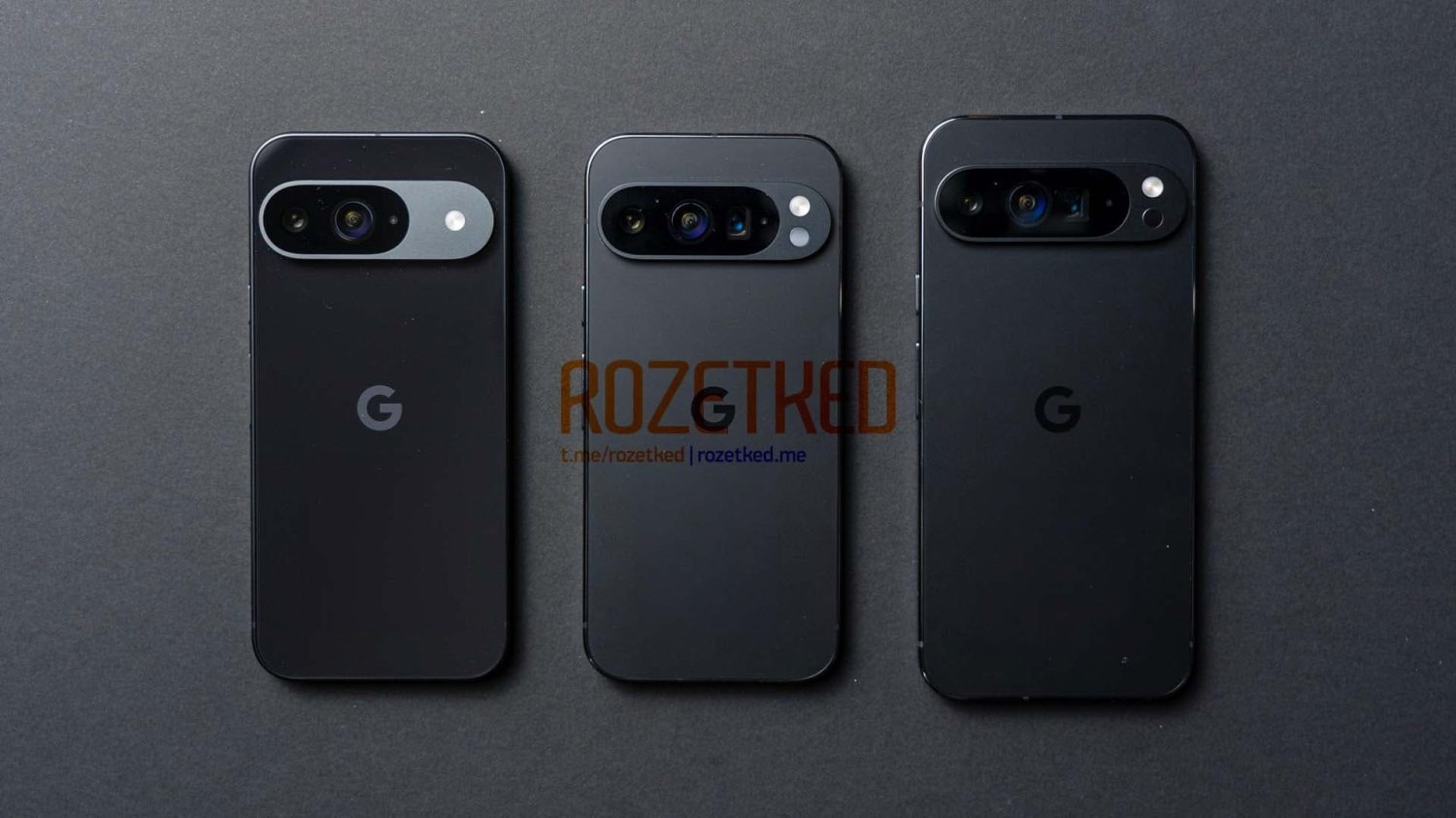
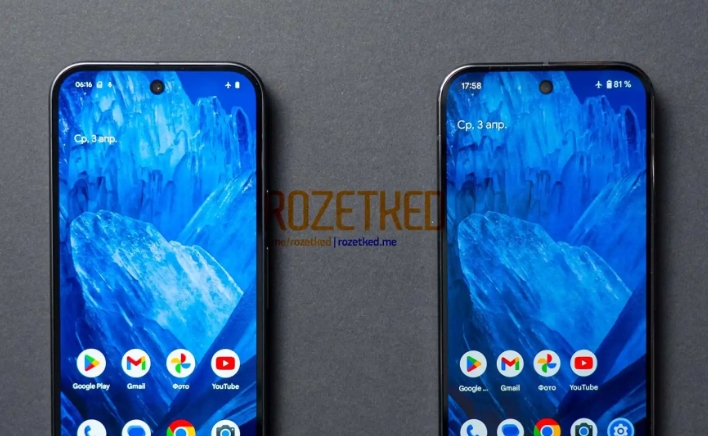
Following the 6.1-inch model in mid-April, real-life images of the Pixel 9 and Pixel 9 Pro XL have now emerged in a leak. In the cover image above, you see the Pixel 9, 9 Pro, and 9 Pro XL side-by-side, with those names not confirmed.
In images shared by Rozetked today, we see the Pixel 9 Pro XL — codenamed “Komodo” — with 16GB of RAM (like the smaller 9 Pro), 128GB of storage, and a 6.73-inch display. These hardware specs are coming from the AIDA64 app running on the devices.
On the camera front, all three lenses on the Pixel 9 Pro and Pro XL are said to come in at 50MP with 0.5x, 1x, and 5x zoom. Design-wise, it’s just a larger Pixel 9 Pro.
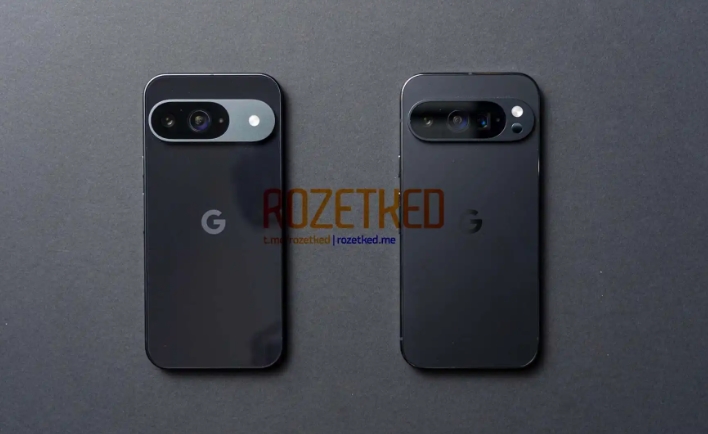
Then there’s the Pixel 9 (“Tokay”) with 12GB of RAM (like on the current 8 Pro) and 128 GB of storage. The dual cameras offer 0.5x and 1x zoom. The Pixel 9 and 9 Pro are said to be identical in size, but the entry model with a 6.24-inch screen has larger bezels than the 6.34-inch Pro, though all three devices have a 120Hz refresh rate.
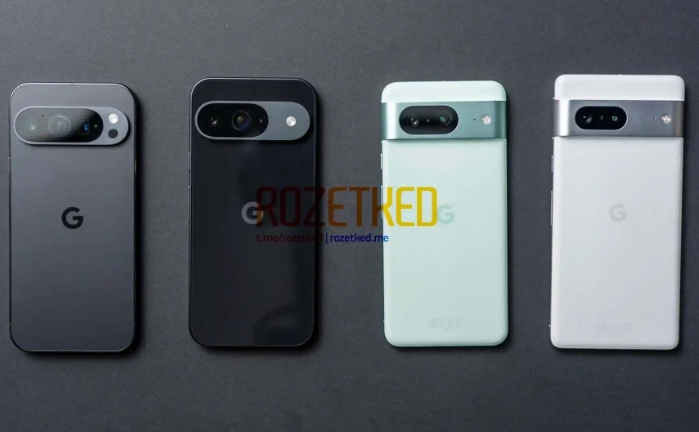
The last image in the gallery above shows the Pixel 9 Pro, Pixel 9, Pixel 8 and Pixel 7. Both Pixel 9 models are larger than the 8, with Rozetked noting how it’s closer to the Pixel 7.
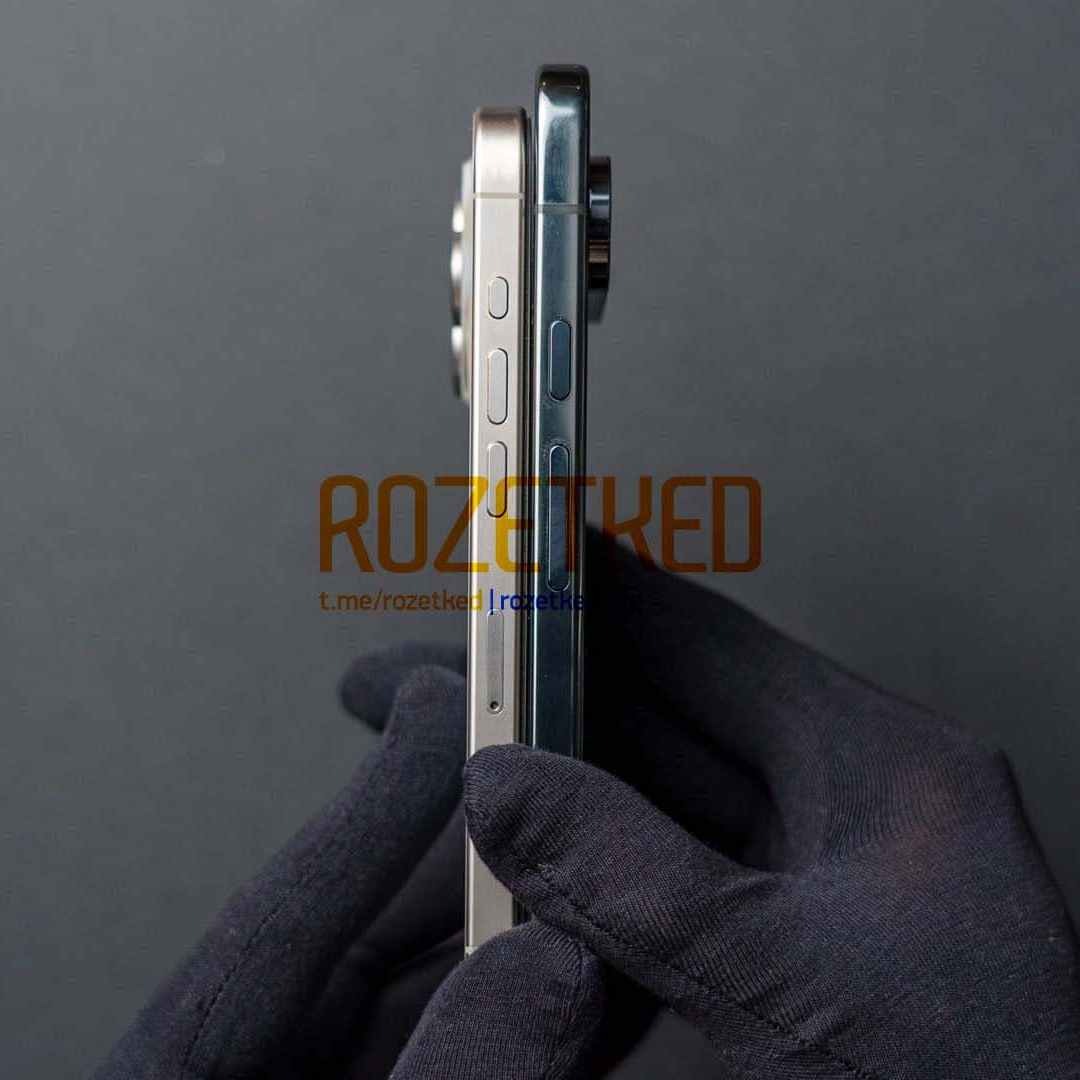
Only the two Pro phones have Ultra Wideband (UWB), as well as a matte back paired with a polished frame that looks smudged up in the image below (where it’s compared to an iPhone 15 Pro). The Pixel 9 is the reverse with a glassy rear but matte frames for a stark difference, at least in these shots. (It reminds me of the Pixel 7 series.)
All three phones are running the same chip, which will presumably be called the Tensor G4.
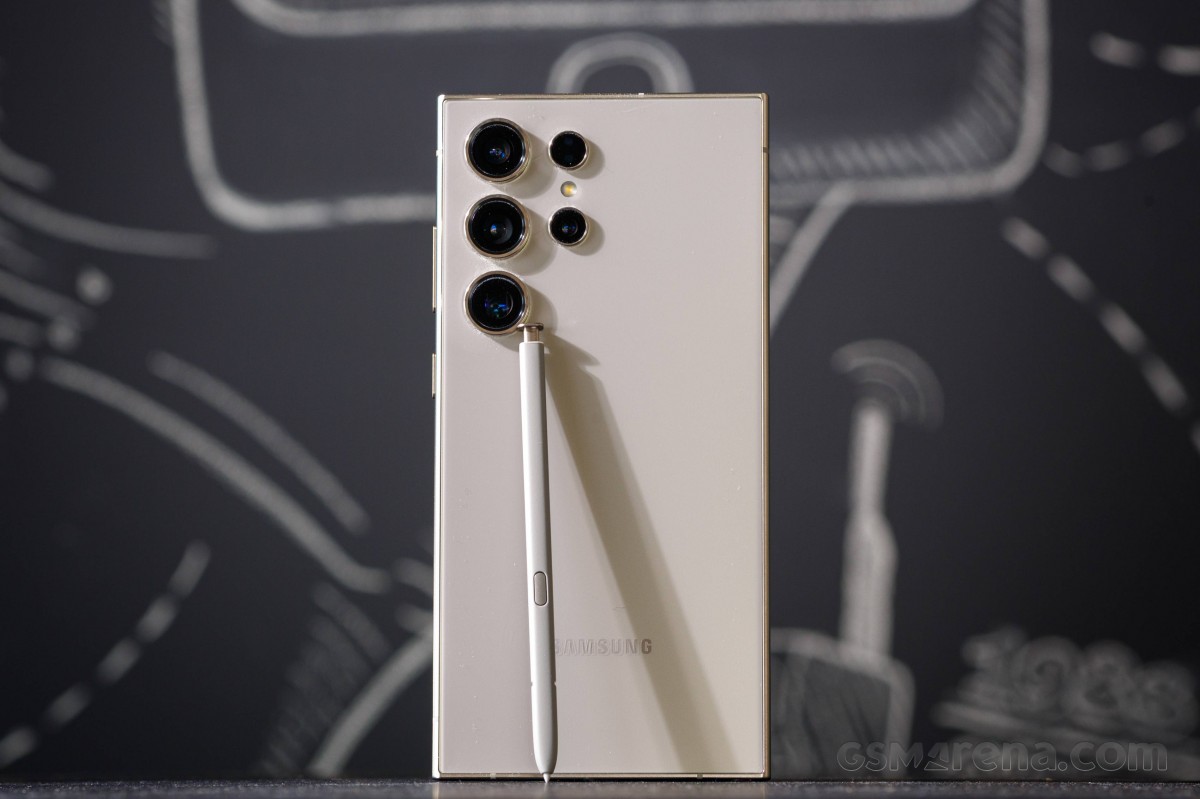
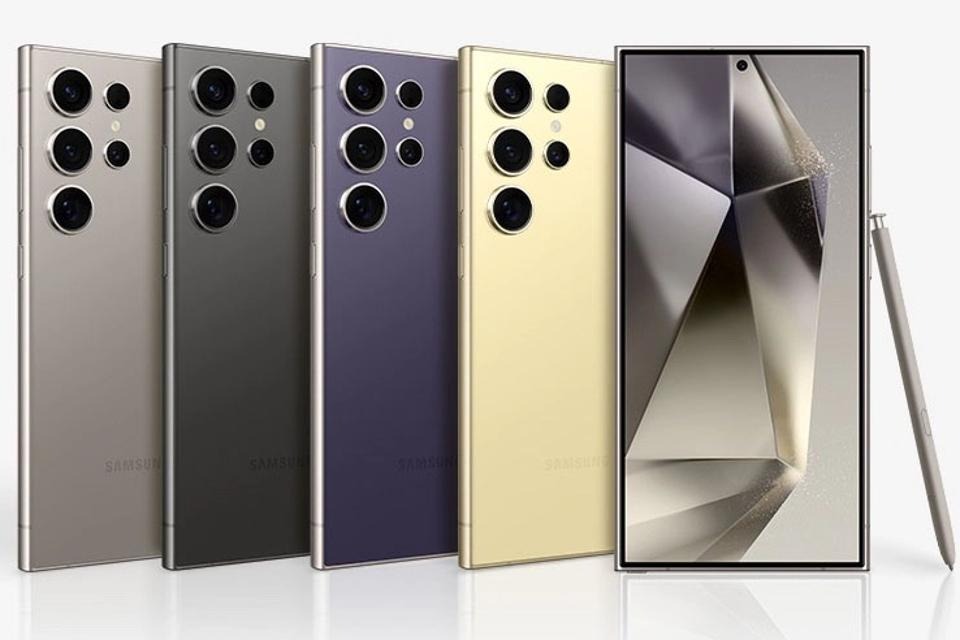
You look at the Galaxy S24 and S24+ and can’t help but wonder if they really are the new models, or Samsung just went and reissued the old ones. The Ultra, on the other hand, is a different beast. The Galaxy S24 Ultra does make some significant strides towards improving on what was already the ultimate smartphone package.
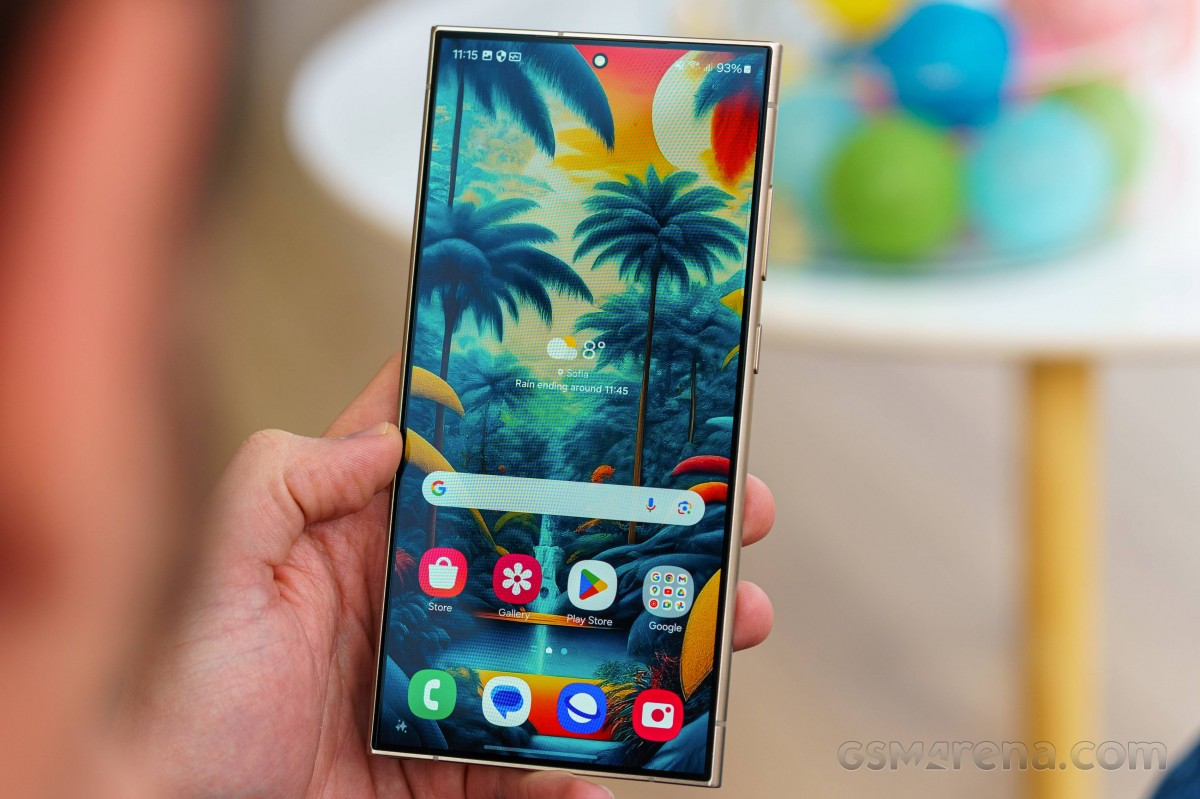
Some of the changes are immediately visible and start with the even blockier design with a fully flat face and the less reflective display glass. You won’t immediately tell, but that glass should also be tougher, and as months go by, you’ll perhaps appreciate the switch to titanium for the exposed frame, too.
An even less obvious development, but one that has potential to be a major step in solidifying the Galaxy Ultra’s position as a top cameraphone, is the new 5x zoom telephoto. Undoubtedly better at 5x than the old model, can it be as good at 10x?
The Ultra won’t partake in the chipset divide that’s now returned to the lesser models, and all of the ultimate Galaxies will feature a Snapdragon 8 Gen 3 – no Exynos here if that makes any difference. Sure enough, the S24 Ultra will have all the AI smarts Samsung and Google came up with to fill an hour of Unpacked 2024.
Unchanged is the battery capacity on this year’s model, and so too is the maximum charging rating, for better or for worse. No change can be a good thing too, and the S Pen remains another differentiator that elevates the Galaxy Ultra above all others when it comes to productivity and just general usefulness (it’s the best camera remote is what it is).
You can have another look at the key specs below, before we proceed to get our hands on the Ultra, at long last.
Disclaimer. We can not guarantee that the information on this page is 100% correct.
Samsung Galaxy S24 Ultra unboxing
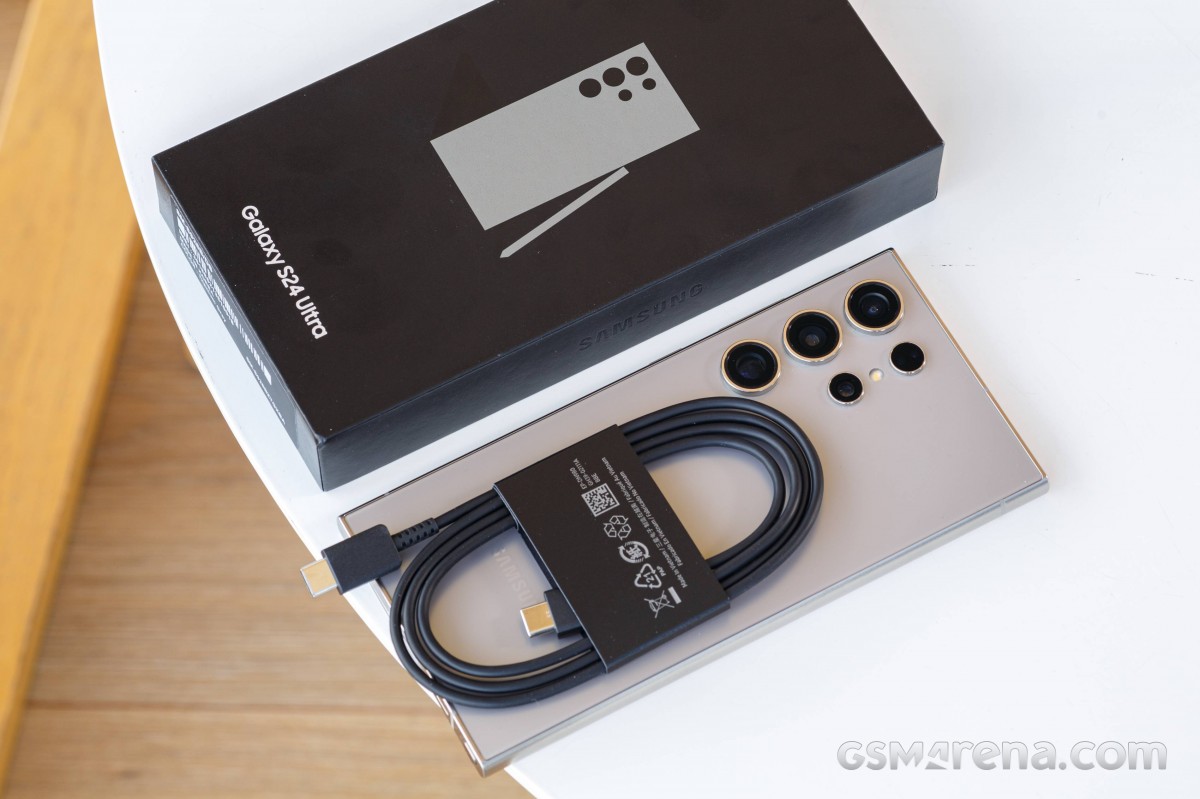
Another uneventful unboxing experience awaits, but it’s not like the slimline box is making any promises. A SIM eject pin is still included, though a line in the instructions that says ‘use a paper clip or an earring’ could be replacing that in the near future. That, or eSIMs.
The other thing of any practical use inside the box is a USB-C cable, but it’s only good for 3A of current, and that may not be enough to get the promised 45W of charging. We might have a rant on that subject later on in the review.
Competition
The Galaxy S24 Ultra’s ultimate smartphone status can only be threatened by similarly uncompromising offerings, though some allowances can be made given the right reasoning. First things first, though, and we reckon there’s some in-brand competition that you must sift through before looking outside the Galaxy.
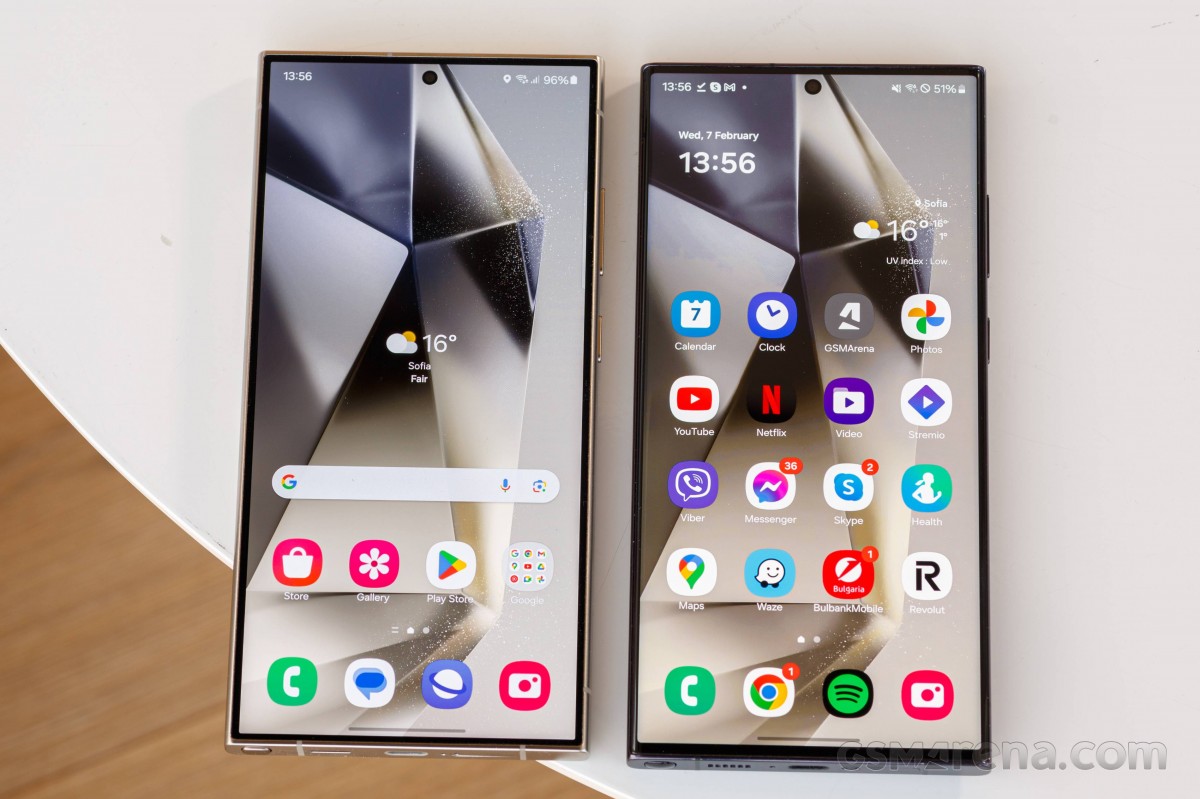
Galaxy S24 Ultra (left) next to Galaxy S23 Ultra
The most obvious alternative is the previous generation – opting for that one has the potential to save you roughly 20-30% depending on locale, possibly even more given the right combination of research and luck. You’d be missing out on the less reflective display, the overall improved build, and the latest camera advancements. But the old cameras are still plenty capable, battery life and charging are similar, the last-gen Snapdragon has many good years left in it, and the S Pen is the same. We’d always pick the latest one, but a more reasonable person can see the value in the 2023 model.
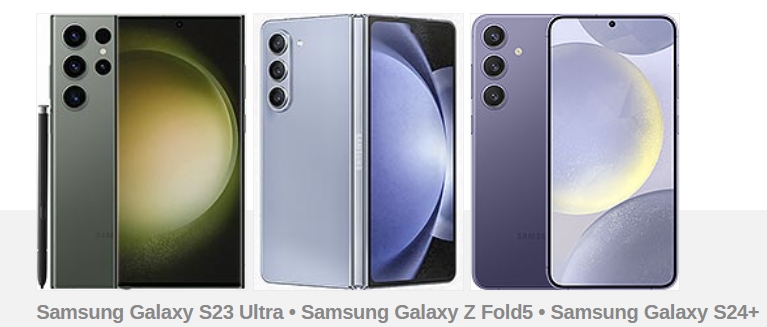
Another one from last year, but not to be replaced any time soon, the Z Fold5 can challenge the Ultra for productivity, particularly if you grab the optional S Pen with one of those nice cases that let you carry it around everywhere. The price difference goes the other way here and you’ll be paying more for the Fold pretty much everywhere in the world, and you’ll be getting a notably inferior camera system in the process. But the utility of the 7.6-inch canvas may very well be worth it all.
On the other hand, if you ended up seven pages into a Galaxy S24 Ultra review simply looking for a large-screen regular Samsung smartphone, perhaps the S24+ is your answer. This one runs for S23 Ultra money or a little more, throwing you into yet another galactic dilemma. That could be resolved with a trip to our S24+ review, but basically if you want the latest chipset, AI smarts and unrivaled update policy, and don’t care for the greatest cameras or a stylus, the S24+ is worth a look.
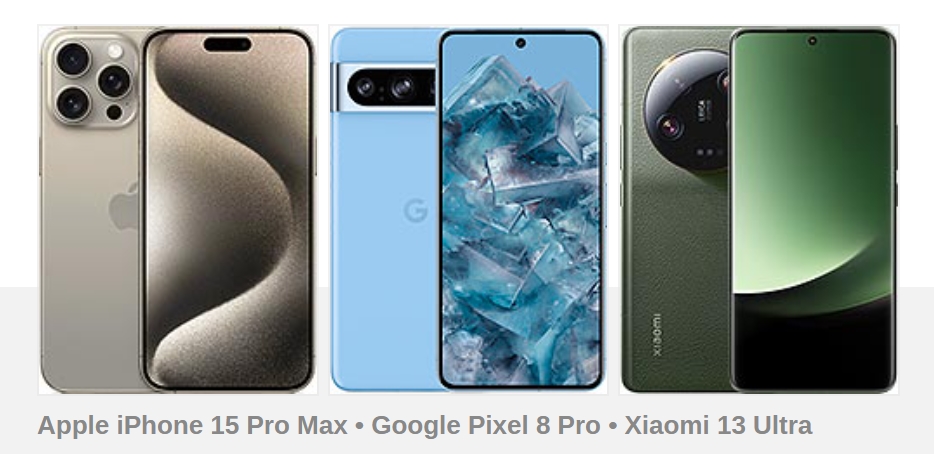
Let’s say you’ve dismissed all those and are willing to explore other avenues. The iPhone 15 Pro Max is one such alternative route, which is somehow cheaper in the US and more expensive everywhere else. The ecosystem pros and cons aren’t for us to decide for you, but the iPhone just may have one objective advantage in endurance. The S24 Ultra is likely the superior cameraphone and it’s hard to argue with the S Pen and DeX support for work and play.
If you’re in it for the Google AI smarts and the long-term support, what better option than the Google phone itself, the Pixel 8 Pro? The Pixel is no match for the Galaxy’s battery life, nor can it charge as fast, and despite the general inclination for #teampixel camera fandom, the Galaxy is quite probably the superior cameraphone. But you can have a base 128GB Pixel 8 Pro for two-thirds of the price of an Ultra, and even for matched storage, there will be considerable savings.
A less obvious option and one with considerable camera prowess that outspecs the Galaxy S24 Ultra is another Ultra – the Xiaomi 13 Ultra. Technically, an international version is in existence, but tracking one down might be tricky. With four 50MP rear cameras, among them a 1-inch sensor dual aperture lens primary unit and a properly large ultrawide, the Xiaomi has hardware that can make the Galaxy’s setup look upper midrange, almost. No S Pen though. Somewhat iffy battery life and last year’s chipset. But really, it’s the availability that’s the main issue.
Verdict
The Galaxy S24 Ultra surprised us – we didn’t expect it to have any flaws, and suddenly, we have a cons section. With a list in it. Indeed, most perplexing is the fact that Samsung has produced a display that is anything less than perfect. Of course, it’s not that bad, and its shortcomings are minuscule or will be addressed later in software. But that’s not what we’d expect from Samsung’s ultimate smartphone.
Continually irritating is Samsung’s lack of initiative in the charging department, and no amount of new 45W adapters is seemingly going to bring truly fast top-ups. This one we did expect, but it doesn’t mean we like it any better.
Perhaps an overworked software team with unrealistic deadlines brought us some peculiarities in the new camera’s zoom action. We’ve heard that it happens and such oversights get fixed as weeks go by. We just didn’t think that happens to Galaxies.
But rereading the above for some perspective, we also realize that while imperfect to a certain level, the Galaxy S24 Ultra remains Samsung’s ultimate smartphone, and it’s the most complete package you can buy today.
Samsung didn’t just coast for another year, which we felt was the case with the S23 Ultra. We got more new stuff this time around than we could have predicted. The new materials in the build don’t just feel nice; they also improve the visual experience. After years of enjoying the coolness of curved displays, we’ve now grown up to realize that flat screens have their benefits, and Samsung’s now giving us flat screens across the range.
Without much fuss around that subject, the S24 Ultra is one of the longest-lasting Androids you can buy, and even if the big names from China charge three times as fast, the Pixel and the iPhone don’t. An always-with-you stylus remains elusive outside of the Samsung flagship, and you may not know you want or need one until you’ve had one.
The camera system is also mostly a source of satisfaction. The rethinking of the telephoto setup is a forward step that adds another layer of versatility. The rest of the rear modules we’d almost call stale next to what we’re seeing from Chinese brands and their impressive hardware, but Samsung has managed to squeeze out such performance out of these otherwise uninspired bits that it doesn’t feel like we’re getting less than what is right.
In the end, Samsung’s ultimate smartphone comes easily recommended.
Pros
The new display glass offers an improved viewing experience, and the display itself is plenty bright.
Tougher materials and build all around, the titanium frame is nice to the touch, the target audience will likely appreciate the return to a flat screen.
Battery life is towards the top of the class; charging is faster than Pixels or iPhones.
The S Pen is just as unique a proposition in 2024 as it has been for years.
Exciting One UI with plenty of AI, DeX support, and great connectivity options.
Camera system as versatile as ever thanks to an even more useful telephoto and overall improved processing.
Cons
The display has flaws which may be obscure or fixable along the way but mar the overall impression.
Charging speed is still behind the curve; the phone is picky about adapters, and the bundled cable is 3A only.
Illogical image quality disparity between 10x and slightly lower zoom levels.
Apple has dabbled in audio transcription in the past with mixed success. One shining example lately has been Apple Podcasts transcripts; more pessimistically, voicemail transcripts are still subpar. But according to a new report, the upcoming iOS 18 release will unlock a host of new system-wide audio transcription and summary features, all powered by AI.
People familiar with the matter have told us that Apple has been working on AI-powered summarization and greatly enhanced audio transcription for several of its next-gen operating systems. The new features are expected to enable significant improvements in efficiency for users of its staple Notes, Voice Memos, and other apps.
These features appear set to make one of the strongest cases for AI integration into various parts of Apple’s operating systems.
Transcription of audio content, and the ability to receive AI summaries of that content, are two highly practical features that can save users a lot of time.
If everything works well, students will be able to record lectures and quickly, easily revisit key information via a transcript. Recorded business meetings can be summarized as a helpful reminder of what was discussed.
If these things are accomplished with true intelligence, they can provide meaningful improvement to users’ lives. These examples would be a great fit for the iPhone, of course, but I also see them being nice selling points for the AI powers of the M4 iPad Pro.
Verdict
Notes and Voice Memos seem like two perfect apps to integrate these features into, but I’m curious to see where else they land. We love a Shazam-style button in Control Center that listens to your environment and automatically transcribes what it hears—all in the background, with minimal power drain. Perhaps this could even tie into Shortcuts somehow. There are so many possibilities.
We’re just one month away from WWDC, where Apple will unveil all the details about its AI ambitions for iOS 18, iPadOS 18, macOS, and more.
With the Pixel 8a unveil this week, Google appears to have taken down the “5G on your Pixel” website.
Since the Pixel 5 and 4a 5G, Google has offered a list of countries where 5G is supported. The list was last updated around March to bring the total count to 38. For reference, the Pixel is sold in 23 countries.
This page does not have an equivalent country list and just has this line: “Ask your carrier about its 5G area, speeds, and support for your phone model. Only some carriers offer 5G service. Their 5G areas may be in smaller areas than their other services.”
People have long complained that Pixel 5G availability is not universal, with certification and testing presumably holding things back. That remains the case today.
Every now and then, Apple forces you to choose between more than just size when you’re out for this year’s “best iPhone ever” – there have been instances where the Max one-ups the ‘regular’ Pro in that one line in the camera specsheet. Such is the case with the iPhone 15 Pro which only gets a moderate telephoto camera and not the longer reach of the Pro Max.
But, really – does 3x vs 5x make a world of a difference? Particularly with iPhones, where Apple goes to great lengths to standardize the experience across one generation, but also from one generation going into the next? We reckon not, at least for the sake of this reviewer who opted for a Pro, instead of a Pro Max.
The 15 Pro otherwise gets the same treatment as the 15 Pro Max in all the other key areas – like the titanium in the frame that makes it a lot lighter than last year’s model. This is, in fact, perhaps even more of an important development on the smaller model, and it now makes it a more viable option for those looking for a pocketable Pro iPhone.
Naturally, a chipset upgrade is also part of the generational changes and there the Pro is as Pro as the Pro Max, of course – the 3nm A17 Pro is standard equipment. Not quite so is the storage situation, where the regular Pro’s 128GB base trim level isn’t befitting the name – the Pro Max starts at 256GB and that’s a lot more like it.
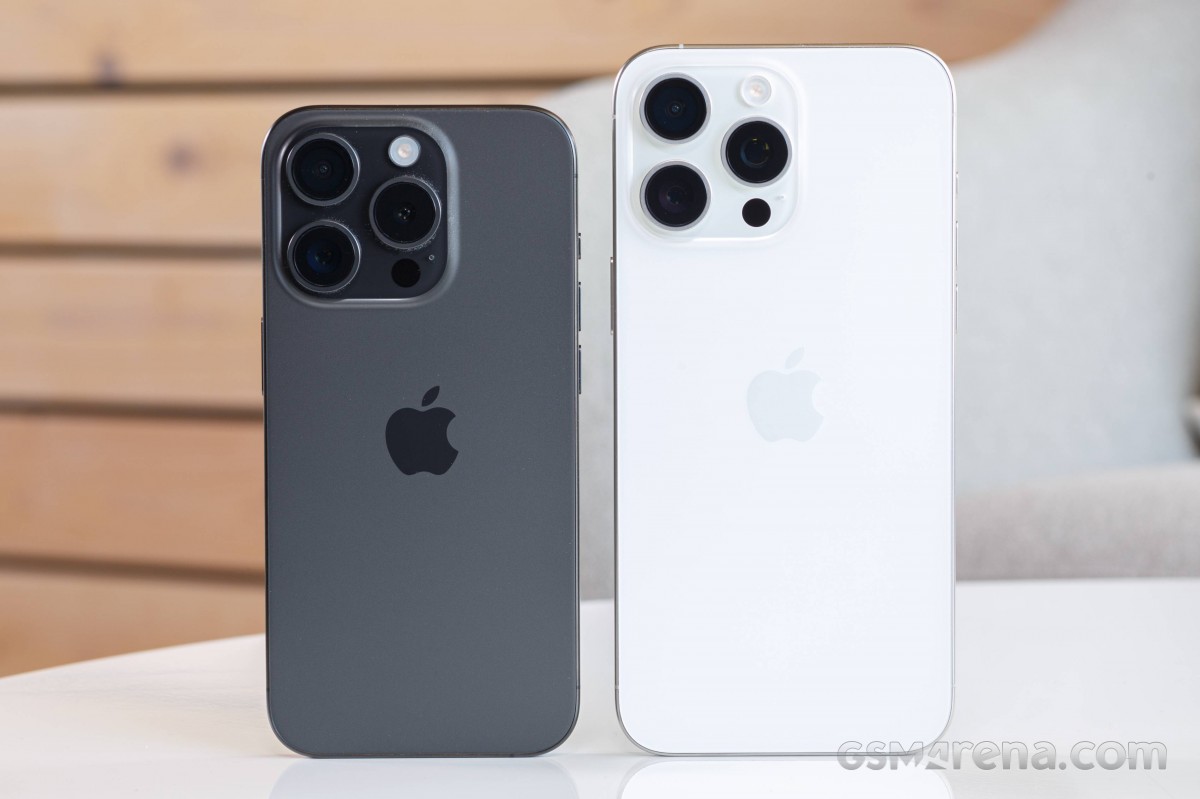
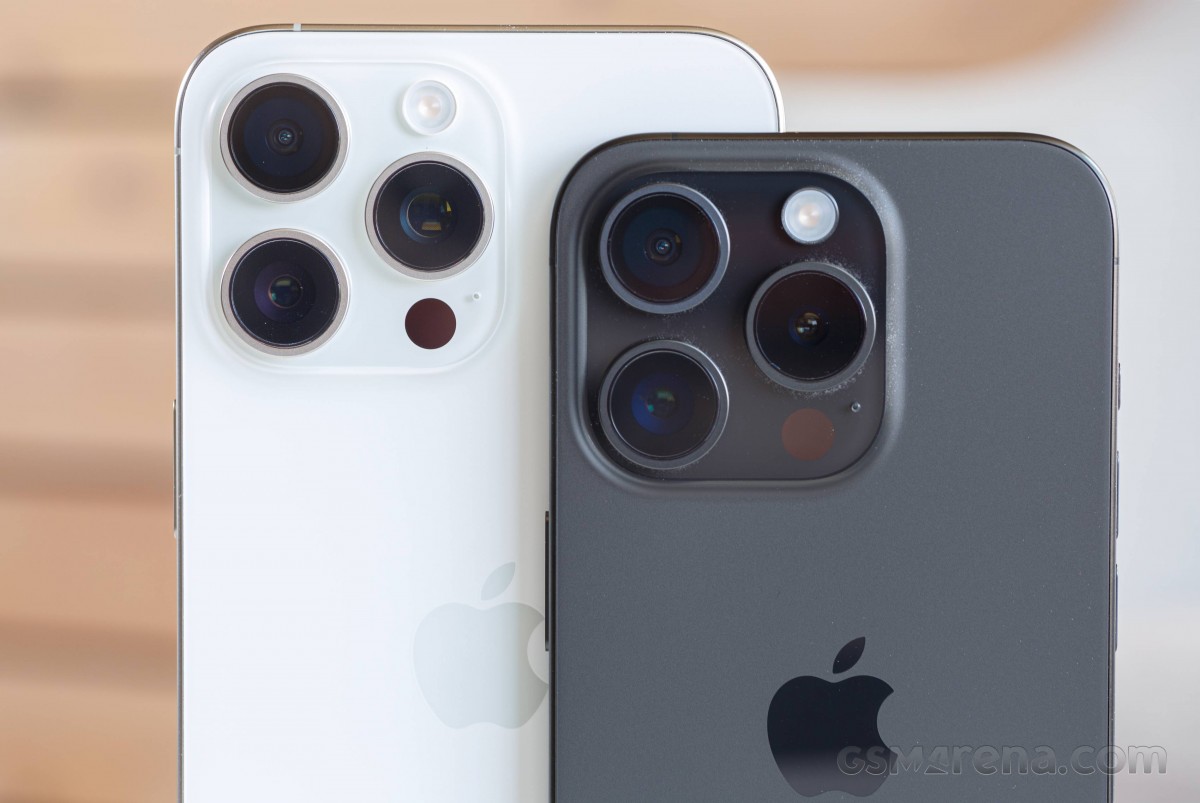
iPhone 15 Pro (left) next to iPhone 15 Pro Max
Circling back to the cameras (because it’s not all about the telephotos), the iPhone 15 Pro also gets the 24MP jpegs (or heifs, if that’s your thing) and the two intermediate pretend-focal lengths – there’s so much more parity in the imaging department than there are differences, after all.
Apple also invented USB-C this year, perhaps nudged in the right direction by the EU, but why not out of their own accord? (Because probably not.) Not strictly a Pro feature this one, since the vanilla iPhone 15 and the 15 Plus also use the industry-standard connector, but a most welcome development either way.
Then there’s some more of the usual stuff, the usual good stuff. The Pro iPhones have some of the best displays in the business, and the one on the 15 Pro is no different – in the same compact 6.1-inch size Apple settled on in 2020 with the 12 generation. While we’d say that underdisplay fingerprint readers should be mature enough for Apple to finally add one into the mix, Face ID remains a solid option for authentication. The autofocusing selfie camera that’s in that same vicinity has proven great in the past too.
iPhone 15 Pro (left) next to iPhone 15 Pro Max
Battery life has been a strong suit of iPhones for a while and we’re seeing little reason why that would change now. We do sense we’ll be complaining about the 15 Pro‘s charging speeds though, as usual. Have a look at this quick rundown of the specs before we tear the paper tabs on that white box.
Disclaimer. We can not guarantee that the information on this page is 100% correct.
Apple iPhone 15 Pro unboxing
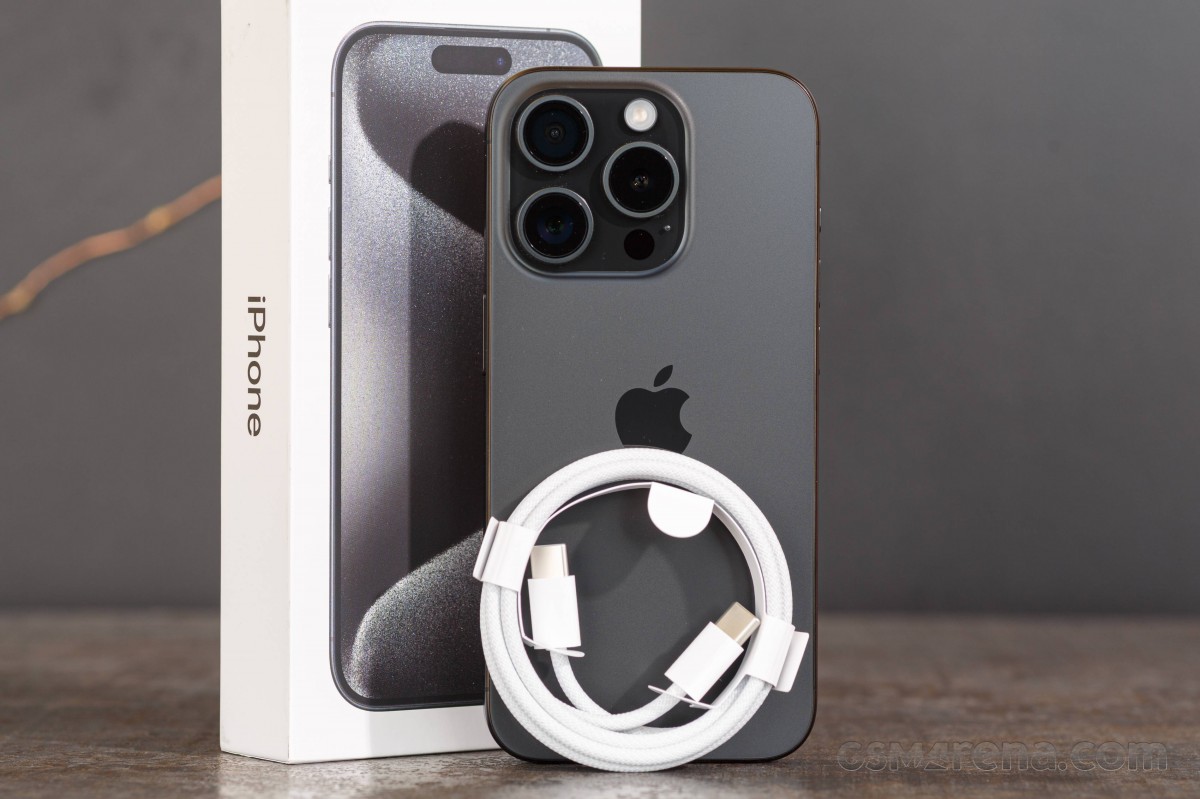
As expected, the iPhone 15 Pro ships in a half-height retail box, with little inside other than the phone itself. The less important bits that are still included are a SIM ejection tool, an Apple sticker, and some documentation.
The one bundled accessory that’s of more practical significance is the new USB cable (C-C) which is now braided. That should help make it last longer than the plain Apple cables of yesteryear, though we’re not sure the white fabric will be looking pristine a few weeks down the road. The cable is also USB 2.0 spec, so if you’re after the fastest possible transfer speeds, you’d need to get a different one. On to the phone itself we go now.
Competition
An iPhone‘s competition most often comprises other iPhones – be they older ones, the other size from the same lineup, or one from the other lineup. In that sense, you need to have your priorities all figured out when picking the right iPhone for you.
iPhone 15 Pro in front of iPhone 15 Pro Max
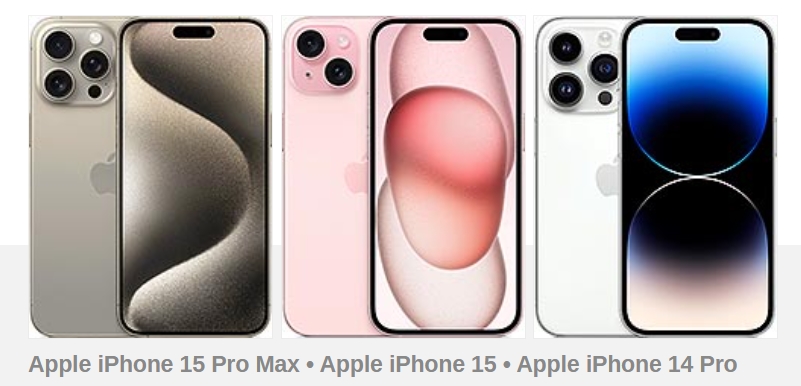
For example, if you want the absolute best iPhone on the market, the 15 Pro isn’t that. The 15 Pro Max will get you a longer-reaching telephoto camera, better battery life and more screen estate, though conversely, it will take up more room in your pocket, and it’s also more expensive (€250/$200).
On the other hand, if you’re looking to save some money (€300/$200), you could give up on the Pro and get the vanilla iPhone 15 – not only is it the same size as the 15 Pro, but it’s tangibly lighter, which can be a priority. The 15 is nowhere as good a cameraphone as the 15 Pro – no telephoto, no AF on the UW, and less fancy main camera.
An interesting middle ground is the iPhone 14 Pro. Apple may have discontinued it, but we reckon there’s ample stock at third-party retailers, and for €150 less you can have almost the same phone as the 15 Pro – minus the USB-C port, the latest intermediate zoom modes, the newest chipset (last year’s is fine), and the titanium frame (which may actually be an advantage for the previous generation).
If you’re OS-agnostic or just like jumping ship every now and then, or you may want something that Apple doesn’t make yet, there are plenty of Android options you could entertain.
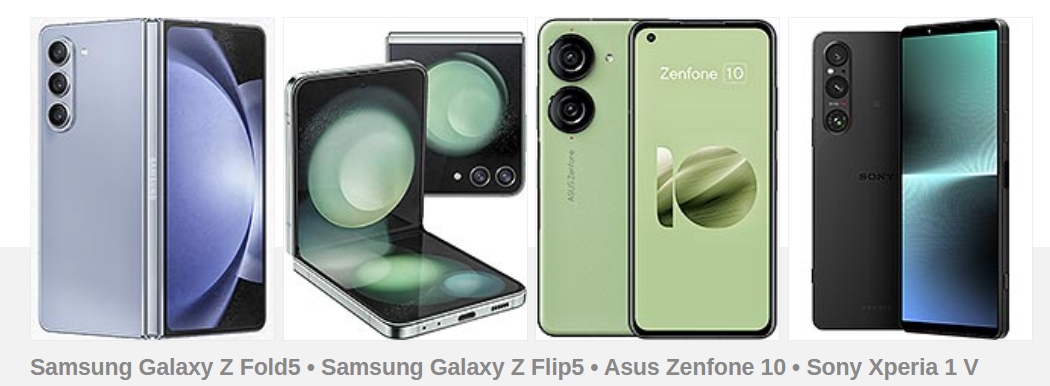
Samsung’s two foldables easily come to mind – there’s no bendy iPhone just yet. The Galaxy Z Fold5 is perhaps the best bet if you’re after the ultimate smartphone for productivity, while the Z Flip5 is more of a fashion statement with the benefit of some form of pocketability. If that last bit is a top priority, then the Zenfone 10 just might be able to entice you, while an Xperia 1 V could appeal to the right crowd with its extensive video recording chops.
Verdict
The iPhone 15 Pro is a logical if not quite exciting, evolutionary step for the lineup. Small advancement in key areas go with continued refusal to improve on others, but Apple will be Apple. Perhaps that statement alone explains the fact that the new 5x telephoto only comes on the Pro Max and not the Pro, and we’re bummed about it on principle, even if it’s objectively not a big deal.
The high price, scant retail bundle, iOS quirks, and heavy throttling sound like cons we’ve listed before and will continue to do so. On the other hand, traditional strong points of the iPhone are only getting stronger – like the upmarket build and in-hand feel, spectacular display, versatile camera system and great speakers. We’re more than happy to welcome the USB-C port this year on iPhone too.
Ultimately, the iPhone 15 Pro is what you’d expect it to be – the best one to date in size small. As usual, if you’ve already got an iPhone 14 Pro, there’s no truly compelling reason to get a 15 Pro. However, if you’re on an iPhone 13 Pro or older, or on one of the other branches of iPhone (like a vanilla 14 maybe), the 15 Pro will more easily make a convincing case for itself.
Pros
Exquisite and now lighter design, water-resistant up to 6m deep.
Outstanding OLED display – super bright, color-accurate, Dolby Vision capable.
Superb speaker loudness, balance, sound quality.
Top-notch performance.
Every iPhone comes with at least five years of iOS updates.
Upgraded connectivity across the board, UWB2 too.
USB-C is here, and we love it.
Class-leading video capturing and stabilization, impressive Pro modes.
Superb daylight and nighttime photos from all cameras.
Cons
A lot more expensive than corresponding Android alternatives.
No charger in the box, and charging isn’t particularly fast.
Apple’s iOS restrictions can be off-putting to newcomers to the ecosystem.
The photo processing could benefit from less sharpening at times.
Limiting the 5x telephoto to just the Max feels arbitrary (and so is the 256GB base storage).
The rear glass is reportedly much more shatter-prone than before.
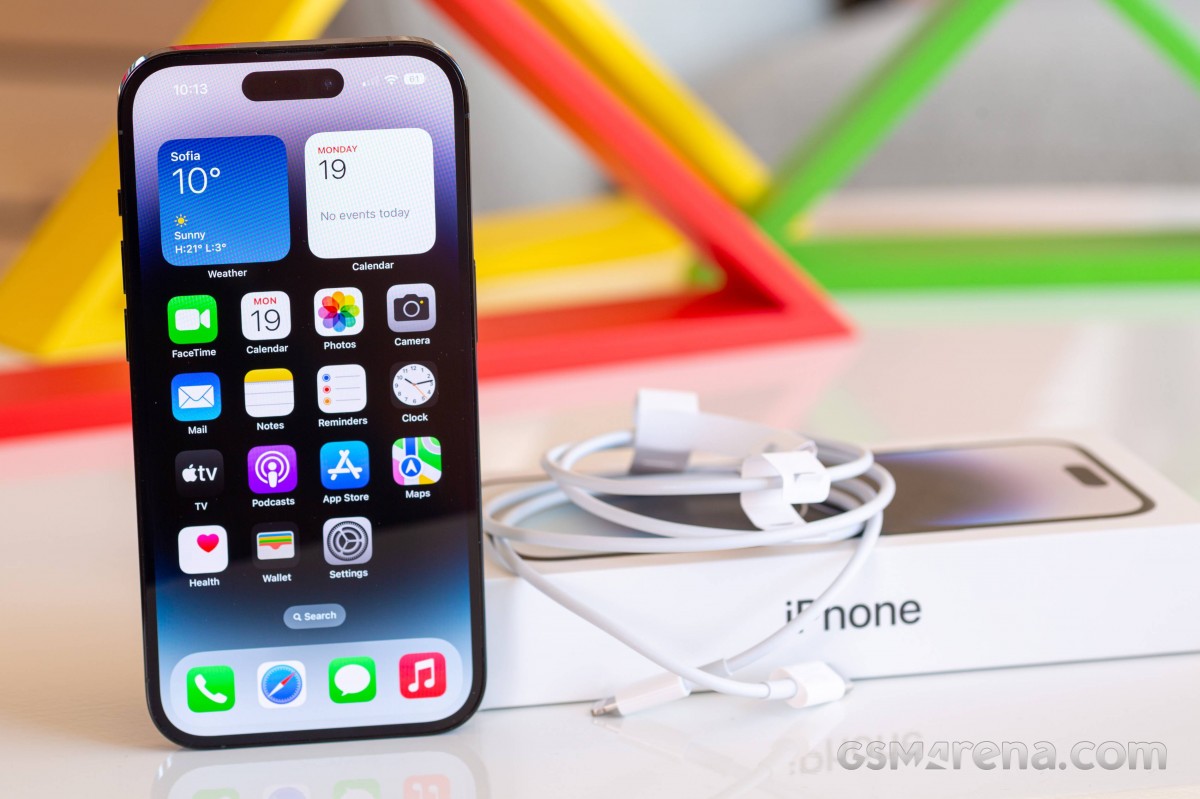
An improved display. Better cameras. A faster chip. This is the new iPhone. A phone that’s often criticized for being behind-the-curve in certain ways, but often copied. A polarizing device that sets the trends in more ways than one. The iPhone 14 Pro is as controversial as any high-profile iPhone to come before it, if not more.
The iPhone 14 Pro follows Apple’s formula to a T – it brings an even brighter Super Retina XDR OLED with an Always On option and a smaller pill-shaped cutout. Apple has done it again – turning weakness into strength. Once an eyesore, the infamous notch is now the Dynamic Island, a unique feature other brands are considering copying.
There are other improvements across the cameras, courtesy of new sensors, lenses and ISP. And, of course, Apple’s A16 Bionic chipset is faster and more energy-efficient than the A15, just as expected.
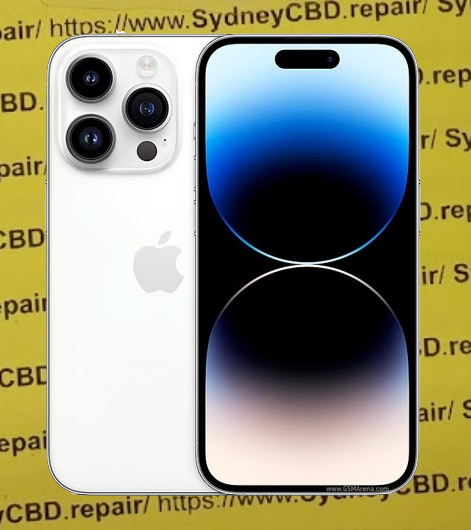
Let’s start with the screen. While it’s still a 6.1-inch OLED, it has a smaller pill-shaped cutout, can be as bright as 2,000nits, and supports Always On thanks to new more energy-efficient panel. The cutout is arguably the most iconic iPhone 14 Pro series feature, which actually comprises of two small cutouts – one pill-shaped and one round. Apple has turned this into a feature with various cool animations for notifications and calls it Dynamic Island.
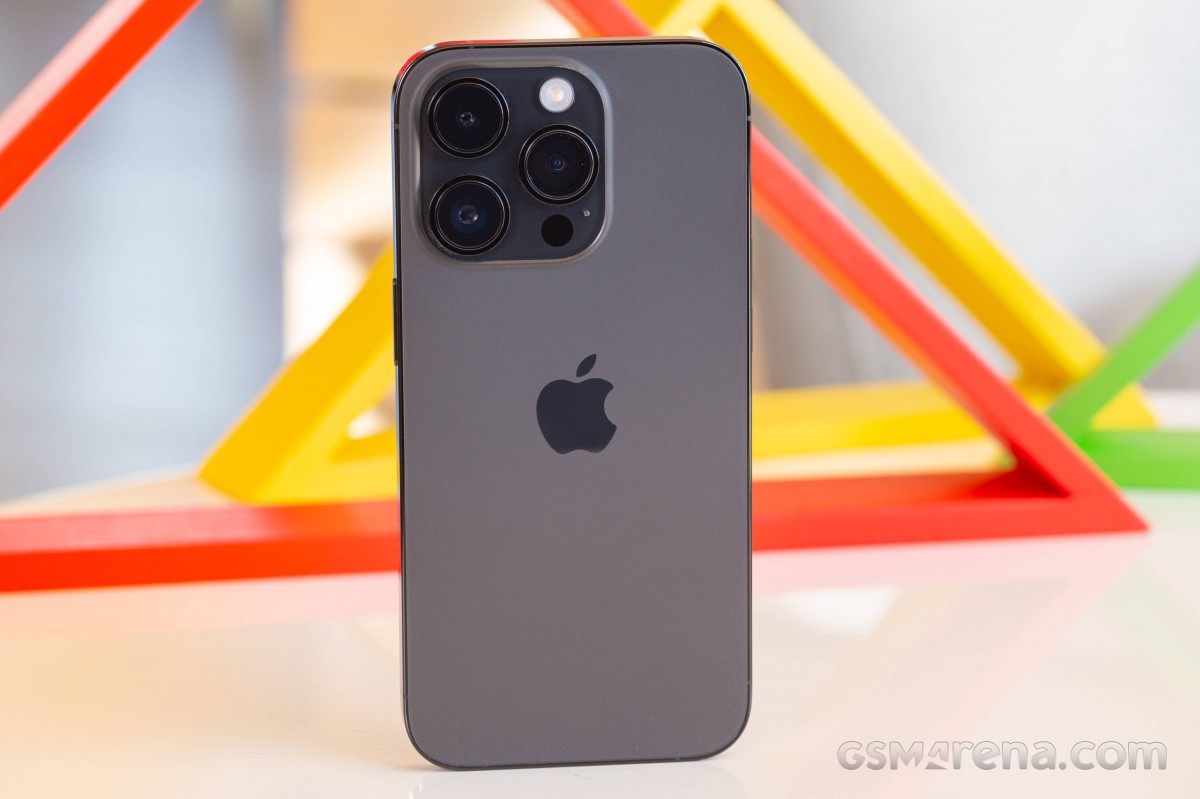
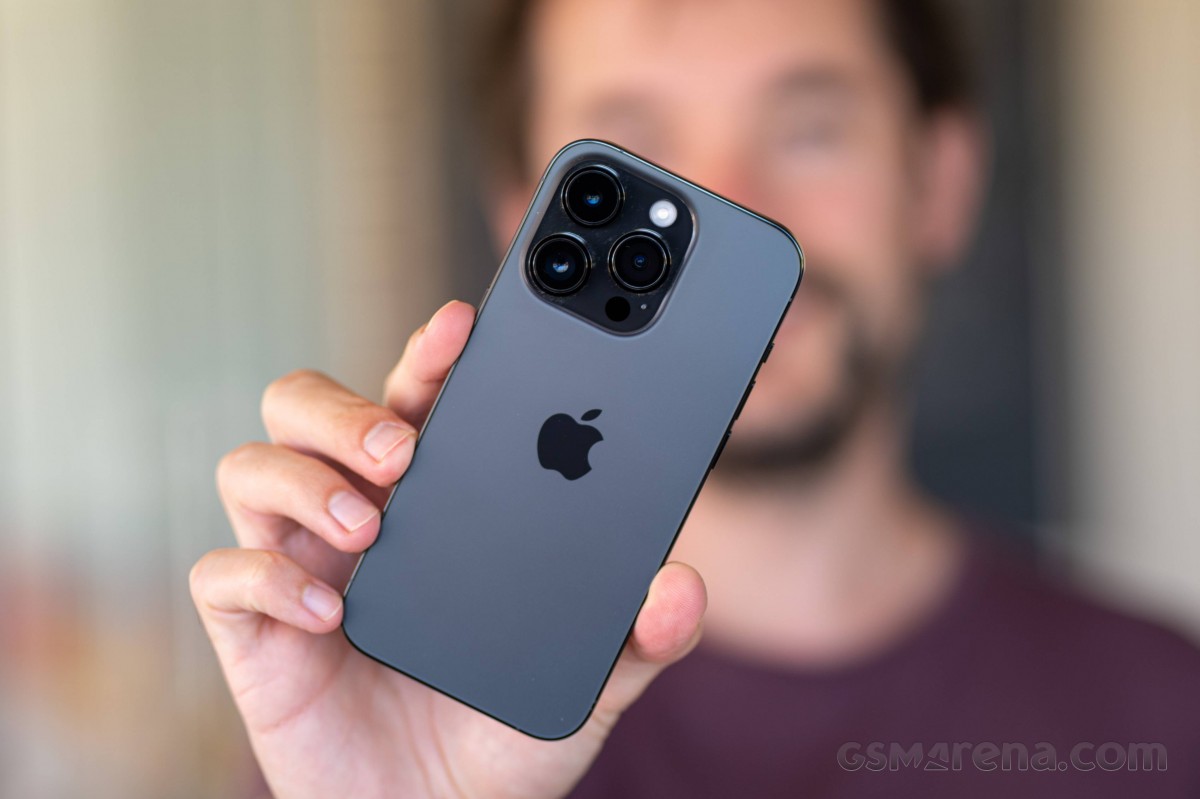
Then come the cameras. The rear camera is still a triple-setup with a LiDAR scanner, but now the main shooter features a 48MP sensor with second-gen sensor-shift stabilization and a 2x lossless zoom option. The 12MP ultrawide camera got a new larger sensor and improved lens. Then there is the front camera, which now has a brighter lens, autofocus and even optical stabilization. There is also a better image processing called Photonic Engine and a new 9-LED flash.
The Apple A16 Bionic chipset offers an even faster processor and graphics though it still features a similar 6-core CPU and 5-core GPU architecture. It does support LPDDR5 RAM now and has higher memory bandwidth. Finally, a new ISP and DSP are present, of course.
Another new introduction as part of the new hardware is the Emergency SOS via satellite – a feature that allows you to send a message to emergency services wherever you are around the world – no need for SIM or network coverage. And thanks to a bunch of new sensors, the new iPhones now support Crash Detection and can automatically send for help if they detect you were in a crash.
This is the first iPhone series to come without a SIM slot in the US, which means the trial run for the SIM slot retirement has officially begun – at least as far as Apple is concerned. If successful, like it was with the nano-SIM, get ready for a smartphone world without SIM cards in a few years.
What hasn’t changed is the design – it’s the same as on the iPhone 12 and 13 series, and just as tough with Ceramic Shields and improved IP68 ingress protection. Battery and charging capabilities have also stayed unchanged.
Disclaimer. We can not guarantee that the information on this page is 100% correct.
So, what’s missing on the new iPhone 14 Pro? A proper file manager! Just kidding, this ain’t happening. It seems Apple has addressed many of the omissions from the past generations, and we have the best iPhone ever. Until USB-C-featuring iPhone 15 comes, that is.
Unboxing the Apple iPhone 14 Pro
The thin paper box contains the iPhone and a USB-C-to-Lighting cable. We were disappointed Apple didn’t retire the Lightning port on the iPhones this year, as it already did on its other devices. We guess that’s a task for the next one.
Other than the cable, you will get a SIM ejection tool for models with a SIM slot and one Apple logo sticker. While Apple has ditched the plastic wrapping from the boxes, the plastic sticker remains.
Alternative options
The new iPhone 14 Pro has a lot of upgrades over the iPhone 13 Pro, even if only a single one is visible at first sight – the Dynamic Island. There are new cameras, a new chipset, a new satellite connection and crash detection, and higher brightness for the screen, plus an always-on display option. But even with these novelties, upgrading from an iPhone 13 Pro to the 14 Pro makes little sense.
In fact, Apple has never been a company that wants you to upgrade every year and the 5-year software support plus the aggressive battery care are both statements for that. People still do that more often than not, of course, and if you’ve set your eyes on the new iPhone, be it this one, or another, there is nothing that will change your mind.
The new iPhones have seen a price increase everywhere but the US, which will surely lift a few eyebrows. This is the world we live in right now, with inflation and an ongoing war raging in Europe, unfortunately.
We still have to conclude this review like any other, and we will certainly do it. So, let’s suggest a few iPhones you can buy if this €1,300 iPhone 14 Pro is not your love at first sight.
The iPhone 14 Pro Max is a good alternative with a larger display and better battery life. It starts at €1450, which is hefty premium.
Smaller and lightweight iPhones are available, too. We certainly won’t suggest the new iPhone 14 unless you want the satellite feature, as it is the most insignificant update the iPhones have ever seen. Apple is selling both the €900 iPhone 13, the €800 iPhone 13 mini, and the €800 iPhone 12, so we’d suggest thinking about those if you want a light and compact iPhone and don’t mind not having a zoom camera or a 120Hz display.
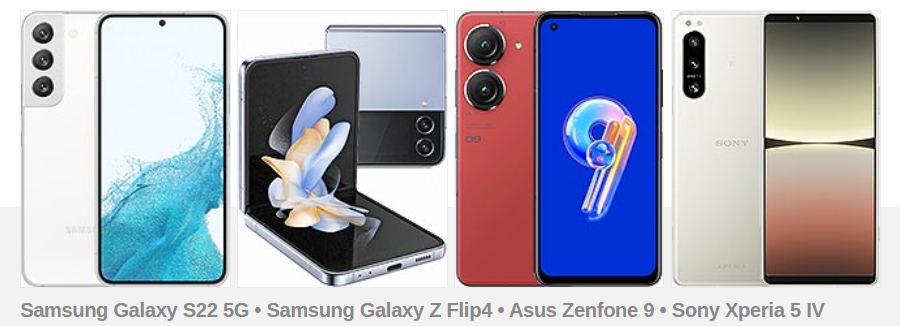
The Android market is thriving, too, and you can now both have compact yet flagship smartphones. Samsung has the €700 Galaxy S22 and the foldable €900 Galaxy Z Flip4, a couple we encourage exploring. The €800 Asus Zenfone 9 will give you an all-around flagship package within an incredibly compact body. And you may want to consider the €1,050 Sony Xperia 5 IV for its superb camera kit and natural processing.
Our verdict
The Apple iPhone 14 Pro is the best iPhone Apple has made so far, as the maker just loves to point out. And it is – it has the best screen, cameras, performance, speakers and durability not only among the iPhones but across all flagship smartphones.
It introduces more than enough upgrades over the previous generation to make it interesting – an improved OLED with higher brightness, a smaller cutout with cool animations, and always-on option. The cameras have been updated all around, but the primary with its 48MP sensor and 2x lossless zoom is the showstopper, of course.
The new generation comes with interesting additions like global satellite connection for emergency and crash detection with automatic emergency call. The new faster chipset with improved stability is also worth mentioning.
Even with so many updates, the iPhone 14 Pro looks like the old iPhones, and if it weren’t for the new Deep Purple color and the pill-shaped cutout, you wouldn’t even know. And this design stasis may not be everyone’s favorite, even if this design is a self-proclaimed toughest in the world.
And it’s an iPhone, so not having a top-notch battery life and full OS access is something you choose to accept and live with for the foreseeable future.
Expensive or not, you will love the iPhone because it’s as good as advertised. The iPhone 14 Pro does make little sense as an upgrade over the 13 Pro, the 12 Pro even. But who are we to judge. The heart wants what it wants, right? And that’s the new iPhone. So, you should probably go and get it.
Pros
Class-leading design, water resistance and durability.
The best iPhone ever, version 2022, size XL – we have the iPhone 14 Pro Max. The list of novelties this year includes the notch morphing into a pill, the introduction of an Always-On display, and an all-new primary camera – and while you can get all of that on the 14 Pro, the extra screen estate and longevity coupled with the Max’s ‘ultimate’ status mean it has a market niche of its own.
The Face ID notch that’s been with us since the iPhone X was nobody’s favorite, and perhaps its reincarnation as a pill is a step towards its eventual removal. But not before turning the eyesore into a feature – the pill is a Dynamic Island of notifications, blurring the line between hardware and software.
In a similar vein is the Always-On display – a software feature only made possible now in Apple’s world thanks to LTPO displays being able to ramp down to 1Hz refresh rate.
A massive increase in brightness is also among the key developments this year, this one solely in the hardware department.
Late to yet another party, Apple finally joins virtually every other manufacturer and introduces a camera with a Quad Bayer type sensor – the specs on the 48MP main unit don’t read like any other, so apparently, it’s an exclusive design. The telephoto remains unchanged, but the ultrawide has gotten a sensor size upgrade, while the front-facing one now features autofocus (and maybe even OIS).
On the hardware front, there’s the mandatory chipset update, of course, and little else worth mentioning. Well, there’s the blanked-out SIM card slot for the US models, which will only operate with eSIMs – does that count as a hardware change? Crash detection and emergency sort-of satellite connectivity are also on the list of new features combining software and hardware.
Disclaimer. We can not guarantee that the information on this page is 100% correct.
Apple iPhone 14 Pro Max unboxing
Hardly anything has changed in the presentation of the iPhone 14 Pro Max compared to last year’s model. The half-height box has a color-matched likeness of the phone printed on the lid, and opens with a couple of paper tear-off pull tabs.
Inside, the phone is lying face down, its back greeting you as you remove the lid. There’s no charger bundled, but there’s still a USB-C-to-Lightning cable, at least. And an Apple sticker, because free advertising.
Competition
There are two ways to look at the possible competitors to the iPhone 14 Pro Max. On the one hand, you have the people looking for an iPhone, and those can be subdivided into those looking for a large-screen iPhone and others looking for a Pro iPhone. On the other hand, you have the undecided folk with less of an ecosystem allegiance and more of a ‘what’s the best I can get regardless of price’ attitude.
Then there’s another matter complicating things further – iPhone prices vary greatly from region to region this year, more so than usual. While the US numbers have remained unchanged, the Euro prices have gotten a steep hike – €200 is not insignificant, even at this level. The INR 10K increase in India isn’t as severe, but it’s still an increase.
That price development can make a strong case for the iPhone 13 Pro Max, which fits neatly into both subsets of prospective iPhone buyers – it’s got a large screen, and it’s a Pro model. Sure, Apple may have discontinued it, but retailers appear fully stocked still. You’ll be missing out on some improved cameras, but the last generation is still a competent cameraphone, while the pill vs. notch argument is, well, hardly an argument.
If, on the other hand, it’s specifically the new cameras and/or the pill that you’re after, but you don’t quite fancy the Max’s bulk and heft, then there’s the 14 Pro. The same as the Max, but more compact and with slightly shorter battery life, the 14 Pro will also save you some cash – $100/€150/INR 10K.
The 14 Plus, too, can appeal to those looking to spend a little less and still have a large-sized iPhone. It’s not quite the best deal in the US, where it goes for 14 Pro money ($200 less than the 14 Pro Max), but in Europe and even more so in India, you’d be looking at some serious savings – €300/INR 50K. You’d need to wait a couple of extra weeks and settle for last year’s internals, but it’s still a big iPhone at a sort of bargain price.
For the brand agnostics out there, the obvious choice is the Galaxy S22 Ultra. Samsung’s ultimate non-foldable is Max-sized too, has a great set of cameras and packs a stylus (or a remote shutter release, depending on how you look at it). There’s also the Galaxy Z Fold4 – a phone and a tablet in the same device that’s only barely heavier than the 14 Pro Max. A Pixel 7 Pro is also on the way if you’re more into Google’s way of doing cameras and software. Somewhat of a niche alternative (judging by market share, at least) can be found in the Xperia 1 IV too.
Verdict
The best iPhone ever comes with a wide range of advancements, and even if you don’t consider any of them groundbreaking or relevant to your usage, they’re there and add up. The brightest screen by a country mile, now with AoD, a pill for the notch-ache, a camera system with all-around improvements and great full-res images, and emergency hardware/software features – that’s the new stuff.
These come on top of Pro Max staples like great battery life, superb speakers, and premium and durable build quality. The most potent chipset in the business and at least 5 years of support for the software you’ve known for ages (and likely love and hate at the same time) are other classic arguments for the iPhone, Pro Max included.
The price increase in RoW markets (that is, outside of the US) is a tough pill to swallow on at least two levels. There’s the absolute monetary dimension of the extra cash leaving your pocket, and then there’s the sense that you’re paying for part of the US customers’ iPhones – we’re not sure which is the more bitter sentiment.
But in any case, the iPhone 14 Pro Max is undoubtedly a wonderful handset with few faults. And where you can see possible negatives, those come with the territory and aren’t exclusive to this specific generation or size. So, ultimately, if it’s your time to upgrade and the price is right for you, you can’t go wrong with this one.
Pros
Class-leading design, water resistance and durability.
The Pixel 8a is likely only a couple of weeks away from its debut and the leaks keep on coming. In another new leak, a Pixel 8a product page reiterates and confirms details about the upcoming device, including that it has a matte finish on the back.
We’ve heard basically all of the important things about the Pixel 8a already. Tensor G3, a 120Hz display, 7 years of updates, and even pricing.
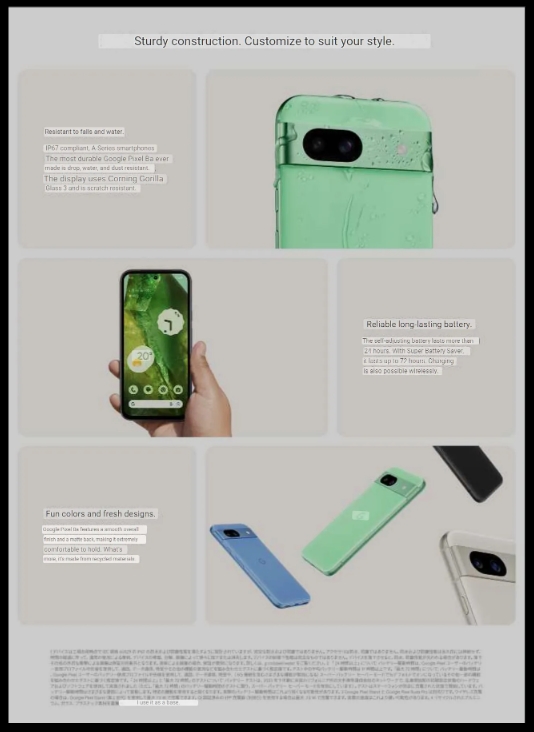
Now, a full product page posted by Evan Blass reiterates all of the details we already knew, and throws in a couple of new ones. There’s mention that Pixel 8a has Gorilla Glass 3 protecting its display, the same as was used on the Pixel 7a. Google does claim, though, that the Pixel 8a is its “most durable” A-Series release yet, alongside confirmation of IP67 water resistance (again, in line with 7a).
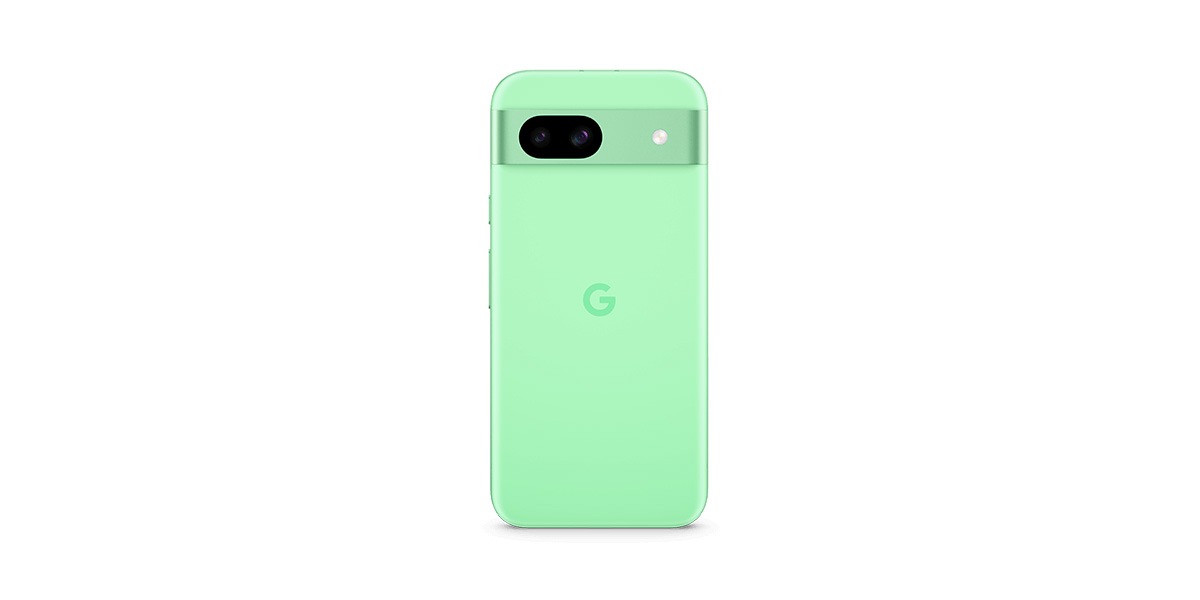
The same page also talks about the “fun colors” and the use of a matte finish on Pixel 8a.
Technically we already knew this through hands-on leaks. An image of the black model clearly showed a matte finish on the back, and another image of the blue and green models further cemented the idea, though there’s always a bit of leeway there. But this product page leaves no room for doubt, with an explicit mention (translated) that the Pixel 8a has a matte finish.
The page also says that Pixel 8a is made, in part, from recycled materials. In context, this sounds like it’s referring to the back of the device, but it could easily be referring to the frame. Pixel 7a used recycled aluminum in its housing.
Google Pixel 8a features a smooth overall finish and a matte back, making it extremely comfortable to hold. What’s more, it’s made from recylced materials.
The only color we don’t know for 100% certain at this point is the white model, but given that it looks identical to the other models in renders we’ve seen leak, it certainly looks like Google is going for a matte finish across all colors. That’d match the company’s pattern on the Pixel 8 Pro, too.
Interestingly, one portion of the page also mentions 6 months of Fitbit Premium with the 8a. That’s not something Google offers on its other Pixel phones, usually only offering it on Pixel Watch.
Google is expected to launch the Pixel 8a soon, probably around Google I/O which takes place on May 14.
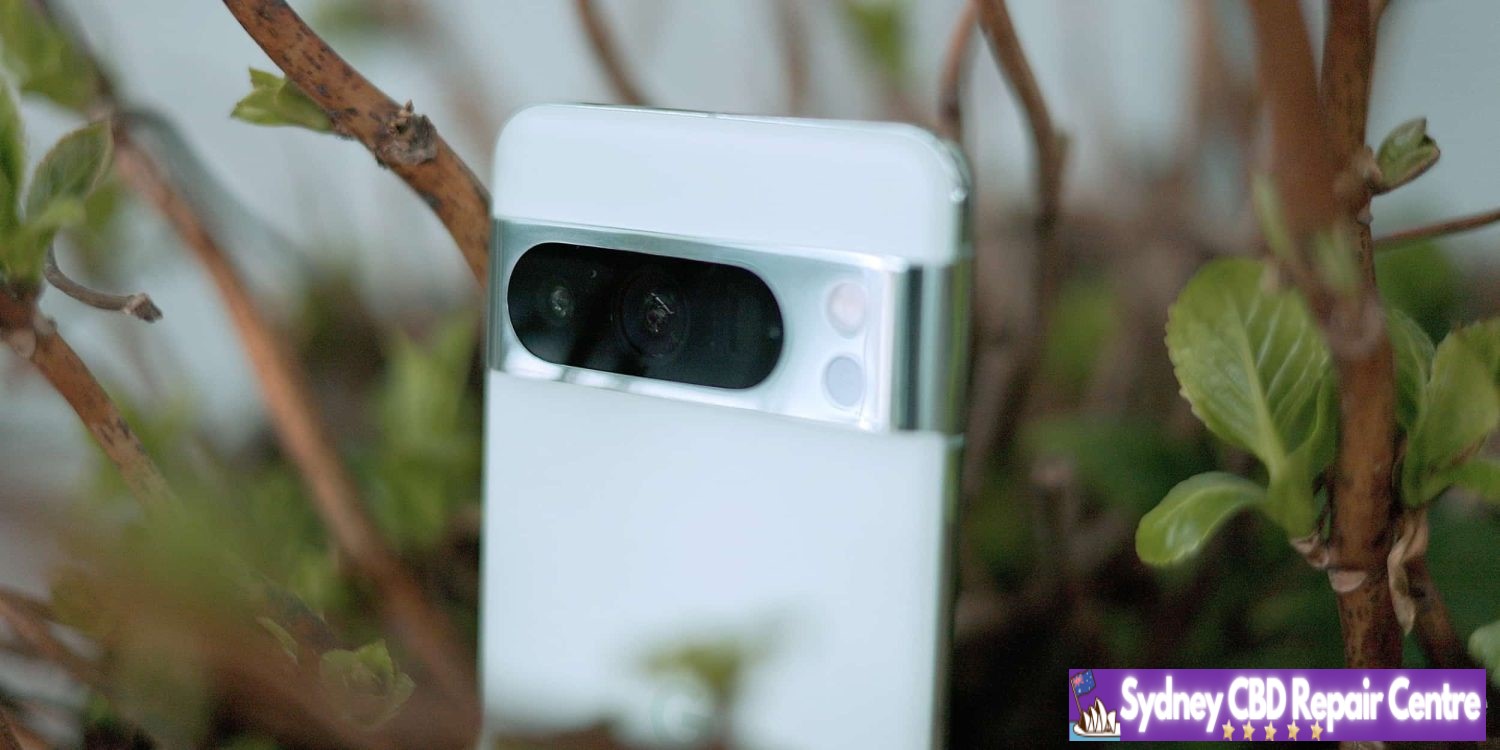
Google’s Pixel 7 Pro and Pixel 8 Pro are well-designed smartphones, but the polished metal finish around the camera module is often easy to scratch and not the best look. Now, though, one Pixel 8 Pro owner took it upon themselves to manually give the metal a brushed look, and it’s really quite nice.
The polished metal around the camera module on Pixel 7 Pro and Pixel 8 Pro is pretty easy to damage even if the phone is in a case. The metal is just easy to scratch, and it doesn’t look all that good when that happens. That’s part of the reason it’s so frustrating that the smaller and cheaper Pixel 7 and Pixel 8 use a matte finish instead, which is considerably more durable.
There are protectors on the market to help with the durability issues, but it’s pretty universally agreed that Google probably should have just gone with some form of a textured metal on these phones.
Reddit user u/the_skinny_drummer took up the challenge of turning the polished metal into a brushed look, and the results are really good! Images shared of the Pixel 7 Pro and Pixel 8 Pro show this new brushed finish which was achieved using Scotch Brite scouring pads.
We definitely would not advise doing this as it likely wouldn’t be viewed kindly by Google in the case of a warranty claim, and you also risk scratching the glass on the back and on the camera lens too (which it seems like may have happened on the 7 Pro). But, still, the cheap and clearly effective mod really does improve the look, especially on Pixel 8 Pro as the camera now more closely matches the matte glass finish.
The much safer solution is to pick up a skin. dbrand includes a camera bar skin with a full package, but there are others who will sell just the camera skin, such as XtremeSkins.