Following the release of iOS 14.5 to the public last month, multiple apps began asking users to enable the App Tracking option. With the latest version of the Twitter app for iOS, users are now being asked to enable tracking in order to receive “relevant ads.”
The new prompt was implemented with version 8.65 of the Twitter app, which is now available on the App Store. Once you install this version of the app, Twitter might ask you if you want to enable the App Tracking option. The social network argues that enabling tracking will let Twitter provide more relevant ads according to the content you like.
More choices for relevant ads on iOS 14.5. Keep ads relevant to you by allowing Twitter to track data from other companies on this device, like apps you use and websites you visit. You can decide if you’ll allow tracking in the iOS prompt and you can always change this later in your device settings.
By tapping the Continue button, the user is redirected to the iOS Settings app in the Tracking menu. There you can opt to enable App Tracking for Twitter or keep it disabled. By default, tracking for third-party apps is turned off.
With App Tracking Transparency, apps can no longer track users across other apps and websites without first asking them. Most apps use this data to display advertisements based on what the user searches for on the web or what they have installed on their device. According to a recent research, only a small amount of users have been letting apps track them with this new option.
At the same time, there are still multiple users who are not being able to access App Tracking Transparency settings in iOS due to the grayed out toggle — even after Apple said it fixed this issue with iOS 14.5.1.
With over a dozen locations worldwide, the Apple Developer Academy has empowered thousands of students with app development and entrepreneurial training, providing them with the tools to find and create jobs in the thriving iOS app economy.
Thousands of students worldwide will have access to expanded Apple Developer Academy programming
The first Apple Developer Academy opened in Brazil in 2013, with the goal of providing the tools and training for aspiring entrepreneurs, developers, and designers to find and create jobs in the thriving iOS app economy. Since then, the company has opened more than a dozen academies across the world with two more on the way: one in Korea, and one in Detroit, Michigan, the first-ever US location. The program has empowered students around the world with app development and entrepreneurial training, many of whom have gone on to start their own businesses, create and sell apps on the App Store, and give back to their communities. With the expansion plans underway, thousands more students worldwide will now have access to these opportunities each year.
The new academy programs in Detroit and Korea will join more than a dozen other sites in Brazil, Indonesia, and Italy. Across the world, whether students are in Naples, Italy, or Jakarta, Indonesia, academy participants learn the fundamentals of coding as well as core professional competencies, design, and marketing, ensuring graduates have the full suite of skills needed to contribute to their local business communities. The curriculum also incorporates Apple’s values throughout the coursework, encouraging students to design inclusively and make a positive impact in the world.
Apple Developer Academy graduates around the world have gone on to start their own businesses, create and sell apps on the App Store, and give back to their communities.
Apple offers two distinct training programs as part of the Apple Developer Academy: 30-day foundations courses that cover specific topic areas, including an introductory course for those considering app development as a career path, and a more intensive 10- to 12-month academy program that dives deeper into coding and professional skills.
Applications for the first academy cohort in Detroit — Apple’s first Developer Academy in the US — open this week. The academy, part of Apple’s Racial Equity and Justice Initiative, is scheduled to open in October in a newly redesigned space in downtown Detroit. All Michigan residents 18 and over are welcomed to apply, regardless of prior coding experience, at developeracademy.msu.edu/students.
Antonio Chiappetta, a graduate of the Apple Developer Academy in Naples, Italy, now works as an iOS developer at Elevate Labs in Paris.
Antonio Chiappetta, 25, was part of the very first Apple Developer Academy cohort in Naples, Italy, in 2016. A computer engineer by training, Chiappetta was inspired by the hands-on learning opportunities and close collaboration with mentors he met at the academy. His experience reinforced computer engineering as a career path, and he ultimately found success as an iOS developer at Elevate Labs in Paris, where he works on Elevate, the award-winning brain training app. Antonio credits his time at the academy with helping him gain the skills and confidence that power his career today: “The Apple Developer Academy is not just about learning to code. It’s about breaking barriers and empowering students, and has infused me with the enthusiasm and curiosity that drive me today.”
After graduating from the Apple Developer Academy in Naples, Italy, Antonio Chiappetta was hired as an iOS developer at Elevate Labs in Paris, where he works on Elevate, the award-winning brain training app.
For many academy graduates, the community aspect is as important as the hard skills they learn through their coursework. Students have the opportunity to learn from new colleagues from different personal and professional backgrounds, each of whom brings new ideas and life experiences to their app designs and business plans. For some, those new friends go on to become co-workers and business partners.
Arthur Motelevicz attended the Apple Developer Academy in Curitiba, Brazil, and now works with 11 other Academy graduates as colleagues at his company.
rthur Motelevicz, 36, met his future business partner at the Apple Developer Academy in Curitiba, Brazil, in 2013 — and now counts 11 academy graduates among his 25 employees. Formerly the lead singer and guitarist of a band, Arthur knows first hand how the academy encourages creativity and collaboration, skills that are as important in business as they are in music. After graduating from the academy, Motelevicz decided to quit his full-time job to dedicate himself to entrepreneurship in pursuit of a new way to mix coding with music. Super Pads, a fun and easy-to-use DJ app, was born out of that dream. “I love being able to work with amazing people, learn every day, and experiment with combining coding and music,” said Motelevicz. “The Apple Developer Academy gave me the strength to pursue and implement my ideas into something that I will spend my life working on.”
Super Pads, founded by Apple Developer Academy graduate Arthur Motelevicz, is a fun and easy-to-use DJ app.
The Apple Developer Academy is one of a broad suite of resources Apple provides to support the global developer community.
After participating in the Apple Developer Academy in Jakarta, Indonesia, Aisyah Widya Nur Shadrina was selected to attend Apple Entrepreneur Camp in 2020, working alongside other women founders and developers.
For Aisyah Widya Nur Shadrina, 23, her experience at the Developer Academy in Jakarta, Indonesia, introduced her to those resources. At the academy, Shadrina and her all-women team used the front-facing camera and machine learning on iPhone to create Hearo, an app that can translate sign language into voice and text, providing a more seamless way to communicate with friends who are deaf. The team was subsequently selected for Apple Entrepreneur Camp in 2020, where they received code-level guidance from Apple experts and engineers, facilitating significant improvement to in-app navigation and user experience. This year, Shadrina and her team will attend Apple’s Worldwide Developers Conference virtually. She says she looks forward to learning more about new Apple technologies, frameworks, and tools that can help developers build more innovative and inclusive apps.
Hearo, founded by Apple Developer Academy graduate and Apple Entrepreneur Camp attendee Aisyah Widya Nur Shadrina, can translate sign language into voice and text.
Apple’s annual Worldwide Developers Conference (WWDC) will take place June 7 through 11, in an all-online format. WWDC will feature hundreds of sessions for developers of all ages and backgrounds — including hundreds of current and former Apple Developer Academy students — to learn about the new technologies, tools, and frameworks they rely on to build innovative and platform-differentiating apps and games.
Back in 2019, Apple, Amazon, and Google teamed up with the Zigbee Alliance to announce the “CHIP” alliance for promoting smart home devices that work across multiple platforms. As the first devices certified by this alliance are expected to hit stores in 2021, the companies behind “CHIP” announced today that the project will have a new name: Matter.
In order to get Matter’s certification, the product needs to adopt a new royalty-free standard that makes it compatible with Amazon’s Alexa Smart Home, Apple’s HomeKit, and Google’s Weave protocols. The alliance will embrace devices such as smart light bulbs, video doorbells, door locks, smart speakers, and more.
Tobin Richardson, chief executive of Matter, told CNET that every device certified by the new alliance will have a unique logo to indicate that it works with the Apple, Amazon, and Google ecosystems. “He expects the logo to become as ‘ubiquitous’ as the Wi-Fi logo currently is,” says the report.
The Matter logo has three arrows pointing toward the center, representing the partnership of the three companies behind the alliance. Customers will see this logo on the boxes of compatible products and even on the devices themselves once they become available.
“As these different devices become more complex networks, it’s all the more important that they’re all talking the same language,” Richardson said. “That mark will be a helping hand to make sure that you can add whatever lightbulbs, whatever door locks, whatever you want to add.” Richardson made the comment in an interview ahead of a Matter press event on Tuesday.
Concept shows a smart light bulb with the Matter logo. Image: CNET
According to Michelle Mindala-Freeman, head of marketing at Matter, compatible accessories will have setup codes to let users easily pair them on any platform. The main idea of the Matter alliance is to break the barrier between smart home devices so that the user does not have to worry about which platform the accessory is compatible with.
The report says that the first Matter-certified accessories should be available later this year, but a more detailed schedule is still unclear. Developers interested in working with the Matter protocol can check out the GitHub page of the Zigbee Alliance.
App developer Jeremy Provost discovered that Apple has given Zoom access to a private iPad camera API. With that, the meeting app is the only one, except by Apple’s FaceTime, being able to use the camera during iPad Split View multitasking.
With this feature only available on the Zoom app, it gives an advantage to the app among the others, since the user can use the Split View multitasking to access Twitter, a notes app, etc.
As Provost explains in his blog post, when he first discovered Zoom could take advantage of the Split View feature, he started to search for the process for other developers being able to do the same.
“We asked Zoom and to our surprise, they gave us the answer, and in the process revealed an apparently private process, available only to those deemed worthy by Apple.“
To receive access to some API, Apple must give an “entitlement,” which is a right or privilege that grants an executable particular capabilities. Apple explains:
“For example, an app needs the HomeKit Entitlement — along with explicit user consent — to access a user’s home automation network. An app stores its entitlements as key-value pairs embedded in the code signature of its binary executable.“
While Apple provides public documentation and a process for requesting access to entitlements, for example, Provost discovered that there isn’t a public process for requesting this specific API.
As we’ve been informed, it is called com.apple.developer.avfoundation.multitasking-camera-access. Unfortunately, unlike with CarPlay there is no public process for requesting this entitlement. In fact, its existence is not even documented by Apple publicly. Go ahead and Google it, you’ll only turn up the Zoom Developer Forum.
While it’s still unknown why Apple only gave this particular feature for the Zoom app — as the company says, it treats every developer the same, on Thursday, App Store VP testified in Epic trial as emails revealed special API access for Hulu and other devs:
“One email shows there was an internal question about why Hulu was able to switch between App Store billing and Hulu billing. As it turns out, Hulu is part of a “set of whitelisted developers” with access to the subscription cancel/refund API. The company had initially given Hulu access to this API to support upgrade and downgrade plan changes before this was natively built-in to the App Store.“
On the other hand, in the ‘Spring Loaded’ event in April, Apple announced a feature called Center Stage, exclusively available on the M1 iPad Pro, and will let all videoconference apps be able to take advantage of it if their developers choose to.
With the Center Stage feature, the Ultra-Wide front camera will be able to track the user in a conference and position him in the center of the frame. As for now, if you use an iPad in landscape mode, you’ll probably not look good in front of the camera.
iPad Camera Multitasking
A few months back I was surprised to see that Zoom had somehow been able to tap into using the camera during iPad Split View multitasking. This is an obvious feature for a videoconferencing app so that you can keep one eye on your meeting while you consult notes, look at a presentation, or slack off on Twitter.
I scoured the web and found no reference to how to enable this feature for our own iOS Zoom client, Participant for Zoom. We asked Zoom and to our surprise they gave us the answer, and in the process revealed an apparently private process, available only to those deemed worthy by Apple.
This capability is enabled by means of an entitlement. You can read more about entitlements here. In order to access certain OS features, app developers enable public entitlements, like iCloud access or push notifications. But for quite some time there have also existed private entitlements. One example is the ability for an app to integrate with CarPlay.
Apple provides public documentation and a process for requesting CarPlay access that any developer can apply for. Of course, Apple wisely restricts what types of apps can integrate with CarPlay. You need to fall into one of the following categories:
Audio
Automaker
Communication
EV Charging
Navigation
Parking
Quick Food Ordering
Once Apple has granted you the entitlement it will appear in your developer account for you to add to a particular app.
So then, what is the entitlement for iPad Camera Multitasking? As we’ve been informed, it is called com.apple.developer.avfoundation.multitasking-camera-access. Unfortunately, unlike with CarPlay there is no public process for requesting this entitlement. In fact, its existence is not even documented by Apple publicly. Go ahead and Google it, you’ll only turn up the Zoom Developer Forum.
It’s understandable that this entitlement may not be appropriate for every app, or perhaps there may be ways for it to be abused. Maybe it makes sense for there to be an approval process, like with CarPlay. But it doesn’t make sense for this to be private, undocumented, and only accessible to Apple’s preferred partners. You can’t say “we treat every developer the same” while privately giving special capabilities to certain developers.
We’ve gone ahead and reached out to Apple through their developer contact page and made a request for “iPad Camera Multitasking”. We’ll see where this goes.
Apple’s AirTag is reasonably small and lightweight, but the accessory may be too thick for those who want to put it in a wallet. Because Apple only offers AirTag with a single design option, Andrew Ngai decided to make his own version of Apple’s tracking accessory that looks like a card — and the result is quite impressive.
The process is not exactly easy, as you might imagine, but Andrew managed to do it all himself with just a few tools and a lot of patience. As he demonstrated, removing the back of the AirTag was quite simple, but the components are all glued to the plastic shell with the exception of the removable battery.
Andrew had to heat the AirTag to 150ºF (or 65℃) to get the AirTag logic board out of the plastic shell. However, the biggest challenge in making the AirTag thinner was relocating the CR2032 battery, which is 3.2 millimeters thick by itself. Together with the whole structure, each AirTag is 8 millimeters thick.
By using extra wired connections, it was possible to connect the battery to the AirTag side by side instead of keeping them together on top of each other. The final step was to create a 3D card made to fit the AirTag’s disassembled components together so that they would not come loose. The result was a fully functional AirTag card that can be placed in a wallet just like a credit card.
This, of course, is not something you should do with your AirTags as the process can permanently damage the accessory, but it’s nice to see the possibilities with this product.
Each AirTag costs $29 and there’s also a 4-pack for $99, while Apple also sells multiple accessories like ring holders and leather loops. You can also check Amazon’s website for deals on AirTag and related accessories.
One week after the release of iOS 14.5, Apple today is releasing iOS 14.5.1 to the public with bug fixes and performance improvements. Apple is also releasing iOS 12.5.3 for older iPhones that are not supported by iOS 14.5.
Today’s new release iOS 14.5.1 is available via an over-the-air update in the Settings app. As usual, if the update does not immediately appear for download, keep checking, as it sometimes takes a few minutes to roll out to all users. The build number for today’s release is 18E212.
iOS 14.5 was a major update for iPhone users, bringing new features such as App Tracking Transparency, Appel Watch Unlock, Siri improvements, and more. For such a big update, it is unsurprising to see Apple release a point update with bug fixes.
Apple says iOS 14.5.1 fixes a bug that prevented some users from seeing App Tracking Transparency prompts:
This update fixes an issue with App Tracking Transparency where some users who previously disabled Allow Apps to Request to Track in Settings may not receive prompts from apps after re-enabling it. This update also provides important security updates and is recommended for all users.
Notably, iOS 14.5.1 does not fix an issue that causes the App Tracking Transparency toggle in Settings to be grayed out. After updating to iOS 14.5.1, the “Allow Apps to Request to Track” toggle is still grayed out for some users in the Settings app.
iOS 14.5.1 is rolling out today and you can update by going to the Settings app on your device, choosing General, then choosing Software Update. Apple is also rolling out iPadOS 14.5.1 today as well.
Telegram founder Pavel Durov announced the app will add group video calls starting next month. This feature has been long anticipated by many Telegram users.
Telegram often taunts rivals over their tardiness to add new features but on video calls it has been a laggard, only adding the ability to make one-on-one video calls last August — rather than prioritizing a launch of group video calls, as it had suggested it would a few months earlier.
In an April 2020 blog post, to mark passing 400M users, it wrote that the global lockdown had “highlighted the need for a trusted video communication tool” — going on to dub video calls in 2020 “much like messaging in 2013”.
However it also emphasized the importance of security for group video calling — and that’s perhaps what’s caused the delay.
(Another possibility is the operational distraction of needing to raise a large chunk of debt financing to keep funding development: Last month Telegram announced it had raised over $1BN by selling bonds — its earlier plan to monetize via a blockchain platform having hit the buffers in 2020.)
In the event, rather than rolling out group video calls towards the latter end of 2020 it’s going to be doing so almost half way through 2021 — which has left videoconferencing platforms like Zoom to keep cleaning up during the pandemic-fuelled remote work and play boom (even as ‘Zoom fatigue’ has been added to our lexicon).
How secure Telegram’s implementation of group video calls will be, though, is an open question.
Durov’s post mades repeat mention of “encryption” — perhaps to make a subtle dig at Zoom’s own messy security claims history — but doesn’t specify whether it will use end-to-end encryption (we’ve asked).
Meanwhile Zoom does now offer e2e — and also has designs on becoming a platform in its own right, with apps and a marketplace, so there are a number of shifts in the comms landscape that could see the videoconferencing giant making deeper incursions into Telegram’s social messaging territory.
The one-to-one video calls Telegram launched last year were rolled out with its own e2e encryption — so presumably it will be replicating that approach for group calls.
However the MTProto encryption Telegram uses is custom-designed — and there’s been plenty of debate among cryptography experts over the soundness of its approach. So even if group calls are e2e encrypted there will be scrutiny over exactly how Telegram is doing it.
Also today, Durov touted two recently launched web versions of Telegram (not the first such versions by a long chalk, though) — adding that it’s currently testing “a functional version of web-based video calls internally, which will be added soon”.
He said the Webk and Webz versions of the web app are “by far the most cross-platform versions of Telegram we shipped so far”, and noting that no downloads or installs are required to access your chats via the browser.
“This is particularly good for corporate environments where installing native apps is now always allowed, but also good for users who like the instant nature of web sites,” he added, with another little nod toward enterprise users.
As reported by Yahoo Finance, Durov made the announcement via a text message posted to his official Telegram channel today. He wrote:
“We will be adding a video dimension to our voice chats in May, making Telegram a powerful platform for group video calls”.
“Screen sharing, encryption, noise-canceling, desktop and tablet support — everything you can expect from a modern video conferencing tool, but with Telegram-level UI, speed, and encryption. Stay tuned!”.
While Telegram usually taunts its competitors over their delay in offering new features, the app is behind WhatsApp, which already offers end-to-end encrypted video calls.
Also today, Durov touted two recently launched web versions of Telegram, adding that it’s currently testing “a functional version of web-based video calls internally, which will be added soon.”
“He said the Webk and Webz versions of the web app are ‘by far the most cross-platform versions of the app we shipped so far’, and noting that no downloads or installs are required to access your chats via the browser.”
While Telegram is focusing on this new feature, WhatsApp is currently testing ways to integrate Facebook Messenger and WhatsApp, as well as migrating chat history between an iPhone and an Android device.
AirTag is a small and elegantly designed accessory that can be personalized with free engraving, and enables iPhone users to securely locate and keep track of their valuables using the Find My app.
Apple expands the Find My ecosystem with AirTag, an iPhone accessory that provides a private and secure way to easily locate the items that matter most, available beginning Friday, April 30
Apple introduced AirTag, a small and elegantly designed accessory that helps keep track of and find the items that matter most with Apple’s Find My app. Whether attached to a handbag, keys, backpack, or other items, AirTag taps into the vast, global Find My network and can help locate a lost item, all while keeping location data private and anonymous with end-to-end encryption. AirTag can be purchased in one and four packs for just $29 and $99, respectively, and will be available beginning Friday, April 30
“We’re excited to bring this incredible new capability to iPhone users with the introduction of AirTag, leveraging the vast Find My network, to help them keep track of and find the important items in their lives,” said Kaiann Drance, Apple’s vice president of Worldwide iPhone Product Marketing. “With its design, unparalleled finding experience, and built-in privacy and security features, AirTag will provide customers with another way to leverage the power of the Apple ecosystem and enhance the versatility of iPhone.”
Precision Finding gives users the exact distance and direction to their AirTag, guiding them through a combination of sound, haptics, and visual feedback.
Lightweight Design with Magical Setup
Each round AirTag is small and lightweight, features precision-etched polished stainless steel, and is IP67 water- and dust-resistant. A built-in speaker plays sounds to help locate AirTag, while a removable cover makes it easy for users to replace the battery. AirTag features the same magical setup experience as AirPods — just bring AirTag close to iPhone and it will connect. Users can assign AirTag to an item and name it with a default like “Keys” or “Jacket,” or provide a custom name of their choosing.
A simple setup magically connects AirTag with iPhone, iPad, or iPod touch.
Customers can personalize AirTag with free engraving, including text and a selection of 31 emoji, when purchasing from apple.com or the Apple Store app. Users can easily place AirTag into a bag or pocket on its own, or utilize a wide range of Apple-designed AirTag accessories, including the Polyurethane Loop, which is both lightweight and durable, and the Leather Loop and Leather Key Ring, featuring specially tanned European leather. The enclosure of each accessory fits securely around AirTag, while conveniently attaching to a user’s belongings, further personalizing AirTag while making sure it is always with their important items.
AirTag can be placed into a bag or pocket on its own, or utilized with a wide range of Apple-designed AirTag accessories, with personalized free engraving including text and a selection of emoji.
The Apple-designed Leather Key Ring features specially tanned European leather and comes in three elegant colors.
The Apple-designed Polyurethane Loop is both lightweight and durable, and fits securely around AirTag.
A Comprehensive Finding Experience
Once AirTag is set up, it will appear in the new Items tab in the Find My app, where users can view the item’s current or last known location on a map. If a user misplaces their item and it is within Bluetooth range, they can use the Find My app to play a sound from the AirTag to help locate it. Users can also ask Siri to find their item, and AirTag will play a sound if it is nearby.
Users can keep track of AirTag in the new Items tab within the Find My app.
Each AirTag is equipped with the Apple-designed U1 chip using Ultra Wideband technology, enabling Precision Finding for iPhone 11 and iPhone 12 users. This advanced technology can more accurately determine the distance and direction to a lost AirTag when it is in range. As a user moves, Precision Finding fuses input from the camera, ARKit, accelerometer, and gyroscope, and then will guide them to AirTag using a combination of sound, haptics, and visual feedback.
Precision Finding with AirTag fuses input from the camera, ARKit, accelerometer, and gyroscope on iPhone to provide a more precise, directionally aware finding experience.
If AirTag is separated from its owner and out of Bluetooth range, the Find My network can help track it down. The Find My network is approaching a billion Apple devices and can detect Bluetooth signals from a lost AirTag and relay the location back to its owner, all in the background, anonymously and privately.
Users can also place AirTag into Lost Mode and be notified when it is in range or has been located by the vast Find My network. If a lost AirTag is found by someone, they can tap it using their iPhone or any NFC-capable device and be taken to a website that will display a contact phone number for the owner, if they have provided one.
AirTag includes support for the accessibility features built into iOS. Precision Finding using VoiceOver, for example, can direct users who are blind or low-vision to AirTag with directions like “AirTag is 9 feet away on your left.”
If AirTag goes missing, the Find My network can help track it down, providing a notification to the user if it has been located.
Privacy and Security Built In
AirTag is designed from the ground up to keep location data private and secure. No location data or location history is physically stored inside AirTag. Communication with the Find My network is end-to-end encrypted so that only the owner of a device has access to its location data, and no one, including Apple, knows the identity or location of any device that helped find it.
AirTag is also designed with a set of proactive features that discourage unwanted tracking, an industry first. Bluetooth signal identifiers transmitted by AirTag rotate frequently to prevent unwanted location tracking. iOS devices can also detect an AirTag that isn’t with its owner, and notify the user if an unknown AirTag is seen to be traveling with them from place to place over time. And even if users don’t have an iOS device, an AirTag separated from its owner for an extended period of time will play a sound when moved to draw attention to it. If a user detects an unknown AirTag, they can tap it with their iPhone or NFC-capable device and instructions will guide them to disable the unknown AirTag.
iOS devices can detect an AirTag that isn’t with its owner, and notify the user if an unknown AirTag is seen to be traveling with them from place to place over time.
AirTag and Hermès
Apple and Hermès are introducing AirTag Hermès, featuring an elegant assortment of handcrafted leather accessories including the Bag Charm, Key Ring, Travel Tag, and Luggage Tag. Hermès accessories will be sold with a custom-engraved AirTag based on the brand’s iconic Clou de Selle signature.
AirTag Hermès features an elegant assortment of handcrafted leather accessories, including the Bag Charm, Key Ring, Travel Tag, and Luggage Tag — all of which will be sold with a custom-engraved AirTag based on the brand’s iconic Clou de Selle signature.
The Find My Network Accessory Program
Third-party products and accessories can also add support for finding with the new Find My network accessory program. Through the program, device and product manufacturers can now build finding capabilities directly into their products using the advanced Find My network with uncompromising privacy built in, allowing customers to use the Find My app to locate other important items in their lives. Details about the program can be found at mfi.apple.com.
With the Find My network accessory program, the vast and secure Find My network now helps users locate and keep track of even more important items in their lives using the Items tab in the Find My app.
Committed to the Environment
Today, Apple is carbon neutral for global corporate operations, and by 2030, plans to have net zero climate impact across the entire business, which includes manufacturing supply chains and all product life cycles. This means that every Apple device sold, from material collection, component manufacturing, assembly, transport, customer use, charging, all the way through recycling and material recovery, will be 100 percent carbon neutral. AirTag will utilize 100 percent recycled tin in the solder of the main logic board, is free of harmful substances and highly energy efficient, and uses wood fiber in the packaging that is recycled or comes from responsibly managed forests.
Following the announcement of the new M1 iPad Pro and M1 iMac on Tuesday, Apple executives John Ternus and Greg Joswiak have sat down with the Independent for an in-depth interview. The two Apple executives spoke in the interview about Apple’s plans for the iPad and Mac, the new features of the 2021 iPad Pro, and more.
On merging the iPad and Mac
The most notable comments during the interview came from Joswiak, who serves as Apple’s senior vice president of worldwide marketing. When asked about the future of the iPad and Mac, as the lines start to blur in terms of power, Joswiak explained that Apple has no plans to merge the two platforms.
“There’s two conflicting stories people like to tell about the iPad and Mac,” says Joz, as he starts on a clarification that will lead him at one point to apologise for his passion. “On the one hand, people say that they are in conflict with each other. That somebody has to decide whether they want a Mac, or they want an iPad.
“Or people say that we’re merging them into one: that there’s really this grand conspiracy we have, to eliminate the two categories and make them one.
“And the reality is neither is true. We’re quite proud of the fact that we work really, really hard to create the best products in their respective category.”
(Joz, however, is reluctant to name the category he’s talking about: he jokes that he “can’t even stand using” the word, because the “iPad is better than tablets”. “I hate to diminish it by calling it the category name,” he says.)
Ternus, who is Apple’s senior vice president of hardware engineering, echoed Joswiak’s sentiment. He explained that Apple does not look at things with the lens limiting what one device can do in order to note “step on the toes” of another device.
“But we’re just going to keep making them better. And we’re not going to get all caught up in, you know, theories around merging or anything like that.”
“We don’t think about well, we’re going to limit what this device can do because we don’t want to step on the toes of this [other] one or anything like that,” he says. “We’re pushing to make the best Mac we can make; we’re pushing to make the best iPad we can make. And people choose.
“A lot of people have run both. And they have workflows that span both – some people, for a particular task, prefer one versus the other.
On the new iPad Pro’s M1 chip
When asked about the M1 processor in the new iPad Pro and the software part of that story, Joswiak explained that Apple has “provided that performance even before the need was there.”
“It needs to exist first, right? You can’t have an app that requires more performance than the system’s capable of – then it doesn’t work. So you need to have the system be ahead of the apps.
Joswiak went on to list examples of powerful third-party apps from companies like Adobe and Affinity, but he wouldn’t say whether Apple was working on its own ways to tap into the new power of the M1:
(When asked again, the morning after the reveal, whether Apple is one of those developers that is planning to take advantage of the extra headroom with its professional app, Joz jokes that he’s not going to let something like that slip out.)
Joswiak also explained that this gives users more headroom and ensures their new iPad Pro purchase “isn’t going to be immediately obsolete.”
On mini-LED in the new iPad Pro
Terns also provided some interesting detail on the mini-LED display in the new 12.9-inch iPad Pro. He explained that one of the biggest undertakings in this process was shrinking the display technology — which is also used in the Pro Display XDR — into the 12.9-inch form factor.
“Shrinking it was a huge undertaking,” says Ternus. “If you just look at the two products, obviously the iPad is a lot thinner than a Pro Display XDR, and the way the architecture works – you have the LED backlight behind the display.
As you shrink it down, you necessarily need to add more LEDs; you need to kind of increase the density, because you don’t have as much room for mixing the light and creating zones.
From the very beginning it was: how do we create a backlight with sufficient density? So we had to design a new LED. We had to to design the process for putting down 10,000 LEDs on this backlight in this incredibly precise manner.”
Ternus and Joswiak also noted that one of the reasons Apple is able to make technological leaps like this is because it develops so much of the technology in-house.
On the new Center Stage front-facing camera technology in the iPad
One of the most interesting new features of the 2021 iPad Pro is something called Center Stage. The new iPad Pros pack a 12MP Ultra Wide camera sensor on the front, and Apple is using this to follow users during video chats to ensure that they are always in the frame.
Ternus explained:
“One of the things that I found really cool about it is – spending all this time in these meetings, you sit a lot,” says Ternus. “And it’s so liberating to be able to just stand up and stay framed in the image, and stretch and move around and sit down,” he says, noting that it is a neat way to still be able to close rings on the Apple Watch.
“And one of the things I found sometimes is in group scenarios – you may be FaceTiming with your family and be able to get the family in the frame, or those kind of things, I think are going to be really, really big and powerful. It’s certainly an amazing technology for the times we’re in.”
Today we are taking a look at how to get your music video on Apple Music. More specifically, the various options and difficulties with regards to independent digital distribution of our music videos and music-related video content to Apple’s streaming platform. We have previously discussed services like TuneCore — one of the better options for getting your music on Apple Music, Spotify, and many others — however, things have evolved in the space since then with TuneCore competitor Distrokid now making waves, but to some degree, options are still somewhat limited when it comes distributing your companion video content. So let’s take a closer look at Apple’s official list of distributor partners, the best options available for independent music makers/content creators, and how to distribute your music video on Apple Music.
How to get your music video on Apple Music
At this point it seems, for the most part, quite straight forward to get your music on Apple Music and other comparable services. Music videos, however, are a slightly more complicated beast for completely indie artists.
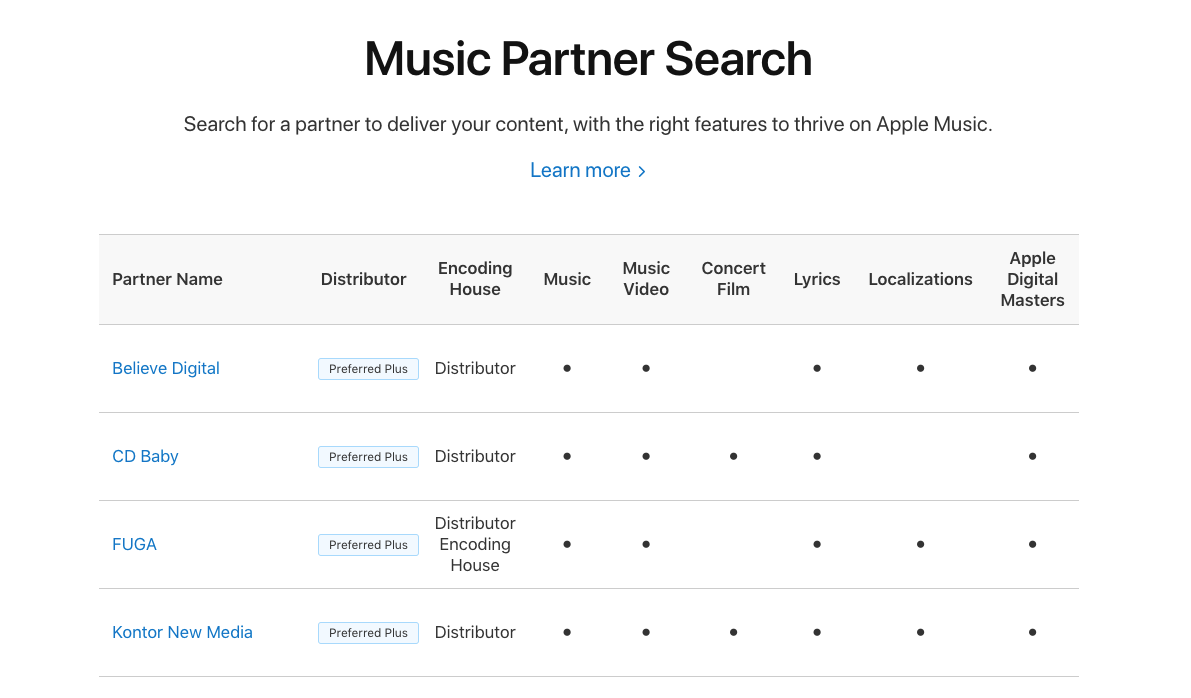
Apple’s Music Partner Search list – Apple Music video distribution
Apple’s official Music Partner Search list is an obvious place to start here, but there really aren’t very many of the officially highlighted services that you can just go sign up for, pay your money, and watch you music video on Apple Music (usually a few weeks later) as far as we can tell. You’ll find loads of them on there that say they do, and that might very well be the case, but it seems as though many of them are really more like a small label you would need to submit your package to before you’re even considered — or something to that effect. And on the other hand, much of the larger, well-known services on the list (TuneCore, Distrokid, etc.) do not support music video distribution.
Which services are the best for distributing music videos to Apple Music?
This leaves independent artists, bedroom producers, and aspiring content creators at a bit of a loss, or in a somewhat confusing mess of options to consider with limited possibilities for personal authorship when it comes to how to get music videos on Apple Music. Parsing through the royalty splits and pricing for each music video distribution avenue, policies/pricing for changes to content after delivery, and understanding video content requirements/limitations for each service, among other things, is already way more than enough for independent creatives to deal with — never mind some of the services on Apple’s list that present a complicated mess of a home page and/or are really only available for folks outside of North America.
So finding a service that’s simple and easy to understand with the details clearly laid out, is invaluable, even despite all of the other monetization considerations here. Some creatives just want to get their content out there to the world and on the biggest platforms in the game, so the ability to just submit content, pay the cash, and go without having to worry about the rest of it is what we are really after here today.
Symphonic music video distribution
And that brings us toSymphonic. Of all the options Apple mentions on its official Partner list, Symphonic appears to be the most straight forward for how to get your video on Apple’s platform. While TuneCore and Distrokid (use this link for 7% off your distribution job)— arguably the two biggest players in the indie music distribution game — don’t offer music video services, Symphonic appears to have a simple submission process that anyone can use.
The usual royalty splits and video spec requirements apply here as expected (no lyric videos on Apple Music anymore, no Facebook uploads unless you have a public official artist page, etc.), but in the end, you fill the forms out, send your cash, and you’re on your way. No need to have a million Spotify plays or a massive Instagram following for the independent distributor to consider you, just pay your cash and get your content out there.
Symphonic has a simple to follow submission process available that walks creatives through the entire process with several tips and details on what is required on your end and what to expect from the various streaming services, including Apple Music. There’s a handy four step checklist you can use to ensure your music video is ready to go as well as some important specifics regarding VEVO and videos featuring content in another language. You can browse through all of these details right here before you lay any cash down and you can review the Symphonic royalty schedule here.
More Apple Music distribution options
Sure, there are loads of options on Apple’s list that will get the job done, but most of them aren’t entirely open services. Popular distributor CD Baby, for example, is listed as supporting music videos but they don’t appear to offer or advertise that service anywhere. Does anyone have any experience paying for distribution with CD Baby and/or the music video situation?
Of the five services on the Partners list denoted as being a “Preferred Plus” option by Apple, CD Baby is the only one that doesn’t look like some kind of music label that has to want to distribute your creations to get your content out to the world or at least require some kind of private communication and submission process that feels like you’re trying to get a record deal or something. The others fall into the label-like side of things or aren’t even in english when you hit the home page.
While there are certainly other ways beyond Symphonic for getting your music video on Apple Music, when it comes to the officially supported options, it does appear to be the easiest way to make it happen at this point.