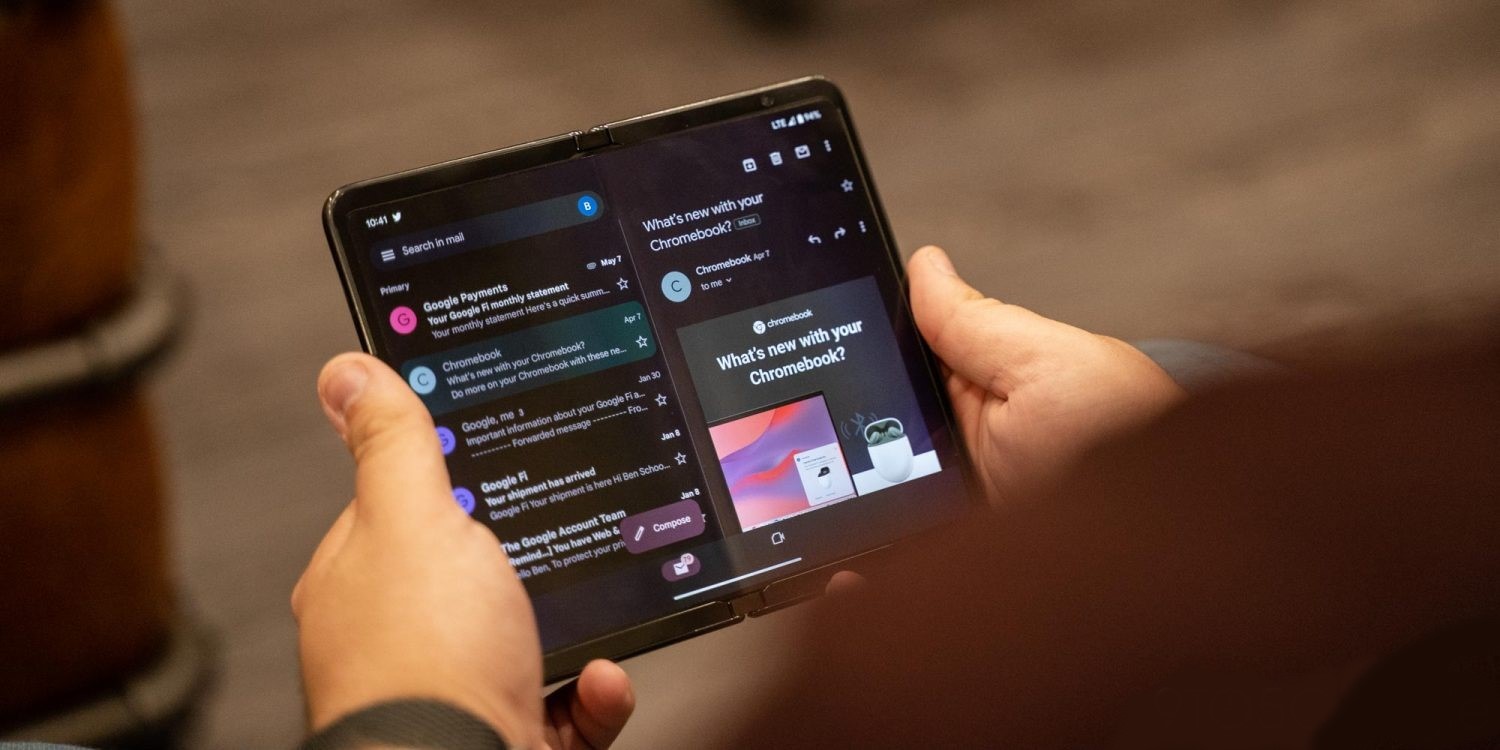
In Gmail for web, some users can experience Google’s Workspace Labs integration, which pulls Gemini’s AI functionality into the email site. One of the ways Gemini can operate is with the email summary feature.
In essence, Gemini can create a summary of email threads and content so you don’t have to dig through messages. It can prove to be rather helpful, but it’s still in the early stages of development.
According to PiunikaWeb, the email summary feature may also be coming to Gmail for Android. Hidden in an upcoming version of the app, the email summary tool was discovered. It comes as a button that sits right under the email’s subject, reading “Summarize this email.” Tapping would likely generate a summary at the bottom of the email, much like in the web version.
The tool doesn’t work in this infantile stage, but it showcases Google’s plans to bring Gemini to the mobile Gmail app rather than pioneer it solely on the web, which was unlikely. One could also argue that the feature would be even more useful in a mobile setting rather than on a desktop, where text and formatting are easier to make out.
Since this is a feature that shows signs it’s still being prepared Google hasn’t made any mention of when Android users can expect to see the Gemini-powered email summaries in Gmail. It’s also unknown as to whether the email summary feature from Gemini on mobile will be a limited rollout like the current version on the web.
Google’s Find My Device (FMD) network was originally supposed to launch in the summer of 2023, but it was delayed until Apple implements unknown tracker alerts. The upcoming iOS 17.5 update is adding that support.
Apple released iOS 17.5 Beta 1 and strings detailing how the iPhone will be able to detect third-party trackers. Once found, iOS will direct users to instructions on how to disable them.
For example: “This item isn’t certified on the Apple Find My network. You can disable this item and stop it from sharing its location with the owner. To do this, follow the instructions provided on a website by the manufacturer of this item.”
As of today’s release, this capability is not yet enabled and there’s no user-facing UI. It might go live with later betas and ultimately be ready when iOS 17.5 hits stable.
Looking at past schedules, iOS 17.5 might launch in May. After that update sees wide adoption, Google’s FMD network will be clear of any obstacles.
Google has been waiting “until Apple has implemented protections for iOS,” so that FMD devices cannot be used to track iPhone owners without warning. This delayed the original summer 2023 launch of the network that will leverage over 1 billion Android to periodically check for nearby devices to crowdsource the location of missing ones. The new Find My Device network can “locate devices that are offline or that don’t have location capabilities.”
Several tracker tags were delayed as a result of Google’s safety stance, while phones and earbuds, like Pixel Buds, have also been prevented from adding these capabilities.
iOS 17.5 to introduce new system to disable unwanted tracking accessories
Apple last year announced a partnership with Google to work on a new “industry specification to address unwanted tracking” after many concerns about stalkers using accessories like AirTags to silently track people. Now it seems that Apple is planning to launch these new anti-stalking features with iOS 17.5.
Detecting and disabling unwanted tracking accessories
As found evidence of these new anti-stalking features in the internal code of iOS 17.5 beta, which was released to developers on Tuesday. Strings added to the Find My app reveal that iOS will identify tracking accessories, even when they’re not Apple or Find My certified, and help users disable them.
“This item isn’t certified on the Apple Find My network. You can disable this item and stop it from sharing its location with the owner. To do this, follow the instructions provided on a website by the manufacturer of this item,” reads one of the new strings.
The feature doesn’t seem to be enabled for beta users for now, but this is strong evidence that it may become available with the official release of iOS 17.5. Companies including Samsung, Tile, Chipolo, Eufy, and Pebblebee have expressed interest in supporting this technology.
At the time, Apple and Google said they would create a new universal system for iOS and Android to detect and alert users about unwanted tracking accessories. Currently, iOS is already able to detect unwanted Bluetooth location-tracking devices, but only when they’re Find My certified. The company also offers an Android app to detect AirTags.
More about iOS 17.5
iOS 17.5 beta 1 doesn’t seem to bring any significant changes, as we’ve only seen a few minor tweaks so far. Apple is likely to release iOS 17.5 to the public next month, as the company is also rumored to launch new iPads and accessories in May.
iOS 17.5 beta 1: Here’s everything new
Apple released iOS 17.5 beta 1 to developers, after a month-long gap with zero beta releases. While iOS 17.5 beta 1 is a relatively minor update, there are a few things worth pointing out. Head below for more.
iOS 17.5 beta details
iOS 17.5 beta 1 features build number 21F5048f. It’s available now to registered developers, who can update via the Settings app by going to “General” and then choosing “Software Update.” We expect iOS 17.4 to be released to public beta testers sometime later this week or next week.
What’s new in iOS 17.5 beta 1?
Web installation
In the European Union, iOS 17.5 enables support for installing apps directly from a developer’s website. Apple announced this new “Web Distribution” feature last month, explaining that it lets developers distribute their iOS apps directly from their website.
To use this feature, developers will have to opt into the new App Store business terms, which means they will pay the Core Technology Fee of €0.50 for each first annual installation over one million in the past 12 months.
Any app distributed through the web will still be required to meet Apple’s notarization guidelines. Apps can only be installed from a website domain that the developer has registered in App Store Connect. Apple will also make a number of APIs available for integration with system functionality for developers.
While iOS 17.5 beta 1 lays the groundwork for this feature, there currently aren’t any developers offering their apps via this new Web Distribution feature. We don’t expect this to change until iOS 17.5 is released to the general public in May.
Design changes
iOS 17.5 beta 1 also includes a few small design changes throughout the operating system.
In the Settings app, there is a new glyph for the “Passkeys Access for Web Browsers” menu under “Privacy & Security.”
The Podcasts widget has been updated to have a new dynamic color that changes based on the artwork of the podcast you’re currently playing.
New unwanted tracking system
According to code found, iOS 17.5 appears to include a new system based around anti-stalking features for accessories like AirTags. This comes after Apple last year announced a partnership with Google to work on a new “industry specification to address unwanted tracking.”
Strings added to the Find My app reveal that iOS will identify tracking accessories, even when they’re not Apple or Find My certified, and help users disable them.
“This item isn’t certified on the Apple Find My network. You can disable this item and stop it from sharing its location with the owner. To do this, follow the instructions provided on a website by the manufacturer of this item,” one of the new strings says.
More
According to Aaron Perris on Twitter, iOS 17.5 also includes an update for MDM users: “MDM solutions can now enforce a beta version during automated device enrollment.”
New in iOS/iPadOS 17.5 and macOS 14.5: MDM solutions can now enforce a beta version during automated device enrollment!
Whether Apple has more changes planned for iOS 17.5 beyond what was launched today remains to be seen. The focus is clearly on the European Union, where Apple continues to adapt to the Digital Markets Act being enforced by the European Commission.
iOS 17.5 will likely be released to the broader public sometime in mid-to-late May. It will be the last iOS 17 update released before Apple unveils iOS 18 at WWDC in June.
A new rumor today reiterates the expectation that iOS 18 will be compatible with all the same devices as iOS 17. For iPadOS 18, however, Apple is planning to drop support for several older generation devices.
iOS 18 device compatibility
Today’s rumor comes after an initial rumor last month offered our first look at iOS 18 device compatibility. At the time, however, we cautioned skepticism because the rumor was posted and quickly deleted, suggesting the source wasn’t confident in their claims.
In what seems to be a more concrete rumor today, shared on social media by a private account with a strong track record, here’s which devices will be compatible with iOS 18:
iPhone 15
iPhone 15 Plus
iPhone 15 Pro
iPhone 15 Pro Max
iPhone 14
iPhone 14 Plus
iPhone 14 Pro
iPhone 14 Pro Max
iPhone 13
iPhone 13 mini
iPhone 13 Pro
iPhone 13 Pro Max
iPhone 12
iPhone 12 mini
iPhone 12 Pro
iPhone 12 Pro Max
iPhone 11
iPhone 11 Pro
iPhone 11 Pro Max
iPhone XS
iPhone XS Max
iPhone XR
iPhone SE (2nd generation)
iPhone SE (3rd generation)
For those keeping track at home, this means that iOS 18 will be compatible with all the same devices as iOS 17.
Other than those changes, iPadOS 18 will be compatible with the same devices as iPadOS 17. This includes the iPad (7th generation), which was first introduced in 2019 and is powered by the A10 Fusion chip.
iPadOS 18 compatibility:
iPad: 2019 and later
iPad mini: 2019 and later
iPad Air: 2019 and later
iPad Pro 2018 and later
This is a bit odd. The iPad Pro (10.5-inch) and iPad Pro (12.9-inch) (2nd generation) are both powered by the A10X Fusion processor, and will reportedly be dropped by iPadOS 18. The iPad (7th generation), meanwhile, is powered by the A10 Fusion and will reportedly support iPadOS 18.
After “hardware limitations” were cited as the reason that the Pixel 8 isn’t getting Gemini Nano earlier this month, Google announced today that the on-device LLM is coming after all.
The Pixel 8 will get Gemini Nano, in developer preview, to power Summarize in Recorder and Gboard Smart Reply. The latter allows for “higher-quality smart replies” that have “conversational awareness” and should be generated faster. On the Pixel 8 Pro, it works with WhatsApp, Line, and KakaoTalk. Meanwhile, Summarize can take a recording and generate bullet points.
RAM — 8 GB versus 12 GB — is the main hardware difference between the two Tensor G3 phones. Google today says “running large language models on phones with different memory specs can deliver different user experiences, so we have been testing and validating this on Pixel 8.”
It looks like Google found a way to run the LLM on less RAM without impacting the rest of the user experience, with the smaller Galaxy S24 doing the same. As a reminder, Google only ever said Gemini Nano was coming to the Pixel 8 Pro in December. Meanwhile, the comment earlier this month came from an engineer outside the Pixel team.
Gemini Nano is coming to the Pixel 8 with the next Pixel Feature Drop, which should be Android 14 QPR3 in June (if previous timelines remain in place). Besides end users getting those two Google app features, developers with the Pixel 8 will be able to use AICore for their own applications.
The work to make Gemini a better phone assistant continues, with Google recently updating it to automatically start Maps navigation “when you ask for directions.”
“Navigate to [place]” or “take me to [x]” commands first show a brief summary with the route, how long it will take, and how many miles, as well as a map and link to “directions.” This is one capability that Gemini can handle natively with the Google Maps Extension instead of having to punt to the legacy Assistant.
After a few seconds, Gemini now opens Google Maps with the route underway to save you a step and improve the hands-free experience. This is according to the latest Play Store release notes for the Gemini app/icon, which also include:
“You can now use your voice to set reminders and calendar entries with the Gemini app if your Workspace extension is turned on in your Gemini app settings. Workspace extension availability varies by country. See more details here: https://support.google.com/gemini/answer/14579631#workspace_extension“
“We updated voice commands to include auto submit. No need to hit the ‘send’ button anymore.”
Meanwhile, we’re still waiting for the ability to issue “play music” commands. Google implies that this is coming: “Media service providers: Podcasts, news and radio stations, and third-party music providers aren’t currently supported in Gemini.”
It’s taken way too long, but after the better part of eight years now, Samsung has finally adopted Android’s Seamless Updates on its latest Galaxy devices.
Seamless Updates were first introduced in Android Nougat way back in 2016, almost eight years ago now. The feature allows devices to install an update in the background and apply the update on a reboot. While it’s typically slower and can eat up more storage, the A/B partition allows for a safer install as a messed-up installation can be reverted to the prior software build. It also leaves the device fully usable during the lengthy install process. Google has also made improvements to Seamless Updates over the years, with the feature now being much faster and also requiring less storage using a “virtual A/B mechanism.”
Yet, for all this time, Samsung has repeatedly skipped out on this feature that virtually every other Android OEM currently uses.
That’s finally changed now, though, as the Samsung Galaxy A55 is the company’s first smartphone with Seamless Updates support for Android updates.
The change was spotted on the new mid-range device by early buyers (via Mishaal Rahman) as well as SamMobile and The Mobile Indian. On downloading an update on the device, a new “downloading and installing” message appears with “Restart Now” appearing when the device has the update installed. Existing Samsung smartphones have an “Install Now” prompt when the update
Samsung may have finally implemented seamless updates on their Android devices! When updating the new Galaxy A55 5G, users have noticed that the software update screen now shows a "downloading and installing" as well as "verification" steps.
a feature configured before the device is in the customer’s hands. Back in 2016, Google had confirmed that existing devices wouldn’t support it.
However, future Samsung Galaxy devices are very likely to support Seamless Updates going forward. It was revealed earlier this year that Android is moving to only support this form of update, and while Samsung could technically work out a way to stick with its existing model, it seems the company has decided to just give in to how Android is supposed to work in 2024.
AirPods today offer a handful of different features related to hearing health and Accessibility. A new report today, however, says Apple has big plans for iOS 18: a new “hearing aid mode” for AirPods Pro.
AirPods Pro with iOS 18
In the latest edition of his Power On newsletter, Bloomberg’s Mark Gurman writes that AirPods Pro aren’t set to see any hardware changes in 2024. Instead, he says that the “big news will be a major new hearing aid mode, coming alongside iOS 18.”
AirPods already offer a feature called Live Listen, which launched as part of iOS 12 in 2018. This feature essentially turns an iPhone into a directional microphone, transmitting the audio captured by that iPhone to AirPods in real time. A handful of testimonials over the years have shown how useful this feature can be.
Apple also introduced a Conversation Boost capability to AirPods Pro in 2021, which boosts mic pickup from directly in front of you, to better hear someone talking to you. A study in 2022 showed that some of these existing AirPods Pro features already compare well to much more expensive dedicated devices.
Also notable: in 2022, the FDA established new guidelines to allow for a category of hearing aids that can be purchased over-the-counter. Hearing aids within this category can be sold directly to consumers in stores or online without a medical exam or a fitting by an audiologist.
More details on this new iOS 18 feature for AirPods Pro users are unclear. This isn’t the first time Gurman has written about Apple’s plans to bring new hearing health features to AirPods, though. Last year, he reported that Apple is also working on a hearing test feature for future AirPods as well.
iOS 17.4 is a massive new iOS update for iPhone users, and includes new features to support European Union regulations, which makes it possible for to use alternative app marketplaces. However, the recent changes aren’t just limited to those who fall under EU jurisdiction. iOS 17.4 has tons of new changes and features, like new emoji, new Apple Music and Apple Podcasts updates, an updated “Hello” screen, and much, much more.
Notable iOS 17.4 updates
Podcast transcription
My favorite iOS 17.4 change relates to the Podcast app. I appreciate it even more since I recently launched a brand new podcast called 9to5Mac Overtime with my colleague Fernando Silva. The Podcast app now has text transcriptions that work similarly to the lyrics view in Apple Music. As the hosts talk, you’ll see each word from the transcription highlighted, and the highlights will adjust in real-time based on playback speed.
Another nice thing about text transcription in Apple Podcasts is the ability to search for a term quickly and jump directly to a specific part of the show with just a tap. I’m impressed with the accuracy of podcast transcription, and I was surprised at how well it accommodated my Kentucky twang.
iOS 17.4 RC changes and features
Apple Cash virtual card numbers and Safari autofill
Apple Cash gets more valuable thanks to the new virtual card numbers that can be regenerated on the fly in iOS 17.4. These numbers let you use your Apple Cash balance at merchants that don’t use Apple Pay. It also includes the ability to autofill card numbers in Safari and will even reflect your Apple Cash balance on the autofill button so that you know if you’ll be able to cover the balance in advance.
Music recognition
Updated integrated Shazam music recognition can now add a song directly to your Apple Music library or a specific playlist. Music recognition will also let you add classical music songs to Apple Music Classical.
Stolen Device Protection update
Stolen Device Protection gains additional security in iOS 17.4 thanks to a new option that lets you enforce the 1-hour delay at all locations before you can access critical areas of your iPhone. In previous versions of iOS, the security delay was only enforced when not in a familiar location.
Battery Health
Apple updated battery health by decoupling Battery information from Charging Optimization. It also instituted a new, more straightforward Battery Health status, similar to what Mac users have. In addition, pertinent battery information like cycle count, manufacture date, and first usage date now reside directly within Settings → Battery → Battery Health.
Full list of what’s new in iOS 17.4
Updated “Hello” Screen
New emoji
18 new right-facing body emoji
City Digital Clock Widget
Apple Podcasts full episode text
Apple Podcasts transcripts
Podcast app Home tab replaces Listen Now
Music recognition update
Music app “Home” tab replaces “Listen Now”
Apple Music Classical Music Recognition
Updated Lock Screen song title animation
Siri announces messages in any supported language
Stolen Device Protection update
Battery Health decoupled from charging
Battery Health Status
Additional Battery data
Passkeys Access for Web Browsers
Apple Cash virtual card numbers
Apple Cash autofill in Safari
Updated dialer background for unknown calls
Quantum Computer Protection for iMessage
Support for game streaming apps
Updated TV app channel links
Updated “How to Watch” in TV app
Updated iCloud glyph in Files app
Updated App Store user settings
Other iOS 17.4 bug fixes
CarPlay Updates
Beats Solo 4 Headphones
iOS 17.4 isn’t all about EU regulatory changes, but there are noteworthy updates that all users, regardless of location, will benefit from. Highlighted a few in this post, but as you can see from the bullet point list above, there are tons of new changes and features in iOS 17.4, not to mention the various bug fixes and security updates.
iOS 17.4 RC was stable in my brief hands-on time with the release. This is likely the version that Apple will launch next week. We’ll know if next week’s release sports the same 21E217 build number.
It sounds less drastic than the visual changes seen in the iOS 6 to iOS 7 transition, though. He writes “the company is indeed working to update the design of iOS as early as this year, but I don’t believe it will be a total overhaul that mirrors visionOS”. While Gurman says we can expect to see changes in iOS 18 this summer, the work on macOS has only just started and won’t be ready until 2025 or 2026.
Since Apple Vision Pro operating system was first unveiled, many people have wondered whether Apple will update the design of its other operating systems to match the visionOS aesthetic of 3D buttons and and glassy background textures. This doesn’t necessarily hold, as the visionOS design is specific to a platform that revolves around passthrough video. Being able to see the context of the world around you ‘through’ the open app windows is a concept that doesn’t really apply to iOS.
However, it has been a while since we’ve seen major design changes come to the iPhone and iPad. A visual refresh of any kind would make for an exciting release, that is also set to include significant AI-powered features.
Indeed, Mark Gurman previously said that Apple sees iOS 18 as its “ambitious and compelling” with major new features and designs. The company will officially unveil its next-generation operating systems at the annual WWDC conference in June. iOS 18 will be in beta over the summer and release for everyone in September, assuming Apple follows its usual traditions.
According to a public-facing comment, Google is set to launch its first preview of Android 15 later this week.
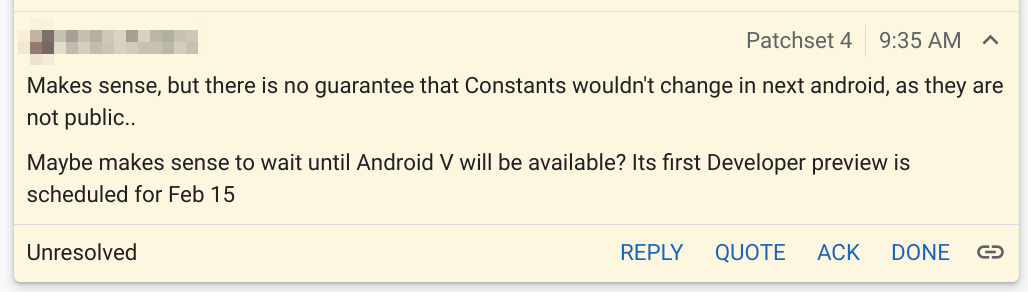
In a comment posted to the Android Open Source Project on Tuesday morning, a Google developer said that the first preview of Android 15 is “scheduled for” this Thursday, February 15, 2024. The developer calls it “Android V,” which refers to the release’s internal dessert codename, “Vanilla Ice Cream.”
Maybe makes sense to wait until Android V will be available? Its first Developer preview is scheduled for Feb 15
If the timing holds, the first Android 15 Developer Preview will arrive just over a week after the launch of Android 14 QPR3 Beta 1. Somewhat notably, Android 15’s first preview is arriving later than last year’s preview, which was released on February 8, 2023. By comparison, though, Android 13’s second quarterly update was still being tested at the time.
It’s safe to assume that only Pixel devices will be eligible for the Android 15 Developer Preview, as was the case in years past. Those enrolled for beta updates will likely stay on Android 14 for the time being, as “Developer Preview” releases are typically less stable and not ready for public use.
This Android 15 Developer Preview should afford our first solid look at what to expect from the next annual release of Google’s mobile OS. That said, we have gotten quite a few hints over the last year in the form of features that our APK Insight team has found/enabled that Google has yet to launch. Chief among these is the “Private Space” feature that will allow you to hide and lock certain apps from appearing in your app list.