The Nokia X20 was the premium offering among Nokia’s budget-focused April 2021 launch, offering a great-looking design, long battery life, Zeiss cameras and three Android OS upgrades starting at just £299.
But while the Nokia X20 may tempt consumers with a stock Android experience, extended software updates and a three-year warranty to match, performance issues stop it from reaching its full potential.
Design and build
Premium build quality
Simplistic yet attractive design
Non-remappable Google Assistant button
Nokia smartphones tend to sport the same form factor, and those looking for a change with the Nokia X20 may be disappointed. It’s very much business as usual from a Nokia perspective, offering a simplistic take compared to the likes of Realme and Xiaomi who tend to peacock with their offerings, offering shimmering finishes, curved displays and more to entice consumers.
That’s not to say it’s dull; the Nokia X20 sports a reflective matte finish on the rear that looks premium, feels great in the hand, and helps to negate those pesky fingerprints too. However, there’s no denying that it’s also among the thicker smartphones out there at 9.1mm, and it’s a little weighty at 220g too.
It’s the small details that help the X20 shine, like the premium metal band that runs around the exterior, matching the colour of the rear – either the bronze-tinted Midnight Sun or deep Nordic Blue – and the Zeiss-branded circular camera housing on the rear.
It’s clear that this isn’t an entry-level Nokia, although that line would’ve been more clearly defined if Nokia opted for a glass rear in place of plastic.
On the right of the 6.67in display, you’ll find volume rockers and a fingerprint reader, and on the left, you’ll find a SIM card tray and the Google Assistant button – another staple of Nokia smartphones. And, just like every other Nokia, it’s not remappable, so it’s pretty useless unless you actively use Google’s virtual assistant.
The Nokia X20 tempts users with stock Android, three OS upgrades and a three-year warranty, but that’s not enough to make up for comparatively lacklustre hardware.
It’s the middle child in the current lineup between the X and G series, and as the middle child, it needs to be reasonable, and very logical. You definitely won’t get any dazzling specs here, and there are definitely some compromises, but do they get in the way in the grand scheme of things? Are the compromises too much compared to the X20? You can watch the video review below:
Nokia is challenging other manufacturers: Not necessarily with the fastest smartphones on the market, but with a company policy that is as sustainable as possible. This includes prolonged Android update cycles for the X series devices, i.e. Nokia’s most expensive smartphones, and the absence of a charger in the box, for example.
The Nokia X10 is the somewhat watered-down counterpart of the Nokia X20. In terms of design, there is hardly any difference between the two devices, and many specifications appear to be very similar as well. The official price difference is 80 Euros (~$95), and the Nokia X10 is priced at 319 Euros (~$378), placing it in the traditional price range of the smartphone mid-range.
Solid, well-built hardware design with a nice in-hand feel. No fancy glass or aluminum on the outer shell, but the practical approach is very much appreciated when it’s executed well, and it is executed very well here. I love that forest green personally.
Excellent battery life. It might not have the largest battery capacity at 4,500 mAh, but it lasts 1.5 days with ease, and up to 2 with a more conservative approach. I’m averaging 8-9 hours of screen on time too.
Reliable FHD+ IPS LCD display with Pixelworks tech for pushing more punchy colors when consuming content. Good outdoor visibility too.
The side-mounted fingerprint scanner that’s been integrated into the power button works well and is decently fast too.
Respectable daily performance. The SD480 might have gathered attention for all the wrong reasons, but in benchmarks, the X10 matches the X20, and the SD480 goes head to head against devices running with an SD720G processor in numbers. This also reflects in gaming, where the Adreno 619 plays games like COD at high settings with max framerate with ease. Haven’t missed the 2 extra gigs of RAM on the X20 at all.
Okay 48MP camera. Not better than the X20’s 64MP, as it pushes out more saturated, extra sharpened images with slightly fewer details, but it does work well enough, even in low light. It also perfectly matches the X20 when it comes to features. Pro mode,Cinema mode, dual sight, and OZO audio are all present.
Attention to details in things that might not be obvious, such as the Impressive heat management and haptic engine. It never got warm during my regular usage, and only got mildly warm when gaming for 30+ minutes. It matches devices that are far more expensive in this regard.
5G support, and not just as a marketing gimmick. The phone supports a wide range or 5G bands so should work worldwide without any issues. The phone also doesn’t skimp out on any sensors, has NFC, and a headphone jack. Yay!
3 Years of OS updates, matched by 3 years of security updates. Nice.
MINUS POINTS FOR THE X10
The X10 is quite big and heavy for its class. While the heft adds to the overall quality perception, it might not suit everyone. The bezels on the front are also bigger than average, which adds to the overall size.
The display offers no high refresh rate, which usually helps with the overall smoothness of the experience, but this usually comes at the expense of battery life. Giving people an option to go higher than 60Hz would have been nice.
The 8MP selfie camera is weak. So are the 5MP ultra-wide cameras and 2MP macro cameras due to lack of resolution. You also can’t record 4K videos at all, so the max you can do is 1080p at 60fps.
While Android One has its fans, some people might miss the additional customization options offered by the competitors.
The phone only has a single bottom-firing speaker. It gets pretty loud while keeping decent quality levels, but some competitors offer dual speakers with better audio quality.
Despite the excellent battery life, the charging speed is limited to 18watts. So it takes just less than 2 hours to fully charge, and around 40 minutes to reach 50%. This is definitely below average for its class.
The Moto G8 Power Lite is an affordable counterpart to the Moto G8 Power, which is in turn one of the Moto G8 siblings along with that phone, the Moto G8 Plus and G8 Play. It’s also arguably a more apt successor to the Moto G7 Power than the G8 Power, as it’s cheaper than the 2019 smartphone, rather than pricier as the G8 Power is.
The key selling point of the G8 Power Lite is, as the name suggests, its battery capacity: with a 5,000mAh power pack this is a phone that’s built to keep going for a long time, and thanks to its middling chipset and low screen resolution, it’ll see you through two days of use in a pinch. One downside, though, is its micro USB port, which only allows for modest charging speeds and data transfer speeds compared to the standard USB-C, and means that charging your phone back up again will feel like it takes two days. In some ways, it feels like Motorola is trying to prove something with the Moto G8 Power Lite’s specs. There are three rear cameras, although only the 16MP main snapper feels useful, and its 2MP macro and depth-sensing buddies feel tacked on. Similarly the 6.5-inch screen is as big as a plus-size premium phone’s display, but it’s only HD, and content looks so low-res blown up to this size that arguably a smaller screen would be better.
That’s not to say the Moto G8 Power Lite does a poor job of being a cheap phone that’s trying to be a mid-ranger, but the extra elements feel tacked on, while the phone nails the elements that are more common in cheaper phones: the rear fingerprint scanner feels intuitive to use, the plastic frame feels sturdier than those of other phones that use the same material, and the 3.5mm headphone jack is a welcome addition.
All in all, the Moto G8 Power Lite is one of the best phones you can buy at its price point, thanks to its long-lasting battery and the aforementioned design elements. We just think that Motorola could make an even better phone by fully embracing its low-end nature and cutting out some of the superfluous elements.
The Moto G8 Power Lite lives up to its name, and it’s one of the longest-lasting smartphones out there, so you won’t need to charge it up that frequently.
You don’t need top-end processing power
Many people don’t need smartphones that are as powerful as your average laptop, and while the Moto G8 Power Lite is pretty underpowered, you don’t need top-end performance if you’re only going to send texts and make calls, and check social media from time to time.
You don’t use all the newest tech
The Moto G8 Power Lite sports older tech, from its micro USB port and 3.5mm headphone jack to the Android 9 software on board, but some of this helps to keep the price down, and if you’re upgrading from an older phone you may be perfectly happy with what’s on offer here.
Don’t buy it if
You have smaller hands
The Moto G8 Power Lite is a big handset, in terms of both screen size, and weight and dimensions, and if you’re looking for a compact phone, or one that you can easily use one-handed, this phone probably isn’t right for you.
You need a great camera
You’re getting what you paid for with the Moto G8 Power Lite’s camera setup – that is, you’re not getting much. If you’re not a frequent phone-camera user, either because you’ve got a dedicated camera or you just don’t take many pictures, it’ll be fine for you, but if you want to be able to take good-looking photos with your phone you’ll need to look elsewhere.
You like playing mobile games
Because of its weak processor the Moto G8 Power Lite isn’t exactly a gaming powerhouse, unless you consider Sudoku the only game worth playing; you’ll need something with a more advanced chipset if you’re looking to play the likes of PUBG: Mobile or Fortnite.
Verdict
The Moto G8 Power Lite is cheap and has a long-lasting battery, and if that’s all you’re looking for from your phone, it’s likely a device you’ll be happy with. In some ways Motorola has tried too hard to hide the phone’s ‘budget’ roots, notably with the large screen and three rear cameras, and these attempts fall a little flat, but look past the pretences and this is one of the best cheap phones you can buy.
With Unpacked 2022 only a couple of weeks away, we already have a pretty good idea of what the Galaxy Z Fold 4 and Galaxy Z Flip 4 will look like, both inside and out. To put any doubts aside, new official renders have appeared online, showcasing four attractive colorways.
Over the past couple of months, we’ve already seen just about anything there is to see with the upcoming Galaxy Z Flip 4. Generally unchanged from the previous model, the Galaxy Z Flip 4 is set to come in four colorways – black, blue, cream, and purple.
According to Giznext, these colorways are likely to be officially named Graphite, Pink Gold, Bora Purple, and Blue. In an exclusive leak, the site was given official press renders of the Galaxy Z Flip 4 via @onleaks (Steve Hemmerstoffer). The images show off each color and several different angles, giving us a great look at each of them
And this is the #Samsung#GalaxyZFlip4 in all it’s glory and four color options through a set of official press renders! #FutureSquad
While the majority of details look virtually identical to the Galaxy Z Flip 3, there are a couple of small differences. First, the hinge seems to have a tighter tolerance when the device is fully open. To add, the rear display and camera bar seems to stretch out almost entirely from side to side.
On the Galaxy Z Flip 3, it seemed as if the black screen and camera array sat off of the edges a little bit. The new design looks to unify the camera bar and rear of the device. Overall, the Flip 4 has a slightly cleaner look.
Aside from that, there isn’t much more to glean from these Galaxy Z Flip 4 renders until Unpacked 2022 gives us a much better look at the devices. We’re expecting the Galaxy Z Flip 4 to be priced roughly starting at €1,080 for the 8GB/128GB storage model.
Latest Galaxy Z Fold 4 leak pins down storage offerings, ‘Burgundy Red’ color option
Samsung’s Galaxy Z Fold 4 is probably only a month away, and a fresh leak is giving us a better idea of what to expect from the storage, as well as revealing a “Burgundy Red” color option.
Evan Blass today posted a list of Galaxy Z Fold 4 variants that break down the color and storage offerings for Samsung’s upcoming phone.
This list confirms two things. Firstly, it seems the 1TB storage option we previously heard of may not be available after all. Blass’s list shows 128GB, 256GB, and 512GB versions of the Fold 4. It was previously rumored that a 1TB model would also be on the way, but this list implies that won’t be the case. Of course, it’s entirely possible this is a regional restriction – while Blass doesn’t mention it, it seems safe to assume this list is regarding the US market.
Beyond that, we also get a breakdown of the color options for the Galaxy Z Fold 4, including “Burgundy Red.”
This color option was previously mentioned by a display analyst, who claimed the color would be tough to purchase. It is noteworthy that this color option is available exclusively in the higher storage tiers, rather than the base 128GB.
The full breakdown of colors and storage options in Blass’ list can be seen below.
Beige – 128GB/256GB/512GB
Burgundy Red – 256GB/512GB
Gray-Green – 128GB/256GB/512GB
Phantom Black – 128GB/256GB/512GB
Samsung is rumored to be launching the Galaxy Z Fold 4, Flip 4, and its next Galaxy Watch sometime in mid-August.
One of the new features of iOS 16 is Lockdown Mode, which helps users protect themselves against targeted cyber attacks by disabling multiple device features. Among everything Lockdown Mode changes, it also restricts web browsing – and now software engineer Alexis Lours details how exactly that happens.
Lours shared on his personal blog how he ran multiple tests to find out which web features are disabled when Lockdown Mode is turned on. Thanks to Modernizr, a JavaScript library that detects features available in a web browser, the engineer has obtained a list of WebKit features that can potentially be used to spy on users.
Lockdown Mode’s impact on web browsing
The first thing noticed by the engineer is that Lockdown Mode disables just-in-time JavaScript compilation (JIT), which compiles code on the fly during its execution. Without JIT enabled, web browsing performance drops by up to 95% based on benchmark tests. This results in longer loading times and even higher battery consumption.
Lockdown Mode in iOS 16 disables also disables WebAssembly. WASM a powerful binary code format that enables high-performance apps on web pages. However, it can also be used to create a digital “fingerprint” of users, which helps third parties track people across websites and apps.
Interestingly, support for MP3 players on webpages is also disabled with Lockdown Mode. Lours believes that Apple wants to prevent attackers from using MP3 decoding for malicious purposes. Of course, this ends up breaking any website with MP3 playback without a fallback to the AAC or OGG formats.
The Gamepad API, which was created to let users interact with game controllers on websites, doesn’t work with Lockdown Mode enabled. This is because malicious websites can use details like the controller ID to track users. Unsurprisingly, this breaks down web games and platforms that rely on an external game controller.
Previewing files in web browsers is also restricted with Lockdown Mode. For instance, JPEG 2000 images and SVG fonts, which are exclusively supported by Safari, are disabled so websites can’t use these formats to target iOS users. PDF previewing for websites is also disabled, as multiple PDF-related exploits have been found in the past.
Other disabled features include WebGL, Speech Recognition API, and the Web Audio API.
What else does Lockdown Mode restrict?
In addition to restricting web browsing, Lockdown Mode in iOS 16 also blocks most message attachments and link previews in Apple’s Messages app. Users with Lockdown Mode enabled only get FaceTime calls from known numbers and iCloud Shared Albums are removed from the Photos app.
Apple also blocks configuration profiles and access to the device over a wired connection with Lockdown Mode turned on.
Of course, Apple emphasizes that Lockdown Mode is intended for a specific group of users who may be targeted by sophisticated espionage threats. These users include journalists, activists, and members of governments. This came after the company filed a lawsuit against ‘Pegasus’ spyware creator NSO Group last fall.
Lockdown Mode is available as part of iOS 16, which is expected to be released this fall. Developers and users registered in the Apple Beta Software Program can now try out iOS 16 beta.
Google is preparing to expand Pixel’s support for showing At A Glance notifications from smart doorbells to also include alerts from Ring products.
About APK Insight: In this “APK Insight” post, we’ve decompiled the latest version of an application that Google uploaded to the Play Store. When we decompile these files (called APKs, in the case of Android apps), we’re able to see various lines of code within that hint at possible future features. Keep in mind that Google may or may not ever ship these features, and our interpretation of what they are may be imperfect. We’ll try to enable those that are closer to being finished, however, to show you how they’ll look in the case that they do ship. With that in mind, read on.
Over the course of this year, Google has put a significant amount of effort into the expansion of the At A Glance widget that is ever present on the homescreen and lock screen of Pixel devices. What originally started as useful reminders from Assistant and Calendar has become an all-in-one hub for things your phone thinks you might want to know immediately.
One such recent improvement was the addition of support for alerts from Nest Doorbells, indicating that someone is at the door and (if recognized by Familiar Faces) who it is. Now it seems Google is preparing to expand At A Glance’s support for smart doorbells to include third-party options.
As spotted in the latest release of Android System Intelligence — “T.5” which is notably the first non-beta update to the app’s Android 13 variant — the At A Glance widget is picking up support for doorbells from Ring. Since 2018, Ring has been owned by Amazon, but the company has been no stranger to Google’s ecosystem, offering full Google Assistant integration.
“Show who’s at the door when your Nest or Ring doorbell rings”
Where the existing integration with Nest is easily possible as the Google Home app is installed by default on Pixel phones, the upcoming Ring doorbell support will require that you have Ring’s app installed. Given the feature has so far only appeared in Android 13 builds of Android System Intelligence, it’s likely this particular integration won’t be launching until much later this year.
At A Glance has steadily expanded over the past year
The new tidbit comes as part of a broader movement by Google to integrate At A Glance with third-party apps and services. In recent weeks, we’ve seen preparation for the widget to support delivery notifications from services like Doordash and ETA alerts from ridesharing apps like Uber and Lyft.
Curious how much RAM Apple has put in its iPhones over the years or how much memory your current iPhone has? While the company doesn’t publicly share the information, memory details surface in teardowns and from other sources like Apple’s supply chain. Read along for a look at the complete iPhone RAM list for how much memory comes with every iPhone model..
Apple doesn’t publish or put any focus on iPhone RAM for a number of reasons. One of the biggest is iPhone performance outpaces the competition like Android phones with less RAM. Apple is able to do that as it makes both the hardware and software and precisely fine tunes its devices to perform as efficiently and powerfully as possible.
So in the big picture, Apple focuses on what its iPhones can do rather than the specs powering them.
One example was in 2019 when the iPhone 11 Pro Max with 4GB RAM beat out the Samsung Galaxy Note 10+ which has 12GB RAM in a speed test. That’s right, the tight integration between iPhone hardware and iOS made up more than an 8 GB memory difference. The same is usually true for iPad and Mac vs Android tablets and PCs too.
Before you look, can you guess how much RAM the original iPhone had? 😁
Motorola unveiled an exciting trio of Edge 20 smartphones with a few shared key features – HRR OLED screens, 108MP primary shooters, 5G connectivity, and 30W fast charging.
Today, we will be exploring the Motorola Edge 20. With a powerful Snapdragon 778 chipset and a 3x tele camera, the regular Edge 20 model is the most balanced one of the trio. There is a Pro model with a flagship Snapdragon 870 SoC and 5x periscope camera, while the Lite model runs on the basic Dimensity 720 platform and has no zoom camera.
Before we continue, we want to warn you not to confuse this Motorola Edge 20 with the US-exclusive Motorola Edge (2021) that is a reworked Edge 20 version, or the India-exclusive Motorola Edge 20 Fusion, which is based on the international Edge 20 Lite model.
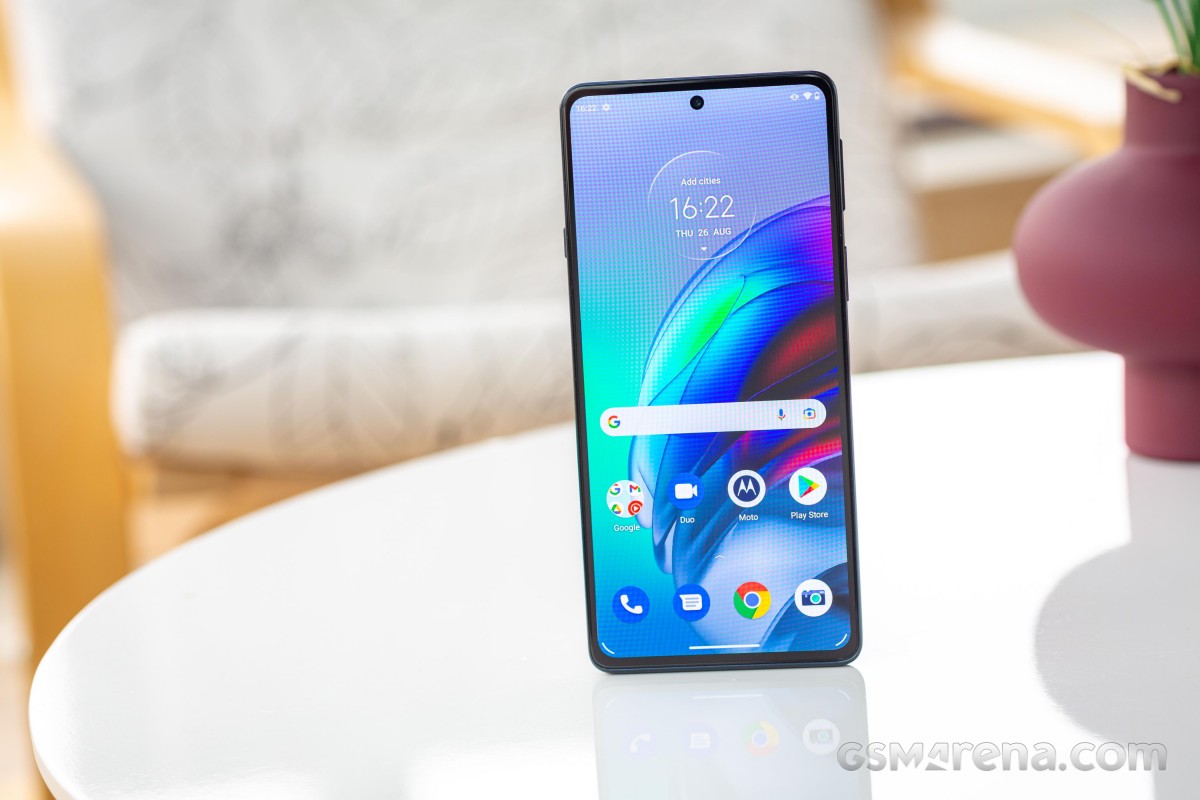
So, the first thing you will immediately notice about this new Motorola Edge 20 is that it is not a curved smartphone like the original Edge, just on the contrary. It has lovely flat sides, screen and rear panel and is incredibly thin at 7mm. As usual, the Edge 20 is splash-proof thanks to its water-repellent build.
The Motorola Edge most impressive feature is the 6.7″ OLED screen with 10-bit colors and 144Hz refresh rate. It supports a dynamic refresh rate too, but we will talk more about this in our display section. For now, let’s say it sure looks great on paper.
This Edge 20 model is based on the Snapdragon 778G 5G chipset, which offers a powerful processor and GPU. It should be enough for smooth HRR gaming, and there is 5G connectivity, too. The Edge 20 Pro is the one with the flagship-grade Snapdragon 870 SoC, but it sure sounds like a bit overkill for a 1080p screen, don’t you think?
Anyway, the rear camera of the Edge 20 is thoroughly interesting. It has a 108MP primary snapper with Samsung’s ISOCELL HM3 sensor, followed by an 8MP camera with 3x optical zoom and a 16MP ultrawide shooter with autofocus for cool macro photos. The selfies are handled by a front 32MP camera. The Pro model offers 5x zoom instead of 3x, while the Lite model has no tele camera.
The Motorola Edge 20 also shines with 30W fast charging and clean-ish Android 11 with some cool Moto tricks.
Video capture:Rear camera: 4K@30fps, 1080p@30/60/120/240fps, 720p@960fps, gyro-EIS; Front camera: 1080p@30fps.
Battery: 4000mAh; Fast charging 30W.
Misc: Fingerprint reader (side-mounted); NFC.
Looking at the specs of the Motorola Edge 20, we can think of only two possible issues – the omission of stereo speakers and the battery capacity. Other mid-range smartphones are offering dual speakers and 4,500mAh or more capacity, especially larger phones like the Edge 20.
Without further ado, here is the Motorola Edge 20.
Unboxing the Motorola Edge 20
Motorola Edge 20 ships within a thin blue box, which contains a 30W power adapter with a USB-C port and a USB-C cable.
The phone also arrives with a transparent silicone case, and it’s already put on for your convenience.
The competition
The Motorola Edge 20 seems like a great smartphone with thoughtfully picked features and a competitive price of €480. It is one of the few devices to offer 144Hz refresh rate support for its OLED screen; there is powerful enough hardware, a versatile camera on the back, and a clean Android package with a cool Ready For desktop-like experience.
Unfortunately, there are plenty of €500 smartphones with flagship-grade features ready to fight for a spot on the market. Let’s look at some of these and see if the Motorola Edge 20 can stand its ground next to them.
The first offer that comes to mind is the nubia Red Magic 6R – the only handset that can offer a similar 144Hz OLED screen at €500. It trumps the Edge 20 with a flagship Snapdragon 888 5G chip, pressure-sensitive shoulder triggers for gaming, stereo speakers, and faster charging. It omits splash protection, a zoom camera and a Ready For alternative. We guess you should decide on which package makes more sense to you.
The Realme GT Master Explorer is about to launch in Europe at about €500, and it’s one of the best phones you can get at that price with one of the worst names. The GT ME has a unique design, the current second-best chip in the world – the Snapdragon 870, and a tri-camera rear setup with an impressive 50MP primary with OIS with good 2x lossless zoom and 4K at 60fps capturing. There are also stereo speakers and impressively fast 65W charging. The Edge 20’s inferior in almost all aspects but the splash resistance, the longer zoom, and the Ready For support. If you like the Realme GT ME, but you don’t want to wait for its release, the Realme GT is even faster but not as fancy as far as cameras are concerned.
The recently launched Galaxy A52s by Samsung runs on the same Snapdragon 778G 5G SoC and offers a large 120Hz Super AMOLED screen. Its quad-camera omits a zoom snapper, but the 64MP primary has OIS, which helps a lot at night. The Galaxy A52s is fully water-resistant, packs two loudspeakers, an under-display fingerprint scanner; then there are rarities like a 3.5mm jack and a microSD slot. If only the A52s had DeX support, it would have been the better choice. Alas, it doesn’t, so once again, it’s up to you to weigh on the pros and cons.
Finally, the €300 splash-proofed Poco F3 is a budget offer worth considering. It packs a couple of flagship essentials such as a 120Hz AMOLED and Snapdragon 870 5G chip, loud stereo speakers, and long-lasting battery life. It cannot match the Edge’s software experience and camera versatility, but at that price, it’s something you should at least consider.
ZTE nubia Red Magic 6R • Realme GT Explorer Master • Samsung Galaxy A52s 5G • Xiaomi Poco F3
Obviously, no other than Motorola can offer Read For support, so let’s see the in-house competition.
The Moto G100 was the Ready For pioneer, and it’s still quite attractive. It has a slower 90Hz LCD screen but has a more powerful Snapdragon 870 5G chip and a much better battery life. There is no zoom camera on the G100, but you do get a second ultrawide selfie camera for what’s that worth. The G100 costs about the same as the Edge 20, so unless you need the more powerful SoC or you find the G100 at a bargain price, we’d choose the Edge 20.
The other two Edge 20 phones are good alternatives. The Edge 20 Lite relies on the budget Dimensity 720 5G chip with support for up to 90Hz refresh rate and drops the zoom camera, but it is about €150 cheaper at €340 and offers much better battery life. We are not sure if we’d be okay with that entry-level chip, but the price difference is sensible, and the Lite should be considered for that.
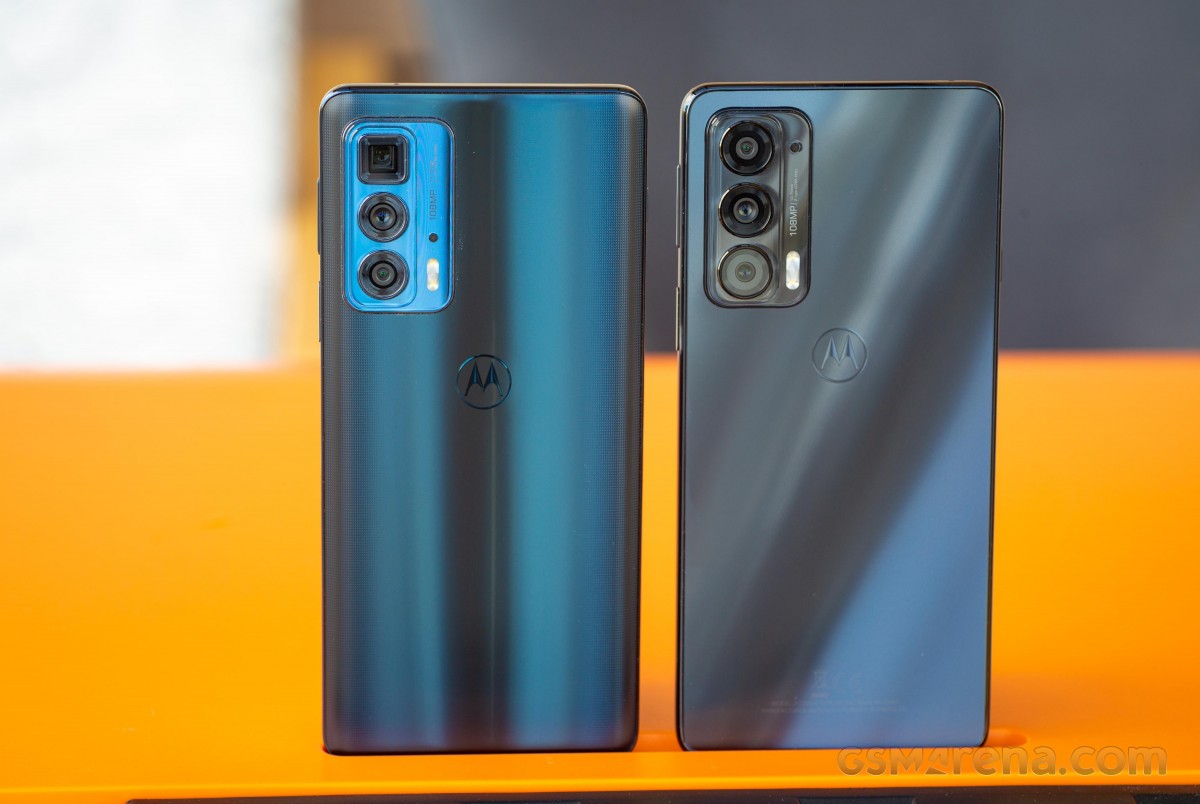
Motorola Edge 20 Plus and Motorola Edge 20
Then there is the Edge 20 Pro, which will bring three upgrades for €200 on top of the Edge 20 – a more powerful Snapdragon 870 chip, a 5x telephoto camera, and a beefier battery. Seems a bit overpriced, though, doesn’t it?
Motorola Moto G100 • Motorola Edge 20 Lite • Motorola Edge 20 Pro
Our verdict
The Motorola Edge 20 seems like the most balanced smartphone among the Edge 20 trio. It has the most reasonable pick of features – a 144Hz OLED, powerful but not overkill Snapdragon 778G 5G chip, a versatile triple camera going from 0.5x up to 3x, and a large enough battery with fast charging.
We loved the display, and it is indeed a flagship-worthy one, the Edge 20 can handle games very well, including high framerate ones, and its camera is dependable despite its weird resolution handling.
One of the key features of this Motorola Edge 20 is the vanilla-like Android OS with Ready For desktop-like experience, and it runs well, delivers on the promises, and can be a powerful tool for those of you who multi-task heavily on a number of devices.
The Edge 20 is not ideal – it doesn’t have stereo speakers, the battery life is subpar, and the camera app and processing are in need of a few tweaks.
But even that doesn’t take away from the fact that it is the best offer within the Edge 20 trio, and among the best €500 phones you can get.
Pros
Attractive splash-proofed design.
Excellent 144Hz OLED display.
Fast charging.
Clean Android 11, and Ready For is not a gimmick.
High-framerate gaming supported and dependable sustained performance.
Good photo camera quality, day and night.
Great daylight videos.
Cons
No stereo speakers.
Average battery life.
Poor low-light videos.
Photo resolution settings don’t make a lot of sense.
With rumors of the official One UI 5 beta starting soon and internal previews already underway, people are getting excited to see what Samsung has up its sleeve for Android 13. Luckily, I’ve managed to get my hands on the latest One UI 5 beta before the public beta even starts. Let’s take a look at everything that’s new in One UI 5.
To provide some context, this build was provided by a source and is not one that Samsung has released publicly, so it might not provide a complete picture of One UI 5 given the initial nature. It is an early beta that unfortunately does not have a changelog, so everything new below has been from using One UI 5 and comparing to One UI 4.
Tweaked notification design
The notification design has been slightly tweaked between One UI 4 and One UI 5. There are new icons for notifications along with an updated design style. The notification shade and quick settings also have a slight tweak to opacity. Neither of these changes are major, but they do bring an overall different feel to the notification shade as a whole in usage.
Stock Android permission dialogs
One big surprise with One UI 5 is Samsung’s choice to use the default Android permission dialogs. This is by no means a bad thing, and it is very similar to how Google does it. This could have been to help speed up the update process by not changing things that don’t need to be changed in Android, or it could just be so early Samsung hasn’t gotten to changing it in One UI 5 yet. We’ll find out soon enough in future betas.
OCR in Gallery and insert text from image in keyboard
Samsung has now added OCR (Optical Character Recognition) that lets you copy text from images to the Gallery app and keyboard. When the device detects text in a photograph, it will now have a button at the bottom of the gallery letting you pull text from the image. This used to be part of Bixby Vision, but was turned into its own feature in One UI 5.
Keyboard OCR works the same way it does on iOS. In any text field, you can select extract text and hold the camera up to anything to grab text from it and insert it. The UI on Samsung’s version is incredibly similar to iOS as well.
Security and privacy hub
One UI 5 Security and Privacy Hub
The security and privacy hub is a Samsung proprietary version of what Google made for Pixel on Android 13. It places all your accounts, passwords, security, and privacy features into one screen, thus allowing for easy access to everything. It will also scan for anything that might be abusing app permissions or a security setting that isn’t enabled and recommend you enable it for all around better security.
Unfortunately, there is nothing new in the hub. All of the settings and features here were also found in One UI 4, but it is good to see Samsung making access to all of this easier and being proactive about warning those who are less tech-savvy.
New multitasking gestures
In Labs, there are now two options for multitasking and accessing the feature. You’ll now be able to swipe up from the bottom of the screen with two fingers to access split view or swipe in from the top right corner to make a popup window. Neither currently work in this build, but they should by the time it launches.
Miscellaneous changes
Collaboration in Samsung Notes
Currently active app in quick settings
About phone page now shows image of device
UWB toggle in settings
At the end of the day, there really isn’t much new in One UI 5. It has minor improvements across the board with an upgrade to animations. This isn’t a bad thing. It seems like Samsung is focusing on update speed, seeing as the beta is likely starting a month earlier with a planned release also being a month earlier.
Focusing on getting Android updates out there fast then bringing newer features with later updates that launch alongside new devices allows for more devices to get updates and for Samsung to focus on new features later. With promises of four years of OS updates, this is a good thing to see and a good start for the Galaxy S22s. We’ll have to see how things go for Samsung’s Z foldables, A line of phones, and Tab series of devices.
Stage Manager is Apple’s solution for improving (or at least trying to) the iPad’s multitasking system. The feature lets users run apps in windowed mode, but there’s a catch: it only works with the M1 iPad Air and iPad Pro. Apple hasn’t said a word at this point about changing the feature requirements, but we’ve found a way to see how Stage Manager would work on the iPad mini.
How Stage Manager works
First of all, if you haven’t seen Stage Manager in action, it basically brings windows to iPadOS 16. However, there are still some limitations when it comes to resizing and moving apps around the screen. It’s not exactly like what you have on a Mac or Windows PC, but it certainly makes the iPad feel more like a real computer.
Unfortunately, only iPads equipped with the M1 chip support Stage Manager. Apple says it set the M1 chip as a requirement because Stage Manager lets users open up to eight apps simultaneously. Stage Manager also enables full support for an external display up to 6K resolution, and unsurprisingly, Apple claims that other iPads don’t have enough performance for this.
Some users didn’t seem to believe Apple’s statements as some of them are quite controversial. For instance, the company argues that Stage Manager benefits from the fast memory swap that is only available on the M1 chip. However, the 64GB iPad Air 5, which runs Stage Manager, lacks RAM swap.
Stage Manager on the iPad mini
Officially, there’s no way to enable Stage Manager on non-M1 iPads. However, 9to5Mac found a hidden internal mode in the iPadOS 16 code that enables Stage Manager on any iPad running the latest version of the operating system. Since there’s no jailbreak tool available for iPadOS 16, we can’t enable this mode on a real iPad, but we can take a look at it using iOS Simulator – an Apple tool that lets developers test their apps on a Mac.
More interesting than seeing Stage Manager working on the previous generation iPad Pro or iPad Air, I was wondering what the feature looks like on the iPad mini. And this is what I just found out.
Of course, the iPad mini’s display is too small for an advanced multitasking system, but still, Stage Manager can be quite useful for some iPad mini users. I took some screenshots of the iOS Simulator and sent them to my iPad mini so I could get a better idea of Stage Manager’s usability in terms of interface size. Honestly, everything looks good enough for me.
You can open three iPhone-sized apps side by side without compromising usability, which seems perfect for checking multiple social networks while you read something. You can also open a larger window while leaving smaller windows in the background to quickly switch between them, which is great for dragging and dropping items.
Current iPads can already open up to three apps simultaneously with Split View and Slide Over, but the experience is much more limited since you can’t have all three apps side by side.
Will Apple ever change that?
Some users are willing to have a limited version of Stage Manager available for non-M1 iPads, but Apple has never said if it will ever do this.
After seeing Stage Manager working on the iPad mini, I’m convinced that I’d like to have the option to run apps in windowed mode, even with some limitations compared to the M1 iPads. As I once said, having windows is not only about how many apps you can run at the same time, but it’s also about organization.
Stage Manager isn’t exactly perfect, but it certainly improves the iPad’s poor multitasking system – and it’s a shame that Apple wants to keep it for the more expensive iPads.
For now, iPadOS 16 beta remains available exclusively to developers. According to Apple, the first public beta will be released this month, while the official release is expected this fall.